
Radio Control: Slope Soaring
Mark Triebes 20794 Kreisler Ct. Saratoga, CA 95070
Welcome / Introduction
Welcome to the exciting world of slope soaring. This column will deal exclusively with planes, sites, contests, and ideas related to RC slope soaring. With your help — letters, photos, stories, ideas, innovations, etc. — we can make this column a success and bring slope soaring to the forefront of the RC soaring community.
This being the first column, I have yet to receive reader input, so I will discuss a few of my favorite areas and aspects of slope soaring.
About the author
I am a junior at San Jose State University majoring in aviation. I have been involved in RC soaring for about 10 years and in sailplane design for roughly half that time. I recently formed Aero-Mark Designs and am kitting a few of my designs. Although I fly mostly at various sites in northern and central California, I have had opportunities to fly at many well-known west-coast sites and hope to visit many more sites around the country.
Competition and slope racing
Although most slope fliers fly just for fun, competition is alive and well. One of the more exciting aspects of slope soaring is slope racing — watching multiple sailplanes fly a closed course at maximum velocity is thrilling.
Competitive slope flying is widespread in Europe and elsewhere. Examples and notes:
- The South Bay Soaring Society newsletter, Silent Flyer, describes slope racing.
- The Danish publication Slope Gliding (P. Norholm) profiles leading Danish slopers.
- Slope gliding is popular in Denmark, Norway, Sweden, and Iceland.
- Northern Germany holds contests for the "Slopers" class.
- At the North Sea Cup British clubs began following F3F slope-soaring rules rather than pylon races. In one event four British pilots raced four Scandinavians in two qualification heats and a final; the racing was fascinating but produced two midairs and three totaled airplanes.
Excerpt (from a European sloper):
- The pilot stands in the center of a 330-ft course. After launch, the pilot has 30 seconds to get his plane into the course. Ten laps are timed.
- The winner of each round receives 1,000 points. A contest has a minimum of 5 and a maximum of 10 rounds with one throw-out round.
- Fast runs in good weather range from 60 to 80 seconds. The best performance at the North Sea Cup was 45.4 seconds in 22 mph winds, wind 20° from one side. The Danish record is 40.3 seconds in 40 mph winds.
- Slopes in Denmark and Sweden are mostly coastside cliffs 110 to 200 ft high, about 45° steep, and very clean. Southwest Norway has similar slopes and also inland mountains up to 4,000 ft.
- Typical Danish sloper racers have twin vanes, ailerons, flaps coupled to the elevator, and no airbrakes. Wingspans average 8 to 8½ ft and use modified Eppler 180 or 374 airfoils. The E374 is thinned; the E180 top reflex is often flattened. A popular configuration is the "Thy Combination": an E180 root with E374 tips.
- Turn-in technique and less ballast are keys to speed. Racing is done in high winds with wing loading from about 13–15 oz/sq ft (unballasted) up to 18–20 oz/sq ft (ballasted).
FUN is what it’s all about. Technical details are often printed in magazines, but little is said about the enjoyment and camaraderie of slope flying.
I agree with that sentiment. I don’t want this column to be dry and purely technical (though I will include technical material). Rather, I want it to be a way for slope fliers worldwide to communicate ideas and stories — humorous, exciting, serious, or otherwise — and to share photos.
For those interested: an International Slope Race will be held in Denmark sometime in 1989. Several west-coast fliers have expressed interest. If you want to go as a spectator or competitor, contact me for more information.
The F3F rules provide a disciplined, organized form of slope competition, but they can lack the excitement of true pylon-style races. In the U.S. and Britain, head-to-head racing (two to five fliers) around a closed course of about 400–500 ft for 8–10 laps remains popular and exciting for competitors and spectators. Midairs are inevitable in this format but are usually the result of careless or over-exuberant flying and can be minimized with good airmanship.
A new trend: smaller racers
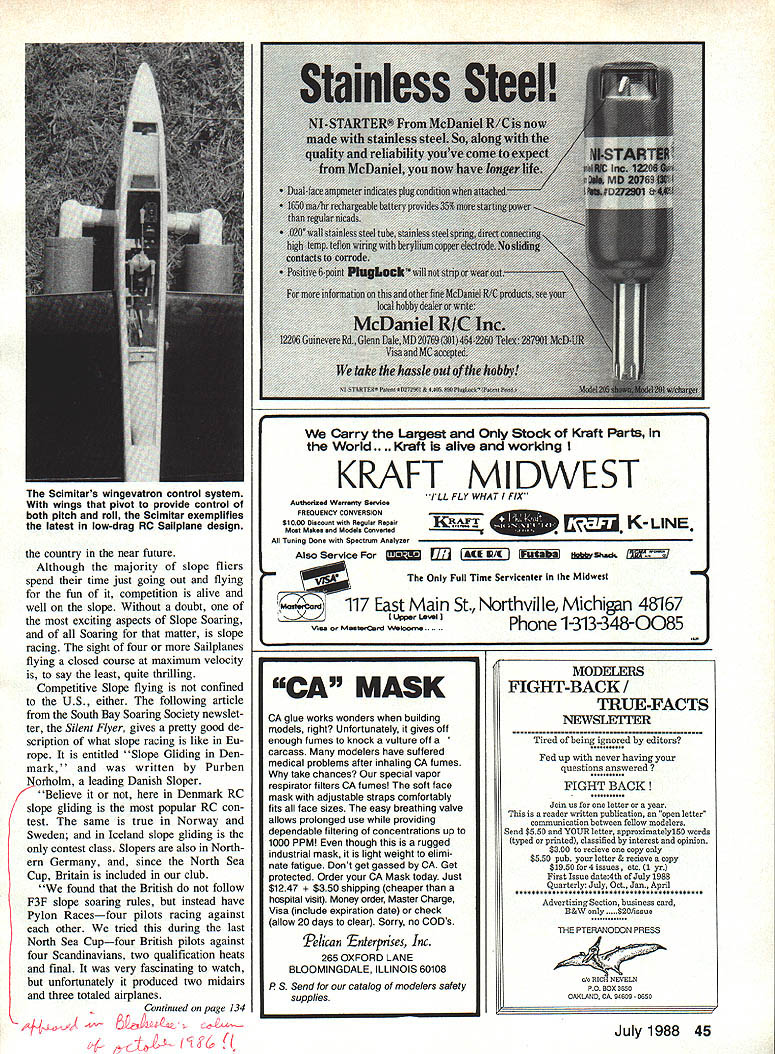
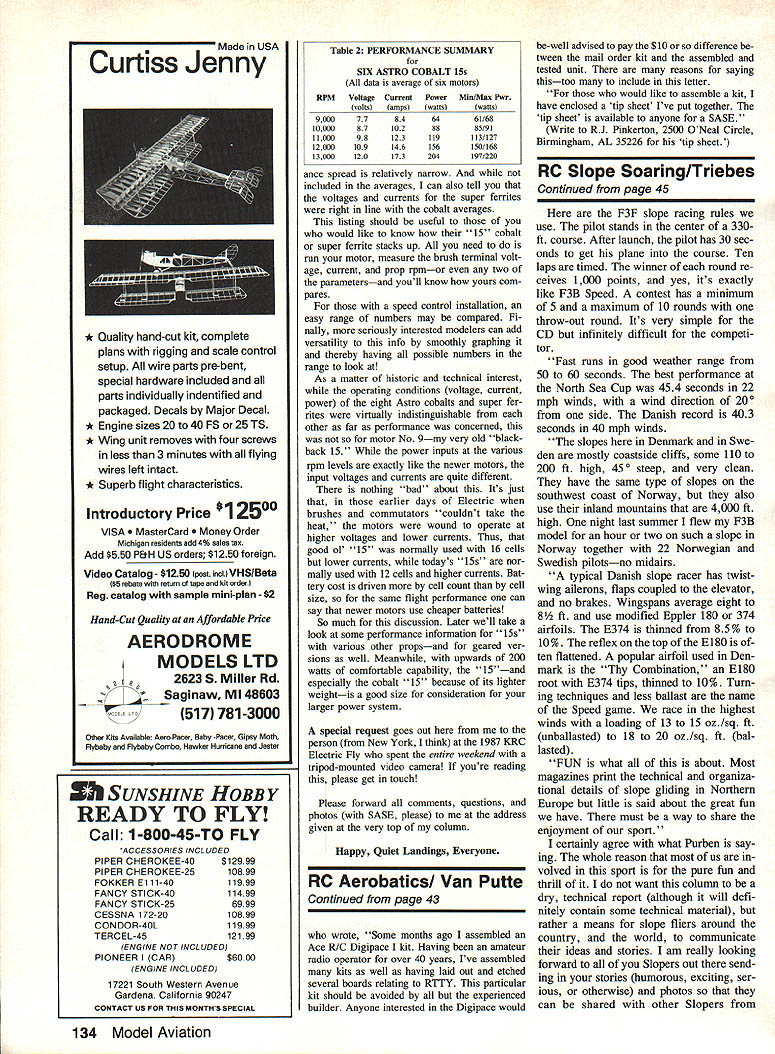
A growing trend is toward smaller sailplanes that fly in lighter winds and cost less than unlimited-class racers. FAI limits for Unlimited Class allow wing loadings up to 25.4 oz/sq ft, which leads to very large (3 meters or more) and expensive sailplanes. A recent California race for 1½-meter sailplanes was reportedly very successful and as exciting as standard racing; the lighter planes allowed competition in lighter conditions. I believe this trend will expand and offers a lower-cost entry path for beginners.
A standout at that event was the Nisus (designed by Mark Allen): a beautiful fiberglass fuselage, foam wings with balsa veneer sheeting, and excellent performance. Kits should be available on the market.
Slope combat
Slope combat began as attempts to "cut" a ribbon trailing from another sailplane, but it has evolved into an all-out destruction-derby style event:
- Everyone launches; the last one airborne wins.
- Pilots try to knock other sailplanes out of the air while minimizing damage to their own.
- If knocked down, you have three minutes to repair and relaunch.
- A common technique is a center punch: approach from behind at higher speed, climb above the target, then execute a split-S to impact its upper wing.
This competition is brutal and not for everyone — especially those who like to fly their sailplanes more than once. Several kits are being developed specifically for combat (examples: the Cheetah and various powered-scale slope planes). Combat flying should be voluntary and undertaken only with willing participants; do not intentionally attack someone else’s expensive sailplane without agreement.
Featured sailplane: the Scimitar
Each column will feature one sailplane or kit. Suggestions for outstanding sailplanes to feature are welcome.
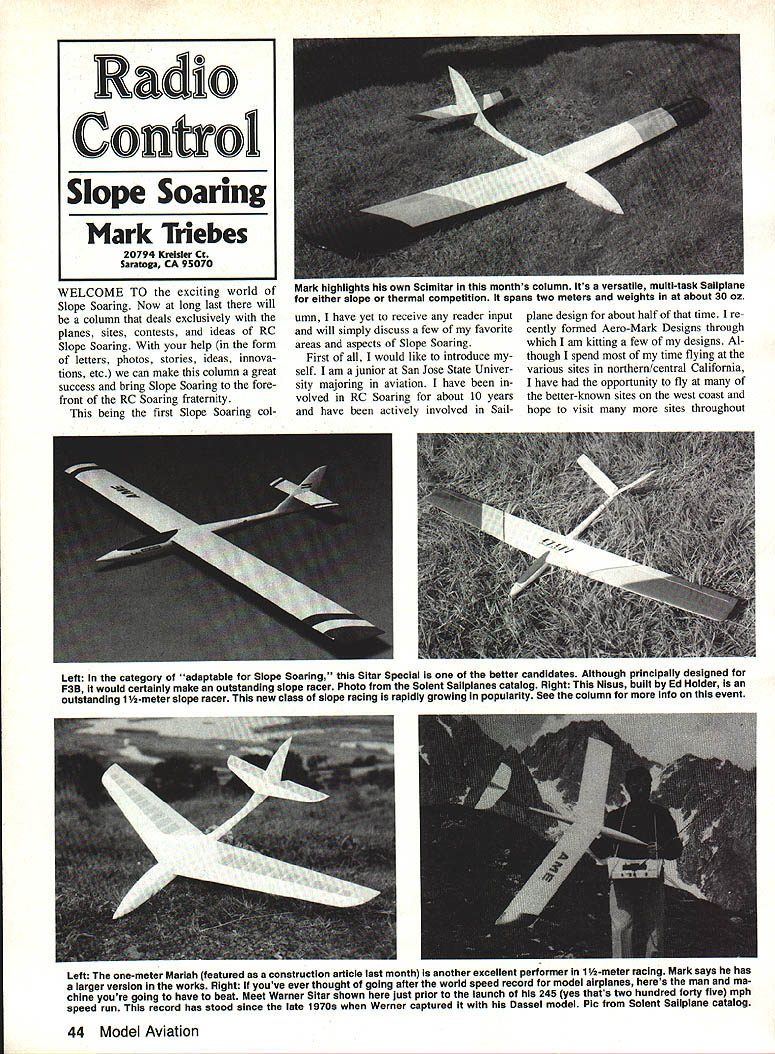
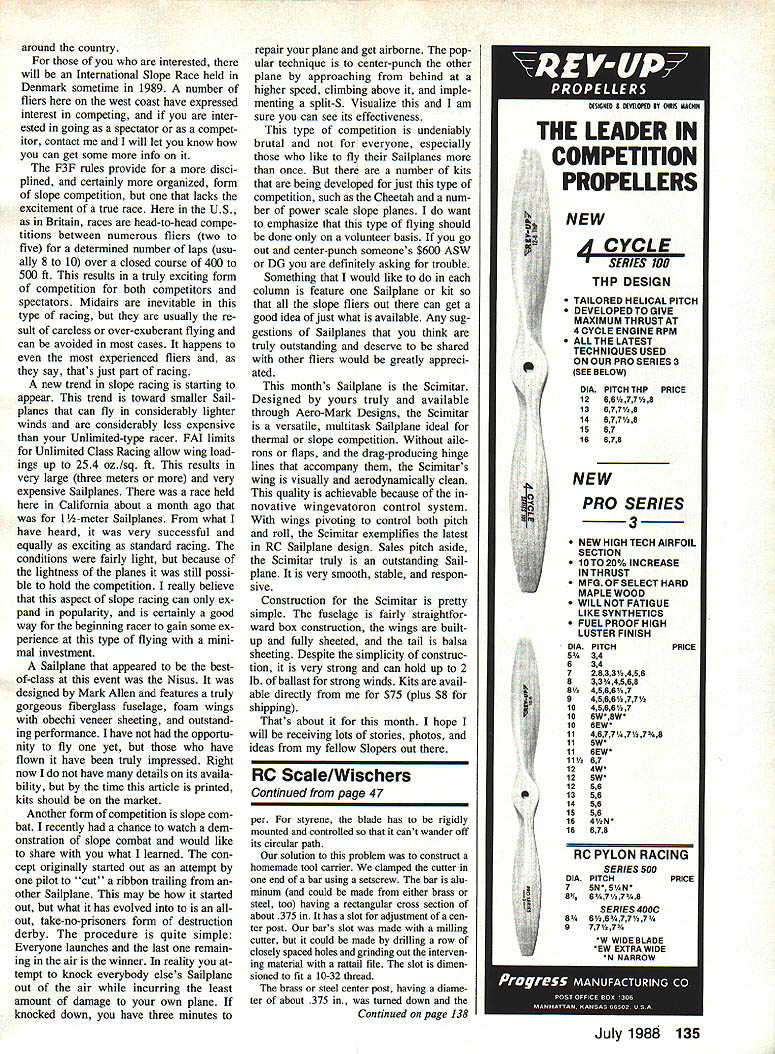
This month’s sailplane is the Scimitar, designed by me and available through Aero-Mark Designs. The Scimitar is a versatile, multitask sailplane suitable for thermal or slope competition. It has no ailerons or flaps (and therefore no hinge-line drag); instead it uses an innovative wing/elevator control system where the wings pivot to control both pitch and roll. The result is a visually and aerodynamically clean wing.
Performance and construction:
- Smooth, stable, and responsive handling.
- Fuselage: straightforward box construction.
- Wings: built-up and fully sheeted.
- Tail: balsa-sheathed.
- Strong construction capable of carrying up to 2 lb of ballast for strong winds.
Kits are available directly from Aero-Mark Designs for $75 (plus $8 shipping).
Closing / Contact
That’s about it for this month. I look forward to receiving stories, photos, and ideas from fellow slopers.
Mark Triebes Aero-Mark Designs 20794 Kreisler Ct. Saratoga, CA 95070
Transcribed from original scans by AI. Minor OCR errors may remain.

