
Radio Control: Slope Soaring
Mark Triebes 20794 Krelsler Ct. Saratoga, CA 95070
Call for slope sites
Slope sites wanted. I'm looking for the best and most available slope sites throughout the country. One of the most frequently asked questions I hear is, "Where can a sailplane flier go to do some slope soaring?" Here in California most of the sites are well publicized and most people have little trouble finding a good place to fly. I know there must be many other undiscovered sites around the country that are probably just as good (or better) than the popular ones.
What I would like to do is compile a list in this column of sites from around the country and form a "source book" of slope flying sites. Other fliers would greatly appreciate the help in finding a quality site, since having a site is half the battle in slope flying.
Helping beginners
Since we're on the subject of helping other fliers, I want to tell you about a recent experience. I was out at the local flying site and was approached by a beginning flier who was having trouble getting a handle on flying an RC sailplane. Up to this point he had experienced only hand-launched flights at the local schoolyard that had lasted in the 1- to 10-second range.
We talked a bit about the fundamentals, I got his model airborne and trimmed it out, then he took it away. His first slope flight lasted over ten minutes and he was, to say the least, ecstatic. He learned more about flying a sailplane in the last ten minutes than he had in the previous two months. Once he had seen the techniques involved in slope flying and had someone standing by for advice—and, more important, to give him confidence—he rapidly developed the skills and knowledge needed to fly.
The point is that spending just a few minutes helping a beginner can be of immeasurable support—and could make the difference between his continuing with the sport or giving it up. So the next time you see someone who is reluctant to fly or who is having trouble, introduce yourself and offer help. Most people are a little reluctant to ask, but will gladly accept an offer. You can help get someone involved in the sport and possibly make a good friend.
Power scale sloping
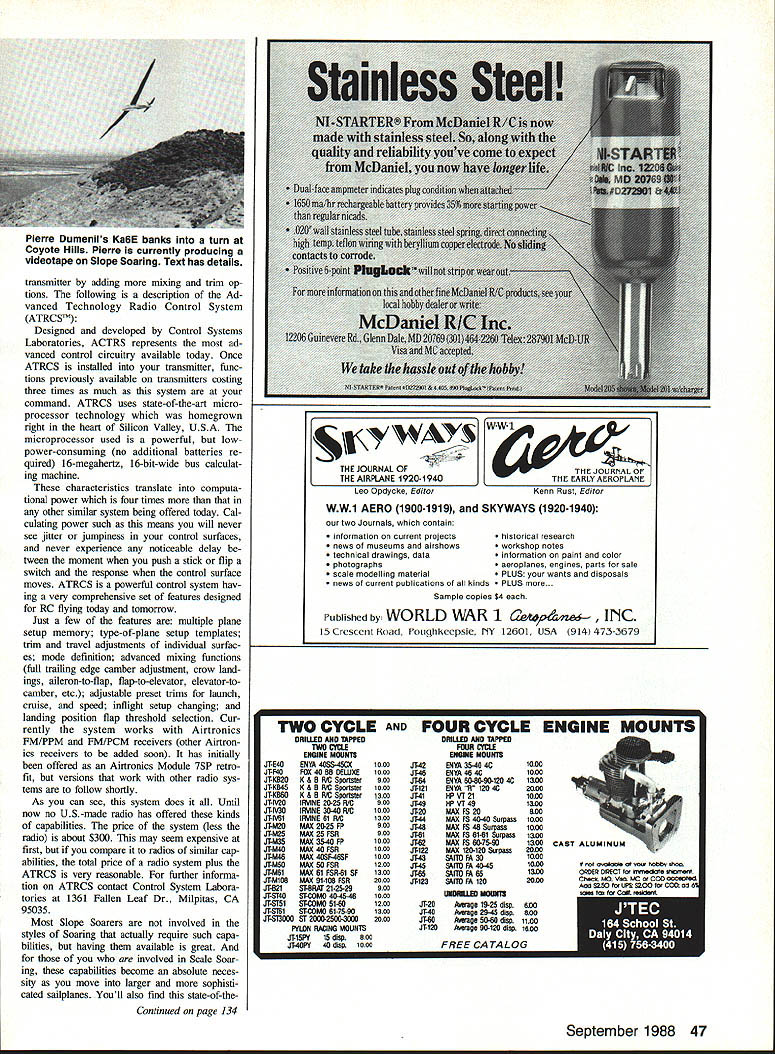
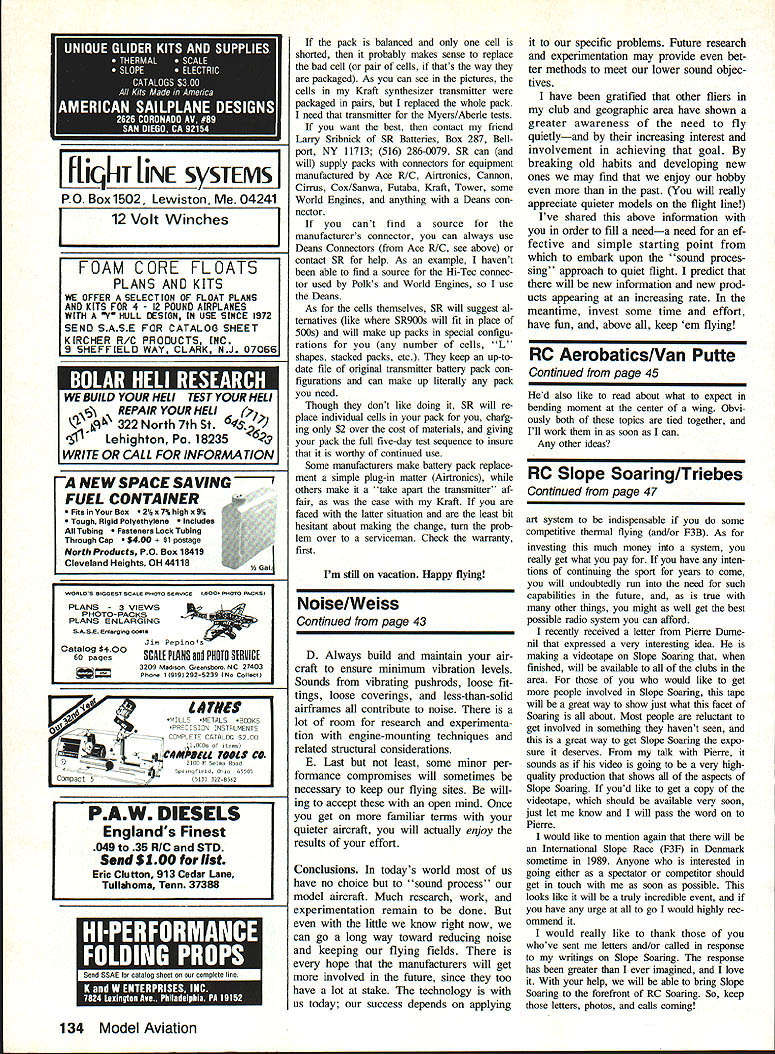
To get off my soapbox and on to the meat of the column: in past articles I have talked about power scale sloping, and in the photos you can see a great example of this. Brad Smith, one of the talented local fliers here in central California, has a truly gorgeous Aermacchi MB326K. The sailplane (yes, sailplane) is fully detailed, including camouflage, cockpit interior, drop tanks, and missiles. The wingspan is 67 in. and the plane weighs just about 6 lb. Performance is outstanding. Even with the stores on, the Aermacchi is extremely quick and very agile. With the stores off, flight performance is incredible.
I believe that when people recognize the incredible variety of sailplane types that can be flown on the slope, we'll see continued expansion of the category's popularity.
Although a few fliers in the U.S. devote time to power scale sloping, the activity is still in its fledgling stages here. In contrast, in Europe—especially England—power scale sloping is very big. Literally dozens of kits are available and, from what I've heard, there are some interesting projects in the works. (How does a 12-ft span B-52 sound?)
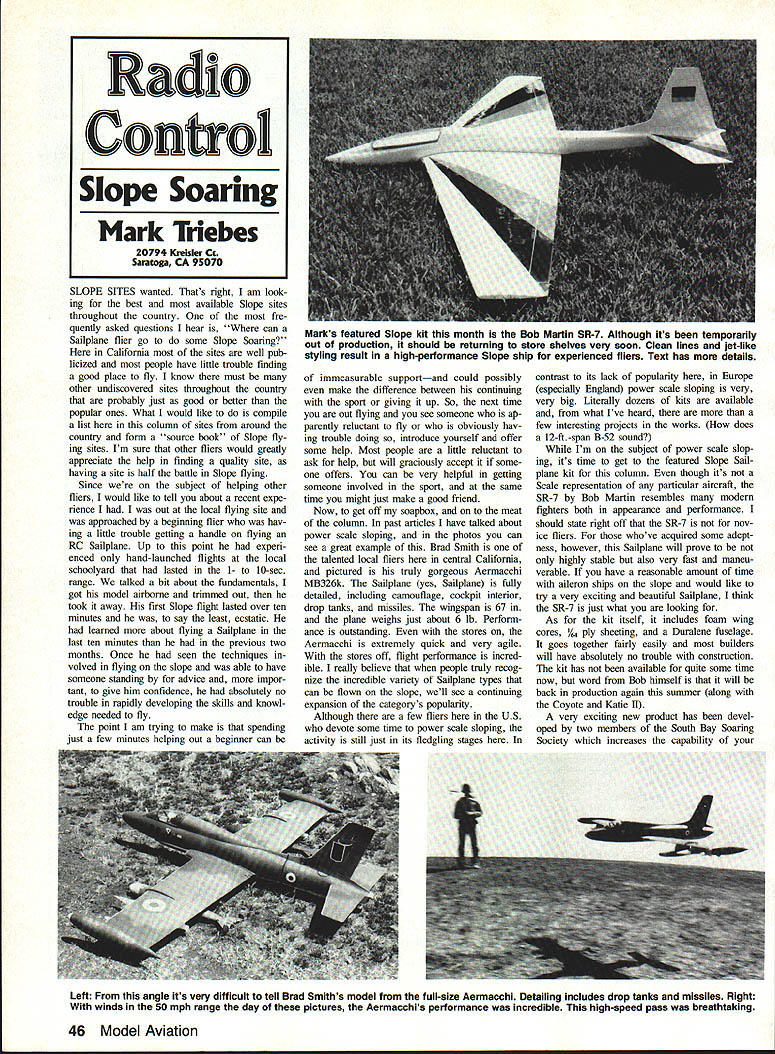
Featured kit: SR-7
While on the subject of power scale sloping, the featured slope sailplane kit for this column is the SR-7 by Bob Martin. Even though it's not a scale representation of any particular aircraft, the SR-7 resembles modern fighters in appearance and performance. I should state right off that the SR-7 is not for novice fliers. For those who've acquired some adeptness, however, the sailplane proves highly stable and also very fast and maneuverable.
If you have a reasonable amount of time with aileron ships on the slope and would like to try a very exciting and beautiful sailplane, the SR-7 is just what you are looking for. The kit includes foam wing cores, 1/64" ply sheeting, and a Duralene fuselage. It goes together fairly easily and builders will have no trouble with construction. The kit has not been available for quite some time, but Bob has said it will be back in production this summer (along with his Coyote and Katie II).
Advanced Technology Radio Control System (ATRCS)
A very exciting new product developed by two members of the South Bay Soaring Society increases the capability of your transmitter by adding more mixing and trim options. The Advanced Technology Radio Control System (ATRCS), designed and developed by Control System Laboratories, represents the most advanced control circuitry available today.
Once ATRCS is installed in your transmitter, functions previously available only on transmitters costing three times as much are at your command. ATRCS uses state-of-the-art microprocessor technology developed in Silicon Valley. The microprocessor is a powerful, low-power-consuming 16-megahertz, 16-bit-wide-bus unit. These characteristics translate into computational power four times greater than similar systems offered today. That computing power means you will not see jitter or jumpiness in your control surfaces and will not experience noticeable delay between stick movement or switch flipping and surface response.
ATRCS is a powerful system with a comprehensive set of features designed for RC flying now and in the future. Just a few of the features are:
- Multiple plane setup memory
- Type-of-plane setup templates
- Trim and travel adjustments of individual surfaces
- Mode definition
- Advanced mixing functions (full trailing-edge camber adjustment, crow, landing, aileron-to-flap, flap-to-elevator, elevator-to-camber, etc.)
- Adjustable preset trims for launch, cruise, and speed
- In-flight setup changing
- Landing position flap threshold selection
Currently the system works with Airtronics FM/PPM and FM/PCM receivers (other Airtronics receivers to be added soon). It has initially been offered as an Airtronics Module 7SR retrofit, with versions for other radio systems to follow.
As you can see, this system does it all. Until now no U.S.-made radio has offered these capabilities. The price of the system (less the radio) is about $300. That may seem expensive at first, but compared to radios of similar capabilities the total price of a radio plus ATRCS is very reasonable.
For further information on ATRCS contact: Control System Laboratories 1361 Fallen Leaf Dr. Milpitas, CA 95035
Who needs it?
Most slope soarers are not involved in styles of soaring that actually require these capabilities, but having them available is great. For those involved in scale soaring, these capabilities become essential as you move into larger and more sophisticated sailplanes. You'll also find the system indispensable for competitive thermal flying and F3B. If you intend to continue the sport for years, you will likely run into the need for such capabilities—so it's often best to get the best radio system you can afford.
Video and events
I recently received a letter from Pierre Dumenil with an interesting idea. He is making a videotape on slope soaring that, when finished, will be available to all the clubs in the area. For those who want to get more people involved in slope soaring, this tape will be a great way to show what the facet of soaring is all about. Most people are reluctant to get involved in something they haven't seen, and this is a great way to expose slope soaring to new people. From my talk with Pierre, it sounds as if his video will be a high-quality production showing all aspects of slope soaring. If you'd like a copy of the videotape (which should be available soon), let me know and I will pass the word on to Pierre.
I would also like to mention again that there will be an International Slope Race (F3F) in Denmark sometime in 1989. Anyone interested in going as a spectator or competitor should get in touch with me as soon as possible. This promises to be an incredible event, and I highly recommend it if you have any urge to go.
Closing
I want to thank those of you who've sent letters or called in response to my writing on slope soaring. The response has been greater than I imagined, and with your help we will be able to bring slope soaring to the forefront of RC soaring. So keep those letters, photos, and calls coming!
Transcribed from original scans by AI. Minor OCR errors may remain.

