

Radio Control: Slope Soaring
Mark Triebes 20794 Kreisler Ct. Saratoga, CA 95070
Return of the ISR
That's right — the International Slope Race (ISR) is back! After a few years of nonexistence due to various (now unimportant) reasons, the famous and exciting slope event will be held again this year. Mark your calendars and arrange vacation time for the weekend of July 7–8, 1990 if you're interested in watching or participating. All the big-name pilots will be at Davenport, CA, including Daryl Perkins, Rich Spicer, Ron Vann, Mark Allen, and others.
We are grateful to John Dvorak for his hard work and persistence in resurrecting the ISR. A few months ago John circulated a proposal to organize Slope Race pilots on the West Coast, particularly in California. His proposal included these goals:
- Provide an annual International Slope Race.
- Sponsor three regional Slope Races during the year (one at each of three different sites: northern, central, and southern California).
- Encourage soaring clubs to include Slope Races in their contests.
Elements of the proposed organization:
- Made up of Slope Race pilots and interested people in California willing to support the annual International Slope Race and the regional races.
- Provide management and secure personnel required to run the international and regional races (Contest Directors, flaggers, scorekeepers, matrix makers, publicity, etc.).
- Possible race sites: Davenport, Los Banos, Santa Maria.
- Encourage soaring clubs to help provide slope sites, support personnel, and communication.
- Cover expenses (trophies, slope-site support equipment, communications) with contest fees; raise start-up costs from membership dues.
- AMA affiliation for insurance and contest status.
After the proposal gained momentum, things fell into place and resulted in the formation of California Slope Racers, an AMA-chartered club. The ISR will be the club's first officially sponsored event; Ray Kurtz will be Contest Director with Daryl Perkins as assistant CD. Organizers hope the ISR will return to its former prominence and serve as a stepping-stone to a larger regional or national racing circuit.
If you're interested in the International Slope Race or slope racing in general, contact John Dvorak: 1638 Farrington Court, San Jose, CA 94087.
Electra B3
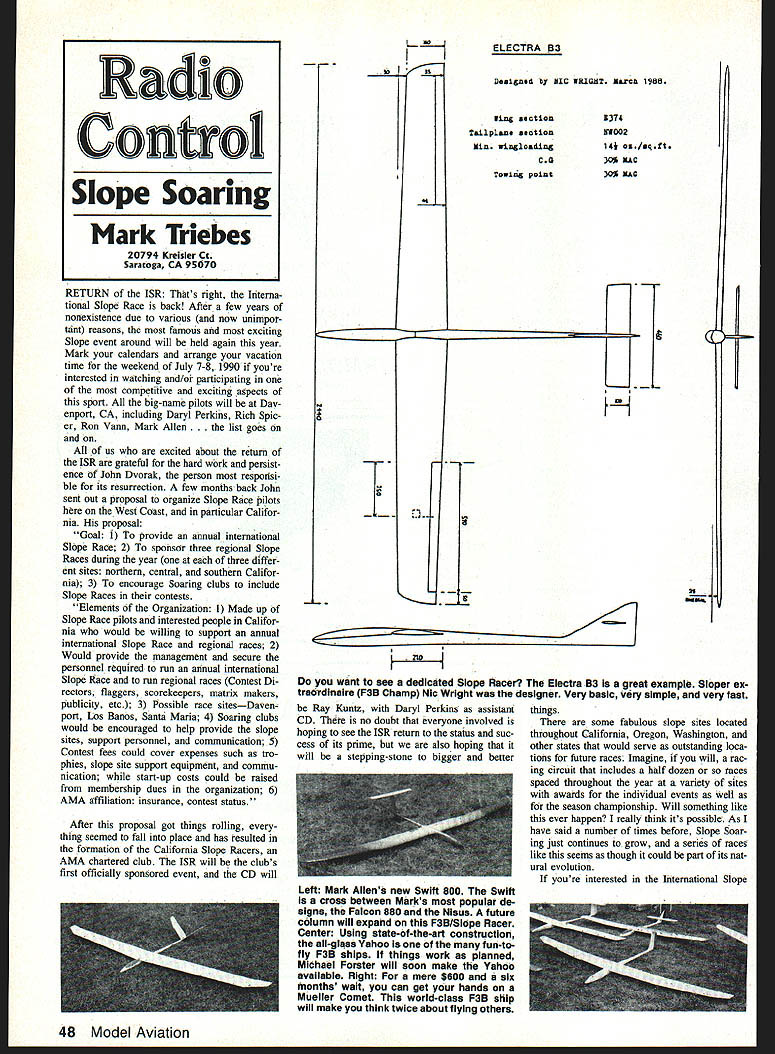
A number of months back John Dvorak purchased a new slope racer from England that has a strong reputation there: the Electra B3. For those who follow slope racing, the Electra B3 is known as a dominant plane in Europe. The following comes from Nic Wright (originally published in The White Sheet, the newsletter of the White Sheet Radio Flying Club, England) describing the design and testing of the B3:
"In 1986 a modified NIC831 pylon racer was built using the E374 wing section and an increased span of 84 in. (by David Hedley in Scotland). The airfoil section was thought to be accurately reproduced, and good performance in the new F3F class was anticipated. When I test flew this model I was pleasantly surprised by both its turning ability and its straight-line speed. At the same time, both Andy Lewis and Tony Leach were flying 100–120 in.-span F3B models on the slopes in Scotland; these also used the E374 and looked every bit as good as my Electra D3.
"In particular I was convinced that in certain conditions Andy's model performed better than the E182-winged Electra D3, which would slow up alarmingly if turns were pulled too tight at low speed.
"In February 1988 I designed a new F3F model using a similar platform to the D3 but based on the Electra B fuselage and using an E374 section. This is the third model to employ this fuselage; hence it became Electra B3. In designing the model attention was paid to simplicity of construction while also using terminology associated with my F3B models. The fuselage employs a full layer of Kevlar cloth, which has been a proven model saver in F3B. It's an actual necessity in F3F models when landing safely at sites like Edge Top in Derbyshire. It is joined in the mold, which is a tricky process but provides unrivaled strength and reduced weight.
"The wing has epoxy-pressed veneer skins on a blue foam core with a full-glass interleave. Wooden spars are laminated in slots in the foam and then glassed into the structure to provide the necessary strength. The ends of the wing panels are capped with 1/16-in. ply to improve torsional stiffness, and ducts are cut into the wing to accept the servo wires, all before the skins are pressed on.
"Tailplane construction follows that of the wing. The prototype is fitted with an operational rudder to assist aerobatics and winch launching, but for F3F the rudder is totally redundant.
"Test flights to date have revealed that the B3 holds its speed through the turns better than the D3 — it also has formidable aerobatic performance, which puts it in a different class from the Electra D3."
A local British trial over an F3F course in mixed slope weather showed the B3 to be every bit as good as the D3 with which Nic had earlier won events; the new model suited his "reversal" technique and performed well in steep gradients.
Airfoil design and testing
The debate over which airfoil is best for a given set of conditions has existed as long as aircraft have flown. Certain airfoils have advantages at low speed and disadvantages at high speed, and vice versa; some are compromises that work fairly well across a range.
Much recent work on airfoil design in the U.S. has been done by Michael Selig and John Donovan, with contributions from David Fraser. Their testing has sparked debate about airfoil testing methods for model aircraft. A few practical points from their work:
- Reynolds number (Re) is not "the number of air molecules flowing across the wing." Re is a measure of the ratio of inertial to viscous forces in a fluid flow. The dynamics of a flow are independent of size or speed provided the Reynolds number is held constant.
- Though turbulent flow has higher drag than laminar flow, it has much less drag than separated flow.
- If an airfoil has a large separation bubble, adding a trip (a small roughness to force transition) will usually improve performance at Re below about 200k. In experiments reported in Soartech #8 (Airfoils at Low Speeds), the drag of the Miley airfoil was reduced by a factor of four with a trip — although that level of improvement is not typical for popular RC soaring airfoils.
- If an airfoil prone to bubble losses is properly reshaped, drag can often be reduced without incurring a high-Re penalty that a trip might cause. Small changes in surface shape and accurate construction matter — little errors in the wrong place can have significant effects.
If you want a detailed reference, Soartech #8 includes over 400 pages of information on airfoils tested at Princeton, with coordinates, polars, lift and drag plots, and commentary. To order a copy ($15, checks or money orders payable to H.A. Stokely), contact Herb Stokely: 1504 North Horseshoe Circle, Virginia Beach, VA 23451.
Sharp vs. squared-off trailing edges
There has been discussion about razor-thin trailing edges versus squared-off trailing edges (the latter sometimes likened to automotive Kamm-tail practice). Ted Noel (Florida) wrote in to support razor-thin trailing edges and explained the difference in design drivers:
- Automotive bodies historically used tapered tails to reduce drag, but weight and bulk of the full body moldings led to compromises: taper somewhat, then square off to save weight and complexity. The Kamm-tail increases drag compared to a fully tapered tail but meets automotive design goals (packaging, weight) more effectively.
- For aircraft, those packaging compromises aren't necessary: a razor-thin trailing edge costs almost nothing in weight or bulk and reduces drag. Therefore, squared-off trailing edges are unnecessary for glider design.
Two cogent viewpoints in favor of thin trailing edges have been presented: one from the Princeton research side and one from field experience (Ted Noel). There may be fringe cases or Reynolds-number-dependent effects, but many modelers favor razor-thin trailing edges and the extra effort spent sanding is often justified in search of lower drag.
Photos and the F3B connection
You may have noticed this column carried many photos of F3B ships this month. There are two reasons for that:
- Although not specifically designed for slope flying, these large sailplanes perform very well on the slope. When loaded up for high winds they move out and can execute impressive aerobatics. Yes, pushing a $600 sailplane to the edge is risky, but it's also exciting to see what these ships can do in strong conditions.
- There is a clear connection between top F3B pilots and slope pilots. Many of the best F3B fliers in the world are also skilled slope pilots. Slope flying teaches smoothness and precise control under demanding conditions — traits that translate well to contest flying like F3B.
Personal note: cross-training between slope, F3B, and thermal contest flying seems to improve overall flying skill. Slope flying teaches smooth, efficient control inputs; F3B and thermal experience contribute other techniques. For those of you who fly primarily the slope, trying other disciplines can sharpen your skills — and vice versa.
Contacts
- John Dvorak — 1638 Farrington Court, San Jose, CA 94087.
- Herb Stokely (Soartech #8 orders) — 1504 North Horseshoe Circle, Virginia Beach, VA 23451.
Transcribed from original scans by AI. Minor OCR errors may remain.

