
Radio Control: Slope Soaring
Mark Triebes 20794 Kreisler Ct. Saratoga, CA 95070
International Slope Race (ISR)
The ISR is just about here — the weekend of July 7–8. If you plan to fly you should preregister with the contest director, Ray Kuntz, as soon as possible. This event requires advance registration only.
- CD: Ray Kuntz
- Phone: (213) 645-4269
A number of manufacturers have been approached for donations to be used as awards for the unsung workers (flagmen, lap counters, timers, etc.). So far responses have come from Futaba, Sheldon's Hobbies, VS Sailplanes, and others. If you can just show up and lend a hand, please drop by — any help will be greatly appreciated.
1990 Torrey Pines Scale Fun Fly
The 1989 event was so successful the organizers moved this year's event to Labor Day weekend so more fliers (especially out-of-state) can attend. This year's event will take place September 1–3 and will include:
- An official hotel
- A Friday night get-together
- A Saturday night banquet and raffle
- A Pilot's Choice Award
Details were still being finalized at the time of writing. For more information contact publicity chairman Charlie Morey:
- Charlie Morey
- 2601 E. 19th Street, #29, Signal Hill, CA 90804
- Phone: (213) 494-3712
Aero L-39 Albatros (Vern Hunt Models)
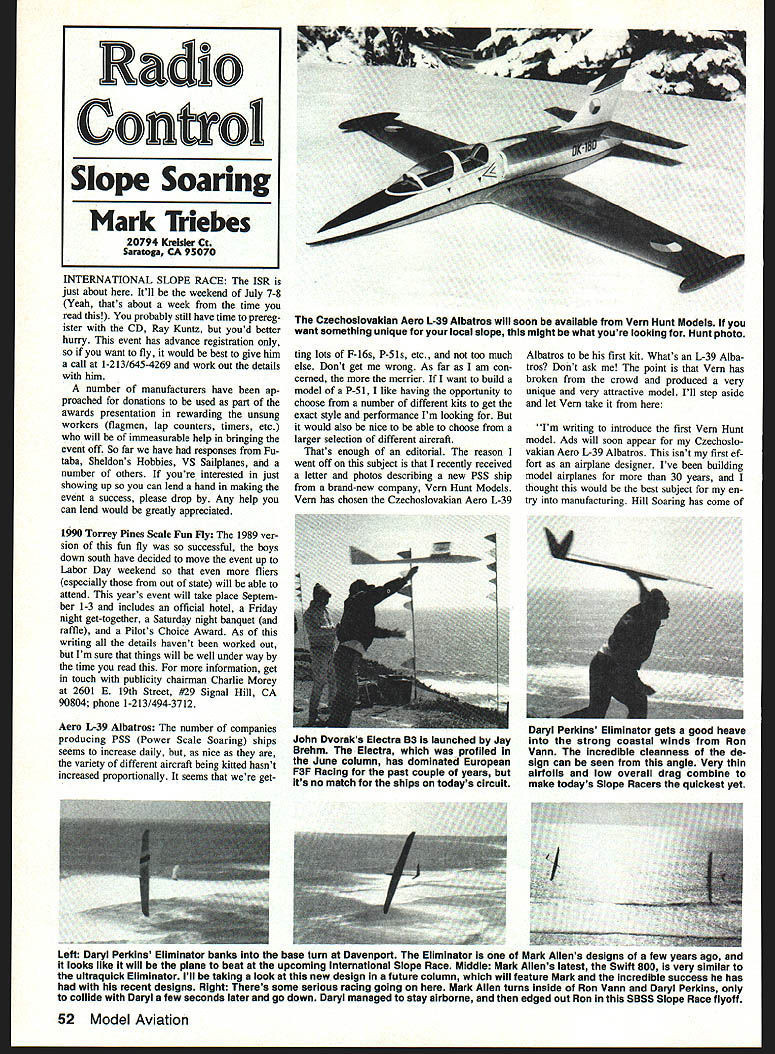
There has been a rapid increase in PSS (Power Scale Soaring) kits, but many are the same subjects (F-16s, P-51s, etc.). Vern Hunt Models has broken from the crowd with a unique subject: the Czechoslovakian Aero L-39 Albatros as their first kit. Vern sent a letter and photos describing the model; below is a polished summary of his introduction.
I’m writing to introduce the first Vern Hunt model. Ads will soon appear for my Czechoslovakian Aero L-39 Albatros. This isn't my first effort as an airplane designer — I’ve been building model airplanes for more than 30 years, and I thought this would be the best subject for my entry into manufacturing. The first model developed over a two-year period (along with two others) to perfect aerodynamics and manufacturing.
Construction highlights:
- Fiberglass fuselage with carbon-fiber reinforcements (rudder and fin molded with the fuselage)
- Foam cores for wing and stabs
- Balsa sheeting
- Glass canopy frame and formed butyrate canopy
- Glass tip tanks
- Modified Eppler 205 airfoil
Model specifications:
- Wingspan: 52 in.
- Weight: about 48 oz.
- Airfoil: modified Eppler 205
The fuselage construction and reinforcements are the result of years of experimenting to establish flyability and durability under hill-soaring conditions. Hill soaring can be hard on models; the tough construction has proven its worth — the prototype has been rolled on the hill several times with only minor damage.
For more information contact:
- Vern Hunt Models
- 4950 Butternut Tr., Juneau, WI 53039
- Phone: (414) 349-8101
I plan to extend the line over the next few years; several PSS gliders are in the works. You’ll be hearing more from Vern Hunt Models as time goes on.
Turnin' and Burnin' at Miguelito (Steve Bircher report)
The Santa Maria Soaring Society (SMSS) reported on one of the first Slope Races of the 1990 season at Miguelito Hill. Steve Bircher’s report captures the flavor of a day of high winds, rough lift, and spirited competition.
We had one of the largest numbers of entries ever — eighteen pilots came to Miguelito Hill on March 11, traveling from as far away as Escondido and the Bay Area. Rudy’s wind meter was never below 30 mph and pegged at 50 much of the day. Repeated blasts of cold rain and even a light hail shower made conditions challenging. The lift was good to superb but rough and tricky.
Two fliers crashed in practice (Dean Clark and Milt McIntosh) and another entrant chose to watch, leaving 15 actual racers. The first round ran in five groups of three, flying six-lap heats. The Bay Area crew — Mark Allen (of Falcon 880 fame), Ron Vann, and Daryl Perkins — came to race and were fast in the turns. Mark’s planes dominated the race; the top three finishers flew Allen designs (two Eliminators split by a Swift 800). Bill Hull from Los Gatos was up with the leaders until radio interference caused a crash; his backup ship wasn’t quite as fast.
Local competitors included Joe Wurts (always competitive), Bill Highfield, and Rich Beardsley. Joe started with one of his characteristic unpainted JW-original planes but switched to a Swift 800 after a hard landing removed the tail. Rich nearly had a major incident when his Metisse flipped between Joe Wurts and Daryl Perkins at launch but, amazingly, recovered the plane and still made his heat. Others were not so lucky: Kirk Olsen, Chris Pappas, and John Pappas all broke planes, some with repairs fresh off the bench.
The flagmen, timers, and lap counters endured wind, rain, and cold — our deep thanks to them. The event proved that slope racing is fun and addictive.
Local Slope Race / Fun-Fly (Bay Area report)
The first race of the season in the Bay Area was held April 1 with over 30 pilots for racing, plus others who came to fun-fly or spectate. Because South Bay Soaring Society club races are held at Davenport, this was an ideal local venue. Pilots came up from southern California, including Daryl Perkins and Joe Wurts, with nearly all local regulars present.
This event mixed racing and fun-fly elements to attract a broader crowd. Between rounds CD George Paige organized an impromptu aerobatics contest — 30 seconds for each contestant to impress the judges. Joe Wurts won on a precision roll/harrier in a Swift 400 (originally Mark Allen’s plane).
Time was also set aside specifically for flying, giving spectators and first-time slope fliers a chance to try the slope. If your club struggles to get people to the slope, combining racing with fun activities is an effective way to draw them out. Most slope surfers are average fliers having a great time; you don’t need ultra high-tech gear or years of experience — bring the right attitude and have fun.
Pushrods and Servos (from Brian Chan, Silent Flyer)
One regular contributor to the South Bay Soaring Society newsletter, Brian Chan, offers helpful insights on pushrods and servos.
Pushrods transmit control motion from servos to control surfaces. If linkages are sloppy, you cannot control your airplane no matter how good your radio is. Several pushrod systems are common:
- Nylon tubing systems (e.g., Nyrods): very light but dimensionally unstable with temperature changes. On long runs (three feet or more) temperature expansion/contraction can alter trim.
- Lear Rod (Du-Bro): claims better dimensional stability (about 75% less growth/shrinkage) but still changes somewhat with temperature.
- Nylon housing with steel cable: better than plain nylon; works best when the housing is anchored along the fuselage length.
- Steel cable types: many cables exist — some are for pushing, some for pulling. Flexible (pulling) cables handle tension well but can compress under push loads, creating sloppiness and even flutter.
- 7 x 1 steel cable: seven wires around a center core — less flexible and keeps length consistent under push/pull loads. This is a good choice for cable pushrods.
- Piano wire: best when a relatively straight run exists between servo and control horn; dimensionally stable and highly recommended.
Speed Control Adjustments
Speed controls typically have one or more adjustment screws to match their behavior to your transmitter’s throttle stick and pulse characteristics. Adjustments allow you to harmonize almost any radio with almost any speed control and accommodate personal preferences.
Guidelines:
- With throttle stick (and trim) fully retarded (down), the motor should be completely off.
- With the throttle stick fully forward (up), the motor should be fully on.
- Aim for a small deadband at the low end — about two clicks — so the motor is fully off even if the stick is moved slightly from the bottom. This prevents inadvertent motor run due to small stick movements or trim changes.
- Adjust the high end so full stick gives full motor output without clipping or sudden jumps near the top.
These adjustments are normal and necessary; one setup that works for a given radio may need readjusting for a different radio or plane.
Final Notes
Slope racing and fun-fly events are growing and evolving. They provide opportunities for competition, skill development, and introducing newcomers to slope soaring. If you can help at events or want more information on upcoming contests and fun flies, contact the listed organizers. Enjoy flying, and be safe on the slope.
Transcribed from original scans by AI. Minor OCR errors may remain.

