
Radio Control: Slope Soaring
Mark Triebes 20794 Kreisler Ct. Saratoga, CA 95070
Tri-Cities Scale Fun Fly — overview
At last I was able to make it to the Tri-Cities Scale Fun Fly. For the last couple of years I'd hoped to get up to Washington for the event, but one thing or another kept getting in the way. I decided this year would be different — I would make the fun fly no matter what. It turned out I had to skip my commencement ceremony at San Jose State, but looking back now I think it was definitely worth it.
Before I go any further I want to publicly thank Wil Byers and the rest of the Tri-City Soarers for making the event such a tremendous success over the past few years. An event like this takes an incredible amount of work, and these guys kept things running smoothly all weekend long. For those who haven't heard yet, Wil and the rest of the crew will be taking a break next year, so the fun fly won't be part of the Slope Soaring schedule. Fortunately, next year's International Slope Race will be held here, and I'm sure the Tri-City Soarers will do as fabulous a job with the ISR as they have with the fun fly.
Since my fellow "RC Soaring" columnist Byron Blakeslee will undoubtedly do his usual outstanding job reporting the event, I'll focus on a few of the more exciting happenings I saw at this year's fun fly.
Highlights
Mid-morning on Friday, the first official day, the wind picked up and the pits quickly filled with some truly amazing aircraft. A few of the standout entries and moments:
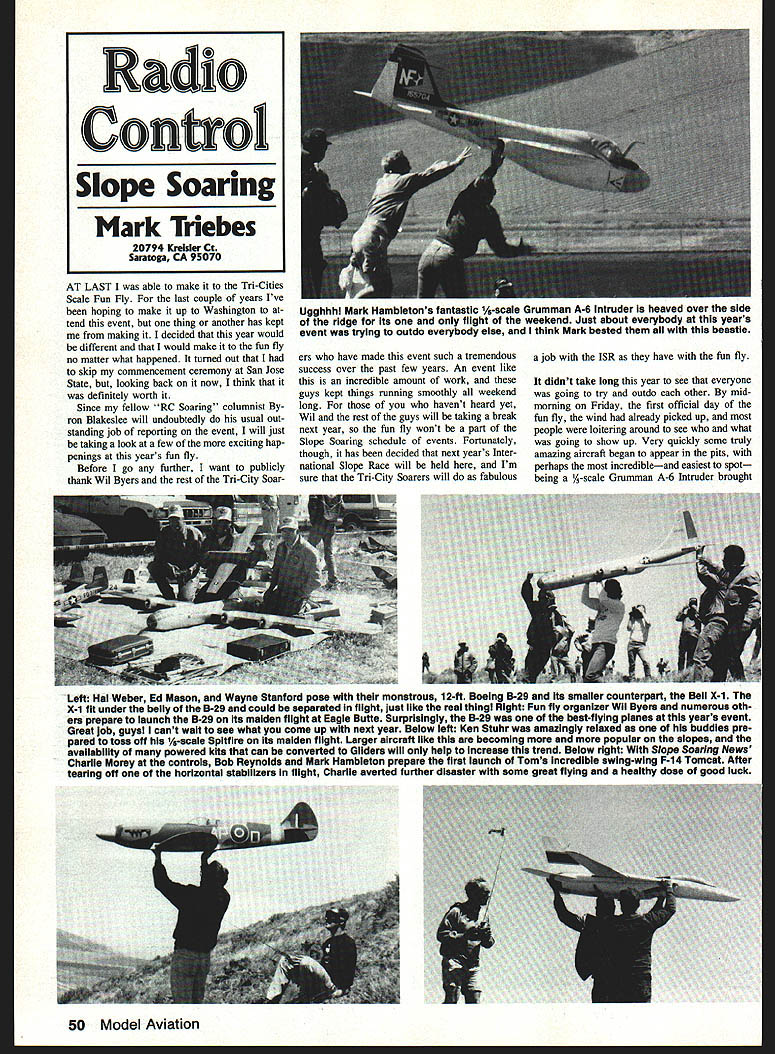
- Mark Hambleton's 1/5-scale Grumman A-6 Intruder (about a 10 ft span) — twin ducted-fan, sailplane-like flight, a bit draggy but spectacular in the air. The A-6 is available as a kit from DCU (see contact below). Mark also has other new designs coming out, including an F-14 Tomcat prototype and Rockwell B-1 projects.
- DCU: 1556 S. Anaheim, Unit C, Anaheim, CA 92805; tel. 1-714/535-6969.
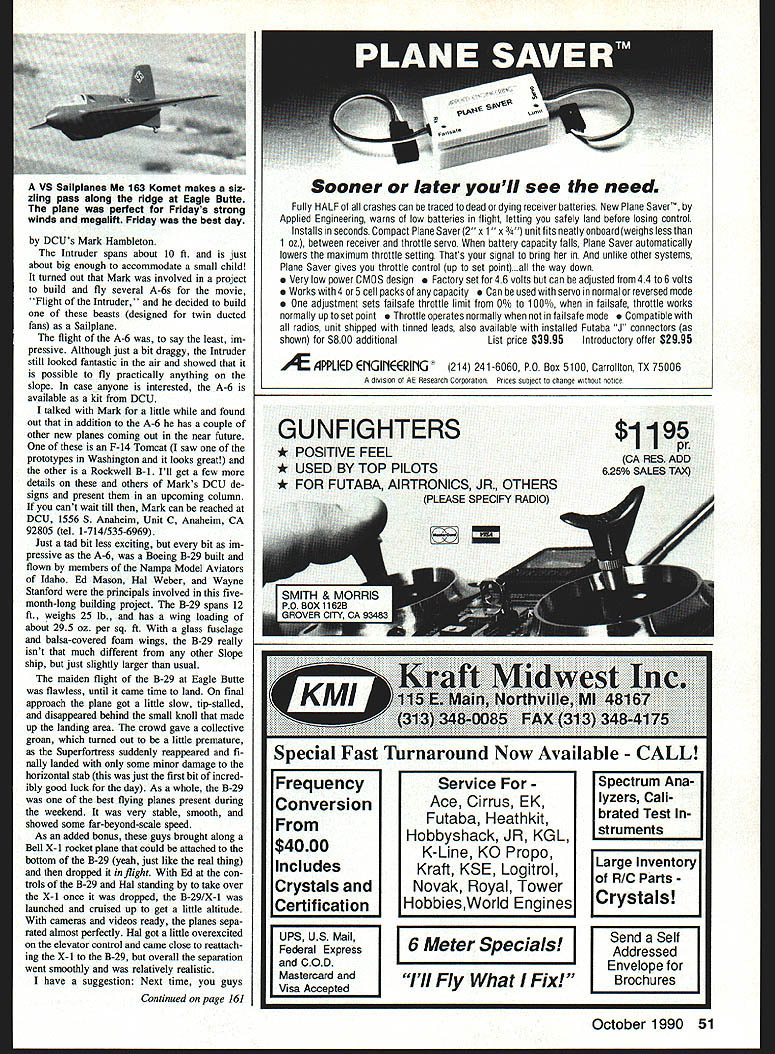
- Nampa Model Aviators' Boeing B-29 — built by Ed Mason, Hal Weber and Wayne Stanford over five months. The Superfortress spans 12 ft, weighs about 25 lb and has a wing loading around 2.95 oz/sq ft. It has a glass fuselage and balsa-covered foam wings. The maiden flight at Eagle Butte was flawless until landing: a tip-stall on final hid the plane behind a knoll, but it reappeared and landed with only minor damage (horizontal stab). Overall it was one of the best-flying ships of the weekend: stable, smooth and showing strong speed. As an added bonus, the crew carried a Bell X-1 rocket replica that fit under the B-29's belly and could be separated in flight.
- The B-29 crew earned the Pilots' Choice Award.
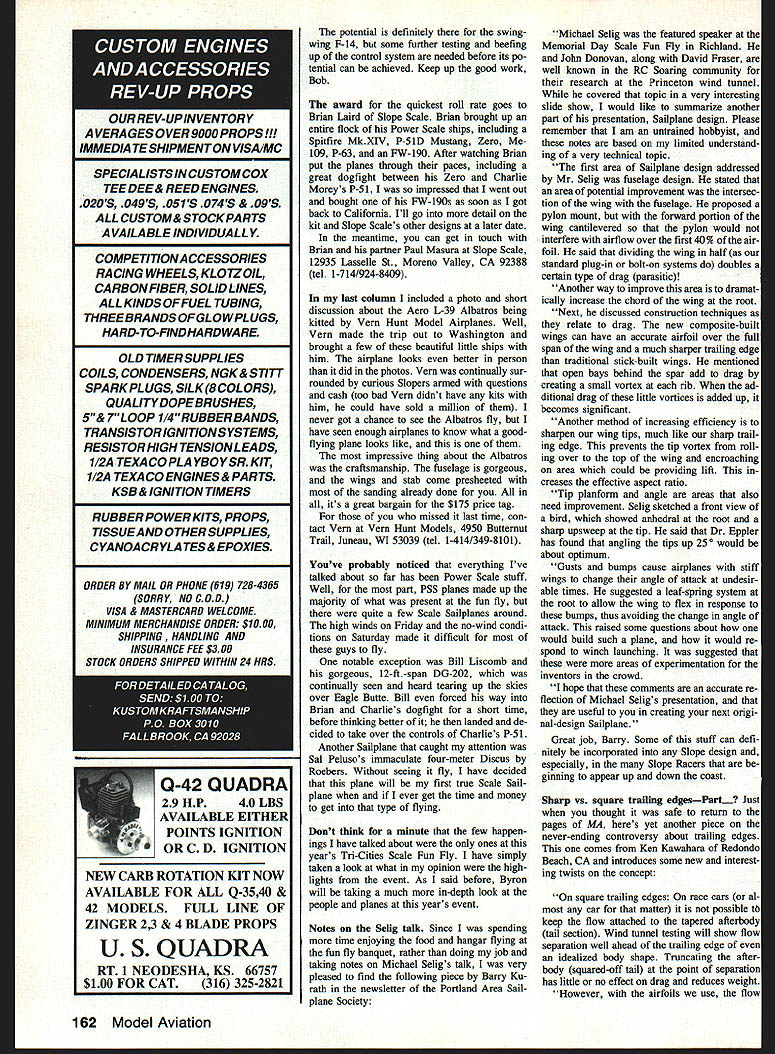
- Bob Reynolds' swing-wing F-14 — a long-anticipated highlight. After painting and reassembling, the F-14 was airborne with Charlie Morey at the controls. It exhibited noticeable stab flutter early on. Charlie trimmed and worked the plane along the ridge, tried sweeping the wings, and proved the swing-wing concept workable. At higher speeds the right horizontal stabilizer eventually fluttered off. With only half a stab the F-14 still flew back up the ridge a couple of times before making a downwind landing with minor damage. The swing-wing has potential, but needs further testing and beefing up of the control system.
- Tom's swing-wing F-14 prototype — also provided exciting moments; after tearing off a horizontal stabilizer in flight the pilot averted further disaster and the plane continued to fly.
- Brian Laird (Slope Scale) — brought a flock of Power Scale ships: Spitfire Mk.XIV, P-51D Mustang, Zero, Me-109, P-63 and FW-190. Brian's planes demonstrated incredible roll rates and sporty performance. After watching I bought one of his FW-190s as soon as I returned to California.
- Slope Scale: 12935 Lasselle St., Moreno Valley, CA 92388; tel. 1-714/924-8409.
Awards and notable models
- Pilots' Choice Award: B-29 crew (Ed Mason, Hal Weber, Wayne Stanford).
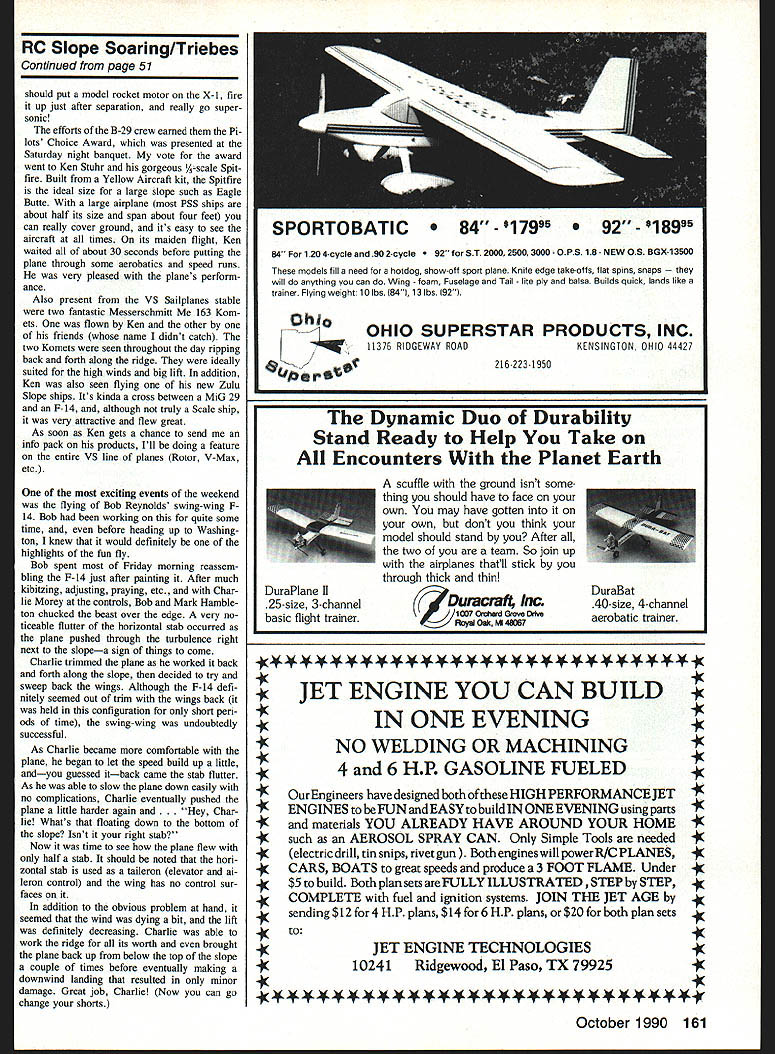
- My personal pick: Ken Stuhr's gorgeous 1/5-scale Spitfire (built from a Yellow Aircraft kit). Its size is ideal for a large slope like Eagle Butte — easy to see and capable of covering a lot of ground. On its maiden flight Ken put it through aerobatics and speed runs with great results.
- VS Sailplanes: Ken brought two Me 163 Komets and a new Zulu slope ship (a cross between a MiG-29 and an F-14). The two Komets were ideal for high winds and big lift, ripping back and forth along the ridge. I'll do a feature on the VS line when Ken sends an info pack.
Other notable kits and manufacturers
- Vern Hunt Models — Aero L-39 Albatros kit: Vern attended and brought examples. The model looks even better in person than in photos; craftsmanship is excellent, with a gorgeous fuselage and well-made wings and tail. A great bargain at $175.
- Vern Hunt Models: 4950 Butternut Trail, Juneau, WI 53039; tel. 1-414/349-8101.
Scale Sailplanes and other sailplane highlights
Although most of the field was Power Scale, there were several Scale Sailplanes present. The variable winds (high Friday, almost no wind Saturday) made flying difficult for many sailplane pilots, but some did stand out:
- Bill Liscomb's 12-ft-span DG-202 — continually seen and heard tearing up the skies over Eagle Butte. Bill even joined in a short dogfight before switching to Charlie's P-51 for a bit.
- Sal Pelosi's immaculate four-meter Discus by Roches — a beautifully finished model that convinced me it may be my first true Scale Sailplane if time and money allow.
I haven't covered everything that happened; these were the highlights I found most memorable. Byron Blakeslee will take a much more in-depth look at the people and planes at this year's event.
Notes on Michael Selig's talk
I spent more time enjoying the banquet food and hangar-flying than taking notes on Michael Selig's presentation. Fortunately, Barry Rill provided a summary in the Portland Area Sailplane Society newsletter; the following reflects Barry's notes and my edits for clarity.
Barry Rill's summary of Selig's points:
- Wing-fuselage junction:
- Selig suggested improving the wing-fuselage intersection by using a pylon mount with the forward portion of the wing cantilevered so the pylon doesn't interfere with airflow over the first ~40% of the airfoil.
- He pointed out that dividing the wing in half (our common plug-in/bolt-on systems) doubles a certain type of parasite drag.
- Another improvement is increasing the wing chord at the root.
- Construction and drag:
- Composite-built wings can maintain an accurate airfoil over the full span and a truer trailing edge than traditional stick-built wings.
- Open bays behind the spar can add drag by creating small vortices at each rib; the sum of these little vortices can be significant.
- Wing tips:
- Sharpening wing tips (like having a sharp trailing edge) can prevent tip vortices from rolling up over the top of the wing and encroaching into lifting area, effectively increasing the aspect ratio.
- Tip planform and anhedral/dihedral at the tip are areas for potential improvement. Selig sketched a bird-like front view showing root sweep and sharp upsweep at the tip. He cited Dr. Erpler's finding that angling tips up about 25 degrees might be near optimal.
- Gust response:
- Gusts and bumps cause stiff-wing airplanes to change angle of attack and thus lift. Selig suggested a leaf-spring design at the root to let the wing flex in response to bumps, avoiding abrupt changes in angle of attack. This raised questions about construction and wind launching; these are experimental areas for innovators.
Barry notes these comments are his interpretation and not from an aeronautical engineer's perspective. Still, many of these ideas can be incorporated into slope designs and especially into Slope Race development.
Sharp vs. square trailing edges — Part 2
Another contribution to the trailing-edge controversy comes from Ken Kawahara of Redondo Beach, CA. His points introduce new twists:
- On square trailing edges:
- For afterbodies (think race cars or tapered tails), flow separation usually occurs well ahead of the trailing edge. Truncating the afterbody (a squared-off tail) where separation already occurs has little effect on drag and can reduce weight.
- Trailing-edge shape affects the boundary layer only very near the trailing edge and has minor influence on total profile drag when the flow is already separated.
- If a laminar-flow airfoil is used correctly, a sharp trailing edge is optimal; however, when the flow separates on the aft portion of the wing, trailing-edge shape becomes less important.
- Ken's concluding observation:
- With the airfoils we commonly use, the flow ...
Transcribed from original scans by AI. Minor OCR errors may remain.

