
Radio Control: Slope Soaring
Mark Triebes 20794 Kreisler Ct. Saratoga, CA 95070
International Slope Race — Davenport, CA (July 7–8)
Acknowledgements
- Contest Director Ray Kuntz and Assistant CD Daryl Perkins — organized and ran the race and also competed.
- John Dvorak — handled promotion; his efforts helped produce a turnout of 60 competitors plus workers and spectators.
- The hobby industry — generous donations made the workers' raffle a success.
- The volunteers — many members of the South Bay Soaring Society and others traveled to help run the event.
Practice and early incidents
- During Friday practice (the official practice day) Daryl Perkins's and Bill Hull's models collided in midair. Bill was able to repair his plane before the race; Daryl lost his Swift 800 and had to use a modified Falcon 880.
- Despite the setback, Daryl turned in some of the best flying of the weekend in the first heat, lapping the field with the Falcon. In the second heat his Falcon nosed in on a turn and he DNF'd, finishing 21st overall.
Format, weather, and final scoring
- The event format called for three rounds on Saturday and two on Sunday, with ties to be broken by flyoffs. However, a lack of wind on Sunday canceled the final rounds and flyoffs, so final placings were determined by fast times from the heats run.
- This outcome caused some grumbling from pilots who expected Saturday’s excellent conditions to continue for head-to-head flyoffs.
Top results
- 1st — Joe Wurts, 02:13 (modified Swift 800) — first-place ISR trophy and $100 Speed Award
- 2nd — Ron Vann, 02:14 (Swift 800)
- 3rd — Rich Spicer, 02:18 (Nova, own design)
- 4th — Jerry Arana, 02:47 (Thunderbird, original design)
Remainder of the top 10 (in order): Jared Stalls, Mark Grand, Tony Martin, Ray Kuntz, Warren German, Norm Timbs.
Additional notes on competitors
- Jared Stalls flew a brand-new Swift 800 and was consistently fast, best time 02:19.
- Ray Kuntz was notable for flying very close to the hill and buzzing the pilots' box — an interesting tactic that disrupted other pilots’ attention.
- Will Byers and his E-Racer nearly performed well despite the plane being somewhat small for the field; a bad launch ended its run into the side of the hill.
Crashes and aircraft losses
- The mortality rate over the three rounds flown was high — about 30%.
- There were 21 DNFs caused by midairs or single-plane crashes (midairs were the majority). Some planes were repaired and flown again; about 15 were finished for the weekend and roughly 10 were totaled.
- Personal note: the author lost a brand-new Swift 800 to a midair in the third round but still went home happy because of the excitement of racing.
Awards
- Speed Award (fastest time): Joe Wurts.
- Design Award: Swift 800 designed by Mark Allen (Flite Lite Composites).
- Many pilots flew Swifts, including Joe Wurts, Ron Vann, Jared Stalls, Daryl Perkins, and the author.
Photo caption (from the event)
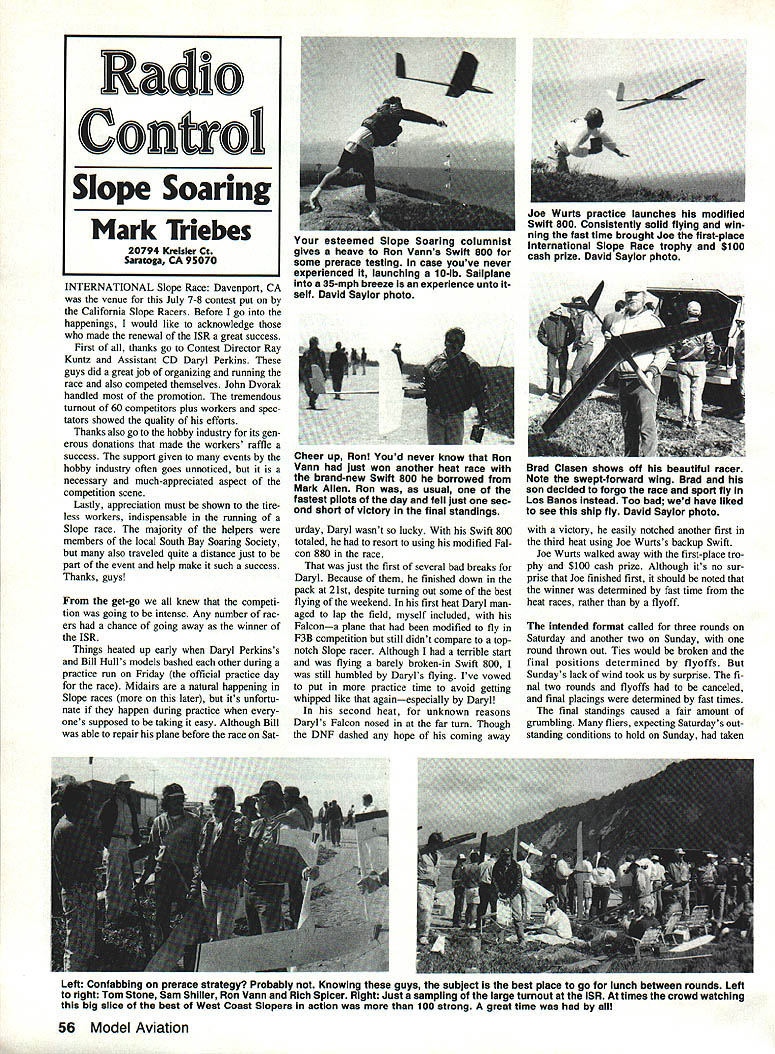
- Left to right: Tom Stone, Sam Shiller, Ron Vann, Rich Spicer — just sampling the large turnout. A big crowd watched a large slice of the best West Coast Slopers in action.
Mid‑Columbia Cup
- Organized by the Tri‑City Soarers as a Slope Race on Memorial Day weekend (since their Slope Soaring Scale Fun Fly is on hiatus in 1991).
- Description (from organizers): "A Slope Racer's race featuring the high-performance RC sailplanes adhering to FAI 2m wing-loading limits in a man-on-man pylon format."
- Date and location: May 24–26, 1991, Richland, WA (either Eagle or Columbia Butte).
- Purse and entry: $2,000 minimum cash purse, trophies, and prizes. Entry fee $80 (includes T‑shirt, awards, and chance to win cash). Space limited to first 50 applicants.
- Helpers are eligible for a workers' raffle. Spectators welcome.
- Contact: Tri‑City Soarers, c/o R. Kow, 954 W. Richland, WA 99352. Phone: 1‑509‑627‑2623 or 1‑509‑627‑5224. Roy: 1‑509‑525‑7066.
Competition
The following essay, "The Joy of True Competitive Soaring," was written by Daniel Harden for the Harbor Soaring Society (Costa Mesa, CA). It offers insights into the nature and motives of competition.
"Competition is found in almost every aspect of life. It is the foundation of our sport and our personal lives as well. We are continually competed with who is the fastest, the smartest, the best builder, the most skilled pilot. Among us there is constant striving to be more correct, more original, more devoted than anyone else. Even the best of friends try to outdo each other in their acquired skills.
"When we compete without thinking to win, valuing everyone's efforts equally, competition can be a very positive motivating force. It can teach us to appreciate our abilities more deeply and it can lead us to an appreciation and a greater respect for the capabilities of others as well. Unfortunately, because competition is the road to success and power in our sport of Soaring, it is usually used to gain selfish aims. Instead of competing with others, we compete against them.
"When competition becomes combat, it loses its power to inspire and becomes instead a form of pressure which creates disharmony in our sport, upsetting the true nature of the joy of Soaring. As we compete with one another to succeed, we widen the distance between ourselves and others. We become so intent on our quest for achievement that it becomes easy to ignore the feelings and hopes of those around us. We become willing to manipulate others to prove we are better than they are, and soon the aspirations and efforts of even our friends are undermined.
"The enmity and suspicion that result from competing in this way can create barriers between ourselves and others that are beyond our ability to overcome. The urge to win causes us to focus on the negative rather than the positive qualities of those around us so that we will appear more successful; we learn to point out the failings of others to make ourselves look superior. But what is the cost of this pattern? Do we benefit in the long run from treating others like this? Are we really better than they are, or are we standing on false ground? Though we may laugh at others, if we faced ourselves honestly, what would we have to laugh at?
"Thrill of the moment. When we lose touch in this way we are cut off from the satisfying feeling that comes from sharing. Caught up in the fascination and excitement aroused by winning, we begin to depend on the thrill of the moment to fulfill us, sometimes even risking our safety in reckless actions to achieve these moments. As our desire to win becomes stronger, competition becomes an end in itself and takes the place of meaningful service. We seek more specialized areas of endeavor—Electric, Old‑Timers, Hand‑Launch, Slope—where we will be sure to win, thus creating grounds for even narrower rivalries. We lose the opportunity to share with others, and we lose interest in things outside our sphere. The energy that could be used to develop a healthy attitude in our sport is directed instead into petty jealousies, and we become increasingly alienated from openness and cooperation, from the real source of true competition. Neither our sport nor our friendships can be truly satisfying.
"A natural quality? Competition can become so ingrained in our attitude that we believe it to be a natural quality, but actually we learn it at home, at school, or at work. We teach it to our children, pushing them to compete because we want them to be more successful than we have been. This pressure to succeed, however, often only teaches us to fear failure, a fear which undermines our self‑confidence and actually prevents us from succeeding.
"Perhaps we compete because we believe it will stimulate true motivation. But motivation that emphasizes success alone cannot encourage the well‑integrated development of our deepest abilities. To succeed we focus only on our known skills and talents, and thus limit our wider potential. As long as we meet with success, everything is fine. But if we fail, the disappointment can shatter our confidence and strongly affect the continuing joy of Soaring.
"As long as competition causes us to exploit our abilities, genuine accomplishment becomes blocked by frustration and failure. If we were to emphasize cooperation rather than competition, we would naturally feel secure, more confident in our abilities, and we would have less need to win at the expense of others. But we cling to the familiar ways; we compete, believing that this is the accepted way to do things, no matter what the consequences may be.
"Discomfort for everyone. When we examine the role of competition and the effect it has on our lives, we can see how it is often our fears and disappointments that spur us to compete. It is useful to take the time to look back over past contests, considering the different forms of competition and the feelings they engender. Only by understanding our motives can we reshape our competitive instincts into a force that encourages improvement, cooperation, and the shared joy of our sport."
Commentary
Pretty deep stuff, huh? You might have thought Slopers were just thrill‑seekers, but the point is simple: we need not let the sport consume us. Slope soaring should be an opportunity to make friends, enjoy nature, and express creativity. That's what it has always been, and what it should remain.
Transcribed from original scans by AI. Minor OCR errors may remain.

