
Radio Control: Slope Soaring
Mark Triebes 20794 Kreisler Ct. Saratoga, CA 95070
BEARDSLEY / California Slope Racers (CSR)
Rich Beardsley was recently elected chairman of the board of the California Slope Racers (CSR), the club organized in 1989 to manage the annual International Slope Race (ISR) and to run regional races. Rich, a member of the Santa Maria Soaring Society, was elected by a slim margin over Southern Cal's Ray Kuntz, who CD'd the 1989 ISR. Thirteen board members located throughout California represent slope-race pilots who are CSR members.
- Any pilot who enters a CSR slope race automatically becomes a member of the organization.
- There are no membership dues; expenses (printing, postage, AMA fees) are covered by CSR contest entry fees.
Contact:
- Rich Beardsley, 2401 Country Lane, Santa Maria, CA 93455
- Tel: (805) 934-3191
CSR Regional Slope Race (Santa Maria)
The first CSR-organized regional event was held at Santa Maria last October. The following report is courtesy of Steve Bircher of the Santa Maria Soaring Society.
"The slope race was superb despite a light wind that never decided whether to blow or not. I doubt it ever got much above 15 mph, and it seemed to drop as the heats started. At least one pilot got caught way down the hill when the wind dropped.
Four rounds of four-plane heats boiled down to a three-way tie between Rich Spicer, Joe Wurts and Daryl Perkins, who met in a five-lap flyoff. It promised to be the best race of the day, but the plot rapidly unraveled as Spicer crossed the start line just before the 'Go' signal. Then, as Daryl and Joe went at it hard and heavy, disaster struck Wurts. Making the far turn on lap two, Joe's plane dropped a wing and dived into the hill. Daryl cruised to the win with Rich running hard but too far back to catch up in five laps. A disappointing end—we had all hoped for a close, hard-fought final. That's racing!
All involved agreed that it had been a pretty good day of flying and fun, despite the iffy wind. A poll was taken of the competitors, and a tentative date was set for late March 1991 for a two-day meet along the lines of the ISR at Davenport. In any case, the California Slope Racers have seen our hill and like it, so we can count on having good turnouts at any future slope events."
The long-term goal of organizing slope racing and creating a unified competitive system appears to be taking shape. With the ISR, the Mid-Columbia Cup and the many club and regional races planned, 1991 looks to be a very strong year for slope racing and slope soaring in general. The remaining ambition is to add more international participation to some of the larger events — a real Slope Racing World Championship, rather than the limited F3F format.
Wing Covers — Soaring Specialties Product Update
Slope soaring is hard on sailplanes; while some dings are unavoidable, frequent "hangar rash" can be reduced with proper protection. Soaring Specialties (formerly Service Plus) offers several protection products:
- Quilted wing covers
- Designed specifically for sailplanes; Pattern aircraft covers also available
- Sizes: Unlimited, Standard, Two-Meter, HLG
- Prices (approx.): Unlimited $29.95, Standard $27.95, Two-Meter $25.95, HLG $23.95
- Shipping: $3.05 (free shipping when ordering two or more sets)
- Oklahoma residents add 8% tax
- State covers available for an additional $5.00 per set
- Quilted transmitter covers
- Same quilted material as wing covers; protect transmitters from dust, scratches and grit
- Price: $4.95 each
- Hard-cover transmitter case
- Size: 12 x 16 x 3 in., three layers of 2-in. foam, hard plastic outer shell
- Holds two transmitters and can be locked with a small padlock
- Price: $16.95 plus shipping
Ninja (Sig) — Kit Review (Ed Franz)
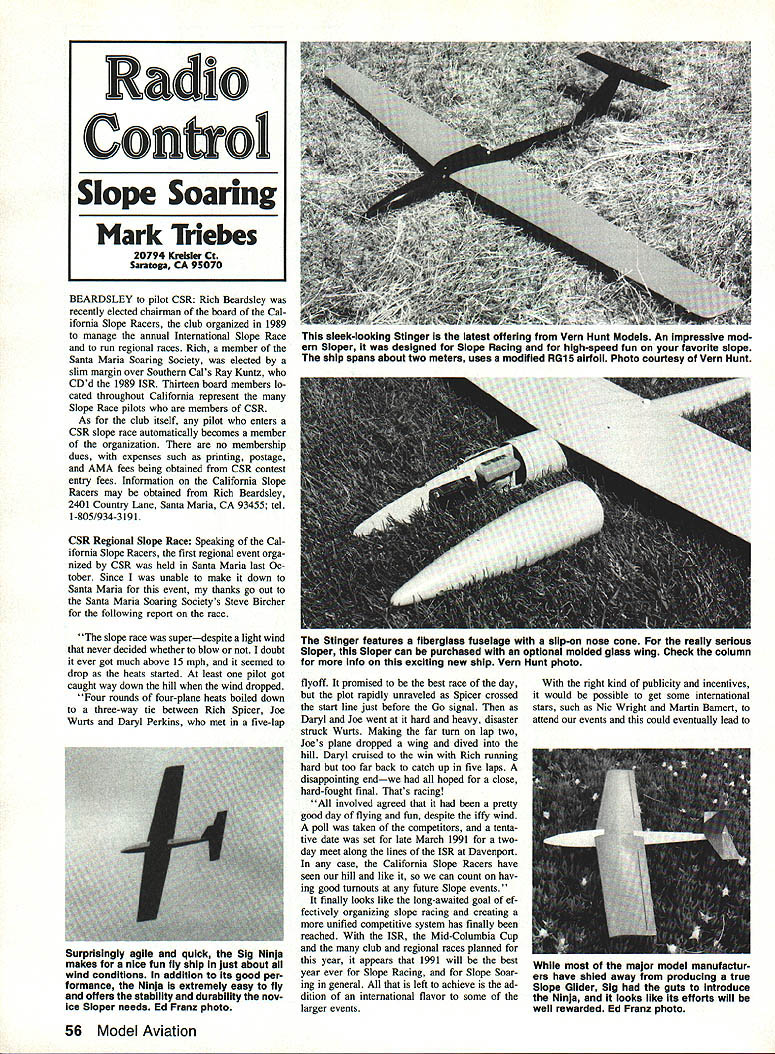
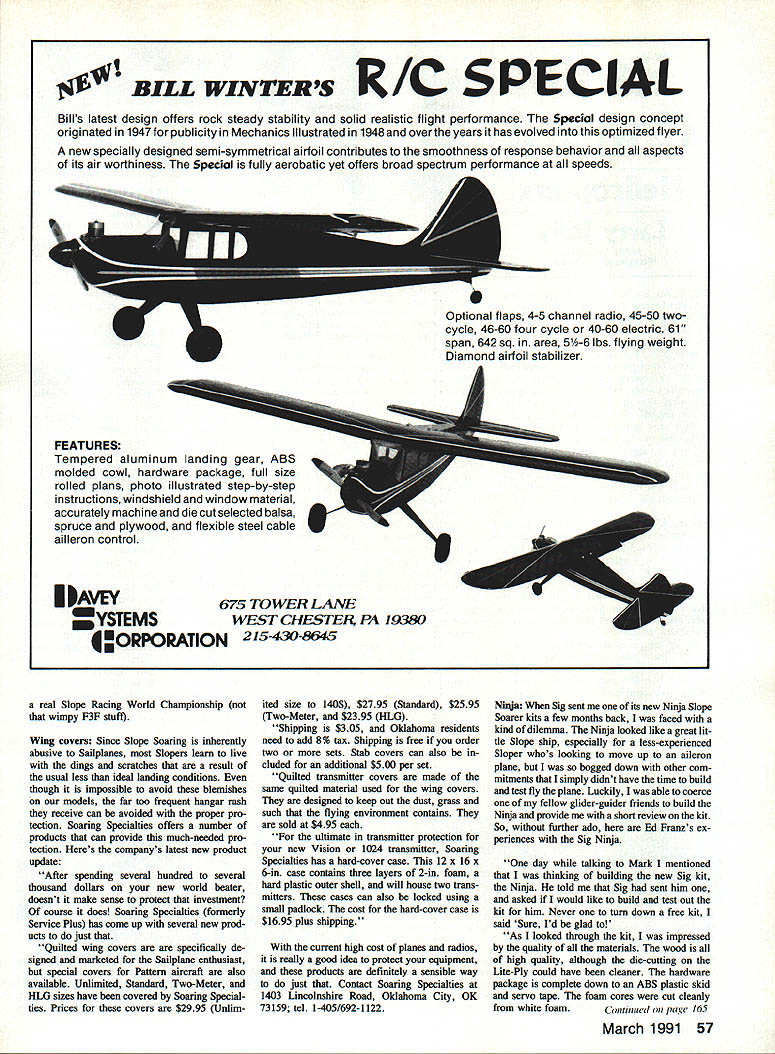
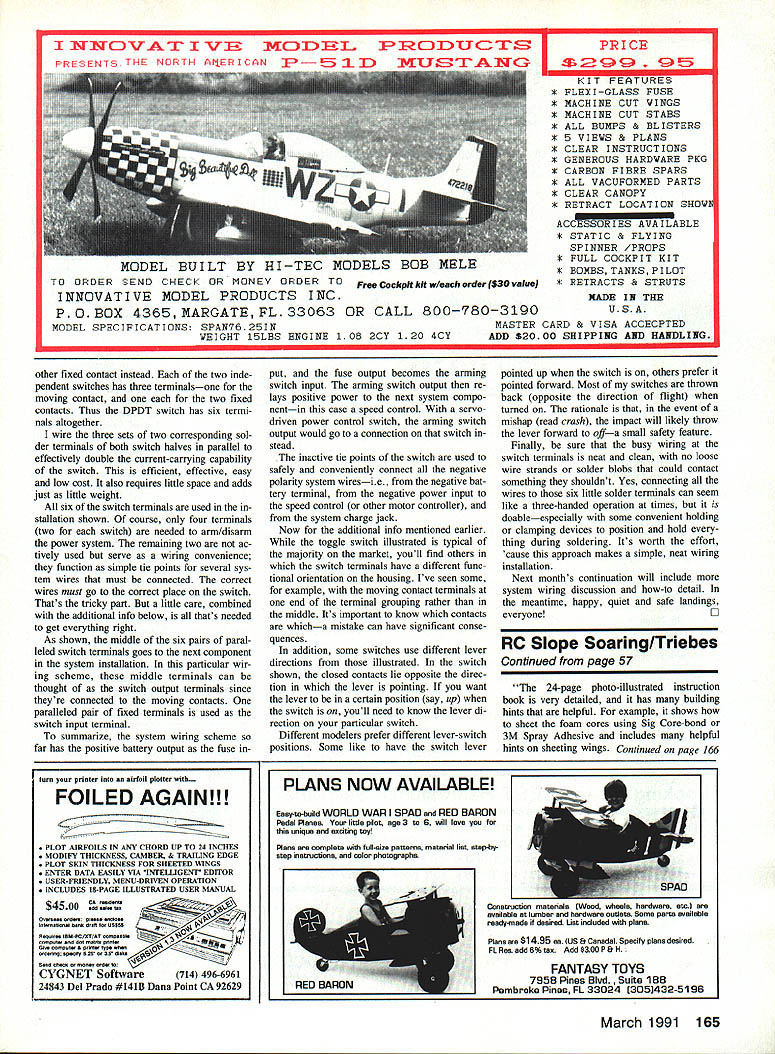
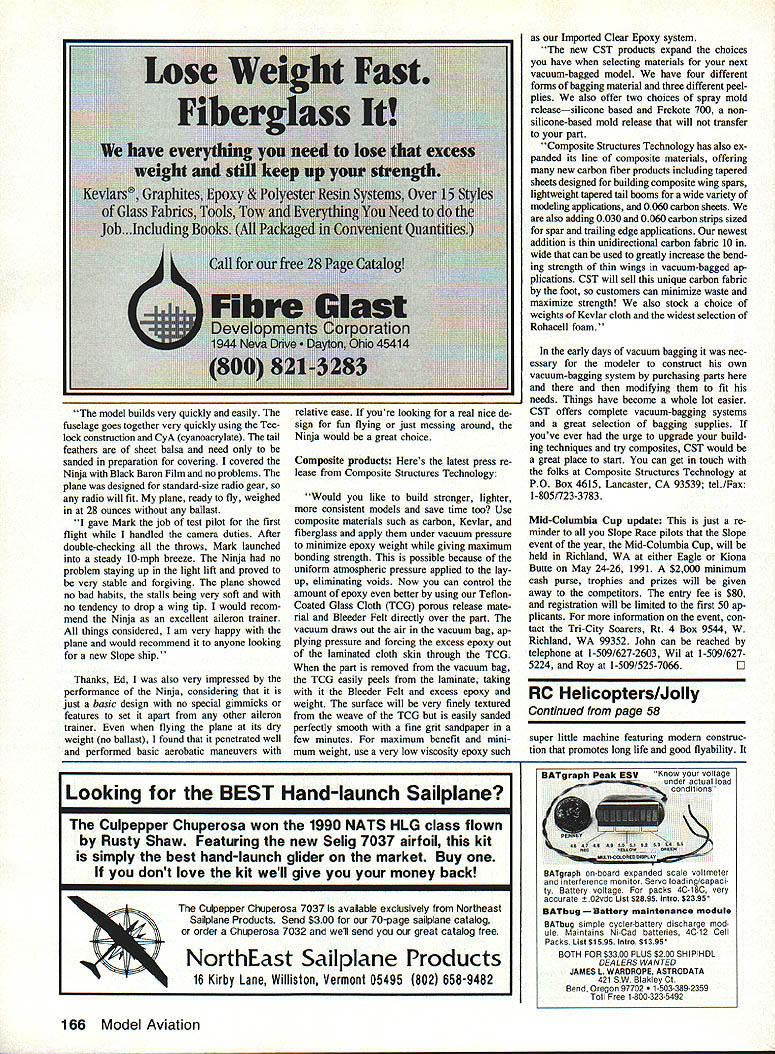
Ed Franz built and tested the Sig Ninja slope sailplane kit. Highlights from his report:
- Kit quality: Good lite-ply (die-cutting could be cleaner), complete hardware package including ABS skid and servo tape, cleanly cut white foam cores.
- Instructions: 24-page photo-illustrated book with detailed building hints; shows how to sheet foam cores using Sig Core-Bond or 3M Spray Adhesive.
- Construction notes: Fuselage assembles quickly using Tec-lock construction and CA. Tail feathers are sheet balsa and require only sanding before covering.
- Covering and weight: Covered with Black Baron Film; ready-to-fly weight was 28 ounces without ballast.
- Flight impressions: Very stable and forgiving in light lift (steady ~10 mph breeze), soft stalls with no wing-drop tendency, good penetration and able to perform basic aerobatics even at dry weight.
- Recommendation: An excellent all-around trainer and a good choice for pilots stepping up to an aileron slope ship.
Power-System Wiring — DPDT Switch Paralleling and Arming Switches
A practical wiring technique for arming switches and relays in power systems:
- Many toggle-style DPDT switches consist of two independent SPDT sections within one housing. Each half has three terminals: moving contact plus two fixed contacts, for a total of six terminals.
- You can wire the corresponding solder terminals of both switch halves in parallel to double the current-carrying capability of the switch. This is space- and weight-efficient and low cost.
- Typical wiring approach:
- The positive battery output goes to the fuse input.
- Fuse output becomes the arming switch input (one paralleled pair of fixed terminals).
- The arming switch output (the middle paralleled pair connected to the moving contacts) relays positive power to the next system component (e.g., a speed control or to a servo-driven power control switch).
- Use the remaining paralleled pair of terminals as convenient tie points for negative polarity system wires (battery negative, speed control negative, charge jack negative).
- Important cautions:
- Different switches may have different terminal orientations; verify which terminals are moving contacts and which are fixed.
- Lever orientation varies between switches—if you want the lever up for "on," confirm the lever direction for your particular switch.
- Many modellers prefer the lever thrown back (opposite flight) when "on" so that crash impacts are likely to move the lever forward to "off."
- Keep wiring neat at the switch: trim loose strands, avoid solder blobs that could short, and use clamping aids while soldering multiple terminals.
Next month's column will continue system wiring discussion with additional how-to detail.
Composite Products — Composite Structures Technology (CST)
CST offers materials and systems to help modelers build stronger, lighter, and more consistent vacuum-bagged composite parts:
- Vacuum-bagging advantages: uniform atmospheric pressure eliminates voids, reduces epoxy weight, and yields higher bonding strength.
- CST products and supplies:
- Teflon-coated Glass Cloth (TCG), porous release materials, Bleeder Felt to control epoxy pickup
- Multiple bagging materials and peel-ply options
- Two types of spray mold release: silicone-based and Frekote 700 (non-silicone, non-transferring)
- Carbon fiber products: tapered sheets for spars, lightweight tapered tail booms, 0.006" unidirectional sheets, 0.030" and 0.060" carbon strips, and a new thin 10" unidirectional carbon fabric sold by the foot
- Kevlar cloth in various weights and a wide selection of Rohacell foam
- Complete vacuum-bagging systems and bagging supplies
For more information, contact:
- Composite Structures Technology, P.O. Box 4615, Lancaster, CA 93539
- Tel/Fax: (805) 723-3783
Mid-Columbia Cup Update
Reminder: the Mid-Columbia Cup, the premier slope race of the year, will be held in Richland, WA at either Eagle or Kioma Butte on May 24–26, 1991.
- Prize: $2,000 minimum cash purse, trophies and prizes
- Entry fee: $80
- Registration limited to first 50 applicants
Contact the Tri-City Soarers:
- P.O. Box 9544, W. Richland, WA 99352
- Joan: (509) 627-2603
- Wil: (509) 627-5224
- Roy: (509) 525-7066
Happy, quiet and safe landings, everyone!
Transcribed from original scans by AI. Minor OCR errors may remain.

