
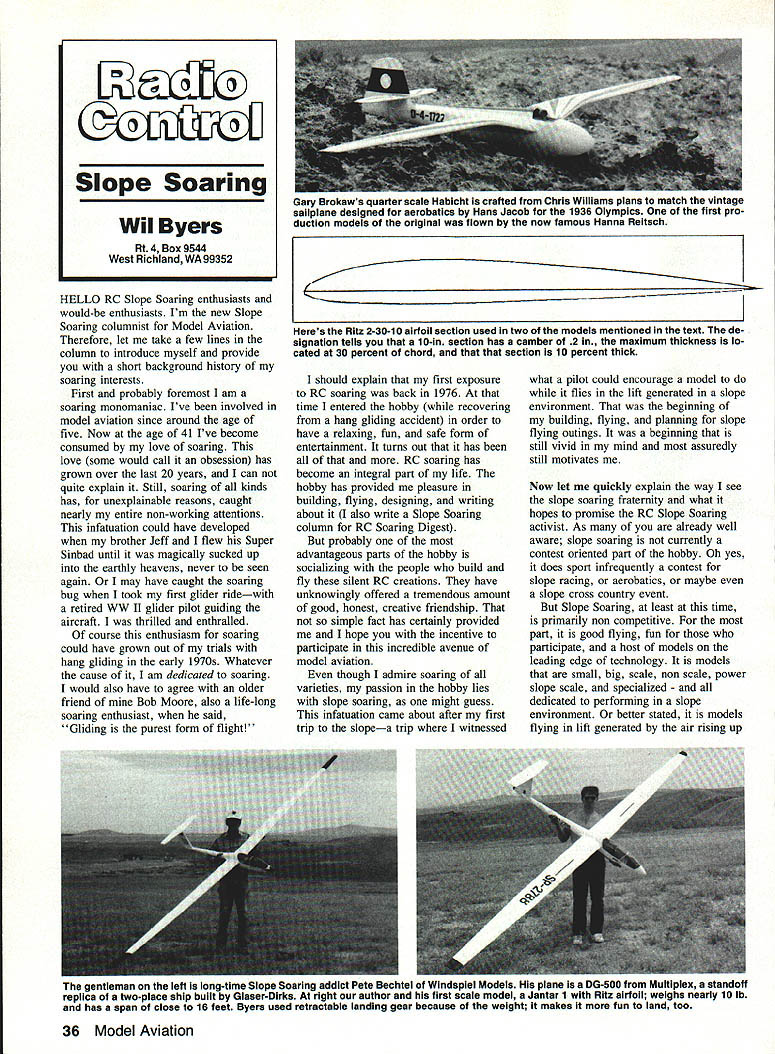
Radio Control: Slope Soaring
Wil Byers Rt. 4, Box 9544 West Richland, WA 99352
HELLO RC slope-soaring enthusiasts and would-be enthusiasts. I'm the new Slope Soaring columnist for Model Aviation. Let me take a few lines to introduce myself and provide a short background and history of my soaring interests.
First, and probably foremost, I am a soaring monomaniac. I've been involved in model aviation since around age five. Now, at 41, I've become consumed by my love of soaring — a passion that has grown over the last 20 years. I can't quite explain it. Soaring of all kinds has, for unexplainable reasons, captured nearly all of my non-working attention. My infatuation could have started when my brother Jeff and I flew his Super Sinbad until it was magically sucked up into the heavens, never to be seen again. Or perhaps it began when I took my first glider ride with a retired WWII glider pilot guiding the aircraft — I was thrilled and enthralled. Trials with hang gliding in the early 1970s may have contributed as well. Whatever the causes, I am dedicated to soaring.
I would also agree with an older friend, Bob Moore, a life-long soaring enthusiast, who said: "Gliding is the purest form of flight!"
I was first exposed to RC soaring in 1976. At the time I entered the hobby I was recovering from a hang-gliding accident and wanted a relaxing, fun, and safe form of entertainment. RC soaring turned out to be all of that and more. The hobby has become an integral part of my life: building, flying, designing, and writing about sailplanes. I also write a Slope Soaring column for RC Soaring Digest.
One of the most advantageous parts of the hobby is socializing with people who build and fly these silent RC creations. They have offered a tremendous amount of good, honest, creative friendship, which has provided incentive and enjoyment for participating in this avenue of model aviation.
Although I admire all soaring varieties, my passion lies with slope soaring. My infatuation began after my first trip to a slope, where I witnessed what a pilot could encourage a model to do while flying in lift generated by a slope environment. That trip began my building, flying, and planning for slope outings — a beginning that remains vivid and motivating.
Now a few thoughts on slope soaring as a community and what I hope to promote. As many of you know, slope soaring is not primarily a contest-oriented part of the hobby. There are infrequent contests (slope racing, aerobatics, occasional slope cross-country), but slope soaring is, for the most part, noncompetitive: good flying, fun, and participation. The fraternity includes a broad range of models — small and large, scale and non-scale, power-slope and dedicated sailplanes — all designed to perform in lift generated by air rising up and over a hill.
Because slope soaring has remained relatively noncompetitive, it has maintained a laid-back, benign image. But it also has another facet that is healthy for model aviation and fun for participants: slope pilots often fly aircraft rarely seen at thermal fields. Many of these models employ state-of-the-art technology and design. Some are evolved to withstand winds of 60+ mph; others can exceed 140 mph in dives through the tremendous lift generated by slopes. Slope soaring stimulates design ideas that can carry over into other areas of RC soaring — ideas that might help U.S. F3B or F3J pilots internationally, or inspire F3F variants from a healthy slopers' community.
I'd like to hear from you: the types of models you fly, the sites you use, special building techniques you find helpful or innovative, model assessments (how your latest kit went together), what works or doesn't work on your hill, and perhaps a picture or two. Take a trip to your local hill with a camera and gather ideas and images. Send them along; many Model Aviation readers are interested and so am I.
If I don't hear from you, I'll share regional news from my club mates. But I can't possibly attend every event, so please pass along your ideas and reports.
Scale and notable models
I'll share a few models from my local club, the Tri-City Soarers (TRICS), and from others I know.
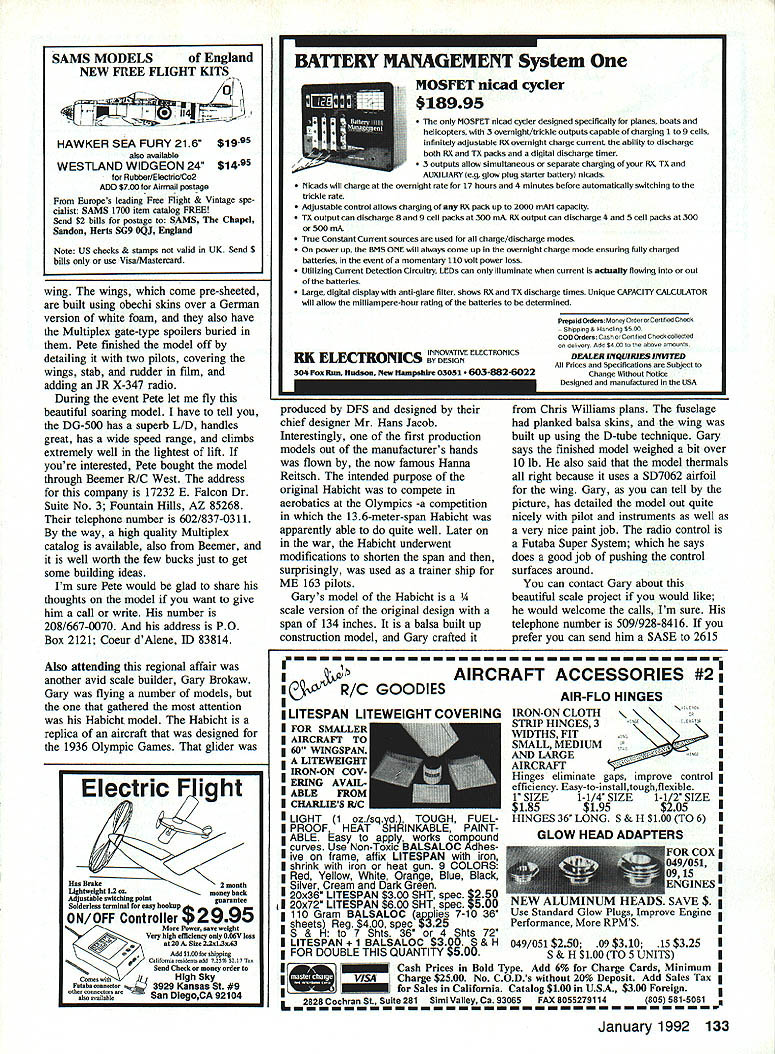
My Jantar 1:
- My first scale model and a superb handling ship.
- Wing span: 4.75 m (nearly 16 ft); aspect ratio: 25.1.
- Wing airfoil combination (Ritz family): 3-30-14 at the root, 3-30-12 at mid-span, and 3-30-10 at the tip.
- Fuselage: fiberglass and relatively roomy compared with an F3B ship.
- Construction: I opted for a foam-cored wing with fiberglass and 1/8" balsa sheeting (original plans called for built-up balsa with spruce spars).
- Control surfaces: elevator and rudder built similarly, using 1/4" balsa sheeting.
- Spoilers: 350 mm double-gauge Multiplex spoilers, very effective for killing lift.
- Weight: nearly 10 lb; because it's heavy (scale ships often are), I added a retractable landing gear to save wear and make landings more fun.
- Radio: JR system.
Pete Bechtel:
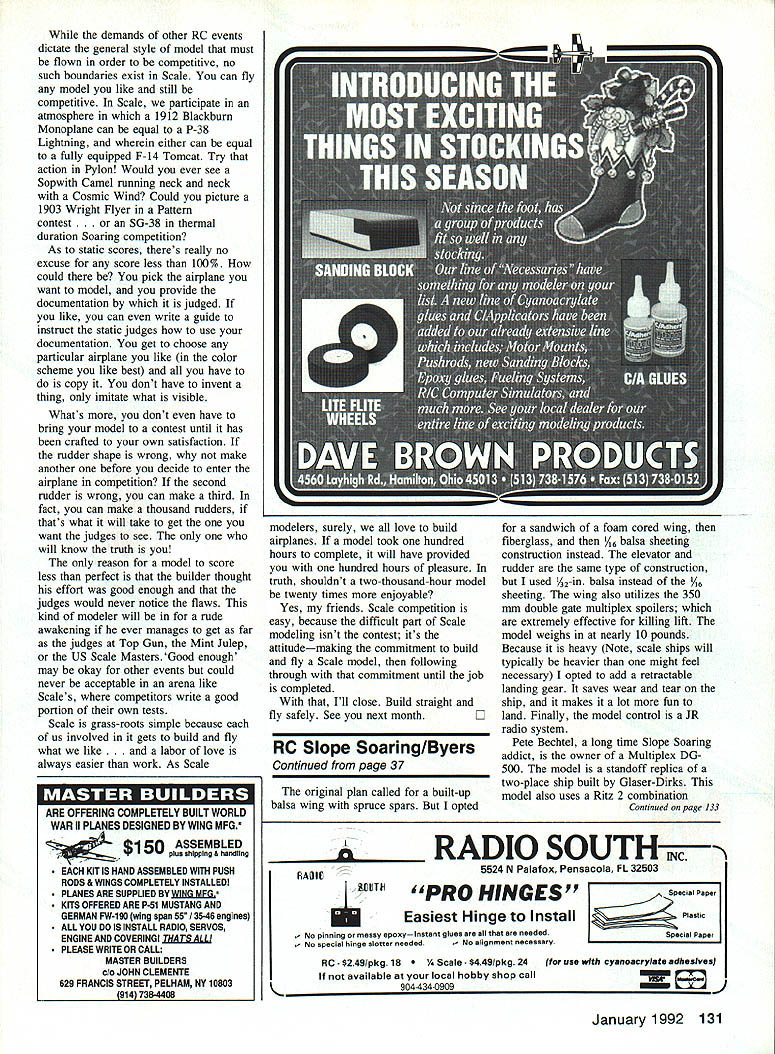
- Owner of a Multiplex DG-500, a scale replica of a two-place Glaser-Dirks ship.
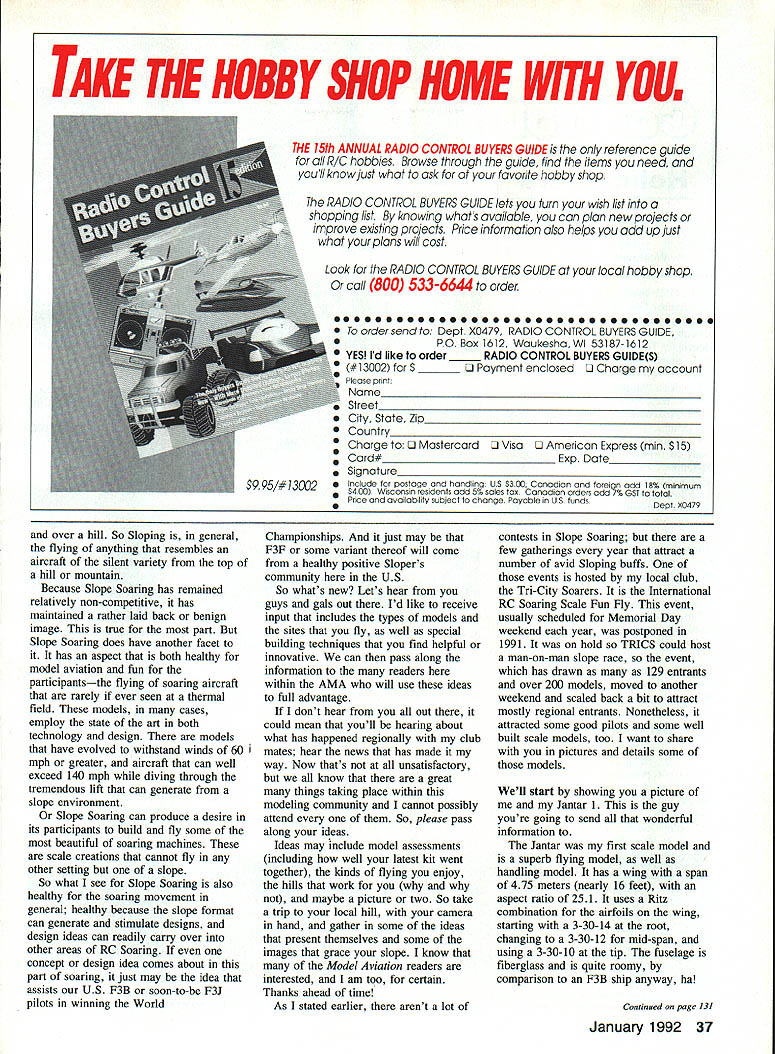
- This model uses a Ritz 2-30-10 airfoil section (see Airfoil section below).
TRICS International RC Soaring Scale Fun Fly and upcoming events
TRICS hosts an International RC Soaring Scale Fun Fly, usually scheduled for Memorial Day weekend. In 1991 the event was postponed so TRICS could host a man-on-man slope race; the scale fun fly moved to another weekend and scaled back to attract mostly regional entrants. The event has drawn as many as 129 entrants and over 200 models in the past.
This is a relaxed event focused on flying and fun, typically including:
- A Friday night social and Washington wine tasting.
- A Saturday banquet dinner with a special guest speaker.
- A superb raffle supported by many generous hobby manufacturers.
Plans (as announced):
- TRICS Fly-In planned for May 29–31, 1992.
- Portland Area Sailplane Society (PASS), through Mike Bamberg, will assist in organizing a scale-only cross-country event (in case wind is light).
For Fun Fly information, send a SASE to:
- Skip Johnsen, 2626 Eastwood Ave., Richland, WA 99352
Or call:
- Roy Lightle: 509/525-7066
- Gene Cope: 509/457-9017
Airfoil
Two of the models mentioned above used the Ritz airfoil family. Below is the Ritz 2-30-10 airfoil section used on the two models referenced. The designation means:
- 2 = 2% camber of the overall chord.
- 30 = maximum thickness located at 30% of chord.
- 10 = 10% thickness (i.e., maximum thickness = 10% of chord).
Ritz 2-30-10 Airfoil Plot Coordinates
No. X YU YL
- 0.000 0.000 0.000
- 1.250 1.650 -0.250
- 2.500 2.350 -0.650
- 5.000 3.450 -1.250
- 7.500 4.350 -2.400
- 10.000 5.000 -2.650
- 15.000 5.950 -2.800
- 20.000 6.500 -2.950
- 30.000 7.000 -3.000
- 40.000 6.700 -2.800
- 50.000 6.000 -2.450
- 60.000 5.150 -2.150
- 70.000 4.150 -1.750
- 80.000 2.950 -1.300
- 90.000 1.600 -0.800
- 95.000 0.850 -0.500
- 100.000 0.100 -0.100
Notes:
- No. = plotted points of the airfoil
- X = X axis (percent chord)
- YU = upper surface ordinate
- YL = lower surface ordinate
L/D polars are unavailable at this time. Based on performance history, the Ritz 2-30-10 is a very good choice for a scale ship: it provides good handling and a wide speed range, a reasonable drag bucket, good climb in lift, and adequate thickness for building a strong wing suitable for heavy models. It also permits aerobatics if desired.
I think that's all the room I have for pictures this month; we'll save the others for the next column. If you enjoyed the pictures and are interested in scale soaring, please send a SASE requesting information and I will make every effort to respond promptly.
Thanks for reading. Please feel free to contact me by SASE or telephone any time you have soaring news to share with Model Aviation readers.
Wil Byers Rt. 4, Box 9544 West Richland, WA 99352
Transcribed from original scans by AI. Minor OCR errors may remain.

