

Radio Control: Slope Soaring
Wil Byers Rt. 4, Box 9544 West Richland, WA 99352
Hello Slope Soaring enthusiasts. The last column started with a fairly long introduction. This month's column jumps right to the meat of the subject and discusses models, construction techniques, and designs sent to me by other slope flyers.
Graham Woods — composite aerobatic ship
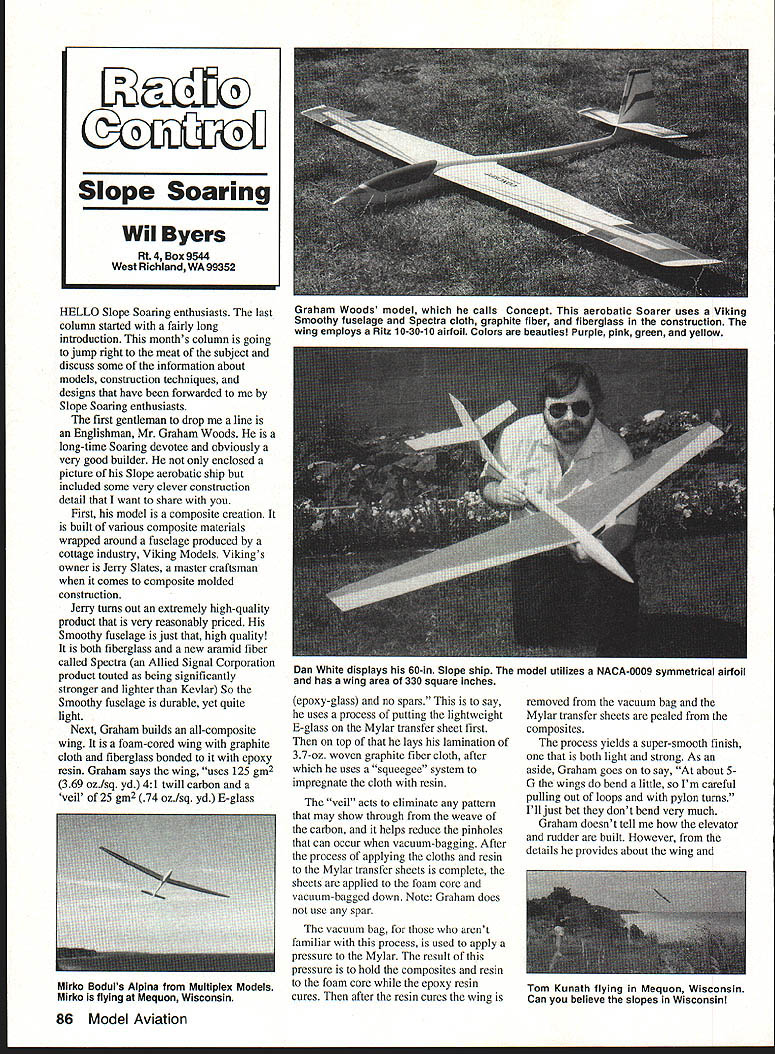
Graham Woods (England) is a long-time soaring devotee and a very good builder. His slope aerobatic ship is a composite creation built around a Viking "Smoothy" fuselage and an all-composite foam-cored wing.
- Fuselage: Viking Smoothy (fiberglass plus Spectra aramid fiber). Durable and light.
- Wing: foam core with graphite (carbon) cloth and a lightweight E‑glass "veil" bonded with epoxy. Graham reports using 125 g/m² (3.69 oz/yd²) 4:1 twill carbon cloth and a 25 g/m² (0.74 oz/yd²) E‑glass veil. He laminates E‑glass onto a Mylar transfer sheet first, then applies the woven carbon, impregnates with resin using a squeegee, applies to the foam core, and vacuum-bags the assembly. After cure the Mylar is peeled off.
- No internal spar is used; the vacuum-bagging yields a super-smooth, light, and strong wing. Graham notes the wings bend only a little at about 5 G, so he is careful pulling out of loops and pylon turns.
- Control surfaces: Graham did not provide construction details for elevator and rudder, but the generous rudder is notable. His brother Dave described a wingover technique: as the model climbs to the wingover entry attitude, apply rudder opposite the desired turn direction, then give full opposite rudder at the wingover point to bring the tail over abruptly.
Contacts:
- Graham Woods: Graham Woods, 21 Daryngton Avenue, Minnis Bay, Birchington, Kent CT7 9PS, England. (Send SASE.)
- Viking Models (Smoothy fuselage): Viking Models, P.O. Box 6680, Concord, CA 94524. Phone: (510) 689-0766.
Dan White — built-up balsa slope ship
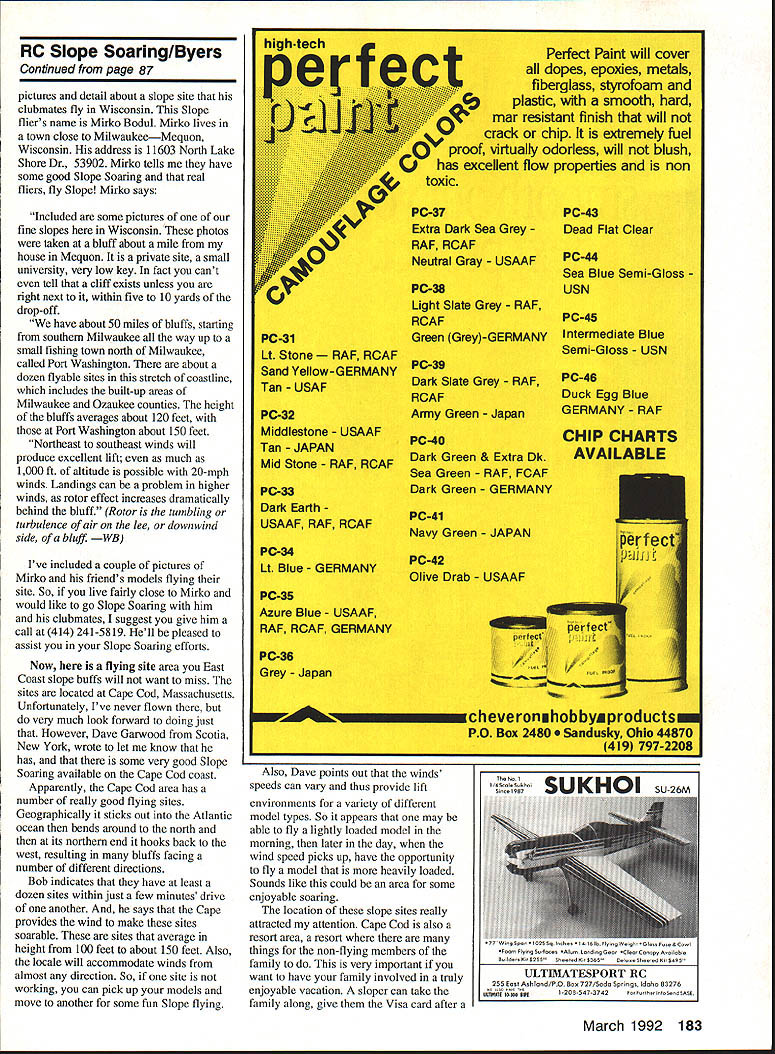
Dan White (Belmont, CA) designed a lower-tech ship optimized for his slope and local lift conditions.
- Wing area: 330 in²
- Span: 60 in
- Root chord: 7.5 in; tip chord: 3.5 in
- Structure: built-up balsa fuselage and fin; built-up balsa elevator. Dan adds two layers of 3.1 oz/yd² crowfoot-weave fiberglass cloth to the fuselage for strength.
- Ailerons: strip ailerons cut from the trailing edge.
- Airfoil: completely symmetrical NACA 0009.
- Radio: Airtronics system with Vision transmitter; the Vision setup allows use of flaperons. Dan reports the model performs maneuvers such as vertical figure eights. Flaperons allow cambering the trailing edge for tighter turns and increased lift when needed.
Contact:
- Dan White: 1723 Chula Vista Dr., Belmont, CA 94002. Phone: (415) 594-0644.
Mirko Bodul — Wisconsin slopes
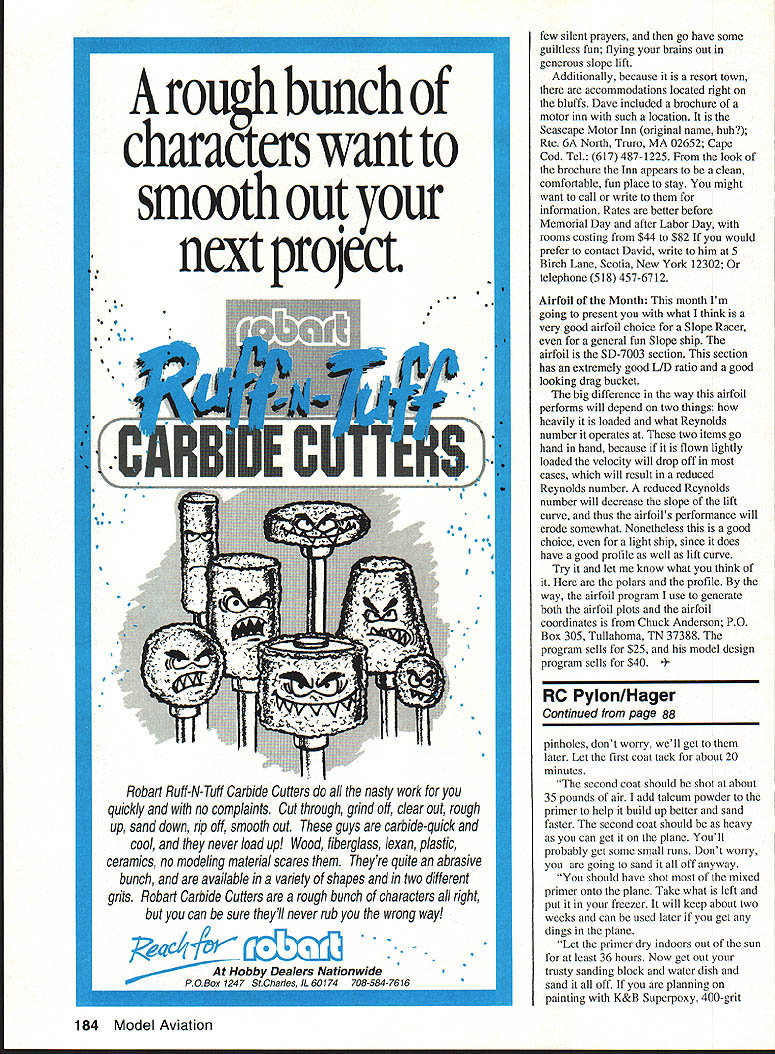
Mirko Bodul (Mequon, near Milwaukee, WI) and his club fly bluffs along Lake Michigan.
- Site: a bluff about a mile from Mirko's house (private university site). The cliff is subtle — you often don't notice the drop-off until you're within five to ten yards.
- Region: about 50 miles of bluffs from southern Milwaukee north to Port Washington, with roughly a dozen flyable sites.
- Heights: average about 120 ft; Port Washington bluffs around 150 ft.
- Winds: northeast to southeast winds produce excellent lift; with 20 mph winds pilots have achieved as much as 1,000 ft of altitude.
- Hazards: landings can be difficult in higher winds because of increased rotor (tumbling/turbulent air on the lee side of the bluff).
Contacts:
- Mirko Bodul: 11603 North Lake Shore Dr., Mequon, WI 53092. Phone: (414) 241-5819.
Cape Cod, Massachusetts — East Coast slope sites
Cape Cod offers a number of excellent slope sites and is worth a visit for East Coast slopers.
- Geography: the Cape projects into the Atlantic and curves, so approaching winds are forced shoreward; many bluffs face different directions, giving sites that work for a variety of wind directions.
- Sites: at least a dozen within a few minutes' drive of one another; typical heights 100–150 ft.
- Winds: differing site orientations and variable wind speeds mean you can fly lightly loaded models in gentler winds (morning) and more heavily loaded ships when winds pick up later.
- Family-friendly: Cape Cod is a resort area with activities for non-flying family members and lodging right on some bluffs — handy for combined family vacations and flying.
Accommodations and contacts:
- Seascape Motor Inn, Rte. 6A, North Truro, MA 02652. Phone: (617) 487-1225. Rates (from brochure): $44–$82 (better rates before Memorial Day and after Labor Day).
- For local information: David (Dave) — 5 Birch Lane, Scotia, NY 12302. Phone: (518) 457-6712.
Pack a few silent prayers, then go have some guiltless fun — fly your brains out in generous slope lift.
Airfoil of the Month
This month's recommended airfoil for a slope racer or a general slope ship is the SD-7003 section.
- Characteristics: very good L/D ratio and a well-shaped drag bucket.
- Performance factors: the airfoil's effectiveness depends on wing loading and Reynolds number. Light loading usually means lower flight speed and lower Reynolds number, which flattens the lift curve and reduces performance somewhat. Even so, SD-7003 performs well for both lightly and moderately loaded slope ships.
- Try it on your next design and report back.
Software and resources:
- Airfoil program used: Chuck Anderson. Address: P.O. Box 305, Tullahoma, TN 37388. Program price: $25. His model design program: $40.
Transcribed from original scans by AI. Minor OCR errors may remain.

