



Radio Control: Slope Soaring
Wil Byers Rt. 4, Box 9544 West Richland, WA 99352
Slope soaring aerobatics and racing are enjoying strong followings in Europe, and interest is growing in the U.S. This article summarizes competitive formats, upcoming events, useful gear, recent models, and a recommended airfoil for slopers.
Slope Aerobatics
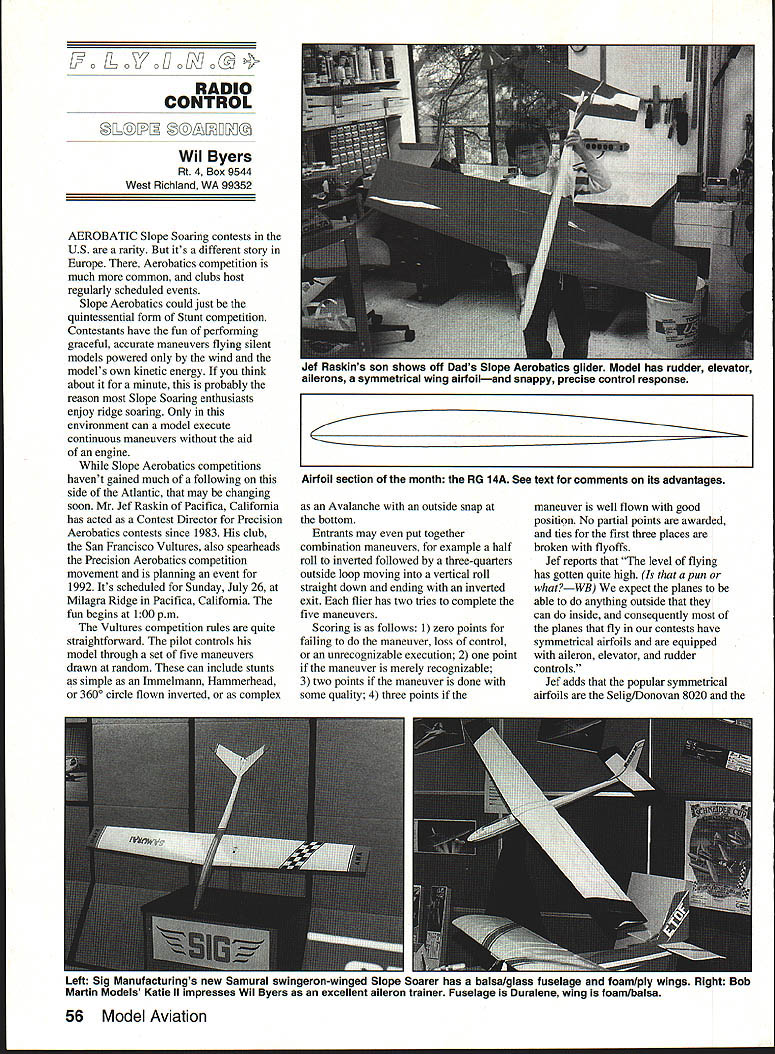
Slope Aerobatics contests are rare in the U.S. but common in Europe. They may be the quintessential form of stunt competition: pilots perform graceful, accurate maneuvers with silent models powered only by ridge lift and kinetic energy. Ridge soaring lets a model execute continuous maneuvers without an engine, which many slope pilots enjoy.
San Francisco Vultures Precision Aerobatics (1992)
Mr. Jef Raskin of Pacifica, California, has been Contest Director for Precision Aerobatics contests since 1983. His club, the San Francisco Vultures, planned an event for Sunday, July 26, 1992, at Milagra Ridge in Pacifica, California. The fun begins at 1:00 p.m.
#### Competition format
- Pilots draw a set of five maneuvers at random.
- Maneuvers may range from simple (Immelmann, Hammerhead, 360° inverted circle) to complex (Avalanche with an outside snap at the bottom).
- Entrants may fly combination maneuvers (for example: half roll to inverted, then three-quarters outside loop into a vertical roll straight down, ending with an inverted exit).
- Each flier has two tries to complete the five maneuvers.
#### Scoring
- 0 points — failing to do the maneuver, loss of control, or unrecognizable execution.
- 1 point — maneuver merely recognizable.
- 2 points — maneuver done with some quality.
- 3 points — maneuver well flown with good position.
- No partial points awarded.
- Ties for the first three places are broken by flyoffs.
#### Aircraft & airfoils
- Contest planes generally have symmetrical airfoils and full control (ailerons, elevator, rudder).
- Popular symmetrical airfoils: Selig/Donovan 8020 and NACA 00xx series.
- Jef Raskin has also designed a WE 30xx series of airfoils for Slope Aerobatics.
#### Contact Jef Raskin 8 Gypsy Hill Road, Pacifica, CA 94044 Fax: (415) 359-9767 Telephone: (415) 359-8588
F3F Viking Cup (September 4–6, 1992)
The F3F Viking Cup, hosted in Norway, is recognized by the FAI though not yet an official FAI event in 1992. This biennial tournament is regarded as the unofficial European Championship of F3F and draws Europe's top slope-racing pilots and fast models.
Task and course
- Goal: fly 1,000 meters (10 legs of a 100-meter course) in the shortest possible time.
- Course: two flags (pylons) designate the ends; the pilot stands in the middle of the course and flies the model around the pylons.
- A turn witness signals each pylon pass with an audible buzz; a timer records overall course time.
Racing technique and design
- Pilots must fly fast and straight, anticipate turns, and avoid overflying the base.
- Competitive pilots fly very tight lines, often completing most of a turn before the buzzer and clipping the base.
- Race gliders use flaps mixed with elevator so that pulling elevator droops flaps, adding lift and drag for a slower, tighter turn; pilots must manage flap settings and airspeed to avoid stalling.
- Airfoils optimized for short sprints and high-G turn exits are typically thin; common sections include RG 14, 14A, 15, Quabeck 1.0/8 and 1.0/9, Selig/Donovan 7003, and Selig 6062.
- Race aircraft often use composite materials to withstand high stresses.
Basic rules
- One model on the course at a time.
- After launch the model has 30 seconds to stage and enter the course.
- The pilot has one attempt per flight.
- A minimum of four rounds must be flown.
Scoring
- Competitor’s result for a round: 1000 × (P1 / Pw), where P1 is the competitor’s time and Pw is the best time in that round.
- The sum of round scores determines final classification.
Contact
Espen Torp Eventyrveien 14B, N-4300 Sandnes, Norway
TRICS / Mid‑Columbia Cup Slope Races (MCCSR) — May 28–31, 1993
The Tri‑City Soarers (TRICS) invited slope racers to the 1993 MCCSR and introduced a new format (TRICS) that modifies the typical man‑on‑man (MOM) heats.
TRICS format rationale
- Traditional MOM heats use four gliders per heat and often incur midair collisions.
- TRICS permits only two models per heat to reduce collisions and produce more closely matched heats.
- Scoring parallels F3F: awards points for both heats and rounds based on a percentage of a perfect score.
Scoring details
- Percentage of Perfect Heat Scores:
- Fastest heat time = 1,000 points.
- Second-fastest = (fastest time / second-place time) × 1,000.
- DNF = 100 points.
- DNS = 0 points.
- Percentage of Perfect Round Scores:
- Fastest round time = 1,000 points.
- Other finishers = (fastest round time / respective round time) × 1,000 (example: 1:31 / 1:42 = 892 points).
- DNF = 50 points.
- DNS = 0 points.
Prize & contact
- TRICS offered $3,000 in prize money at the 1993 MCCSR.
- Contact TRICS (include SASE): 2626 Eastwood Ave., Richland, WA 99352.
Contest Director: Roy Lightle — (509) 525-0766
Gear and Accessories
Transmitter tray (KDI Company)
- Super-lightweight aluminum transmitter tray supports a radio and relieves neck/arm fatigue.
- Includes a wide neck strap; radio mounts in about 10 minutes.
- Price: $49.95
- Contact: KDI Company, 10426 S.E. 206th Pl., Kent, WA 98031. Telephone: (206) 854-8053.
JR Remote Control receivers (JRP 226 / JRP 236)
- New low-profile receivers: JRP 226 (FM) and JRP 236 (PCM).
- Dimensions: 0.553 in. high × 2.06 in. long × 1.43 in. wide.
- Support four-channel servos.
- Availability: U.S. through Hobby Dynamics dealers.
- Retail: JRP 226 FM $129.99; JRP 236 PCM $159.99.
EZ-VAC II vacuum pump (Aerospace Composites)
- Compact vacuum pump: approx. 8 in. long, 5 in. high, 4 in. wide.
- Pulls roughly 20 inches of mercury (~10 psi equivalent pressure at standard atmosphere).
- Efficient for vacuum-bagging wings and skins; small and easy to store.
Recent Models
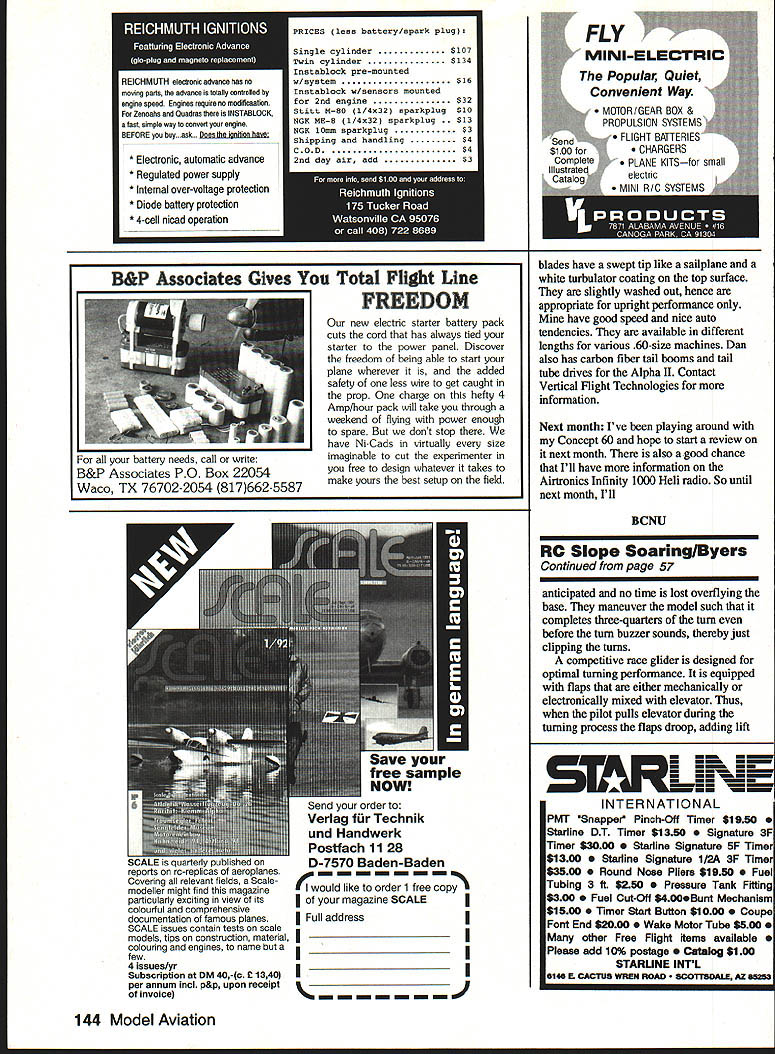
Sig Samurai
- High-performance sloper with a wingeron control system (wing rotation via bellcrank).
- Construction: foam core wings, built-up balsa fuselage with fiberglass layer, V-tail of sheet balsa shaped to an airfoil, epoxy-bonded 1/64" plywood wing skin.
- Chosen airfoil: Selig/Donovan 6060 — good penetration and wide speed range.
- Features: high roll rate, suitable for fun-style aerobatics.
- Availability: being assembled into a kit; contact local Sig dealer for details and price.
Bob Martin R/C Models — Katie II
- Aileron trainer designed for durability and easy handling.
- Features: Duralene fuselage, foam wings sheeted in balsa, balsa strip ailerons, stab-with-elevator tail.
- Specs: wingspan 72 in., wing area 545 sq. in., fuselage length 39 in.
- Contact: Bob Martin R/C Models, 1520 RBS Corona Dr., Lake Havasu City, AZ 86403. Telephone: (602) 855-6900.
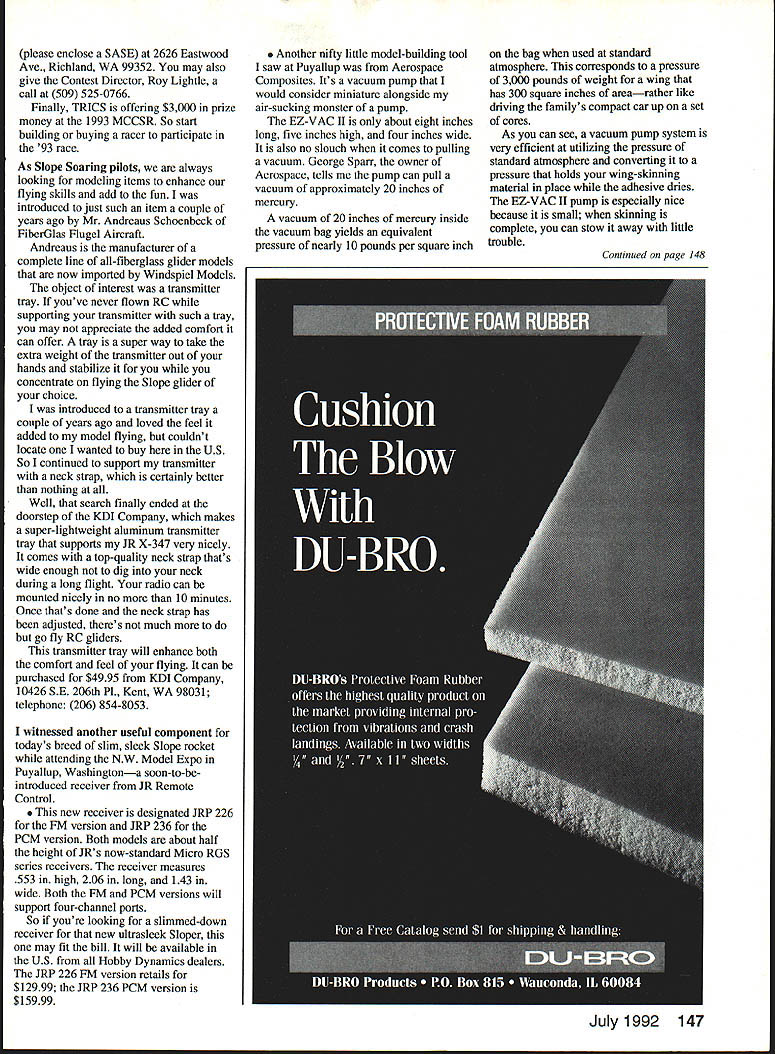
Northeast Sailplane Products — Swallow
- Builder example by Joe Conrad (Kent, WA) shown at N.W. Expo.
- Specs: wingspan 62 in., wing area 372 sq. in. Manufacturer claims all-up flying weight ~24 oz. (wing loading ~9.3 oz./sq. ft).
- V-tail sloper; available with SD-7037 or SD-8000 airfoils (Joe’s had SD-8000).
- Contact: Northeast Sailplane Products, 16 Kirby Lane, Williston, VT 05495. Telephone: (802) 658-9482.
Covering: Coverite 21st Century
Coverite introduced 21st Century Covering, which reportedly adheres well and resists loosening or bubbling when moving between indoors and outdoors. The product continues to shrink for up to 30 seconds after heat application, improving adhesion and durability.
Weight comparison with MonoKote:
- Using a full roll of 21st Century on a set of wings yielded about 12 grams less weight than using MonoKote. This is a modest saving but may be beneficial on light models.
Contact: Coverite, 420 Babylon Rd., Horsham, PA 19044.
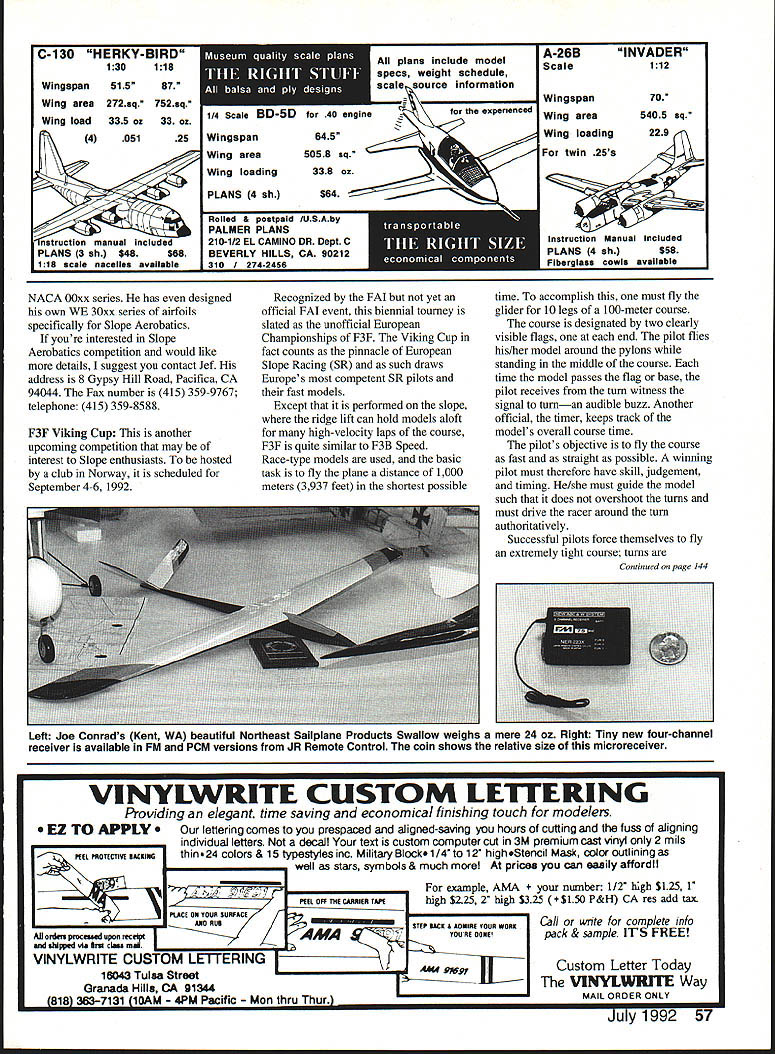
Airfoil of the Month: RG 14A
RG 14A (designed by Rolf Girsberger) — key data:
- Thickness: 8.475%
- Camber: 1.66%
- Zero-lift angle of attack: -2.020°
- Moment coefficient (Cmo): -0.0454
Interpretation:
- The RG 14A is relatively thin and suited to speed-oriented slopers and racing gliders.
- It provides respectable turning qualities and can be flapped without a major performance penalty, making it a good choice for race-focused or high-speed slope models.
Transcribed from original scans by AI. Minor OCR errors may remain.

