
Radio Control: Slope Soaring
Wil Byers Rt. 4, Box 9544, West Richland, WA 99352
GET READY: The Tri-City Soarers' International Scale Soaring Fun‑Fly is certainly not the 25th Olympiad of RC soaring. In fact, it is not even a competition! It is, however, the largest and most enthusiastically attended RC scale soaring event in the U.S. today.
The history of this biennial event is short—dating back only to 1988. That year scale soaring took a monumental step in the U.S. It was the first chance for U.S. soaring enthusiasts to be part of a new, organized movement.
Since then, scale soaring has grown—not only within the slope‑soaring community, which was the format for this first event, but also within the RC soaring community in general. It has grown to new heights—pun intended—with models spanning a replication era greater than 70 years. Interestingly, the models being built and flown now replicate both power models and their silent soaring cousins. As a result, the Tri‑City Soarers' International Scale Soaring Fun‑Fly has a special appeal for soaring modelers—whether or not they are hard‑core slopers.
Scale soaring is a unique facet of model aviation and one of the most splendid forms of the hobby. It is, without a doubt, the only avenue available to the RC enthusiast that offers motorless flight of scale replicas and the opportunity to reproduce flying machines that predate powered flight.
Scale soaring additionally offers the builder/flier the chance to build aircraft with realistic lift‑to‑drag (L/D) ratios of 35:1 or better and sink rates that can approach less than 100 feet per minute (FPM). Power slope scale soaring likewise provides the participant with a chance to fly racers that push the speed envelope and perform crisp, accurate aerobatics.
RC scale soaring is also art. These machines glide silently and, without an engine, can often remain aloft on a single flight for an hour or more. The craftsmanship involved in creating one of these majestic soaring machines is remarkable: wingspans in excess of 25 feet, aspect ratios approaching 37:1, and builders who will gladly spend 500–1,000 hours constructing a superbly accurate aircraft. Details range from scale pilot figures whose heads move with rudder input to a B‑29 that drops an RC replica of the X‑1 while in flight.
The wings of these special models must be accurate, smooth, and strong, with controls that are well balanced and tight. The overall design must minimize drag while retaining replication accuracy. As with any art, all elements must be in balance for the whole to succeed. Slope soaring combined with scale soaring yields a special elegance and a valiant quality—if not the preeminent way to RC soar, certainly an exemplary one.
Maybe with that scale‑soaring sales pitch you can see why the TRICS biennial scale fun‑fly continues to draw modelers from throughout the U.S., Canada, and sometimes Europe. This year's event included more than 80 entrants and many more spectators. It was featured in local news media and even attracted attention from a television station that covered the fun‑fly on the evening news.
The event sponsors hosted a Friday evening social with Washington State wine tasting. Entrants also enjoyed a banquet dinner on Saturday night with a special guest speaker from Cygnet World Class, part of a team building a full‑size sailplane for a worldwide design challenge. The TRICS event also offered entrants an opportunity to win raffle prizes, including X‑347 radios and other merchandise.
The models
With over 150 models entered, it is hard to cover them all. Most of the ships entered were beautifully finished. Highlights include:
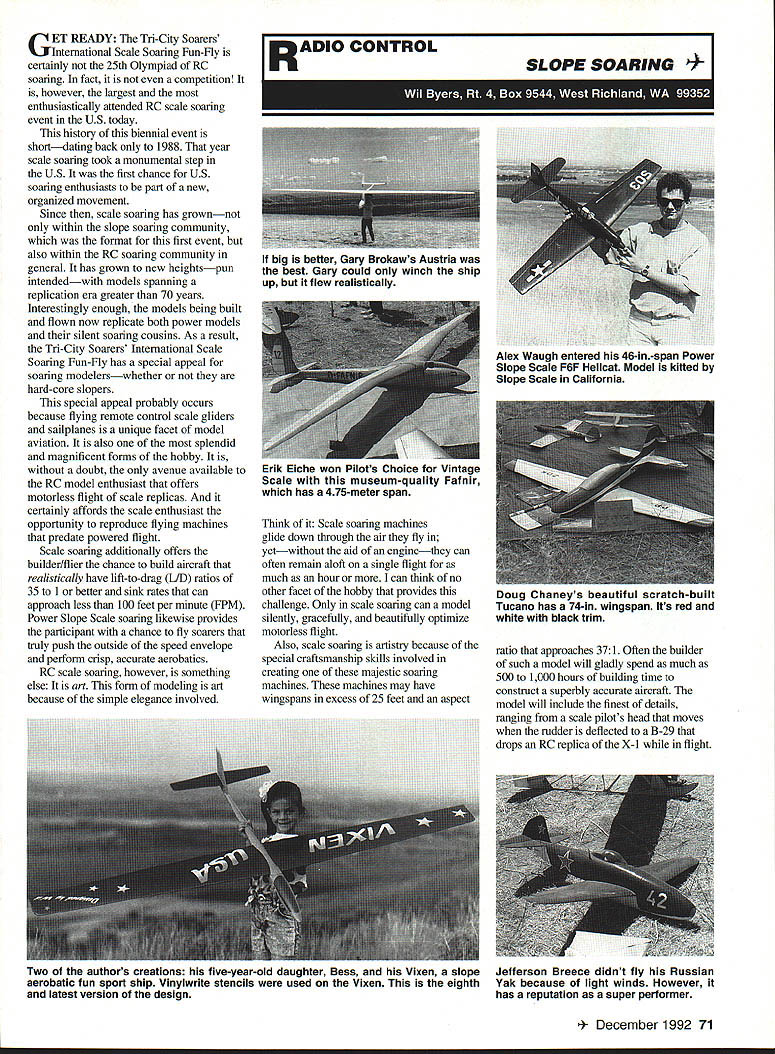
- Gary Brokaw's 3/4‑scale Austria Elephant: a complete standout. This 25‑ft.‑span ship weighs 29 lb and carries an 18‑oz. wing loading. The wings were built up with over 160 ribs. To cover the wings in balsa, Gary used approximately 50 square feet of balsa wood, then covered them with Super Coverite. Painting required one‑half gallon of light cream enamel. Unfortunately, wind at the fun‑fly was light, so the model did not fly on the slope; it did perform a fine winch launch and soaring demonstration at a local soccer field, showing excellent lift indication.
- Erik Eiche's Fafnir (British Columbia): a museum‑quality vintage ship with a clear finish over stained balsa to replicate birch plywood. At 4.75 meters span, the Fafnir still carries a wing loading of 16 oz./sq. ft. Erik spent nearly 1,000 hours building the model. A nice detail: the pilot's head turned when the rudder was deflected.
- Power‑slope entries ranged from small models such as a Hellcat built by Charlie Waugh and his 15‑year‑old son Alex to a variety of World War II fighters, including an extremely nice Italian Macchi.
- Doug Chaney (Idaho) brought a scratch‑built Tucano: a 74‑in. wingspan all‑glass construction model with a wing loading of 32 oz./sq. ft. The wing uses an SD‑0600 section; the stab uses an NACA 009. Doug painted it red and white with black trim and clear‑coated it to a high gloss.
- Other notable entries: a Spitfire, a Kawasaki Ki‑100, a neat Blohm & Voss, a YB‑49, a Schweizer 1‑26, a DG‑600, a Grunau Baby, an ASK‑18 (which absolutely skied out in a thermal), and many more.
Unfortunately the wind didn't pick up enough during the formal event to allow many of these ships to fly on the slope. Nonetheless, it was a gawker's paradise with power‑slope scale (PSS) ships dotting the pit area. There were even two extremely large PSS ships—a P‑51 and a Russian MiG—that had to be seen to be believed.
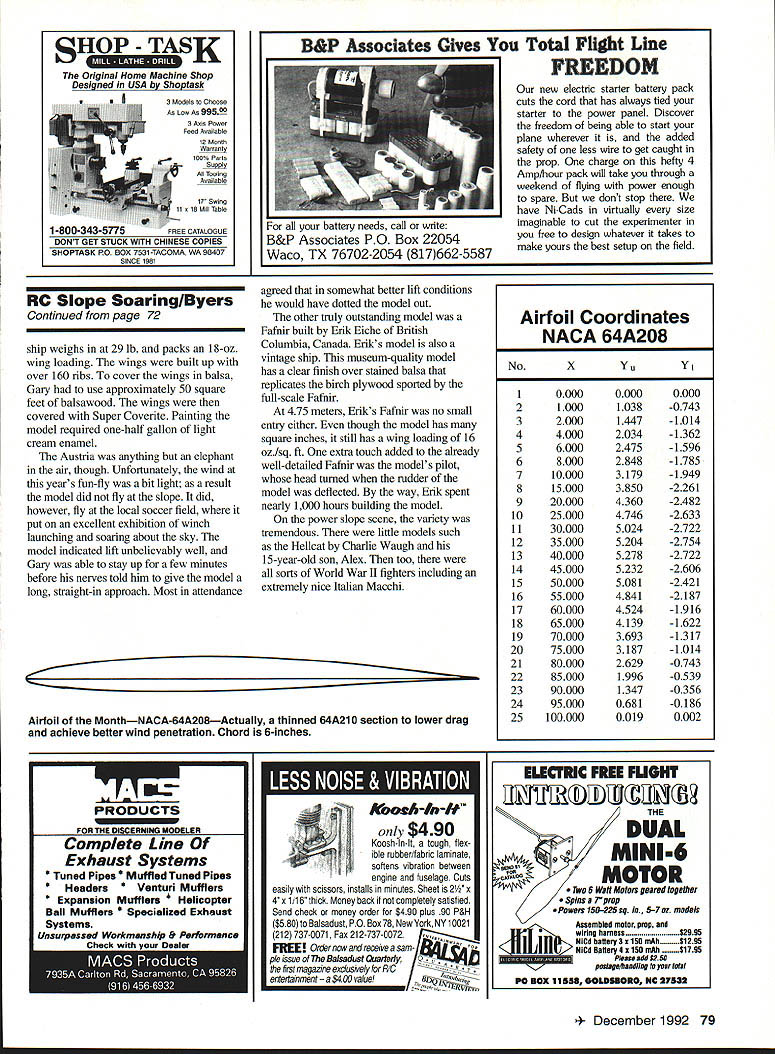
Airfoil of the Month — NACA 64A208
Actually a thinned 64A210 section to lower profile drag and achieve better wind penetration. Chord is 6 inches.
Airfoil Coordinates — NACA 64A208
No. X_u Y_u Y_l 1 0.000 0.000 0.000 2 1.000 0.038 0.000 3 2.000 1.447 -0.743 4 3.000 2.034 -1.362 5 4.000 2.475 -1.596 6 8.000 2.848 -1.785 7 10.000 3.179 -1.949 8 15.000 3.850 -2.261 9 20.000 4.360 -2.482 10 25.000 4.764 -2.635 11 30.000 5.024 -2.722 12 35.000 5.274 -2.754 13 40.000 5.278 -2.722 14 45.000 5.232 -2.606 15 50.000 5.081 -2.421 16 55.000 4.841 -2.187 17 60.000 4.524 -1.916 18 65.000 4.139 -1.622 19 70.000 3.693 -1.317 20 75.000 3.187 -1.014 21 80.000 2.629 -0.743 22 85.000 1.996 -0.539 23 90.000 1.347 -0.356 24 95.000 0.681 -0.186 25 100.000 0.019 0.002
Since I have used the NACA 64A208 section on the Vixen, it is the section of choice. The 64A208 is really a thinned 64A210 section. Thinning lowers profile drag and improves penetration against the wind. The downside is somewhat reduced low‑speed maneuverability and a slightly lower CLmax. Nonetheless, the thinner section offers a wider speed range. It is also a pretty good choice for inverted flight. Although rather old and not much used, the 64A208 can carry ballast well and is forgiving if built accurately (plywood‑skinned wings and careful sanding or vacuum bagging help achieve intended L/Ds).
The Vixen
For those not into scale soaring, here is the Vixen—my personal sloper that has evolved over the years. It is not a world‑record aerobatic ship nor the fastest slope model, but it is a good, versatile sloper that may give you ideas for your own designs.
- History and construction:
- Initially designed in 1978. Current version is 8.0.
- Fiberglass fuselage.
- Wings: 1/64" birch plywood skin over foam core, glassed with 1.4‑oz./sq. yd. fiberglass.
- Stabs: foam core, covered with 1/32" balsa and glassed with 0.6‑oz./sq. yd. fiberglass.
- Original wing used a NACA 64A210; current wing uses a NACA 64A208. Stabs use NACA 64A008.
- Dimensions and areas:
- Span: 73 in.
- Wing area: 493 sq. in.
- Elevator area: 54 sq. in.
- Total surface area: 547 sq. in.
- Root chord: 8.5 in.; tip chord: 5 in.
- Mean geometric chord (MGC): 6.9 in.
- Aspect ratio: 10.58:1.
- Stability and balance:
- Moment arm (distance from main wing quarter chord to elevator quarter chord) ≈ 3.5 MGCs—provides plenty of elevator moment for stability.
- Elevator is 11% of the total wing area.
- Center of balance (CG) set between 28% and 32% of mean aerodynamic chord for good inside/outside loops and rolls without overly sensitive control response.
- Finish and lettering:
- Painted with Ditzler Deltron automotive paint for a smooth flow and special colors.
- Trim and lettering done with Vinylwrite stencils (16403 Tulsa St., Granada Hills, CA 91344; (818) 363‑7131, 10:00 a.m.–4:00 p.m.). Vinylwrite supplies vinyl letters and custom stencils with the right tackiness for easy removal after painting.
I designed the Vixen to be fun in varied wind conditions. It has given many hours of flying and experimentation. As Dan Pruss once advised: if you've never designed a model before, copy the parameters of an existing model into your design. It may not be the esoteric route, but it lets you apply your own aesthetics and learn as you go.
Composite sources
You may be interested in suppliers of composite materials:
- Kennedy Composites (K.C.), Austin, TX:
- Stocks fiberglass, carbon fiber, and Kevlar, including unidirectional and woven fabrics and carbon tow.
- New 45°‑bias carbon fabric that reduces waste because orientation does not require turning the fabric.
- Example prices:
- 1–4 oz./sq. yd., 50‑in. wide fiberglass cloth: $1.95/yd.
- 5.5‑oz., 45‑degree‑bias, 60‑in. wide carbon cloth: $3.35/linear yd.
- 3.4‑oz., 62‑in. wide unidirectional carbon fiber: $2.50/linear yd.
- Contact: Kennedy Composites, 12416 B Deer Falls Dr., Austin, TX 78729; (512) 335‑6450. Shipping & handling: $5 added to all orders.
- Composite Structures Technology (CST), Lancaster, CA:
- Specialty items from Rohacell to rolls of Kevlar.
- Imports a unidirectional carbon at 2.25 oz./sq. yd., super smooth with a spun‑carbon cross thread, width 8.25 in., ideal for vacuum bagging.
- Price: $5 per linear foot. Ask about shipping & handling when ordering.
- Contact: CST, P.O. Box 4615, Lancaster, CA 93539; (805) 723‑3783.
Transcribed from original scans by AI. Minor OCR errors may remain.

