
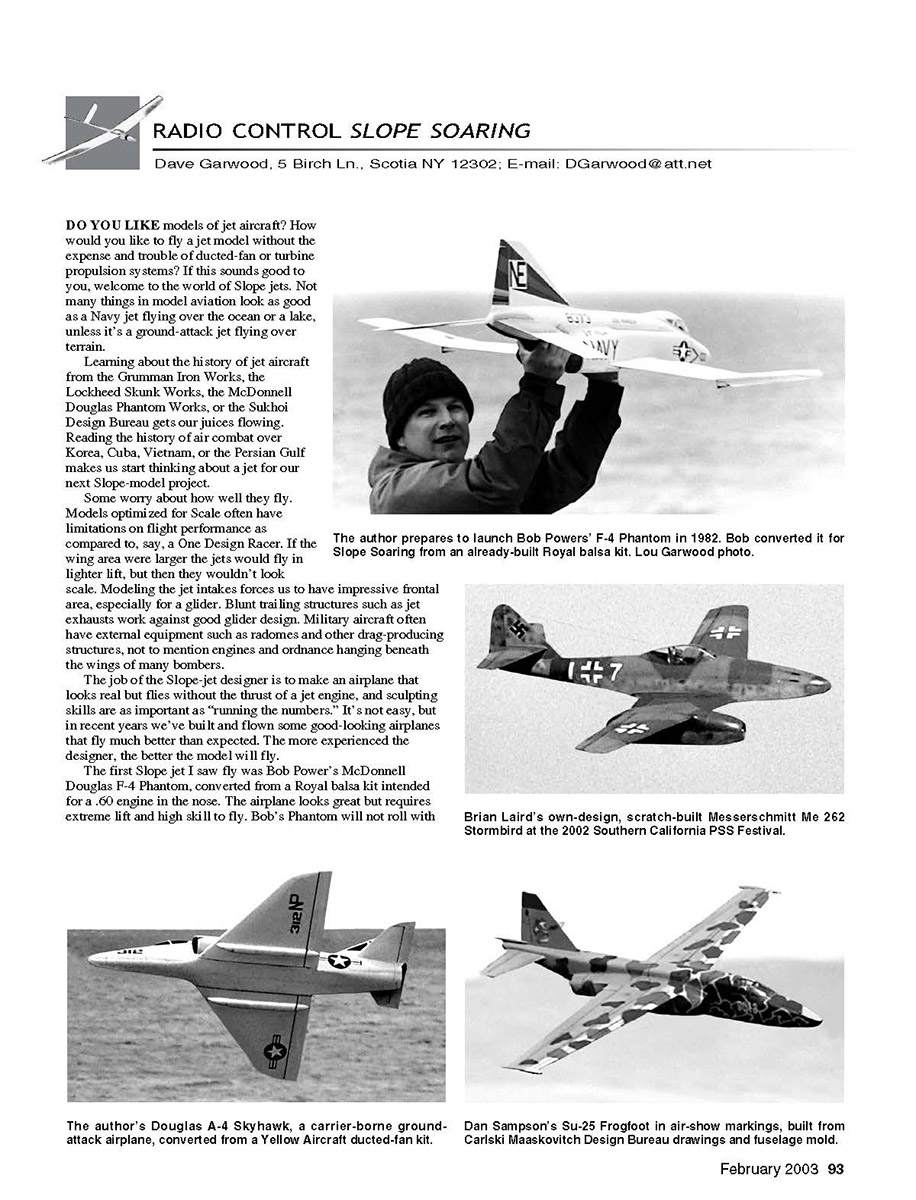
RADIO CONTROL SLOPE SOARING
Dave Garwood 5 Birch Ln., Scotia NY 12302 E-mail: DGarwood@att.net
Do you like models of jet aircraft? How would you like to fly a jet model without the expense and trouble of ducted-fan or turbine propulsion systems? If this sounds good to you, welcome to the world of slope jets. Not many things in model aviation look as good as a Navy jet flying over the ocean or a lake, unless it's a ground-attack jet flying over terrain.
Learning about the history of jet aircraft from the Grumman Iron Works, the Lockheed Skunk Works, the McDonnell Douglas Phantom Works, or the Sukhoi Design Bureau gets our juices flowing. Reading the history of air combat over Korea, Cuba, Vietnam, or the Persian Gulf makes us start thinking about a jet for our next slope-model project.
Some worry about how well they fly. Models optimized for scale often have limitations on flight performance as compared to, say, a one-design racer. If the wing area were larger the jets would fly in lighter lift, but then they wouldn't look scale. Modeling the jet intakes forces us to have impressive frontal area, especially for a glider. Blunt trailing structures such as jet exhausts work against good glider design. Military aircraft often have external equipment such as radomes and other drag-producing structures, not to mention engines and ordnance hanging beneath the wings of many bombers.
The job of the slope-jet designer is to make an airplane that looks real but flies without the thrust of a jet engine, and sculpting skills are as important as "running the numbers." It's not easy, but in recent years we've built and flown some good-looking airplanes that fly much better than expected. The more experienced the designer, the better the model will fly.
The first slope jet I saw fly was Bob Power's McDonnell Douglas F-4 Phantom, converted from a Royal balsa kit intended for a .60 engine in the nose. The airplane looks great but requires extreme lift and high skill to fly. Bob's Phantom will not roll with the original-size ailerons. It's also tricky to land on its low wing.
I got over my fear of big frontal area with Walt Bub's Grumman A-6 Intruder, which was designed for slope from the beginning. Using a slope airfoil and big ailerons on a wing slightly stretched in span, this airplane flies like the Sig Ninja — a slope aileron trainer. On its maiden flight of two hours, the transmitter was passed among four pilots twice. Walt works out of Willington, Connecticut, and while his Intruder is out of production he's working on a Cessna A-37 Dragonfly mold.
I see a hand up in the back of the room. Okay, Joe Sloper mentions that he hasn't seen slope-jet kits on the shelf at his local hobby shop and wonders where to find them. There are three basic sources: an original design, a modification of an existing kit, or a specialty sailplane maker.
1. Design your own model
You hard-core builders can get any jet type you want, in the size you want, and modeled in the weight you want if you do it all yourself. Examples of this strategy include:
- Lynsel Miller's English Electric Canberra and the work from Northeast Aero Design Works.
- Walter Bub's (WaltBub@earthlink.net) Grumman A-6 Intruder.
Start with three-view drawings. My favorite plans and photo-documentation source is Bob's Aircraft Documentation in Costa Mesa, California (www.bobsairdoc.com).
Steve Savoie from Down East Maine began with a large block of foam and a few yards of fiberglass cloth to design and model his large-scale Lockheed U-2/TR-1 Dragon Lady. Crossover that he is, his first few flights were aerotowed at Elmira 2000, followed by his slope debut at Soar Utah 2000, where Steve took aerial photos of the landscape.
Brian Laird (Slope_Scale@compuserve.com) designed and scratch-built a Messerschmitt Me 262 Stormbird flown at the Southern California PSS Festival in 2001 and 2002. He also produced an Aerospatiale Caravelle airliner. Probably the best-known Power Scale Soaring (PSS) designer in the country, Brian has been imagining, building, and producing highly innovative models at Slope Scale (http://ourworld.compuserve.com/homepages/slope_scale) in Moreno Valley, California, for many years.
The Carski Maaskovitch Design Bureau (CarlPMaass@cs.com) in Corona, California, is known for designing and prototyping exotic PSS models, including the Sukhoi Su-25 Frogfoot—Soviet counterpart to the NATO Fairchild A-10 Warthog—and a huge B-29 Superfortress that carries and drops an X-15 rocket plane.
2. Convert a power-airplane kit
For experienced slope builders, conversion from a fuel-power kit presents many possibilities. Bob Powers (RJPowers@aol.com) built an F-4 Phantom as a powered model, then removed the fixed landing gear, added a nose cone where the engine used to be, and launched it off a hill. It looked mighty cool but didn't fly terribly well, requiring massive lift and rolling poorly because the ailerons were small.
Another example is my Douglas A-4 Skyhawk converted from a Yellow Aircraft ducted-fan kit. Working to keep it light, I closed up the retractable-landing-gear bays and extended the ailerons to the full span of each wing half. Although it looked pretty good in the air, it was too light for good performance and the ailerons were too sensitive for me during the early flights. Good model-airplane design is harder than it looks.
3. Slope-jet kits
Maybe the best option for most hobbyists is to buy a kit from one of the slope specialty makers. You may have to hunt a little for a slope jet or other PSS model that pleases you, but at least the design and testing work has been completed.
- Jeff Fukushima (jeffokelly@email.msn.com) in Monterey Park, California, designs models for us. You may remember seeing Jeff on the cover of the August 2000 Model Aviation, launching his McDonnell Douglas F-18 Hornet at the Cajon Summit PSS festival. Jeff sells the Hornet and Lockheed P-80 Shooting Star kits through his company, Vortech Models (www.geocities.com/vortechmodels/vortech.htm).
- Robert Cavazos (robert@rcglider.com) in Moreno Valley, California, is a master modeler and has taken over production of the Slope Scale line of kits, including three slope jets: the Northrop F-20 Tigershark, the Lockheed P-80 Shooting Star, and the BD-5. Find Cavazos Sailplane Design at www.rcglider.com.
- George Voss (gavoss@swbell.net) in Oklahoma City, Oklahoma, has announced that he's bringing the beloved Doug Buchanan British Aerospace Hawk back into production. You can see photos of older BAE Hawks on the Soaring Specialties web site: www.soaringspecialties.com.
- Denny Maize (RCsotnart@aol.com) at the Landisburg Naval Air Station in Pennsylvania (www.polecataero.com) is working on the mold of another Doug Buchanan design; the type will be announced in the spring. I'll give you a hint: identify the author of this quote and the name of the book it appears in: "Fighter pilots make movies. Bomber pilots make history."
New Slope Soaring Column
This column may look new, but actually it's resurrected from times past when Model Aviation ran monthly Slope Soaring columns. I am honored to follow in the footsteps left by former columnists Dave Sanders, Wil Byers, and Mark Triebes.
I did a tour of duty from September 1995 through November 1998, writing 36 Model Aviation Thermal Soaring columns and three Nationals reports. Although I still fly thermal, slope has captured the lion's share of my imagination, time, and money in recent years.
I've been flying slope since 1988 when I discovered, to my fascination and joy, that there was an area of persistent lift in the corner of a field where I was flying an electric model. It turns out that it was a small slope, less than 10 feet high, that was facing into the wind. Wow! This is cool! It wasn't much lift, but it was there every time I flew through it. Another slope addict was born.
Since then I've built more than 50 slope airplanes and flown them at 41 sites in 12 states. I've flown from slopes 1,800 feet high and over Armco barriers at beach parking lots less than three feet high. I hope to log flights in all 50 states before I'm done.
I figure my job is to provide information to the readership that helps them have fun with slope sailplanes and to advance their building and flying skills. I believe the best way to do that is to concentrate on identifying resources, providing how-to information, and documenting trends in the slope soaring scene. When I mention a specific model airplane, it will generally be one that I've flown or seen flown.
Model Aviation has covered the basics and answered many newcomer questions in a series of four of my articles: "Introduction to Slope Soaring" (January 2000), "Finding Slope Sites" (April 2000), "Selecting Slope Sailplanes" (July 2000), and "Extreme Slope Soaring" (October 2000).
If you're unable to get those issues, send me a 9 x 12-inch envelope, self-addressed, with $1.29 US postage affixed, and I'll return a photocopy set of the four articles.
One difference between model-airplane journalism today and back when Sanders, Byers, and Triebes were writing is that now we are solidly in the Information Age. A great deal of information about available models, reviews on how they build and how they fly, and slope-site location data is available on the World Wide Web. If you don't have Internet access at home, try it at your local library. There is a mind-boggling amount of interesting and helpful material available with a few keystrokes and mouse clicks.
I'll leave you with two Internet references. My current preferred search engine is www.google.com. Type in "slope soaring," and you'll find sites to entertain yourself for hours.
My current favorite topic-specific web site is www.slopeflyer.com. Greg Smith of Milwaukee, Wisconsin, has built a wonderful site and has demonstrated the commitment to keep adding new material through the years. The web site lists 83 slope-flying sites in 33 states.
Greg has shown the leadership and technical savvy to set up "remote contributor" software so that occasional contributors can add material. I hope readers will continue to extend and expand the SlopeFlyer.com T-shirt from the web site; that's one way Greg covers the cost of running the site.
MA
Transcribed from original scans by AI. Minor OCR errors may remain.

