

RADIO CONTROL SLOPE SOARING
Dave Garwood, 5 Birch Ln., Scotia NY 12302; E-mail: DGarwood@att.net
BALSA LIVES! If God had intended man to build model airplanes with fiberglass, there would be fiberglass trees. In an era when EPP (expanded polypropylene) foam sailplanes take the lion's share of the market and molded fiberglass sailplanes define one extreme of speed, strength, and craftsmanship, balsa builders are still designing, modifying, and flying stick-built slope jets.
Remembering that designing and building are major components of the hobby and that some glider fliers prefer working with wood rather than resin, wooden slope sailplanes are still being designed and built, and they look good and fly well.
Eric Molstead — Lear Jet
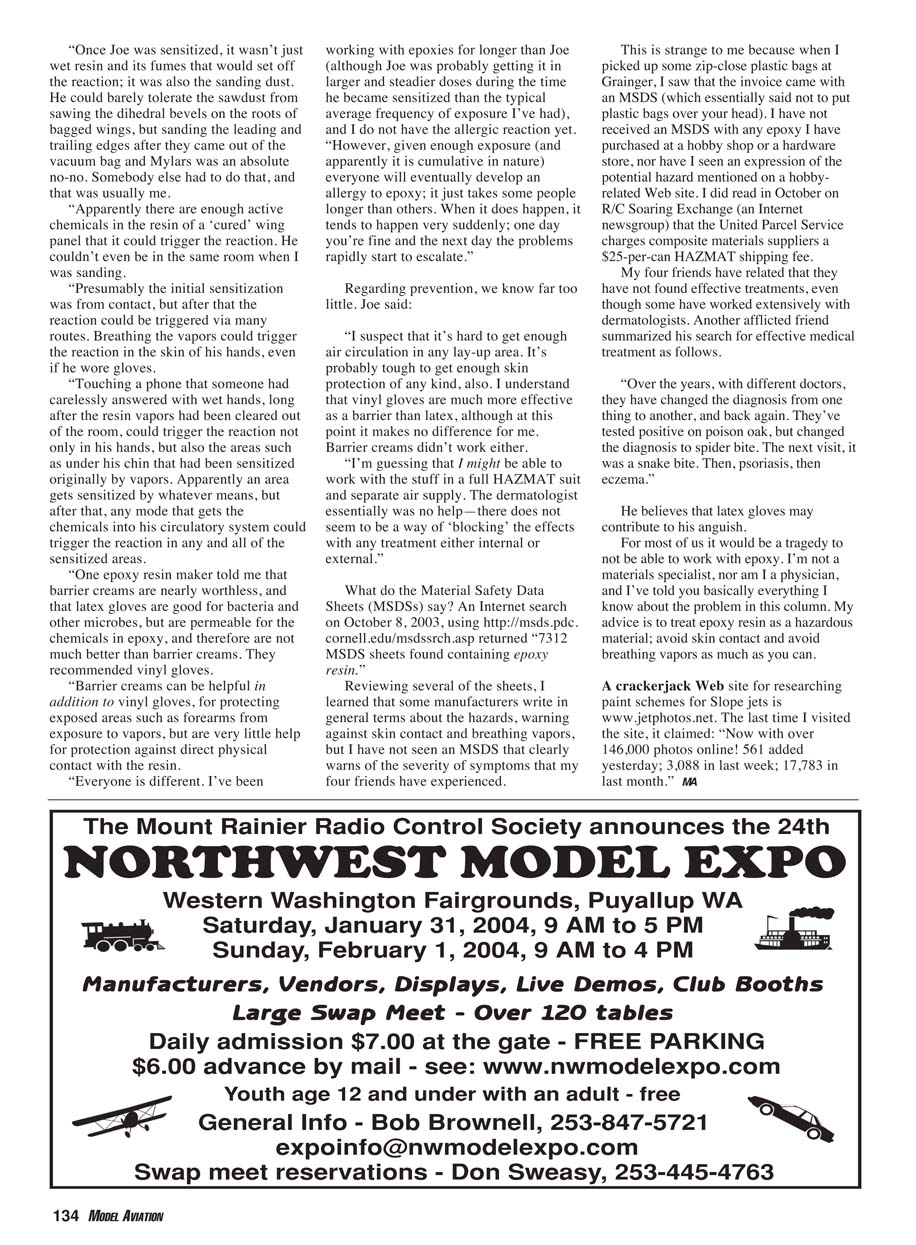
Eric Molstead (emolstead@aeromt.com) of Vancouver, Washington, sent photos and an enthusiastic description of his early flights with his Lear Jet, modified from the Great Planes power kit.
- Span: 69 inches (with tip tanks)
- Weight: about 6-1/2 pounds
- Wing area: approximately 600 square inches
- Construction: wing is pink foam covered with 1/64 plywood and covered with UltraCote
Modifications and construction notes from Eric:
- Tip tanks are removable and are held in place with small magnets and springs.
- The fuselage is basically stock except for the nose; Eric glued a chunk of pink foam to the firewall, shaped it, then fiberglassed the entire fuselage. The belly has an extra layer of fiberglass for slope landings.
- He painted the fiberglassed fuselage with Krylon.
- The nacelles are hair-mousse cans with the ends cut off.
- He built a foam-core horizontal stabilizer with a thin symmetrical airfoil and slightly more area than the original. The vertical stabilizer and rudder are stock; the rudder is operational but has only minor effect.
Eric's first flight was at Bald Butte (about 10 miles south of Hood River, Oregon). He reported that, although the airplane is a bit heavy, it flies very nicely — smooth, stable, and realistic in flight. Several people predicted the open nacelles would be too draggy, but the airplane didn't seem to care; airflow through the nacelles also produces a cool whooshing sound.
Eric's next project is to convert a Great Planes F-14 Tomcat kit for slope use, possibly implementing the swing-wing feature of the prototype.
Grumman F9F Panther — Walt Bub / Bill Griggs
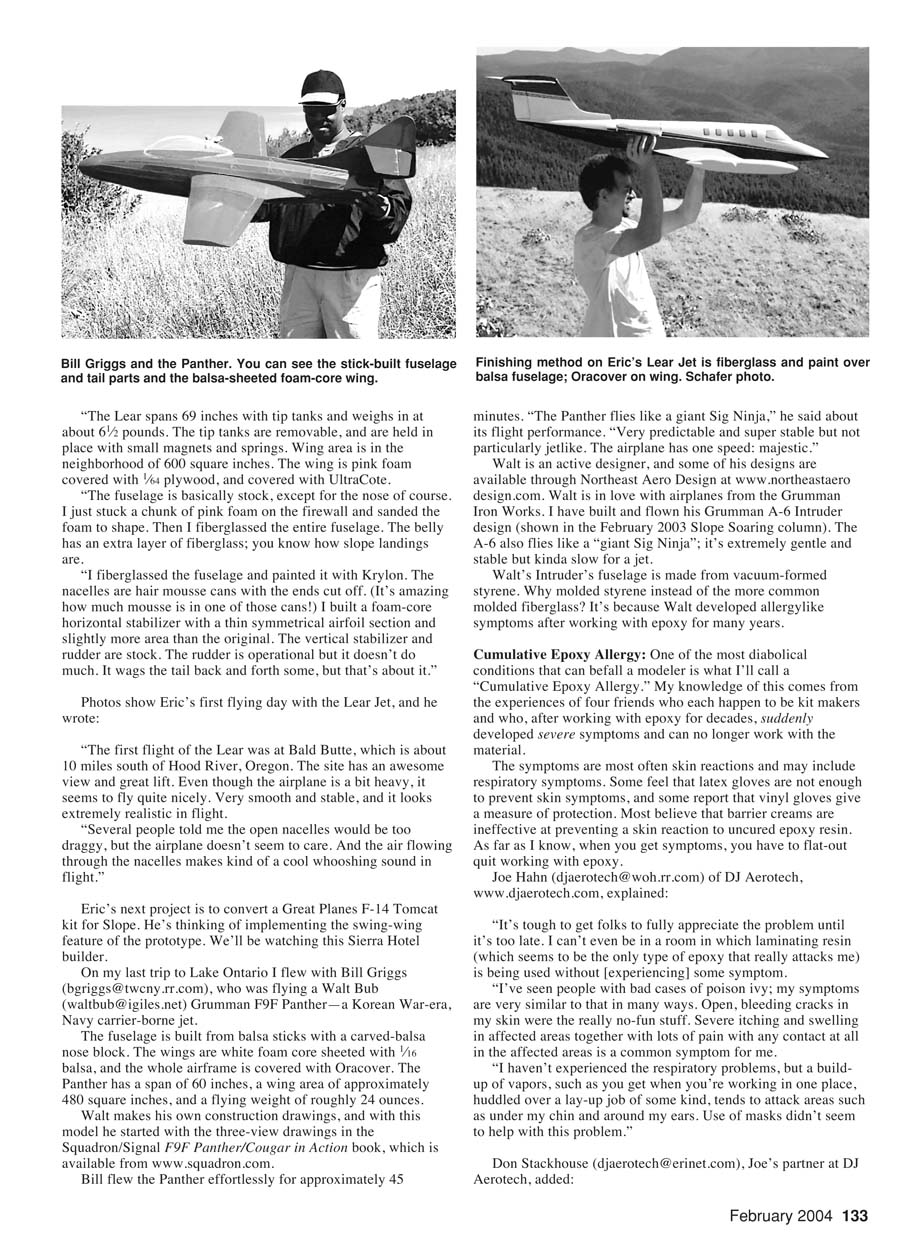
On a recent trip to Lake Ontario I flew with Bill Griggs (bgriggs@twcny.rr.com), who was flying a Grumman F9F Panther built by Walt Bub (waltbub@igiles.net). The Panther is a Korean War–era, Navy carrier-borne jet.
- Span: 60 inches
- Wing area: approximately 480 square inches
- Flying weight: roughly 24 ounces
- Construction: fuselage built from balsa sticks with a carved-balsa nose block; wings are white foam core sheeted with 1/16 balsa; whole airframe covered with Oracover
- Plans source: Walt started from the three-view drawings in the Squadron/Signal F9F Panther/Cougar in Action book (www.squadron.com)
Bill flew the Panther effortlessly for approximately 45 minutes. About its flight performance he said: "The Panther flies like a giant Sig Ninja. Very predictable and super stable but not particularly jetlike. The airplane has one speed: majestic."
Walt is an active designer; some of his designs are available through Northeast Aero Design (www.northeastaerodesign.com). He favors Grumman designs and I have built and flown his Grumman A-6 Intruder (shown in the February 2003 Slope Soaring column). The A-6 also flies like a "giant Sig Ninja" — extremely gentle and stable but somewhat slow for a jet.
Walt’s Intruder fuselage is made from vacuum-formed styrene rather than molded fiberglass because he developed allergy-like symptoms after working with epoxy for many years.
Cumulative Epoxy Allergy
One of the most diabolical conditions that can befall a modeler is what I’ll call a "Cumulative Epoxy Allergy." This description comes from the experiences of four friends who each happen to be kit makers and who, after working with epoxy for decades, suddenly developed severe symptoms and can no longer work with the material.
Common features:
- Symptoms are most often skin reactions and may include respiratory symptoms.
- Some believe latex gloves are not sufficient to prevent skin symptoms; some report that vinyl gloves provide somewhat better protection.
- Most believe that barrier creams are ineffective at preventing a skin reaction to uncured epoxy resin.
- In many cases, once symptoms appear, the affected person must stop working with epoxy altogether.
Joe Hahn (djaerotech@woh.rr.com) of DJ Aerotech (www.djaerotech.com) explained: "It’s tough to get folks to fully appreciate the problem until it’s too late. I can’t even be in a room in which laminating resin (which seems to be the only type of epoxy that really attacks me) is being used without experiencing some symptom.
"I’ve seen people with bad cases of poison ivy; my symptoms are very similar to that in many ways. Open, bleeding cracks in my skin were the really no-fun stuff. Severe itching and swelling in affected areas together with lots of pain with any contact at all in the affected areas is a common symptom for me.
"I haven’t experienced the respiratory problems, but a buildup of vapors, such as you get when you’re working in one place, huddled over a lay-up job of some kind, tends to attack areas such as under my chin and around my eyes. Use of masks didn’t seem to help with this problem."
Don Stackhouse (djaerotech@erinet.com), Joe’s partner at DJ Aerotech, has reported similar experiences and cautions about long-term exposure to epoxy.
Transcribed from original scans by AI. Minor OCR errors may remain.

