
RADIO CONTROL: SLOPE SOARING
Wil Byers, Rt. 4, Box 9544, West Richland, WA 99352
International Soaring — Germany
RC modeling and RC soaring are truly international. Germany, in particular, is a center of full-scale and model soaring — home to major sailplane manufacturers and influential designers such as Dr. Eppler, Dr. Quabeck, and Martin Heide (designer of the ASH-26 18 m sailplane).
German full-scale developments have driven advanced technologies (composite construction, high aspect ratios). For example, the Nimbus IV boasts an L/D (lift-to-drag) ratio of about 62:1. Theoretically, if a glider with that performance were towed to 10,000 feet in still air, it could glide roughly 620,000 feet (about 117.4 miles) horizontally before landing. In real atmospheres there are thermals and sink, so a high-performance ship like the Nimbus IV has very good odds of finding lift during such a long glide.
Because modelers can draw on full-scale knowledge, German modelers are among the best in the world. German models have often led the way (for example, molded wings and fuselages becoming common there earlier than elsewhere). German enthusiasts have also long been avid slope soarers, following the full-scale pilots who flew the Wasserkuppe in the 1920s.
German Slope Soaring and Club Sites
German slope soarers organize a wide range of activities: F3F slope races, scale cross-country events, precision aerobatics contests, speed events, and large scale rallies. Many sites are excellent: some are club-owned, provide good lift, and have grass landing areas — a great combination that prevents loss of access to development pressure and avoids engine-noise complaints from neighbors.
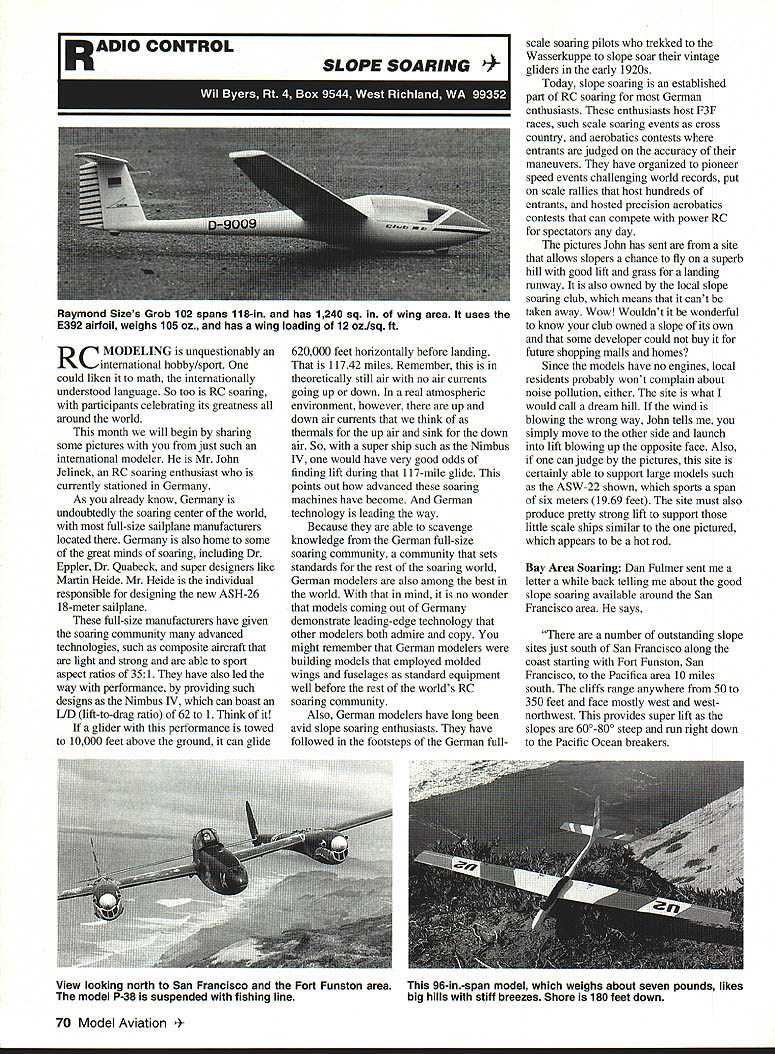
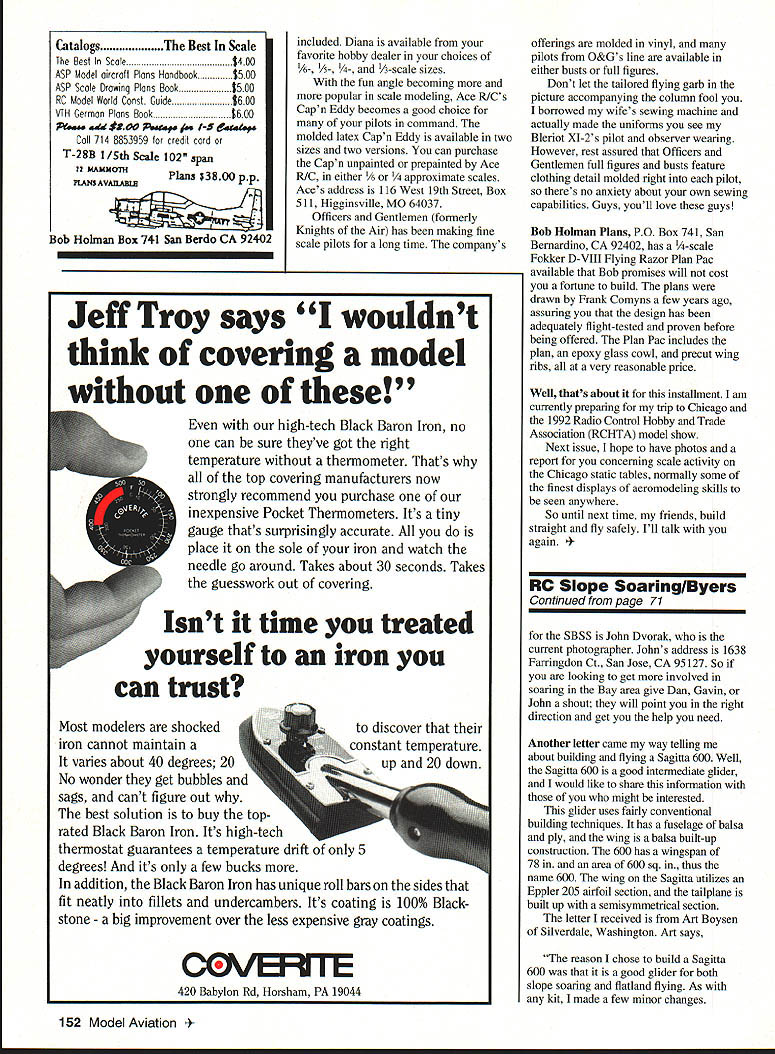
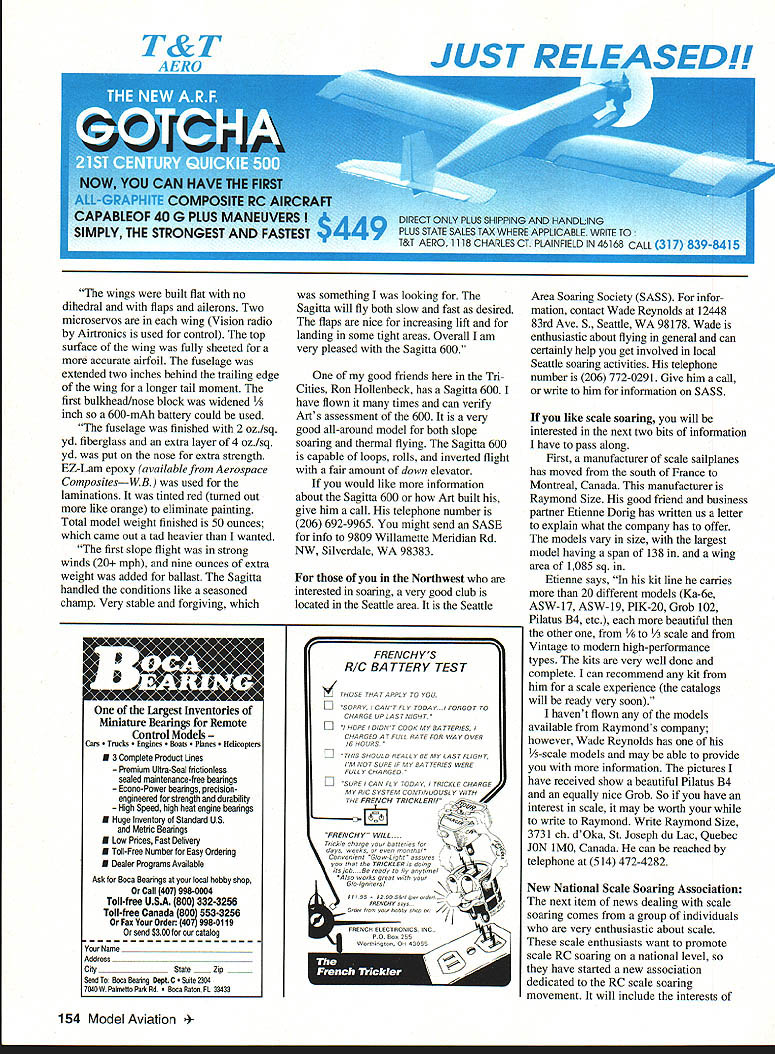
John Jelinek, an RC soaring enthusiast stationed in Germany, sent pictures from such a club-owned slope site. The site can support large scale models (for example an ASW-22 with a 6 m / 19.69 ft span) and apparently produces strong lift capable of carrying both large and smaller “hot rod” scale ships. John also notes that if wind direction is unfavorable on one face, you can often move to the opposite side and launch into lift from the other face.
Bay Area Soaring
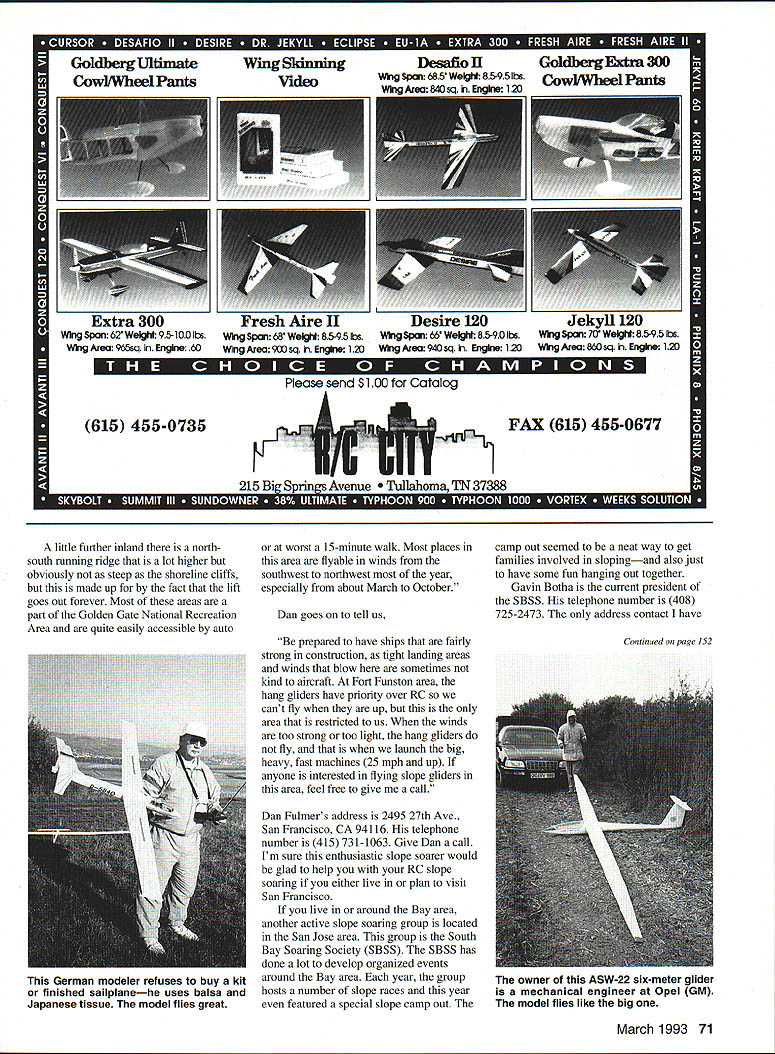
Dan Fulmer reports many outstanding slope sites along the San Francisco coast, from Fort Funston south to Pacifica (about 10 miles). Cliff heights range from about 50 to 350 feet, mostly facing west to west‑northwest, with slopes of 60°–80° that run down to the ocean — producing superb lift. A north–south inland ridge provides lift that extends a long distance. Many of these areas are part of the Golden Gate National Recreation Area and are usually accessible by car or a short walk. Most sites are flyable in winds from southwest to northwest much of the year, especially March through October.
Dan’s advice and notes:
- Use fairly strong construction — tight landing areas and strong winds can be unforgiving.
- At Fort Funston, hang gliders have priority; RC flying is restricted when hang gliders are operating.
- When hang gliders are not flying (winds too strong or too light), RC pilots launch heavy, fast machines (25 mph and up).
Contacts for Bay Area slope soaring:
- Dan Fulmer — 2495 27th Ave., San Francisco, CA 94116. Phone: (415) 731-1063.
- South Bay Soaring Society (SBSS) — active group in San Jose organizing slope races and campouts.
- Gavin Botha (SBSS president). Phone: (408) 725-2473.
- John Dvorak (photographer / contact). Address: 1638 Farringdon Ct., San Jose, CA 95127.
The Sagitta 600 — Building and Flying Notes
The Sagitta 600 is a solid intermediate glider suitable for both slope and flatland flying. Basic construction:
- Fuselage: balsa and plywood.
- Wing: balsa built-up construction.
- Wingspan: 78 in.
- Wing area: 600 sq. in. (hence “600”).
- Airfoil: Eppler 205 on the wing.
- Tailplane: built-up semisymmetrical section.
Modifications and builder notes from Art Boysen (Silverdale, WA):
- Wings built flat, no dihedral; flaps and ailerons fitted. Two micro servos per wing.
- Top surface of wing fully sheeted for more accurate airfoil.
- Fuselage extended 2 in. behind wing trailing edge for longer tail moment.
- Nose bulkhead widened 1/8 in. to accept a 600‑mAh battery.
- Fuselage finished with 2 oz./sq. yd. fiberglass and an extra layer of 4 oz./sq. yd. on the nose for strength. EZ‑Lam epoxy used for laminations (tinted to avoid painting).
- Finished weight: about 50 oz. (a bit heavier than desired). Ballast (9 oz.) used for very strong winds.
Performance notes from Art:
- Very stable and forgiving in strong slope winds (20+ mph).
- Flies slow or fast; flaps useful for increased lift and tight landings.
- Capable of loops, rolls, and inverted flight with a fair amount of down elevator.
Contact for more information about Art’s Sagitta 600:
- Art Boysen — 9809 Willamette Meridian Rd. NW, Silverdale, WA 98383. Phone: (206) 692-9965. (You might send an SASE for info.)
Northwest Soaring Clubs
Seattle area club:
- Seattle Area Soaring Society (SASS).
- Contact: Wade Reynolds — 12448 83rd Ave. S., Seattle, WA 98178. Phone: (206) 772-0291.
Scale Soaring — Raymond Size Kits
A scale sailplane manufacturer, Raymond Size, moved operations from southern France to Montreal, Canada. His lineup includes over 20 kits (examples: Ka-6e, ASW-17, ASW-19, PIK-20, Grob 102, Pilatus B4). The largest offered is an ASW-17 with a 138 in. span and 1,085 sq. in. wing area. Kits are reported to be well done and complete.
Contact:
- Raymond Size — 3731 ch. d'Oka, St. Joseph du Lac, Quebec J0N 1M0, Canada. Phone: (514) 472-4282.
Wade Reynolds (see above) is reported to own one of Raymond’s 1/5‑scale models and may be able to provide additional information.
New National Scale Soaring Association (NASSA)
A group of scale enthusiasts have formed a new association to promote RC scale soaring nationally: the National Scale Soaring Association (NASSA). Initial details:
- Mailing address (for now): Rt. 4 Box 9544, W. Richland, WA 99352 (same as the author).
- Membership cost: $10 per year.
- Funds will support promotion (some to support this column) and sponsorship of an annual scale event. NASSA intends to rotate its annual scale rally between different sites each year so modelers across North America can attend.
- When writing for information, include an SASE.
If you plan to join NASSA, consider subscribing to RCSD:
- RCSD mailing address: P.O. Box 2108, Wylie, TX 75098-2108.
Transcribed from original scans by AI. Minor OCR errors may remain.

