
Radio Control: Slope Soaring
Wil Byers Rt. 4, Box 9544, West Richland, WA 99352
Slope racing — an overview
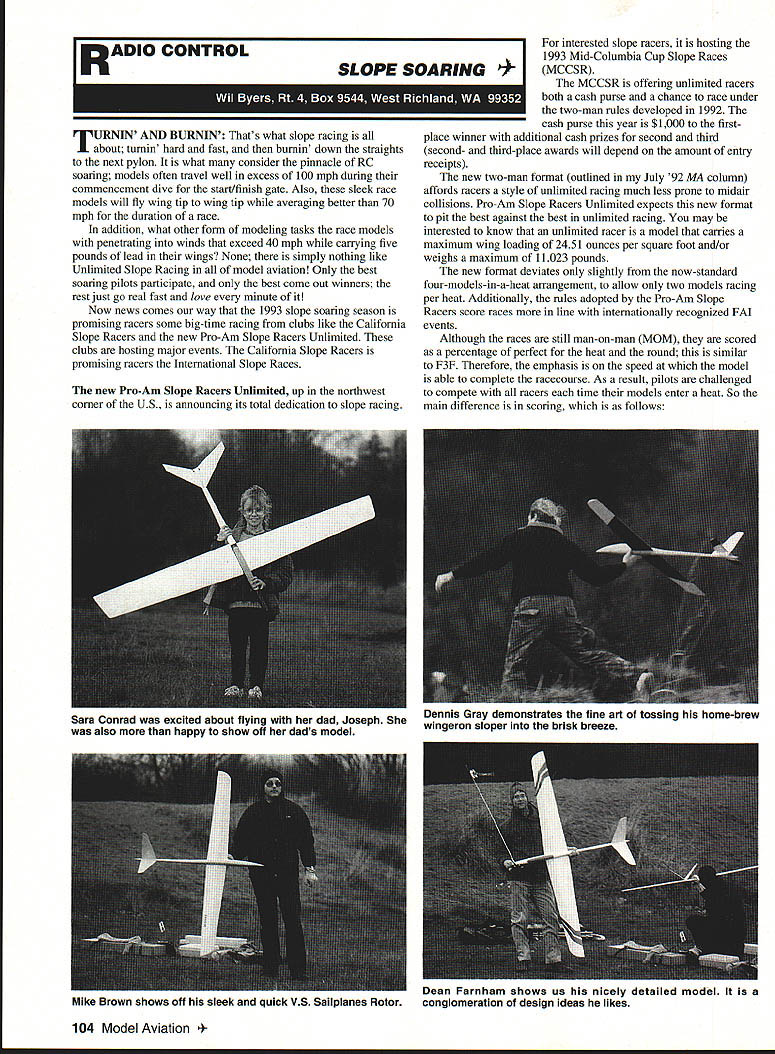
Turnin' and burnin': that's what slope racing is all about — turnin' hard and fast, then burnin' down the straights to the next pylon. Many consider it the pinnacle of RC soaring; models often travel well in excess of 100 mph during their run to the start/finish gate. Sleek race models will fly wingtip to wingtip while averaging better than 70 mph for the duration of a race.
What other modeling discipline tasks models to penetrate winds in excess of 40 mph while carrying five pounds of lead in their wings? None; there is simply nothing like Unlimited Slope Racing in all of model aviation. Only the best soaring pilots participate, and only the best come out winners; the rest just go real fast and love every minute of it!
1993 season, clubs, and events
The 1993 slope-soaring season promises big-time racing from clubs such as the California Slope Racers and the new Pro-Am Slope Racers Unlimited. The California Slope Racers are promising the International Slope Races.
Pro-Am Slope Racers Unlimited, in the northwest corner of the U.S., is announcing its total dedication to slope racing. It is hosting the 1993 Mid-Columbia Cup Slope Races (MCCSR). The MCCSR is offering unlimited racers both a cash purse and a chance to race under the two-man rules developed in 1992.
- Cash purse: $1,000 to the first-place winner, with additional cash prizes for second and third (amounts depending on entry receipts).
- Two-man format: Outlined in my July '92 MA column, this format is much less prone to midair collisions and should pit the best against the best.
- Definition: An unlimited racer is a model that carries a maximum wing loading of 24.51 ounces per square foot and/or weighs a maximum of 11.023 pounds.
- Format deviation: The new format deviates only slightly from the now-standard four-models-in-a-heat arrangement by allowing only two models racing per heat.
- Scoring: Pro-Am Slope Racers now score races in line with internationally recognized FAI events.
Scoring (percentage-of-perfect)
Races are still man-on-man (MOM), but are scored as a percentage of perfect for the heat and the round (similar to F3F). The emphasis is on speed; pilots are challenged to compete with all racers each time their models enter a heat.
Percentage-of-perfect heat scores:
- Fastest time — 1000 points
- Second — (1st place time / 2nd place time) × 1000
- DNF (Did Not Finish) — 100 points
- DNS (Did Not Start) — 0 points
Percentage-of-perfect round scores:
- Fastest round time — 1000 points
- Other round finishers — (fastest round time / respective round time) × 1000
- DNE — 50 points
- DNS — 0 points
Complete rules published in the February 1992 issue of R/C Soaring Digest provide detailed information and an entry form. MCCSR is sending SASE to Pro-Am Slope Racers Unlimited, 606 N. White, Walla Walla, WA 99362. For contest information, contact Contest Directors Joe Conrad or Roy Lightle at 206-630-2670 or 509-525-7066, respectively.
---
Discovery Park
Thanksgiving is normally a weekend of obligation for me — time to stop doing model airplane stuff and dedicate hours to family, food, wine, and thanksgiving conversation. This year was different and happily so. I took my family to Seattle for Thanksgiving dinner at my in-laws' home. The food was great, and I even had fun playing with the kids, although six hours of TV football is a bit excessive for my taste.
The Friday after Turkeyday found us at a slope site just two miles from the in-laws. As many of you know, Seattle is hilly and known for its rain and evergreens. Discovery Park, a couple of miles north of downtown Seattle, is one of the few places not hemmed in by trees. It features a southwest-facing cliff approximately 200 feet high — ideal for slope soaring because wind and weather typically come from the southwest. Discovery Park is an area for walking, picnicking, kite flying, slope soaring, and general recreation.
My first outing to Discovery Park was in 1976, when a friend introduced me to slope soaring. I moved from Seattle in 1979 and hadn't flown there since. Like many sites, Discovery Park has become more crowded with both model fliers and spectators. Seeing the number of spectators watching high-powered models zoom overhead was a bit frightening — at Eagle Butte we attract mostly fliers, not spectators, and models aren't usually whipping over people's heads.
When flying shared sites, remember that fast models carry a great deal of stored energy and could be very harmful if they hit someone. Think about a four-pound model traveling 100 mph and the damage it could do. Using the kinetic energy formula (1/2 mv^2), that example adds up to about 1,344 foot-pounds of energy. An 11-pound slope racer at 120 mph stores roughly 5,324 foot-pounds. It's worth being careful, courteous, and always aware of where your model is relative to spectators and other fliers — accidents can jeopardize the flying site and people's safety.
Models and designs at Discovery
The models flying that day were mostly wingeron ships: a Sig Samurai, a VS Sailplanes Rotor, a home-built design based on leftover VS Sailplanes parts, another home-brew similar to a VS Sailplane Chucker, a Russian Yak, and a Bob Martin Bob Cat. Several other models came but didn't fly due to brisk winds or pilot confidence issues.
Wingeron and winge-vator models are interesting to watch. A wingeron plane moves the wings to effect roll control. A winge-vator glider has a fixed-incidence elevator and moves the wings to effect both pitch and roll: the wing incidence decreases to produce down elevator and increases to create up elevator. These models are known for maneuverability; VS Sailplanes designs are noted for speed and penetration.
The airfoils in use were mainly Eppler 374, modified E-374, or the popular SD-6060 — sections with moderate mean camber lines and modest pitching moments that penetrate wind well. Airfoils like the 374 and 6060 can perform nice aerobatics in the hands of a skilled pilot.
If you're interested in wingeron or winge-vator models, contact:
- VS Sailplanes, 723 Broadway East, Seattle, WA 98102 — (206) 860-7711
- Sig Manufacturing, Montezuma, IA 50171 — (515) 623-5154
Cope Retracts
Cope Retracts now offers one of the most true-to-scale retracts available to the RC scale soaring pilot. Designed and built by Gene Cope (a scale RC soaring enthusiast), the retracts copy the full-scale Kestrel 19 design and are accurate enough for an 11-pound scale model.
- Construction: Made of 4130 steel and bronze tubing, silver-brazed in a building jig to assure accuracy and smooth operation.
- Installation: The builder custom-fits the gear between two bulkheads, providing rugged attachment and allowing adjustment of wheel extension depth.
- Sizes/prices: 1/4-scale version — $125; 1/2-scale version available for larger models. A 1/8-scale model is planned for the future.
Contact Cope Retracts at 3203 Main St., Union Gap, WA 98903 — (509) 457-9017.
Balancing a model — a simple stand
Darrel Johnson of Mesa, Arizona, suggested I show how I balance a model. Sometimes I just mount the model atop my left and right index fingers for a quick check. Other times I use a balance stand for greater accuracy.
- Construction: The stand can be built in minutes from 3/4-inch plywood (or similar). Uprights should be about three inches wide to lower pounds-per-square-inch on the wing and avoid denting.
- Use: Place the model on the rounded edge of the stand and make weight adjustments until the model balances. Once the desired balance point is found, transfer a mark to the model for reference.
- Location: Balance in a calm shop for best accuracy — a windy flying site makes the nose jump around and yields poor results.
An accurately balanced aircraft will be much more pleasant and predictable to fly.
Airfoil of the month — Selig 6063
This month I share the Selig 6063 section, computer-generated by Michael Selig for glider fliers who value speed. It is quite thin (7.06% thickness), giving very low profile drag. Rather than paraphrase, I’ll quote Michael from his paper "Three New Airfoils Designed for Slope Soaring" (sent after the 1990 Mid-Columbia Scale Fun-Fly):
- Michael designed three new slope-soaring airfoils as spin-offs from the SD6060. Slight modifications to original airfoils (e.g., scaling y-coordinates to reduce thickness) can harm the original boundary-layer characteristics; desired thickness is best achieved during initial design.
- The S6061 is a 9% thick section related to the 10.4% SD6060. Drag predictions were made using the Drela XFOIL code (incompressible ISES version) and compared with Princeton airfoil database results; XFOIL predicts low-Reynolds-number performance fairly accurately for comparison purposes.
- Comparison method: Rather than using a constant Reynolds number, comparisons were made at Re multiplied by the square root of C_L = 125,000 (so Re varies inversely with sqrt(C_L)). For example, an aircraft flying at C_L = 1 would have Re = 125,000, typical of slope-soaring aircraft.
- Results: The S6063 (7% thick) produces lower drag than the S6061 (9% thick), though the width of the low-drag range narrows as thickness decreases.
- Michael notes these airfoils are intended mainly for slope soaring; performance limits are tied to C_L and thickness requirements.
What do you think? Maybe give the S6063 a try for some hot straight-line passes — but be careful!
Thanks again for reading. Please pass along your ideas and adventures to share with the slope-soaring community.
— Wil Byers
---
New publications and catalogs
Terry Rimert's Fly-By-Night Press has issued its third plan book of Nostalgia Gas designs, titled The Third Nostalgia. The book contains reduced-size plans of many era designs, with an emphasis on 1/2A designs such as the 1/2A Kiwi, Frank Garcher's Midwest Fortrum, Samuelson's Half Wild Goose, A.J. Phillips's Yo-Ho, Mahlieu's 1/2A Zeek, the Zigenfuse Pogo, Russ Hansen's T-Bird, the Na Sobala Gee, Sal Tabrin's 1/2A Spacer, and many others. Some larger models are also included, like Ed Howe's The Stare (.29–.35 engines) and Denny Davis's Ultra Hogan. There are a few British designs as well.
Terry advises the source for this issue (as for the first two volumes) is Lee Campbell of Campbell's Custom Kits. Prices: The Third Nostalgia — $10 plus $2 postage. Nostalgia — $8. Nostalgia Too — $10. Add appropriate postage. Order from: Lee Campbell, Campbell's Custom Kits, 401 Executive Center Dr., Suite H108, West Palm Beach, FL 33401. Tell 'em Duration sent you!
The British equivalent of the annual NFFS Symposium is the BMFA NFFS Symposium. The 1992 edition is available from Martin Dilly, 20 Links Rd., Wickham, Kent, BR4 0QW, England, for 3.80 pounds. Payment should be by check payable to the BMFA Free Flight Travel Fund in pounds sterling.
Transcribed from original scans by AI. Minor OCR errors may remain.

