
RADIO CONTROL: SLOPE SOARING
Wil Byers 3540 Eastlake Dr., W. Richland, WA 99352
This month I am going to dedicate my entire column to an interview with Joe Wurts. Even if you are not a slope racing fan, I think you'll find some interesting ideas that just may be pertinent to your style of flying.
Then stay tuned for my next column when I will return to scale, aerobatics, fun-flying, and a whole lot more. Now put in some ballast, and let's go fast.
Joe Wurts tells all about slope racing in a World Champs interview. There are a whole lot of good thumbs on the soaring scene these days. The recognized best in F3B soaring is Mr. Joseph (Joe) M. Wurts—the 1991–92 F3B World Champion.
He is also the Open Class AMA Declared Distance and Open Distance record holder for RC soaring, with an impressive accomplishment of 140.67 miles. It needn't be said that Joe's thumb is certainly one of, if not the, finest we have seen in soaring.
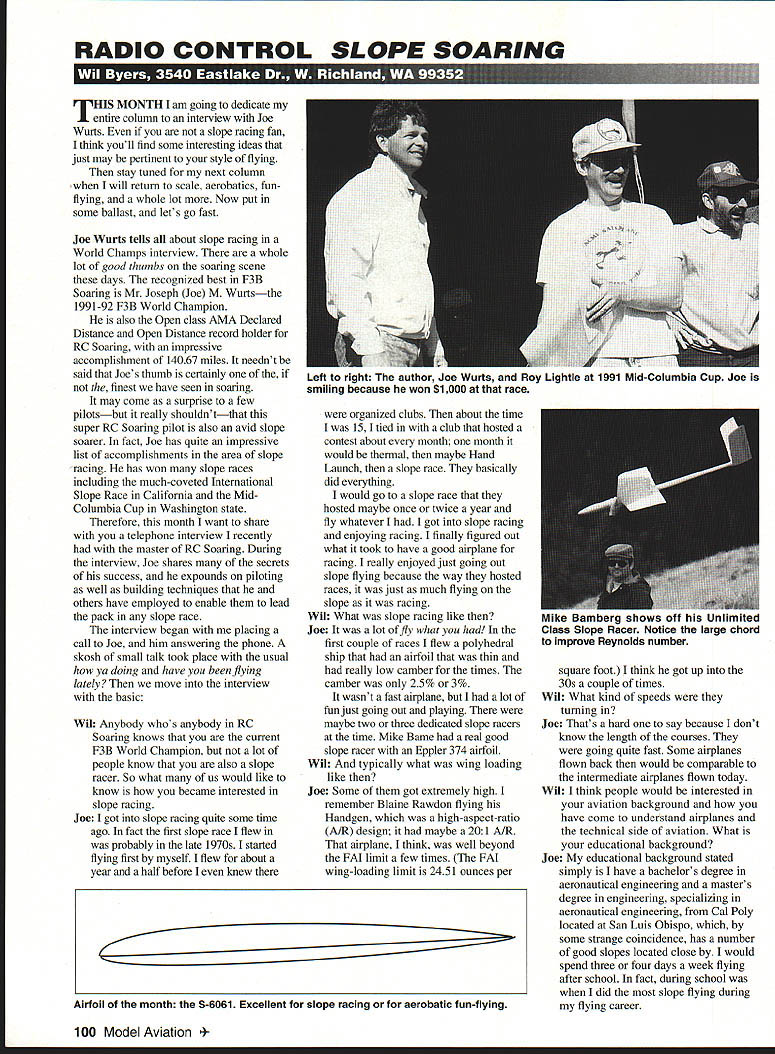
It may come as a surprise to a few pilots—but it really shouldn't—that this super RC soaring pilot is also an avid slope soarer. In fact, Joe has quite an impressive list of accomplishments in the area of slope racing. He has won many slope races including the much-coveted International Slope Race in California and the Mid-Columbia Cup in Washington state.
Therefore, this month I want to share with you a telephone interview I recently had with the master of RC soaring. During the interview, Joe shares many of the secrets of his success, and he expounds on piloting as well as building techniques that he and others have employed to enable them to lead the pack in any slope race.
The interview began with me placing a call to Joe, and him answering the phone. A skosh of small talk took place with the usual "ya doing" and "have you been flying lately?" Then we moved into the interview.
Interview with Joe Wurts
Wil: Anybody who's anybody in RC soaring knows that you are the current F3B World Champion, but not a lot of people know that you are also a slope racer. So what many of us would like to know is how you became interested in slope racing.
Joe: I got into slope racing quite some time ago. In fact the first slope race I flew in was probably in the late 1970s. I started flying by myself. I flew for about a year and a half before I even knew there were organized clubs. Then about the time I was 15, I tied in with a club that hosted a contest about every month; one month it would be thermal, then maybe hand launch, then a slope race. They basically did everything.
I would go to a slope race that they hosted maybe once or twice a year and fly whatever I had. I got into slope racing and enjoying racing. I finally figured out what it took to have a good airplane for racing. I really enjoyed just going out slope flying because the way they hosted races, it was just as much flying on the slope as it was racing.
Wil: What was slope racing like then?
Joe: It was a lot of "fly what you had." In the first couple of races I flew a polyhedral ship that had an airfoil that was thin and had really low camber for the times. The camber was only 2.5% or 3%.
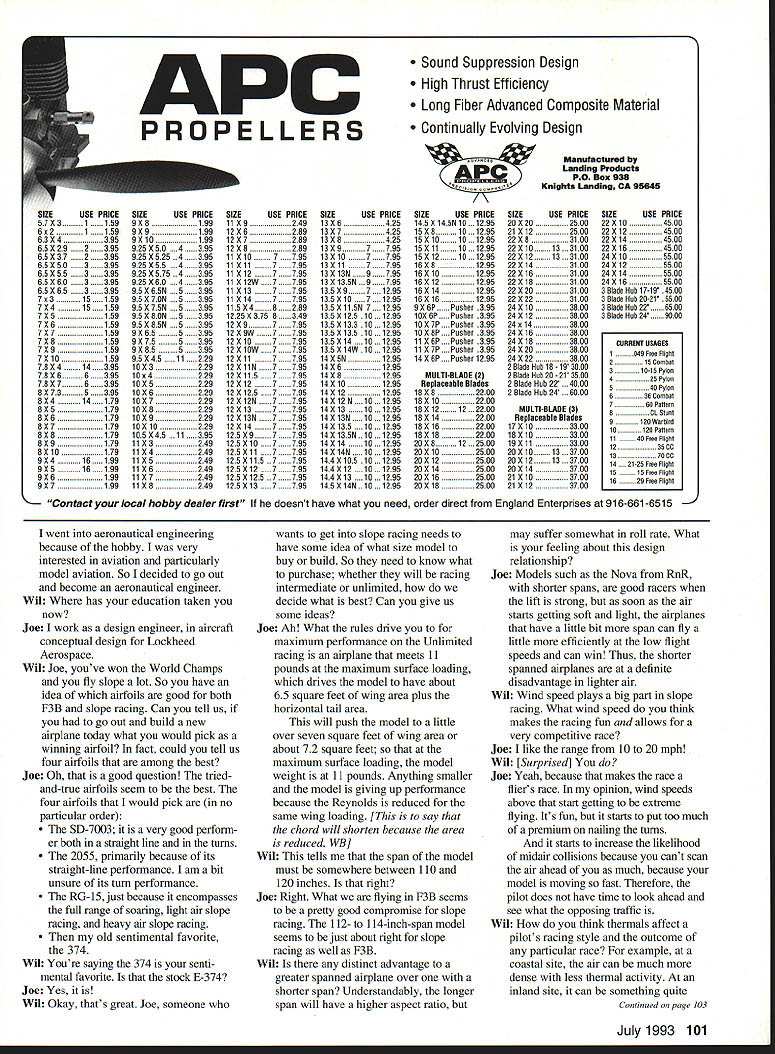
It wasn't a fast airplane, but I had a lot of fun just going out and playing. There were maybe two or three dedicated slope racers at the time. Mike Bamberg had a real good slope racer with an Eppler 374 airfoil.
Wil: And typically what was wing loading like then?
Joe: Some of them got extremely high. I remember Blaine Rawdon flying his Handgen, which was a high-aspect-ratio (A/R) design; it had maybe a 20:1 A/R. That airplane, I think, was well beyond the FAI limit a few times. (The FAI wing-loading limit is 24.51 ounces per square foot.) I think he got up into the 30s a couple of times.
Wil: What kind of speeds were they turning in?
Joe: That's a hard one to say because I don't know the length of the courses. Some airplanes flown back then would be comparable to intermediate airplanes flown today.
Wil: I think people would be interested in your aviation background and how you have come to understand airplanes and the technical side of aviation. What is your educational background?
Joe: My educational background, stated simply, is I have a bachelor's degree in aeronautical engineering and a master's degree in engineering specializing in aeronautical engineering from Cal Poly at San Luis Obispo, which, by some strange coincidence, has a number of good slopes located close by. I would spend three or four days a week flying after school. In fact, during school was when I did the most slope flying during my flying career.
Airfoils and design choices
Wil: Joe, you've won the World Champs and you fly slope a lot. So you have an idea of which airfoils are good for both F3B and slope racing. Can you tell us, if you had to go out and build a new airplane today what you would pick as a winning airfoil? In fact, could you tell us four airfoils that are among the best?
Joe: Oh, that is a good question! The tried-and-true airfoils seem to be the best. The four airfoils that I would pick are (in no particular order):
- SD-7003 — a very good performer both in a straight line and in the turns.
- 2055 — primarily because of its straight-line performance. I'm a bit unsure of its turn performance.
- RG-15 — it encompasses the full range of soaring: light-air slope racing and heavy-air slope racing.
- Eppler 374 — my old sentimental favorite.
Wil: You're saying the 374 is your sentimental favorite. Is that the stock E-374?
Joe: Yes, it is.
Wil: Okay, that's great. Someone who wants to get into slope racing needs to have some idea of what size model to buy or build. Whether they will be racing intermediate or unlimited, how do we decide what is best? Can you give us some ideas?
Joe: What the rules drive you to for maximum performance in Unlimited racing is an airplane that meets 11 pounds at the maximum surface loading, which drives the model to have about 6.5 square feet of wing area plus the horizontal tail area.
This will push the model to a little over seven square feet of wing area or about 7.2 square feet; so that at the maximum surface loading, the model weight is at 11 pounds. Anything smaller and the model is giving up performance because the Reynolds number is reduced for that same wing loading. (This is to say that the chord will shorten because the area is reduced.)
Wil: This tells me that the span of the model must be somewhere between 110 and 120 inches. Is that right?
Joe: Right. What we are flying in F3B seems to be a pretty good compromise for slope racing. The 112- to 114-inch-span model seems to be just about right for slope racing as well as F3B.
Wil: Is there any distinct advantage to a greater-spanned airplane over one with a shorter span? Understandably, the longer span will have a higher aspect ratio, but may suffer somewhat in roll rate. What is your feeling about this design relationship?
Joe: Models such as the Nova from RnR, with shorter spans, are good racers when the lift is strong, but as soon as the air starts getting soft and light, the airplanes that have a little bit more span can fly a little more efficiently at the low flight speeds and can win. Thus, the shorter-spanned airplanes are at a definite disadvantage in lighter air.
Wind, thermals, and ballast
Wil: Wind speed plays a big part in slope racing. What wind speed do you think makes the racing fun and allows for a very competitive race?
Joe: I like the range from 10 to 20 mph!
Wil: (Surprised) You do?
Joe: Yeah, because that makes the race a flier's race. In my opinion, wind speeds above that start getting to be extreme flying. It's fun, but it starts to put too much of a premium on nailing the turns.
It also starts to increase the likelihood of midair collisions because you can't scan the air ahead of you as much—your model is moving so fast that you don't have time to look ahead and see what the opposing traffic is doing.
Wil: How do you think thermals affect a pilot's racing style and the outcome of any particular race? For example, at a coastal site, the air can be much more dense with less thermal activity. At an inland site, it can be something quite different. How should that affect a pilot's strategy?
Joe: The strategy is always similar: the more energy you can build into your model by climbing, the better off you are. There is some strategy involved in looking for a thermal. If you use that thermal to sky out before a start, you should use that energy wisely.
My personal opinion is that if you thermal up above 500 feet, you shouldn't use it up during the start dive. If you use up all the altitude the model has gained during the start, the model will be going at extreme speed and will therefore bleed off speed quite rapidly. So you probably want your model to enter at some fairly high altitude and use that energy during the first couple of laps.
The worry about an inland site is that if there are thermals present, the person who launches first can get to the thermal and start climbing first, resulting in a higher start altitude. Also, thermals present on a racecourse tend to make the F3F format something of a crapshoot.
Wil: Interesting! So your race strategy is to try to get somewhere above 500 feet and then save that energy for the first few laps of the race. Is that right?
Joe: I'd say that for every foot I climb above 500 feet, I will enter the race course that much above 500 feet.
Wil: Let's, for grins' sake, say the wind is blowing your optimum wind speed of 20 mph. How do you know when to add ballast and when not to add ballast? Wouldn't you say that is part of the art of slope racing?
Joe: [Laughing] There are definitely some deep, dark secrets there! When to add ballast is dependent on both the amount of lift and the length of the course. The simulations I have run on slope racing show kind of a cliff for course length at 500 feet. If the course length is below 500 feet, no ballast—you want to be accelerating out of the turns. If the course length is above 500 feet, ballast will help.
No matter how much wind there is, you shouldn't ballast up above a certain value. That value, depending upon the aspect ratio of your airplane, is between 16 and 19 ounces per square foot, and the number gets lower as the course shortens in length.
If you step above a course length of 500 feet and your model can fly and climb, it is not heavy enough. If the course is long, especially like a course of 700 feet, you want to load the model so that it just barely climbs. Then, when it is time to race your model, it is flying at or near its best L/D (optimum lift-to-drag ratio).
Wil: That is interesting, since I would think that on a short course you would want the model to carry as much energy as possible through the turns.
Joe: Why would you not want to ballast the model beyond a certain wing loading?
Wil: On a short course, most of the model's energy loss is in the turns. And if the model is carrying a lot of weight, it actually increases the time the model spends in the turns. The truly theoretical individual will say that the model loses the same amount of height in the turns no matter what it weighs.
Joe: The fact of the matter is that when the model is real heavy, it spends more time in the turns, and the lighter model can turn inside of the heavier model. Therefore, even though the lighter model is slower in the straights, it can gain more time in the turns than it loses down the straights.
Construction, molding, and cost
Wil: Since our models carry four or five pounds of lead in their wings, construction quality is a big concern. And because construction is so important, the cost of a model strong enough to withstand the forces associated with racing are, by most modelers' standards, high.
As a result, many would-be racers have shied away from competitive racing. My question is, how can an individual build a model that is competitive and keep the costs down?
Joe: The airframes I used to race before I got into F3B probably had about $60 worth of materials in them ready-to-fly. This was not counting the radio, of course. The reason this was possible is that in slope racing, weight is not a big issue. So the model could be entirely constructed out of fiberglass. It doesn't need any exotica such as carbon fiber or Kevlar in the structure. All that is required to build a racer is to vacuum-bag up a couple of layers of six-ounce unidirectional fiberglass and a surface layer (a light cloth, such as 0.6 ounces per square yard, to help reduce pinholes), and you will have a wing strong enough to withstand the increased stresses with no problem.
Wil: So there are affordable alternatives for race enthusiasts. Is there an advantage to an all-molded airplane?
Joe: The advantage of the all-molded airplane for F3B is the strength-to-weight ratio and repeatability. The guy building his airplane in the garage can get an airplane that is functionally just about as clean as a molded airplane by vacuum-bagging—if he understands how to do it and knows how to finish off the airplane.
Wil: The nice thing about a molded airplane is that it shows up at your doorstep with the proper finish. You don't have to spend the man-hours necessary for a bagged wing to get the proper finish.
Joe: So they are very repeatable.
Wil: That's the big seller of a molded airplane; every single one comes out perfect. But you can go out with a bagged airplane that will do quite well in slope racing.
Teamwork, signaling, and practice
Wil: How important is a caller and a team to winning races?
Joe: You have to have a knowledgeable caller! Historically, I have either used Darrell Perkins or my wife, Jan. For a winning combination you have to have a built-in trust with your caller.
You need to understand what your caller is doing for you, because the caller will be calling not only the turns but also calling traffic and judging what is happening on the course. So, yes, a caller can be very important.
Wil: Do you prefer lights or flaggers as an indicating system for signaling the turns?
Joe: I definitely like the concept of lights much better. The flagging gets you in trouble sometimes because the flagger can anticipate the turn by moving forward when the model approaches, and an experienced racer will turn on that movement.
So how do you call it? The flagger moved, but did not drop the flag. The result may be an unnecessary turn cut that the pilot is penalized for. With the light signaling method, nothing is given away until the turn judge pushes the button, lighting the turn signal.
Wil: How do you practice for an upcoming race?
Joe: I used to try to get to the site a day early so I could learn the groove of the hill. Different hills have different fastest grooves. So if I can get to the hill early I can learn the groove and what works best.
Probably the biggest reason to get to a site early is to determine what will work best in terms of ballast and to dial in the airplane.
Wil: Are you using a computer radio? If so, do you have two separate settings—one for climb and one for race speed?
Joe: Yes, I have been using a Vision, but I have mostly switched over to the Infinity 1000. I use the standard neutral setup for launch and climbing, with maybe just a bit of camber if I find a thermal and want to climb. It is also set up with the typical aileron-rudder mixing.
However, when it is time to go fast, I flick it into speed mode, which takes out almost all of the aileron-rudder mix. In this mode, it also may reflex the airfoil just a bit and change the amount of elevator-to-camber mix.
Wil: So, you are using elevator-to-camber mix to accelerate the turns?
Joe: Yes, that is definitely the best way to get the best energy retention in the airplane—to get the most bang for the buck.
Wil: You don't feel that flapping the airplane slows it down in the turns?
Joe: It is the most efficient solution to making the airplane turn fast. When you are going to the high Cl (coefficient of lift) that the model will need to operate at in the turns, the addition of full-span camber will shift the drag bucket of the airfoil up so that the airfoil is still operating in its most efficient drag bucket at the higher Cl.
Wil: How much camber do you need to get that turn efficiency?
Joe: Probably about 5° of camber will suffice. One thing to think about is when you are running on a really windy day, you may want to add a little more elevator-to-camber mix because when you are pushing the airplane at these high speeds, you are going to load the trailing-edge surfaces.
As a result, the model may not have as much camber in the air as it did sitting on the ground, because you will get what I call blowback, which can decamber the trailing edge.
Wil: This brings to mind another question. If ailerons can decamber the trailing edge, they can certainly stall servos. On my last racer I was using JR 301 servos that put out approximately 44 ounce-inches. What do you like in the way of servo torque for a race model?
Joe: I don't really look at what the torque of a specific servo is. Rather, I am looking for how a servo will deflect under load. I have been very happy with the performance of Airtronics 141 servos.
Wil: Another question that plagues many would-be racers is the relationship between span, aspect ratio, chord, Reynolds number, and the ability to turn the model. Since those parameters are all interrelated, what seems to be the winning combination?
Joe: Well, you have to look at the full range of flying conditions. When the air is very light, the high A/R model will win out all the time, every time.
When it gets really windy, on the other hand, it almost doesn't matter what A/R your model is flying, within limits, of course. So with a model having an A/R of between eight and 15, there is almost no difference in the airplane performance in terms of nose-over time. I feel it is still slightly biased towards the higher A/R, but there really isn't much difference.
Interest, classes, and entrants
Wil: How much interest are you seeing in your area now for slope racing?
Joe: There is a lot of interest in California. The California Slope Racers (CSR) have generated quite a bit of interest. So a number of people are starting to show up for club races.
Wil: There are a number of fliers who are just plain intimidated by 11-pound racers. My question is twofold: Is there a possibility of creating a Limited class? A class where models are limited to, say, 60% of the 5 kg weight and a wing loading limit that might attract more racers and then prepare them for the transition to Unlimited racing? And what do you think can be done in this area to attract new racers?
Joe: What I have seen that really attracts racers is limited-span races. These are races where the span is limited to some value. Currently the races being hosted by the Torrey Pines crowd are a 60-inch class. These races are attracting racers who have never raced before. One of the things that seems to be attracting individuals to races in this class is the low cost involved in purchasing a 60-inch model.
Wil: What kind of model are they flying in that class?
Joe: The one that comes to mind is the Renegade by Charlie Richardson. This is a conventional design with an RG-15 airfoil, and it's very competitive. But there are others out there, too.
Wil: Great! Well, then, what about buying an Unlimited racer when a pilot is ready for that level of racing? Specifically, what are a few models that come to mind that are really worth buying and will be competitive?
Joe: Any world-class F3B model will certainly do the job. The RG-15 Eagle or the 7003 Eagle by Elite Lite Composites are good choices. The all-molded models would be raceable as well. RnR Models produces the Nova, which is an inexpensive way to enter slope racing. My personal recommendation is to get the Absolute Racer from RnR—either F3B or slope. It is a bit more pricey, but by buying that design you will get an airplane that can fly in a wider range of conditions without being completely overbuilt. That unfortunately pretty much covers everything available in the U.S.
Wil: What do you think of the four-man format versus the two-man format?
Joe: Well, the four-man is very exciting and very adrenaline pumping; however, it is quite risky to the airplanes. It is a lot of fun if you have four really competent pilots and airplanes on the course together that will fly tight formations.
However, as soon as you get variable airplanes and pilot skills and the models get spread out on the course, the potential for midairs goes up exponentially.
Wil: With regard to midairs, it seems to me that they are considerably less likely with two or four good pilots flying than with pilots of lesser skill. So how do you avoid midairs?
Joe: It is true that good fliers have fewer midairs. Part of avoiding midair collisions is picking the right caller. I'd say two-thirds of the information that the pilot is looking for from the caller involves where the traffic is.
The caller should be looking ahead of my model while I'm busy flying it, clearing the air for me, telling me where other models are relative to mine. They will also be telling where I need to fly my model to avoid other model traffic.
Favorite sites, landing, and competitors
Wil: Joe, you have flown slope races at a number of sites here on the West Coast. So what are some of your favorite sites for racing?
Joe: The sentimental favorite has got to be Big Creek Lumber just north of Davenport, California. That is the hill where I learned to do highly competitive slope racing, and it has that deep groove to it that is so fun to fly.
The second slope would be Eagle Butte in Richland, Washington. It is big, open, and has thermals—which make me a real happy guy. Also, it is extremely smooth for landing even in the high winds we raced in. It was super-neat that you could fly two feet above the lip of the hill, even in the 55 mph winds we raced in, and not get buffeted about too much by the turbulence. That is a really nice feature for a slope!
The third site would have to be Torrey Pines because of the sheer vertical face of the hill.
Wil: You touched on a subject that is extremely important. That is landing. As you have seen, landings can be quite turbulent and often result in fliers smashing their models during the first couple of rounds, thus ending the race for them—even good fliers. What is your style for landing, and how do you slow your model so that it can be landed and remain flyable for the duration of the race?
Joe: Each slope has its own character for landing. For example, Eagle Butte is very good for not breaking airplanes, because it doesn't have much of a rotor or much turbulence. The way Big Creek is situated forces a pilot to go off the model down the length of the rotor. So you are guiding the model through a lot of chop.
At a site like Big Creek you desire an airplane with good glide-path control. You want an airplane that is set up similar to an F3B model where you can get the flaps to come down 90° and the ailerons to come up a bit. This will assure good glide-path control and yet retain good roll control while at the same time adding drag for the landing.
I must point out that for the first few years I raced I flew only a three-channel airplane. I just learned how to manage the energy well.
I'd like to make the point that most racers do not fly with the model loaded for speed. They go out and trim for landing. Then they go to the contest and put this four-pound chunk of lead in the airplane. They go through the stress of flying a race, then they are relieved they finished the race. They may even have won the race—been overjoyed about the win. Then they come to land the model with it loaded up with lead. They get familiar with how the plane lands loaded, and they break the airplane.
Wil: Who are the good fliers, then?
Joe: I would rather the question be, Whom do I like to race? I do like a competitive race!
Number one on the list, far and away, is Darrell Perkins. Darrell pushes me like nobody else. There are also a number of traditional fliers like Rich Spicer and Rich Tillman, who have been around for quite a while. Gavin Botha is an up-and-coming good slope racer. Then there is Imrose Cahn, who seems to be getting quite good down here in the southland; Thomas Pilz; and Ray Koontz.
Then too, I forgot about Ron Vann, of Flite Lite Composites, and Mark Allen—both quite competitive slope racers. The list could go on.
It seems like what is happening in slope racing now is that there are some really good thumbs out there who do not have the right airplanes. So some people are handicapping themselves by flying the same old airplanes that just don’t have the top-end performance.
Wil: The last question on my list is, will you be attending the Mid-Columbia Cup in ’93? Do you think the new two-man format will attract racers?
Joe: I’m planning on attending the Cup. There is no doubt I am going to make every effort to make it.
I like the format of two-man races that are based on a percentage of perfect for the round. However, I am pushing for round scores rather than both round and heat scores as a percentage of perfect. So I’m pushing for the 1,000-point rounds.
Wil: Well, Joe, we will have to wait and see, but I think the new race format is a good one and the Pro-Am Slope Racers Unlimited are looking forward to putting on a race for racers like yourself. Thanks so much for a candid interview.
I hope you enjoyed the interview with Joe. He is a super nice fellow, as well as a gracious competitor. Joe also knows how to wring every ounce of speed out of his models—in a slope race and obviously in F3B.
Continued from page 106
- Caller importance: Two-thirds of the information the pilot relies on from the caller involves traffic position and clearing the air.
- Signaling: Lights are preferable to flaggers to avoid premature cues and unnecessary penalties.
- Practice: Get to the site early to learn the groove, dial in ballast, and trim the airplane.
- Radio setup: Use a speed mode that reduces aileron-rudder mix and adjusts elevator-to-camber mix for race configuration.
Airfoil of the month
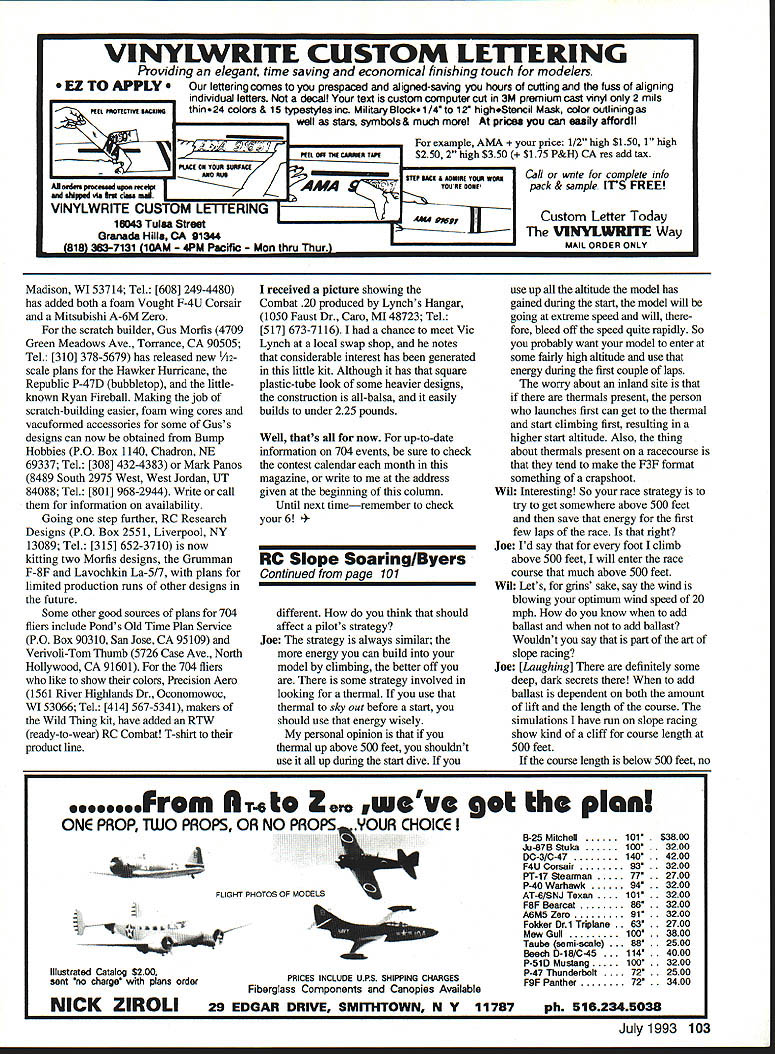
This month’s airfoil is the S-6061 section I discussed last month relative to its thinner cousin, the S-6062.
This section is 9% thick and should be an excellent choice for slope racing or for your aerobatic fun ship. It should have excellent turning qualities and be able to carry a full load of ballast. Also, because it is thicker, the S-6061 will be easier to build structurally.
Give it a try, and let me know what you think of it.
Transcribed from original scans by AI. Minor OCR errors may remain.

