
RADIO CONTROL: SLOPE SOARING
Wil Byers Rt. 4, Box 9544, West Richland, WA 99352
Viking Models, U.S.A., a cottage industry specializing in epoxy, fiberglass-reinforced fuselages and vacuum-formed model parts, has moved to 2 Broadmoor Way, Wylie, TX 75098-7803. The recent move has given the company more room and an opportunity to further expand the business. To reach Viking you can call (214) 442-3910. A fax line is also available: (214) 442-5258.
Viking Models (VM) has been in business for quite some time and has gained a reputation as a manufacturer that caters to the individual flier. In its brochure, Viking points out that all orders are filled on an individual basis; there is no high-volume production. Jerry Slates, owner of this cottage-industry shop, feels he "can maintain the high quality control of each and every fiberglass fuselage and formed product I produce" using this individual approach.
VM manufactures a number of different model fuselages, producing scale, thermal, and slope gliders. Examples include:
- Smoothie — works well for slope aerobatics; used by aerobatics pilot Dave Woods.
- F3B-type fuselages — potentially well suited to slope racing.
- Scale fuselages — such as Libelle and Kestrel.
Give Jerry a call or write for more information. You might even ask about molds he has stashed away for future production.
Flite Lite Composites — the F3B Eagle
Ron Vann of Flite Lite Composites called to say Flite Lite's race team would be coming to the 1993 Mid-Columbia Cup races. He also said Flite Lite will be offering a new all-molded F3B competition soarer: the F3B Eagle, the model Joe Wurts flew to win the 1991 World Championships.
Key points about the F3B Eagle:
- Airfoil: RG-15 (chosen by Joe Wurts for good thermal performance and high speed in the speed task).
- Estimated ready-to-fly weight: approximately 70 ounces — quite light for an all-molded F3B.
- Construction emphasis: very sharp trailing edges, airfoils accurate to the third decimal place.
- Use: designed as an F3B aircraft but also being marketed as a full-blown racer.
Flite Lite Composites contact:
- P.O. Box 311, Windsor, CA 95492
- Tel./Fax: (707) 838-9020
- Estimated price: approximately $900 plus shipping.
Flite Lite's designer Mark Allen and Ron Vann promise photos, a three-view, and more details in a future column.
Weston Aerodesign Company (WACO) materials
Weston Aerodesign Company, builders and designers of the Magic MkII and the WACO series gliders and electric models, offers several materials of interest:
- Style 1012 graphite/Kevlar fabric: a composite fabric of Kevlar and graphite (unidirectional carbon with a light Kevlar fill); weighs 2.9 oz/yd²; available in 50-inch widths for $35/yard.
- Spectra: a new high-tensile material, claimed to be stronger than Kevlar for the same weight. It is thicker and will absorb more resin (molded parts bagged or molded with Spectra will be somewhat heavier). Recommended for impact-prone areas, weak fuselage zones, and leading edges of vacuum-bagged wings.
- Lightweight glass: 3/4-ounce E-glass — excellent for very light lay-ups and as a veil cloth for vacuum-bagging wings.
- Other glass: 1.4-ounce E-glass and 3.1-ounce crow's-foot-weave glass in 38-inch widths. (Crow's-foot weave wraps around corners and forms to contours more easily than plain weave.)
- Kevlar: Style 120 Kevlar available in 50- and 60-inch widths; weave weight 1.7 oz/yd².
WACO contact:
- 944 Placid Court, Arnold, MD 21012
- Tel.: (410) 757-8580
- Fax: (410) 974-0968
Suggestion: label your glass and composite materials before storing them. It's often hard to distinguish similar weights and weaves later; labeling saves mistakes and ensures you use the proper material for each task.
Scale Model Research (SMR)
Scale Model Research's new 132-page catalog includes photo packs and three-view drawings — probably the largest collection of scale detail in the U.S. Bob Banks, owner of SMR, has amassed more than 4,000 photo packs and 22,000 three-view drawings, including documentation on more than 200 sailplanes in the photo pack collection.
If you need photo packs or three-view drawings, SMR's catalog is worth the $5.
SMR contact:
- 2334 Ticonderoga Way, Costa Mesa, CA 92626
- Tel.: (714) 979-8058
Foam-core wings and template making
Over the last decade, foam-core wings have become common among new models, especially sailplanes where wings are vacuum-bagged or sheeted over foam. Sailplane builders pioneered foam-core wings; Jerry Nelson (of KA-6 fame) used foam-cut wings as early as 1968.
I was introduced to foam cutting in 1976 by Jeff Breese and have cut many foam cores since. Techniques have evolved, producing very accurate cores and near-perfect airfoils, including razor-sharp trailing and leading edges. Accurate and functional tools—especially templates—are essential.
Foam selection (recommended):
- Dow Styrofoam (virgin): density 1.8 lb/ft³; compressive strength 40 psi at 10% deformation.
- Sheet sizes: 2" x 2' x 8' or 4" x 2' x 8'.
- Typical cost: about $24 for 2" sheets and $32 for 4" sheets (prices vary; shop around).
- When purchasing, ask for virgin foam (not re-bonded foam, which can contain embedded chunks that spoil cuts).
Cutting wire:
- Suggested: .020" stainless steel wire (nichrome works but stainless stretches less).
Power supply and supplies:
- A suggested supplier of foam cutting and bagging supplies is Aerospace Composites. George, the owner, can provide a power supply for heating the wire and other supplies.
- Aerospace Composites contact: P.O. Box 16621, Irvine, CA 92714; Tel.: (714) 250-1107.
- Tell him you read about his line of products in Model Aviation (MA).
Template material:
- Tried many materials (aluminum, plastic, plywood, epoxy circuit board). Preferred material: Formica.
- Why Formica: easy to cut and sand, stiff, very smooth when finish-sanded with 600-grit wet-or-dry, won’t absorb heat from the wire like aluminum, and won’t cause wire drag like plywood. Smoothness of the template edge is crucial for accurate cores.
Template methods:
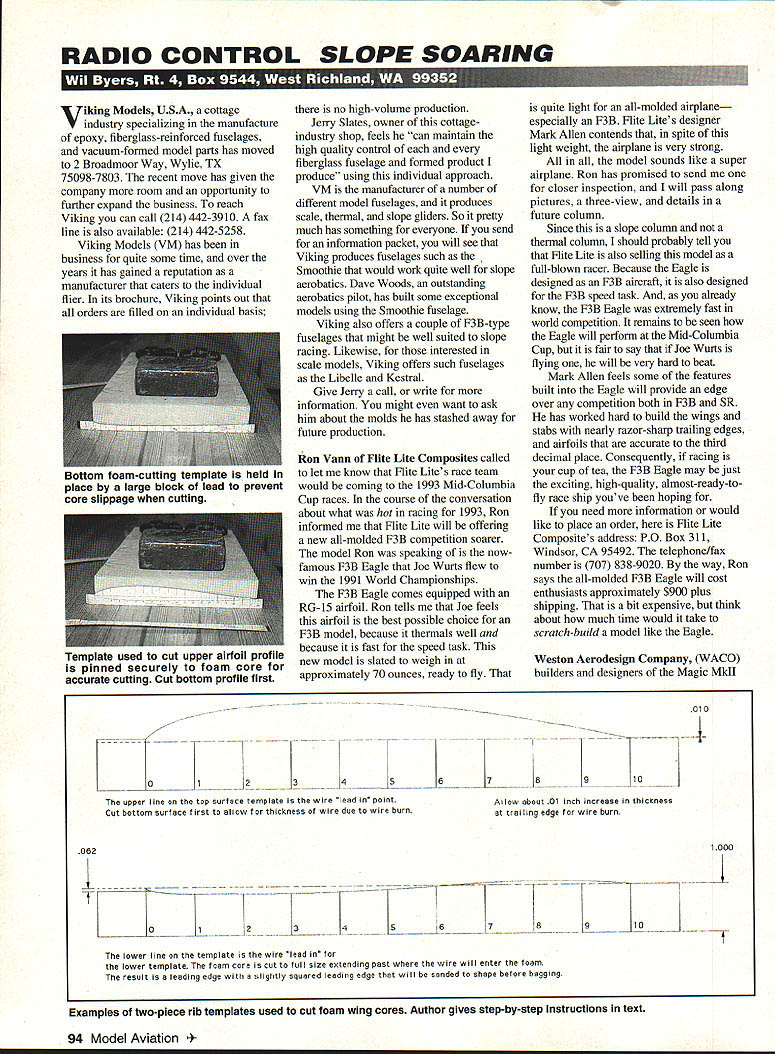
- Two main methods: single-template (one template cuts both top and bottom) and two-template (separate top and bottom templates). I prefer the two-template method, which generally produces better leading and trailing edges.
How do you make these templates?
- Plot the airfoil with cutting stations on the top and bottom.
- Make extra copies of the plot for reference — one for the top-surface template and one for the bottom-surface template.
- Cut Formica pieces sized to the airfoil:
- Allow enough material so the chord line is approximately centered in the piece.
- Extend at least 1" in front of the leading edge and 1" past the trailing edge.
- Use double-sided tape or Super Tape to hold the drawing on the Formica and rough-cut to shape.
- Sand to the reference lines to create the airfoil shape. Leave the pattern on the template for reference and station alignment.
- Polish the cutting edge to an unblemished, smooth surface for the wire to ride on.
- Mark station lines on the reverse side and drill at least two holes (large enough for T-pins) below the airfoil location to attach the template to the foam.
- Align and pin the template to the foam block, then begin cutting.
Tips and tricks:
- Wax the cutting edge of the template with mold-release or automobile wax to help the wire glide rather than drag.
- Cut the bottom surface first so the core drops into the wire cut and compensates for wire burn.
- Weigh the core down to the building surface so it doesn't move during cutting.
- Adjust the wire temperature on scrap foam before cutting; the proper temperature produces "long, wispy runners" (like cotton candy), indicating the wire is right.
- Cutting from the leading edge to the trailing edge is preferable for achieving sharp trailing edges.
If you need help or more details, drop me a line or give me a call.
Reader photo — peregrine falcon
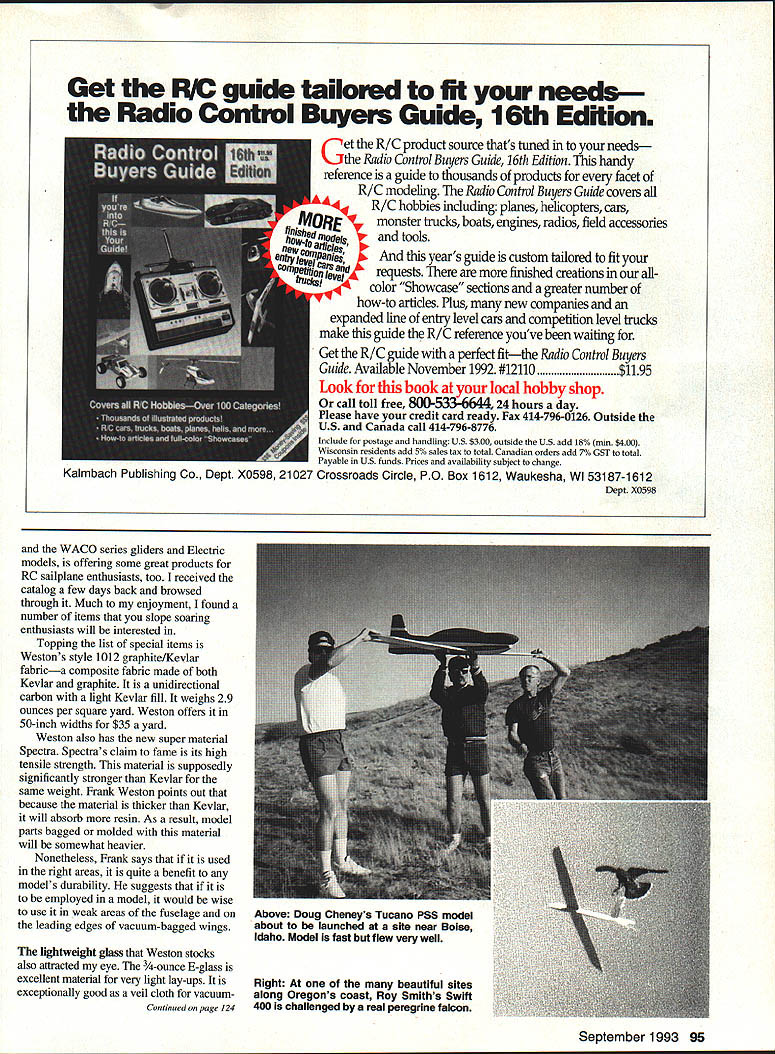
Roy Smith of Kelseyville, California, sent a note and some pictures. Roy says:
"The picture was taken last fall on a trip up the Oregon coast. While flying a Flite Lite Composites' Swift 400, a peregrine falcon joined it. On this particular flight, she stayed with me for approximately five or six minutes. As long as the plane was moving at speed, she would stay approximately two feet behind. As I turned into the wind and slowed, she would drop her talons and approach very close. It was a real thrill."
If you want great vacation slope soaring, there are many good sites along the Oregon coast. At one spot you can simply pull over to the side of the road and slope the bluff; when you've soared long enough, you can land on the sandy beach.
Airfoil of the month: S-6062
The airfoil of the month is the S-6062, a thicker relative of the Selig S-6063 (8% thick versus 7%). Designed by Michael Selig for slope soarers who want to cruise a bit faster than with the S-6060. The S-6062 turns better than the 6063 because of the extra thickness and may be a good section for slope racing.
Notes on usage:
- The S-6062 is 8% thick, so its drag bucket will rise more steeply than the 9%-thick S-6061.
- For long-course racing, straightaway speed may be more important than tight turns, so the S-6062 could be preferable on a longer racer rather than a short course where turns dominate.
If you try it, let me know how it performs. Build a racer and blow past the competition!
Let me know what is happening with your sloping adventures. See you next time!
Transcribed from original scans by AI. Minor OCR errors may remain.

