
Radio Control: Slope Soaring
Wil Byers, Rt. 4, Box 9544, West Richland, WA 99352
Pictures Motivate Modelers
Pictures motivate people to build, fly, and buy model aircraft. They are also fun to look at — or so you tell me. With that in mind, this month's Slope Soaring column is filled with as many pictures as space allows. I hope you enjoy the pictorial.
One picture, from a biased point of view, shows two beautiful ladies holding a fun winger-on sloper from the Oakland Model Academy. The beauty on the left is my daughter, Bess. On the right, holding the Ultra GP, is her friend Michelle Lenseigne. Both girls were excited about getting their pictures taken with the glider for this magazine. Excitement is what motivates young people to become preoccupied with a sport or hobby—wouldn't you agree? These young ladies are part of a new generation and will be competitors someday soon.
I like promoting junior enthusiasts and helping them help the hobby grow. If you send me a picture of one of your favorite junior slopers, maybe we can get them into Model Aviation. It will be fun for all of us, but most assuredly for them.
Ultra GP (Oakland Model Academy)
The Ultra GP is built by George Hunter of the Oakland Model Academy. It is designed for pilots who want to push the envelope with an advanced-aerobatics slope soarer. It is a high-roll-rate aircraft, capable of penetrating strong winds when pushed.
Key features:
- Hollow-core, all-molded wing set.
- Fuselage constructed of epoxy glass with five ounces of Kevlar reinforcing.
- Tail section of balsa sheet. Model arrives about 98% complete, sanded and ready to fly.
- Wing drive mechanism uses machined bellcranks that lock directly to the wing-pivot tubes (no normal drive pins). This prevents wear-related slop and improves wing-incidence return accuracy, and facilitates large wing travel for superb roll rates.
- Durability engineered for the rigors of slope flying — Kevlar adds toughness.
- Wings have different colors top and bottom for better visibility during rolls; colored epoxy saves weight compared to painting.
- Flies smoothly, carves graceful turns, tracks well, accelerates when needed, and handles brisk winds.
Oakland Model Academy can get you flying R/C slope in a hurry.
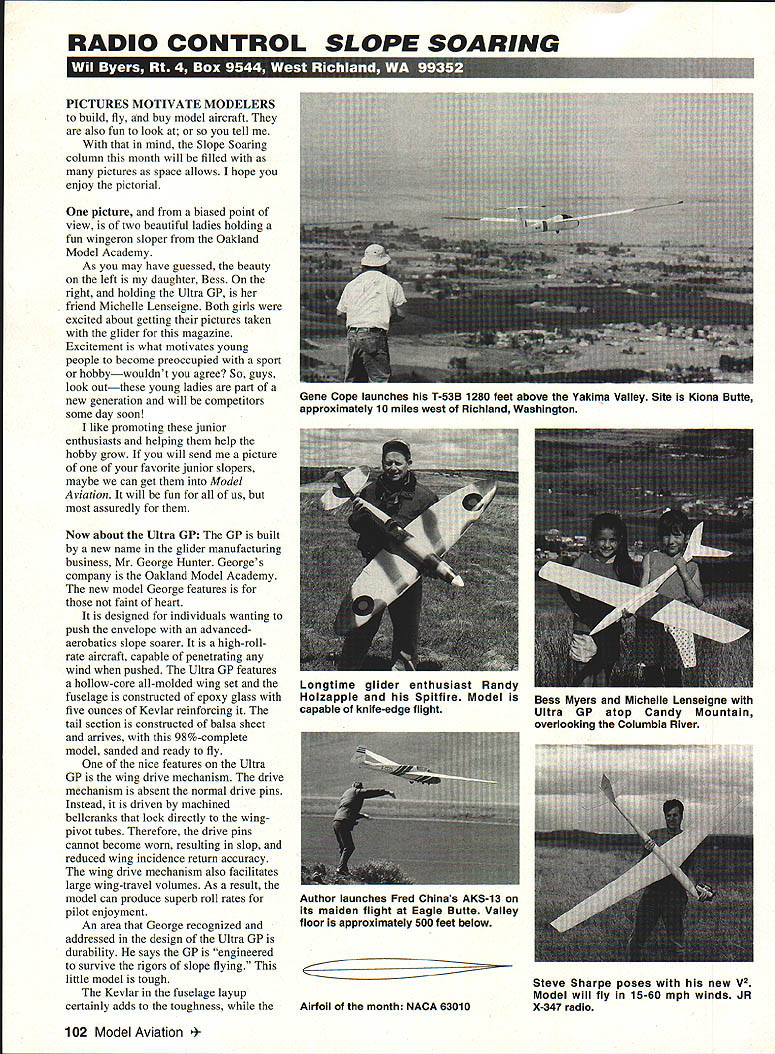
Gene Cope’s 1/5-Scale Slingsby T-53B
Gene Cope recently completed and flew a scratch-built 1/5-scale Slingsby T-53B. He molded a carbon-fiber spar system for the wing and used careful construction techniques.
Specifications and construction:
- Wingspan: 113.5 inches.
- Constant chord: 7 inches.
- Airfoil: Quabeck 3Q135 (3% camber, 13.5% of chord thickness).
- Total dihedral: 3° in each wing panel.
- Forward sweep: 5°.
- Wing skins: obechi wood sheeting bonded to the foam core with epoxy.
- Stabilizer: 22 inches long, 4-5/8 inches chord; full-flying configuration.
- Ailerons and flaps: Fourmost Products Snap-Tight Hinges.
- Fuselage: foam-evacuation type — carved foam plug covered with fiberglass and epoxy; after curing the foam was dissolved out with lacquer thinner.
- Glass layup: two layers of 3.16 ounces per square yard fiberglass in the boom and tail fin, with an additional layer in the nose.
Flight notes:
- The T-53 flies great but has a quite critical CG due to the forward wing sweep. Initial flights were used to adjust balance for proper trimmed flight.
- The Quabeck 3Q135 airfoil lets the model penetrate yet climb in lift; it is fast when the nose is lowered.
Fred China’s ASK-13 (maiden flight at Eagle Butte)
I share a picture of myself launching Fred China’s ASK-13 into slope lift at Eagle Butte. This was the ASK-13's maiden flight; Pete Marshall piloted it after I managed the windy launch. The model climbed right out of my hand once it had sufficient airspeed.
Details:
- Scale: 1/4-scale vintage soarer.
- Weight: 17 pounds.
- Wing loading: 23 ounces per square foot — this increased flying speed and penetration but did not harm performance.
- Wingspan: 4 meters.
- Plans: scratch-built using Cliff Charlesworth plans as a guide.
- Wings: built-up construction, covered with Solartech fabric covering, then painted; spar system strengthened to accommodate the extra weight.
- Original design (per Cliff) was intended to weigh about 8 pounds, but Fred modified it to suit slope conditions while retaining good thermaling capability.
- Fuselage: built-up with formers and stringers, sheeted in 1/16-inch balsa, then covered with 3/4 ounce per square yard fiberglass fabric and detailed with epoxy paint.
- Cockpit: finished with two 1/4-scale pilots, instrument panels, and controls.
- Controls: ailerons, elevator, rudder, and spoilers.
Power Slope Scale (PSS) and PSSA
Power Slope Scale (PSS) models are slope gliders built as replicas of powered aircraft. This form of slope soaring is said to have originated in England. The Power Slope Scale Association (PSSA) was founded by Alan Hulme to recognize this format.
If you are interested in PSS, consider joining PSSA. Michael Kitchen currently produces the newsletter, which mostly covers events in Europe but is an excellent source of information for PSS enthusiasts. To inquire, write:
- Michael Kitchen, Tall Timbers, Sutton-on-the-Forest, York YO6 1DY, England.
Randy Holzapple’s Vickers Supermarine Spitfire (PSS conversion)
Randy Holzapple is a PSS enthusiast pictured holding a Vickers Supermarine Spitfire converted to PSS. The model uses ailerons, elevator, and rudder for control, and is capable of aerobatics.
Flight notes:
- Randy demonstrated knife-edge flight after a dive for speed and performed four-point rolls.
- The model was not terribly fast but was enjoyable to fly — not twitchy and responded well to pilot commands.
If you want contact information for Drew and Randy, send me an SASE and I will provide their addresses.
Velocity Squared (V2) — Steve Sharpe
Steve Sharpe flies a larger version of a design I created called the Velocity Squared (V2). The original had a 48-inch span; over the years it grew into the larger version Steve now flies.
Construction and equipment:
- Entirely fiberglass and Kevlar construction with a molded fuselage and fin.
- Wings and stabilizer: foam core, vacuum-bagged with fiberglass, reinforced with unidirectional carbon fiber.
- Interior wing structure: two aluminum ballast tubes that double as strengthening spars and allow carrying, internal to the wing and over the CG, up to six pounds of lead shot for extra windy conditions.
- Hinges: Fourmost Snap Tight Hinges for ailerons and elevator.
- Aileron servos: two JR-341 servos buried in the wings.
- Radio: JR X-347 transmitter and JR 627 receiver.
Specifications:
- Wingspan: 90 inches.
- Length: 55 inches.
- Wing area: 580 square inches.
- Aspect ratio: 13:1.
- Stabilizer area: 95 square inches, mounted on a fairly long moment arm.
Aerodynamics and performance:
- Wing airfoil: Eppler 374.
- Horizontal stabilizer airfoil: NACA 63010, used to counter the mildly negative Cm0 of the Eppler 374.
- Designed for varied wind conditions: with ballast it will fly into winds up to 60 mph; unloaded it can fly the face of most slopes in a 15 mph wind.
- Capable of sport aerobatics — not precision competition aerobatics, but enjoyable maneuvers.
Airfoil of the Month
This month's airfoil is the NACA 63010, the section used on the V2 elevator. It is an excellent choice for a stabilizer or a vertical-fin section. The section is thick enough to build strong for high-wind conditions, yet thin enough not to penalize overall performance.
Characteristics:
- Quiet section that does not produce ultra-sensitive, twitchy control response.
- Provides good control response with a smooth, flowing feel for the pilot.
Was this month's column good for you? Let me know how I'm doing — there's always room for improvement. Good flying to you.
Transcribed from original scans by AI. Minor OCR errors may remain.

