
Radio Control: Slope Soaring
Wil Byers, P.O. Box 4267, West Richland, WA 99352
Have you had a good couple of months flying slope? I hope so! The summer season here in the Tri-Cities provided exceptionally good winds from all directions, often filled with thermals. Need I say more? It has been great fun sloping in 85+ degree temperatures. Also, the first North American Scale Soaring Association (NASSA) Rally was hosted here July 24–25, attracting some super scale models and some great people. I'll get to that later.
Now, however, I'm wondering what has been happening at your slope-soaring site during this past summer season (yeah, I know it's winter now and it's cold, but as I sit here writing this, it is August 8 and 90 degrees). Drop me a line and let me and Model Aviation share your fun with its readers. You'll discover that sharing is almost as much fun as flying!
Rob Smith has done just that, and I think you'll enjoy reading what he has to say. Rob is a fellow sloper from the Moses Lake, Washington area (approximately 70 miles north of the Tri-Cities). It is not quite as hilly as the Tri-Cities, but nonetheless has some pretty good sites, and Rob and fellow fliers have been exploring the fun of slope soaring.
Rubber Duck — Rob Smith (Moses Lake, WA)
The wind is light, yet this ship cruises the face of the slope effortlessly. You decide to bring it around for a landing, but suddenly you lose it. The model plummets and in an instant makes contact with old Mother Earth. You walk over, pick it up, and brush off the dust and grass. After a quick inspection, you lift it into the wind and toss it over the edge for more fun. What possibly could survive this kind of abuse and yet fly again? Why, only the Rubber Duck!
The Rubber Duck is a flying-wing slope soarer offered by Steve Hinderks. The Duck is almost entirely made from a dense foam rubber — a material responsible for the resilience and robustness of this airplane.
I must admit that I was skeptical as I opened the box. Inside I found two wing halves, a fuselage, and pre-bent pushrods. I cemented the wing halves together with contact cement and installed the 3/8" birch dowel which serves as the spar. I then attached the fuse to the wing. Radio installation was a snap. A standard-size radio fits snugly in the precut holes in the foam-rubber fuse, while the elevons are already installed.
Even though the Rubber Duck uses elevons, a radio with mixing capabilities isn't needed. Steve has incorporated a clever mechanical mixer that works well. The Rubber Duck is also precolored, so no finishing is necessary. My Duck weighed in at 19 ounces, for a wing loading of approximately 7 ounces per square foot.
Finally, the wind arrived, and we headed out to the slope for the maiden flight. After rechecking all controls, I threw the Rubber Duck off the edge into an 8–10 mph wind. A couple of clicks of trim and the Duck was flying smoothly. The stall was straight ahead and recovery was quick. Even in this light wind, we did not have to work hard to keep the airplane at altitude.
Our only real problem developed when we attempted some high-speed passes and aerobatics. The wing would twist on the birch spar, causing the Duck to abruptly turn in that direction. Mr. Hinderks had mentioned in the directions to glue the ends of the spar to the tiplets, but I had failed to do this. Using a little UFO CyA, I did just that, and it seemed to solve the problem.
I made many flights and also shared the Duck with a fellow flier, who was equally impressed with its abilities. The amazing thing about this airplane is that you can actually practice your landings on the slope without fear of hurting it. We would land it, pick the Duck up, and immediately launch it again. I don't know many other slope ships you can do this with.
The airplane responds to input and will go where it is pointed; it remains stable. I did manage on one occasion, however, to break the Rubber Duck. I tore the nose in a crash, but with a little glue it was back in flying condition.
If you have never flown a flying wing before, it does take a little getting used to the orientation of its shape in the air. It seems strange to have no tail feathers out back, but you'll get used to it in no time.
As I understand it, the Rubber Duck is only available RFR (ready-for-radio), which means you can get to the slope that much faster. This version is available in wing colors of red, yellow, or blue with black tiplets and fuselage. Cost is around $40, which is very reasonable for the degree of prefabrication.
Don't expect the Rubber Duck to have blistering speed or to do precision aerobatics — that's not what it was meant for. What it does do well is provide a fun, durable, and quick-building airframe. It's great not having to worry about breaking your airplane and ruining a great day of flying.
We have not had a lot of good strong winds lately, so we could not fully evaluate the Duck in winds over 15 mph. One thing I am sure of, though, is that the Rubber Duck would make a great airplane for checking out slopes with marginal landing areas or for those who like to engage in combat.
Thanks, Rob; I'm sure the Duck gives one a chance to evaluate slope lift in no time.
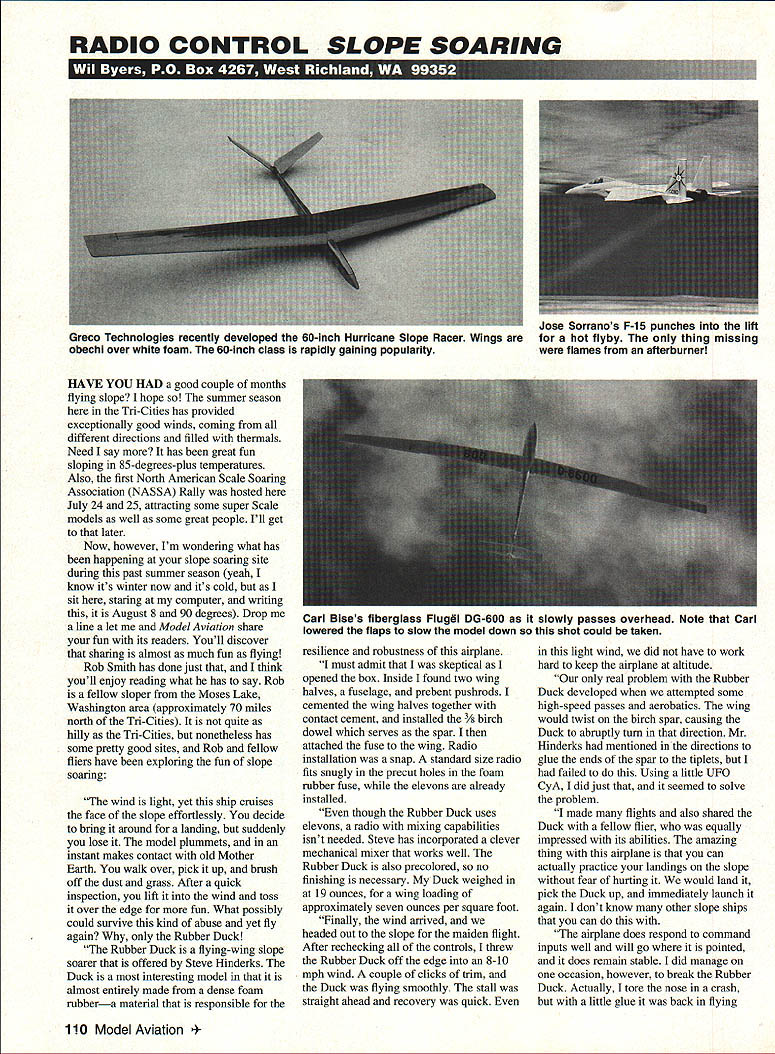
Greco Hurricane (60-inch Racer)
Sixty-inch racing has gained popularity, and Greco has stepped in to offer a model well-suited to racers' needs. Jerilyn Schmidt of Greco sent a press release documenting some of the Hurricane's features:
This racer is quick to build, inexpensive, and durable — exactly what you want, whether racing on the slope or pushing the outside edge of your performance envelope with acrobatic maneuvers. The wings are made of precision-cut white foam, with precut Obechi sheeting for fast building. The Hurricane also employs composite materials for added strength.
The wing is a top-mounted straight wing with a single taper. The use of flaperons allows for great maneuverability. The SDB0080 is fast and turns well; both characteristics are important in racing. The low drag at high speeds and the good sink-rate performance of this airfoil give it more diversity. The fuselage is built up balsa with a V-tail to keep weight down. Both parts have been machine-cut for easy assembly.
This ship requires a four-channel microreceiver and three microservos — one servo for the tail and one servo for each wing.
Specifications:
- Wingspan: 60 inches
- Wing area: 345 square inches
- Weight: 16 ounces
- Wing loading: 6.7 ounces per square foot
- Root chord: 7.5 inches
- Tip chord: 4 inches
- Aspect ratio: 10.4:1
- V-tail: 11°
- Listed price: $80
For more information about the Hurricane or any of Greco's other kits, write to P.O. Box 10, South Pasadena, CA 91031, or call (213) 680-2070 during standard business hours.
Thanks to Jerilyn for sharing the news of Greco's Hurricane racers with Model Aviation readers. If you haven't tried racing, maybe now is the time to get a 60-inch racer and enter a competition.
NASSA Rally (1993)
At the beginning of the column, I mentioned the 1993 NASSA Rally. As some of you may know, NASSA is dedicated to furthering scale soaring in North America. To generate enthusiasm, NASSA members are hosting scale-soaring events throughout the continent. NASSA also hosts an annual scale rally, promoting it as an event that will move around North America, with the sponsoring club receiving support from the association.
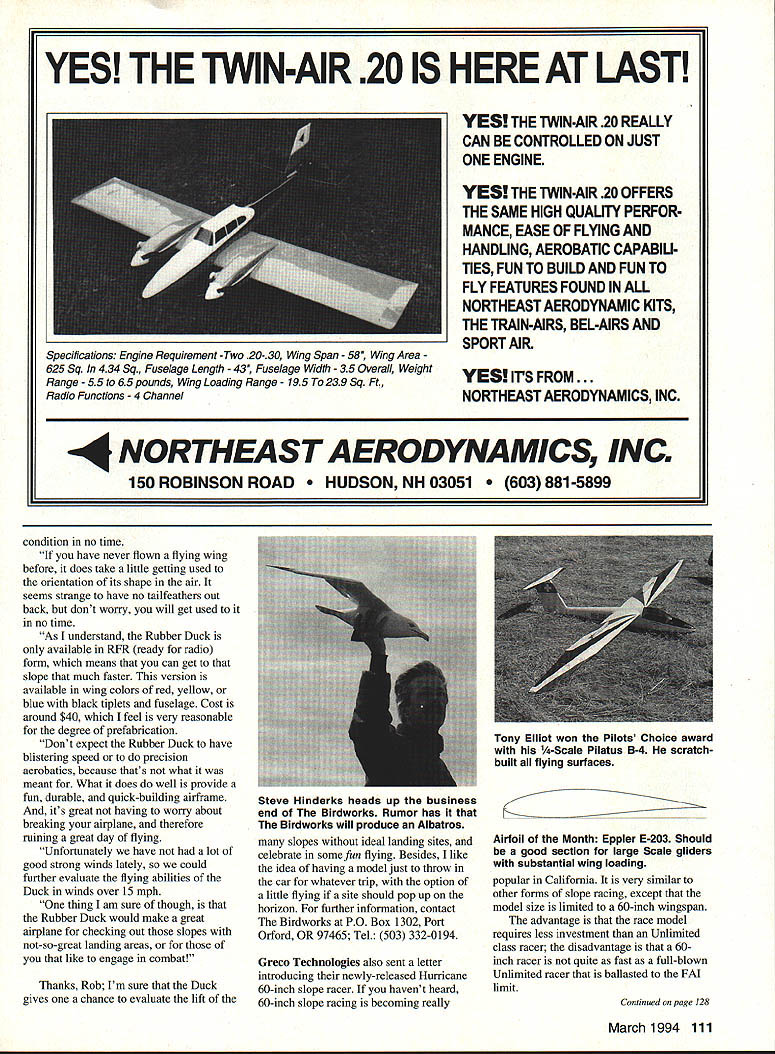
This being the first year of the rally, it didn't go far from the home of those who started it: Eagle Butte at Richland, Washington. It attracted a good number of entrants who brought a gaggle of scale gliders of various vintages, including power-slope scale models.
The winds were superb the entire week prior to the event and on Saturday. However, early Sunday morning the winds died down and didn't come back until late afternoon. No matter — fliers were still able to keep models aloft and climbing.
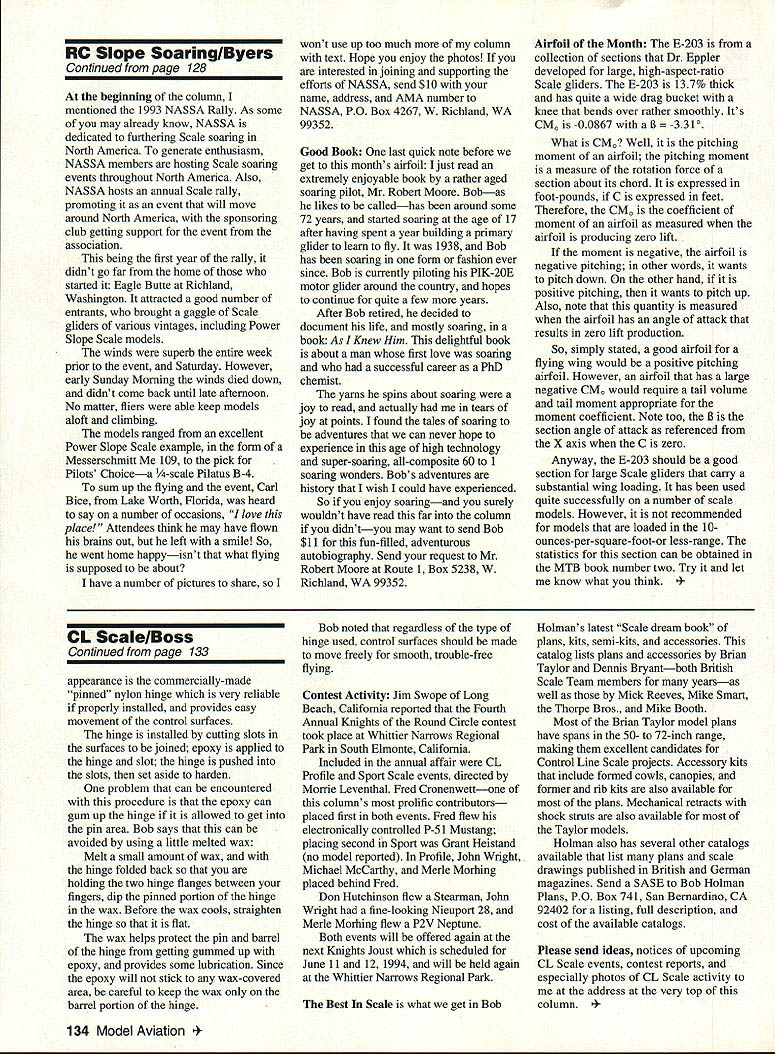
The models ranged from an excellent power-slope scale example in the form of a Messerschmitt Me 109 to the Pilot's Choice pick — a 1/4-scale Pilatus B-4.
To sum up the flying and the event, Carl Bice from Lake Worth, Florida, was heard to say on a number of occasions, "I love this place!" Attendees think he may have flown his brains out, but he left with a smile. He went home happy — isn't that what flying is supposed to be about?
If you are interested in joining and supporting the efforts of NASSA, send $10 with your name, address, and AMA number to: NASSA, P.O. Box 4267, W. Richland, WA 99352.
Good Book
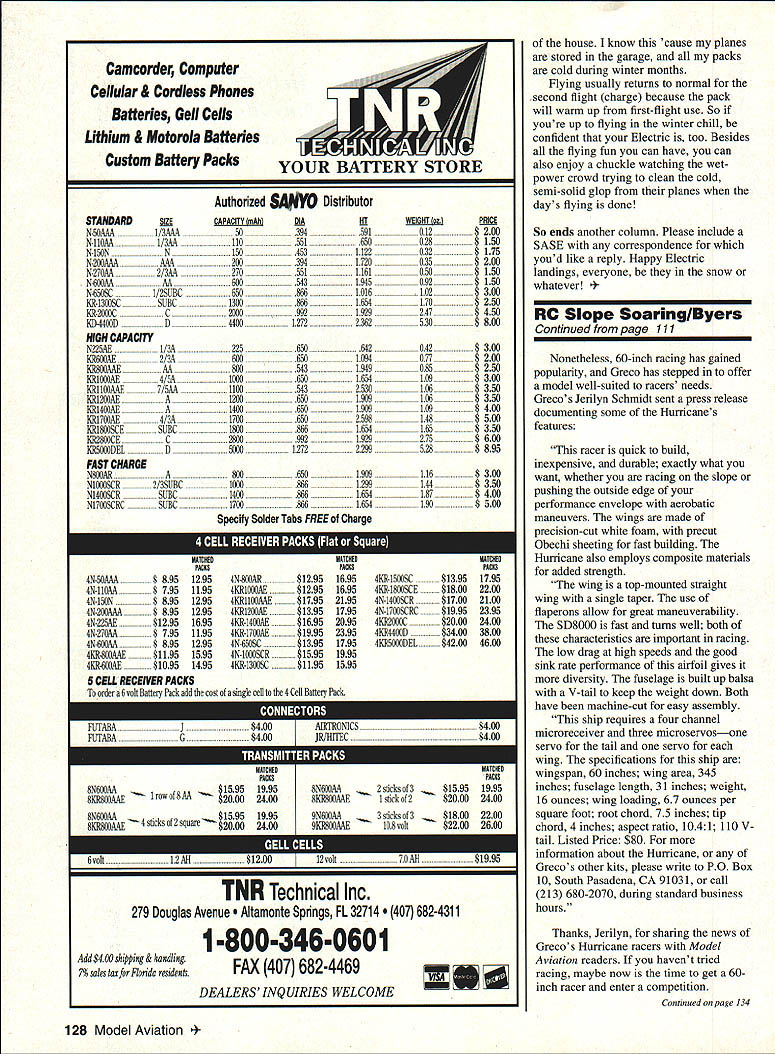
One last quick note before we get to this month's airfoil: I just read an extremely enjoyable book by an aged soaring pilot, Mr. Robert Moore. Bob — as he likes to be called — has been around some 72 years and started soaring at the age of 17 after having spent a year building a primary glider to learn to fly. It was 1938, and Bob has been soaring in one form or fashion ever since. Bob is currently piloting his PH-20K motor glider around the country and hopes to continue for quite a few more years.
After Bob retired, he decided to document his life, mostly soaring, in a book: As I Knew Him. This delightful book is about a man whose first love was soaring and who had a successful career as a PhD chemist.
The yarns he spins about soaring were a joy to read and actually had me in tears of joy at points. I found the tales of soaring to be adventures we can never hope to experience in this age of high-technology, all-composite super-soaring wonders. Bob's adventures are history I wish I could have experienced.
If you enjoy soaring, you may want to send Bob $11 for this fun-filled, adventurous autobiography. Send your request to: Mr. Robert Moore, Route 1, Box 5238, W. Richland, WA 99352.
Airfoil of the Month — E-203
The E-203 is from a collection of sections Dr. Eppler developed for large, high-aspect-ratio scale gliders. The E-203 is 13.7% thick and has a quite wide drag bucket with a nice, smooth drag-rise. Its CM0 is -0.0867 with a b = -3.31.
What is CM0? It is the pitching-moment coefficient of an airfoil measured when the airfoil produces zero lift. The pitching moment measures the rotational force of a section about its chord. If the moment is negative, the airfoil is negative-pitching (it wants to pitch down); if positive, it wants to pitch up. The quantity b is the section angle of attack referenced from the axis when CM0 is zero.
Simply stated, a good airfoil for a flying wing would be a positive-pitching airfoil. An airfoil with a large negative CM0 would require an appropriately sized tail volume and tail moment to counter the resulting pitching moment.
The E-203 should be a good section for large scale gliders that carry substantial wing loading. It has been used successfully on a number of scale models. However, it is not recommended for models loaded in the 10-ounces-per-square-foot-or-less range.
The statistics for this section can be obtained in the MTB book number two. Try it and let me know what you think.
Transcribed from original scans by AI. Minor OCR errors may remain.

