
RADIO CONTROL SLOPE SOARING
Wil Byers, Rt. 4, Box 9544, West Richland, WA 99352
SoarTech #10
The new SoarTech #10 has to be one of the best issues yet. Packed full of useful information, this is a must-have.
For those not familiar with SoarTech publications, they are the works of many contributing authors and are compiled by SoarTech’s Herk Stokely. Herk’s intent is to provide up-to-date technical information for the betterment of RC soaring. The now ten issues are a resource library any modeler can find extremely useful in designing, building, and flying RC gliders and sailplanes.
SoarTech #10’s collection of articles is a super buy at $16 (US). Martin Bamert’s construction and molding article alone is worth the price of this issue. All of the articles, however, are superb.
The articles by Jim Stephens and Steve Pituch offer readers source code to perform model design analysis on a home computer. As Herk says, they also contain valuable modules that relate to input and display of data as well as output of results. A program writer is often challenged more by input, display, and output than by the calculations that produce the answers. This is a great buy for those wanting to expand their RC soaring horizons.
Order information:
- US price: $16
- Outside US: $20 (surface), $23 (air mail)
- Send orders to: SoarTech, 1504 N. Horseshoe Circle, Virginia Beach, VA 23451
Airfoil Design and Data (Dr. Richard Eppler)
Another outstanding book is Airfoil Design and Data by Dr. Richard Eppler. This highly technical book explains the logic and design philosophy behind the development of Dr. Eppler’s computer program for the design and analysis of low-speed airfoils. It also explains the latest state of the development of a program for the design of low-speed airfoils.
Dr. Eppler and Dan Somers are the two individuals primarily responsible for this work, with Dr. Eppler behind the development of the long-used Eppler series of airfoils and Dan Somers responsible for the source code. This book represents more than 30 years of airfoil design work by Dr. Eppler.
The focus of the book is the program and a methodology to solve the potential flow problem for given airfoils. It examines how one designs airfoils from the properties of these potential flow distributions. The book contains descriptions of how the solution of the potential flow analysis and design problems can lead to the calculation of boundary layers and the total lift, drag, and moment coefficients.
Dr. Eppler’s airfoil design and development code is primarily responsible for developing a new age of airfoils. It has allowed designers such as Quabeck, Girsberger, and Selig to produce airfoils that might not have otherwise existed. It is safe to say that Dr. Eppler has pioneered an area of aeronautical engineering, and his book documents those pioneering works.
The book also presents a number of new airfoils developed with his computer program. Although these airfoils appear to be designed mostly for full-scale aircraft, this is an extremely valuable resource.
Order information:
- Publisher: Springer-Verlag New York, Inc.
- Address: P.O. Box 19386, Newark, NJ 07195-9386
- Tel.: (800) SPRINGER (777-4643)
- Price: $79 plus shipping and handling
By the way, Dr. Eppler will be the guest speaker at the 1994 World Soaring Jamboree; he has agreed to present his latest findings on wing-induced drag, featuring special experiments. He will also provide a second presentation at the Battelle Auditorium about the history of aviation as he has observed from his unique vantage point. These presentations should be interesting for all sailplaners, big, small, or Scale. This is an opportunity to meet one of the great minds in aeronautical engineering.
World Soaring Jamboree (WSJ)
If you haven’t heard about the World Soaring Jamboree, it is an event that many of you will not want to miss. Scheduled for May 28–June 5, 1994, the WSJ will have a festival atmosphere with 18 soaring events. Those events include:
- Open Thermal Duration
- Two-Meter
- Standard Class
- Novice Thermal Day
- F3J Thermal
- F3B Thermal
- F3H Cross Country
- Scale
- Power Slope Scale
- Novice Slope Racing
- Unlimited Slope Racing
- 60-inch Slope Racing
- PSS Slope Racing
- Slope Fun-Fly
- Record Trials
The WSJ also offers:
- A Washington wine-tasting and evening social
- The special guest speaker presentation with Dr. Eppler
- An evening banquet and raffle
- A vendor forum
For registration information, send a request to: World Soaring Jamboree, P.O. Box 4267, W. Richland, WA 99352
European PSS and Peter Tribe
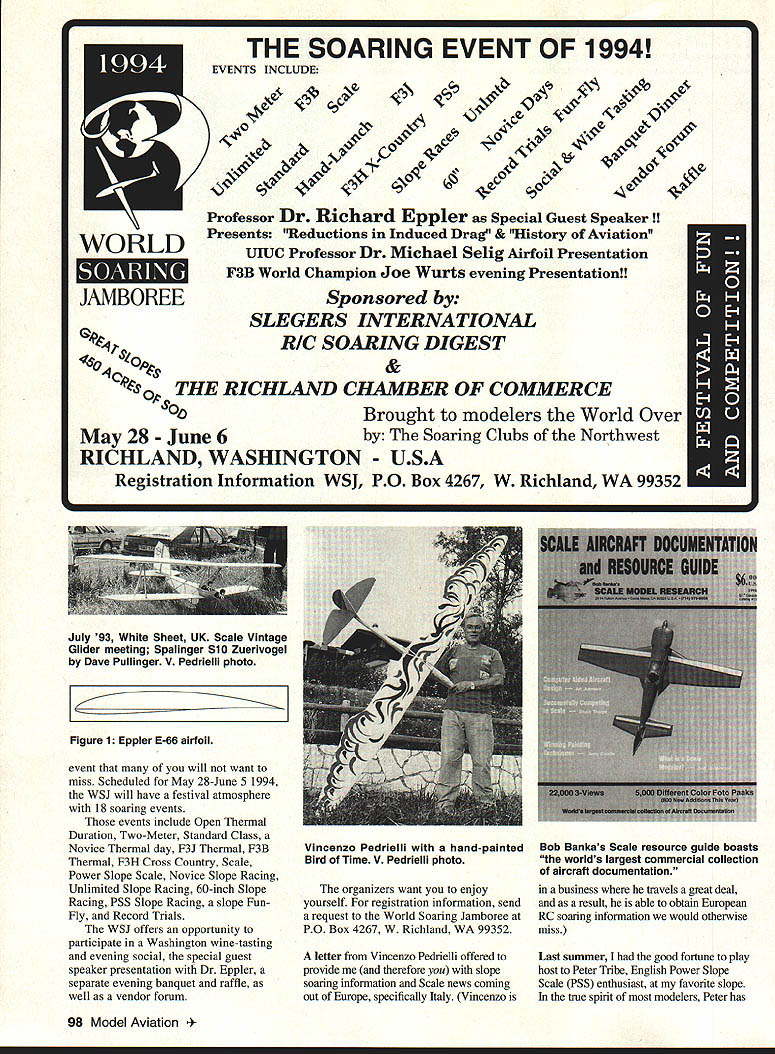
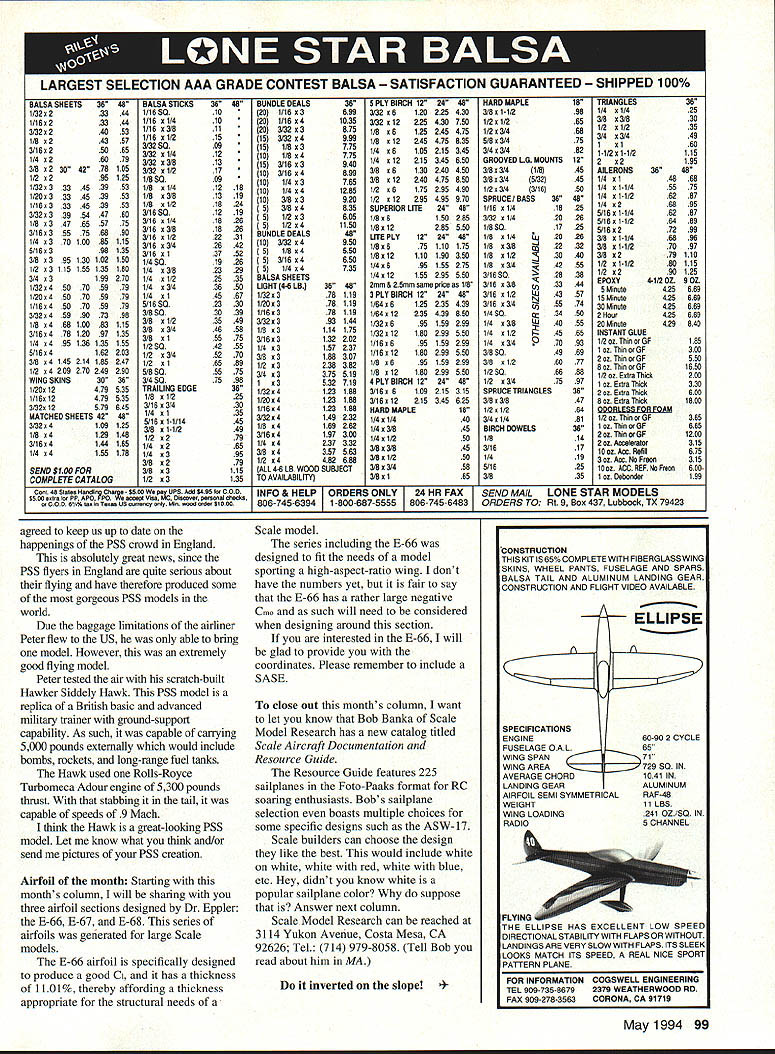
A letter from Vincenzo Pedrielli offered to provide me (and therefore you) with slope-soaring information and Scale news coming out of Europe, specifically Italy.
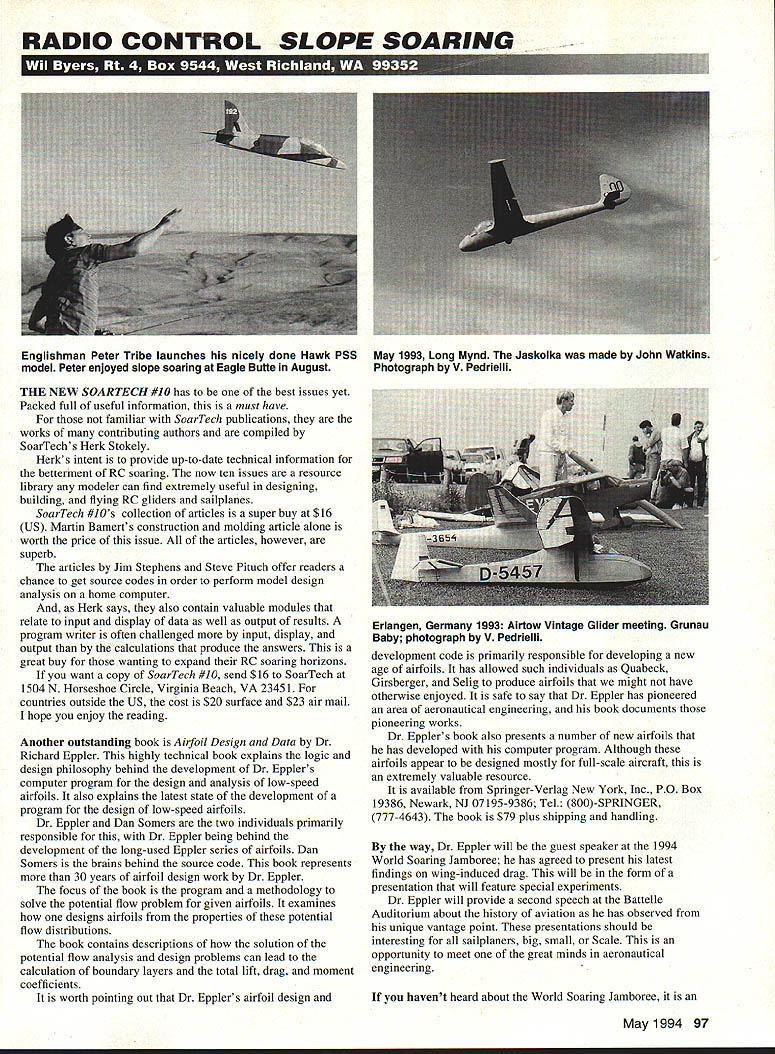
Last summer, I had the good fortune to host Peter Tribe, an English Power Slope Scale (PSS) enthusiast, at my favorite slope. He agreed to keep us up to date on the happenings of the PSS crowd in England. This is great news, since the PSS flyers in England are quite serious about their flying and have produced some of the most gorgeous PSS models in the world.
Due to the baggage limitations of the airliner Peter flew to the US, he was only able to bring one model. However, this was an extremely good flying model. Peter tested the air with his scratch-built Hawker Siddeley Hawk. This PSS model is a replica of a British basic and advanced military trainer with ground-support capability. As such, it was capable of carrying 5,000 pounds externally, including bombs, rockets, and long-range fuel tanks.
The Hawk used one Rolls-Royce Turbomeca Adour engine of 5,300 pounds thrust. With that power in the tail, it was capable of speeds up to 0.9 Mach.
I think the Hawk is a great-looking PSS model. Let me know what you think and/or send pictures of your PSS creation.
Airfoil of the Month
Starting with this column, I will be sharing with you three airfoil sections designed by Dr. Eppler: the E-66, E-67, and E-68. This series of airfoils was generated for large Scale models.
The E-66 airfoil is specifically designed to produce a good CL and has a thickness of 11.01%, affording a thickness appropriate for the structural needs of a Scale model. The series including the E-66 was designed to fit the needs of a model sporting a high-aspect-ratio wing. I don't have the numbers yet, but it is fair to say that the E-66 has a rather large negative Cm and, as such, will need to be considered when designing around this section.
If you are interested in the E-66, I will be glad to provide you with the coordinates. Please remember to include a SASE.
Scale Aircraft Documentation and Resource Guide
Bob Banka of Scale Model Research has a new catalog titled Scale Aircraft Documentation and Resource Guide. The Resource Guide features 225 sailplanes in the Foto-Paaks format for RC soaring enthusiasts. Bob's sailplane selection even boasts multiple choices for some specific designs such as the ASW-17. Scale builders can choose the design they like best, including white on white, white with red, white with blue, etc.
Scale Model Research contact:
- Address: 3114 Yukon Avenue, Costa Mesa, CA 92626
- Tel: (714) 979-8058
- (Tell Bob you read about him in MA.)
Do it inverted on the slope!
Transcribed from original scans by AI. Minor OCR errors may remain.

