


RADIO CONTROL: SLOPE SOARING
Wil Byers Rt. 4, Box 9544, West Richland, WA 99352
Visit to Mount Kurotake (Vincenzo Pedrielli)
This month's column includes a visit to a slope-soaring site in Japan with Vincenzo Pedrielli, an introduction to a new model called the Shark from Duncan Designs, Dr. Selig's new design and testing program, the F3F Viking Race announcement, a new transmitter tray from Pacific Northwest Industries, and the E‑67 airfoil.
In my May column I introduced Vincenzo Pedrielli (7, Via Tintoretto, 20033 Desio, Italy). As promised, Vincenzo has provided some interesting details about RC soaring from one of the many soaring sites he has visited: Japan. Vincenzo sent a nice article and photos detailing this adventure:
"Mount Kurotake is located on the Izu peninsula in the prefecture of Shizuoka, about 100 km west of Tokyo. By car or train, one arrives at Atami city — a very famous vacation spot with hot springs — and drives on Atami-Touge on the Izu Skyline Driveway.
"The slope-soaring site on Mount Kurotake is about 1 km from the Atami-Touge tollgate and reaches approximately 1,000 meters above sea level. The flying area is actually a stretch along the mountain peak line; therefore slope soaring can be enjoyed with winds coming from different directions. Preference, however, is given to west winds, as the soaring area is much wider than for east winds and landing is much safer.
"Although winter is rather cold in Japan, the Izu peninsula is famous for its warm climate, and as there is no snowfall, soaring may be enjoyed throughout the year. The best period is from December to March when west winds prevail due to high pressure from China and low pressure from the Pacific Ocean.
"Standing on the mountain peak for three hours, however, is a rather chilly experience. During the rainy season in June and July, the weekends can easily be spoiled by heavy rains or even by fog.
"There are about 1,500 model soarers in Japan, and every weekend 30 to 40 model gliders can be found on Mount Kurotake; about 20 of whom are regular fliers. Vintage modelers have been given the funny name 'White Fliers.'
"The most peculiar thing about Kurotake, besides the fantastic view including Mount Fuji, is its being covered with bamboo bushes. Only a few hundred square meters have been cleared to allow a short launch and the modelers to move around with their remote controls.
"Now how do the gliders land under these conditions? Hard to believe, but true: the gliders, including vintage models such as Rhoenbussard, Minimoa, Habicht, Hutter H‑28, and Falke, are landed in the bamboo bushes.
"And how do they find them? A buzzer system is installed in all gliders flying at Kurotake to help the pilot recover the airplane.
"This might seem a very rough and risky landing, but actually I believe it might be much safer than one thinks. If you land with one wing down on a normal field, it will probably destroy the glider, while the bamboo bushes make the glider just turn around and finally stop it. Scratches, of course, should not be counted, but rather be seen as evidence of many successful flights.
"To give another odd idea of how vital space is in Japan, even the sky is almost overcrowded during weekends as, besides the 20 people who alternatively launch their gliders, there are 20 to 30 parachutists, ultralight gliders, and hang-gliders. This may seem unbelievable and a little dangerous to our western tastes. As a matter of fact, during such 'rush hours' collisions between gliders are almost inevitable; usually the broken airplanes are found and brought back to the slope, thanks to the effective buzzer system they use.
"The atmosphere is very friendly, and everybody shares the joy of soaring. As in every country, you can meet any kind of people, from the doctor to the sociologist to the shop dealer and electrician. What they all have in common, for sure, is their enthusiasm in playing with their gliders in a beautiful place: Mount Kurotake."
Should some vintage enthusiast have the chance to travel to Japan, Dr. Takashi Shirasu will likely be happy to take him to Kurotake. Dr. Shirasu's contact details:
- Address: 8-5-20 Jindaiji Higashi-machi, Chofu-shi, Tokyo 182, Japan
- Fax (office): 81-3-3769-2090
- Tel (office): 81-3-3767-2092
- Tel (home): 81-424-83-7460
Thanks, Vincenzo, for the details of this superb slope-soaring site. It sounds like a great place for scale soaring.
The Shark (Duncan Designs)
In the September 1993 column I introduced the Selig 6062 airfoil, designed by Dr. Michael Selig for slope soaring. Since then, several modelers and designers (including Mark Allen) have used the section.
I received a letter from Don Thomas Jr. about a new model designed by Clyde Duncan: the Shark. The Shark was designed for the new 60‑inch class slope races and is meeting with some success. As Don said, "I thought the thinner airfoil would hinder lift. Not so. As you state in the article the 6062 was even faster than previous airfoils, and it carried its energy well."
If you want more information about the Shark, contact Duncan Designs:
- Address: 505 Smoketree Glen, Escondido, CA 92026
- Tel: (619) 743-2174
The Shark is a good-looking model, and looks can mean a lot for performance. Let me know what you think.
Low-Speed Airfoil Design and Wind Tunnel Testing (UIUC)
Dr. Michael Selig is again seeking experienced modelers to build a variety of airfoil wind-tunnel models for testing at the University of Illinois at Urbana-Champaign (UIUC).
This testing program will measure airfoils over the Reynolds number range of 60k to 300k. The scope of the tests depends on the number of wind-tunnel models provided and the available funding. Dr. Selig says:
"Hopefully, the proposed modeler-supported airfoil test program will become self-sustaining. Your support and help of any kind will be acknowledged in reports on the project to be published by Herb Stokely in Soartech. We plan to publish the results through Soartech frequently—possibly twice per year."
This is an opportunity to see how a Ritz, Quabeck, Wortman, NACA, Eppler, RG, or even a full-scale airfoil compares to those currently in use. The more test sections provided, the more data will be generated.
If you missed participation in the 1987 tests by Dr. Selig, John Donovan, and the late David Fraser, this is your second chance to take part in new research that will help evolve soaring airfoil design.
For an information packet, contact James J. Guglielmo (Dr. Selig's graduate student):
- Dept. of Aeronautical and Astronautical Eng.
University of Illinois at Urbana-Champaign 306 Talbot Laboratory, 104 S. Wright St., Urbana, IL 61801-2935
- Tel (work): (217) 244-0684
- Tel (home): (217) 367-1960
- Fax: (217) 244-0720
F3F Viking Race (Viking Cup)
"Viking Race" has a good ring to it and conjures images of aggressive slope racing. The FAI provisional event for F3F slope racing typically runs one model on the course at a time, racing against the clock and scored on a normalized basis against others in the round. It is a demanding test of hand-eye coordination, precise turn timing, and a model designed to handle high G turns — often ballasted and built to be both strong and quick-turning.
Recent advances in F3B technology have produced competition models that make excellent F3F racers. F3F racing is a true test of man and machine.
Ron Russell, the contest organizer in Scotland, announced the upcoming 1994 Viking Race. The site promises to be extraordinary with a vertical rise of approximately 1,000 feet (though it is a bit of a walk to the top). The promotional flyer also notes several local attractions, including a couple of castles.
If you are interested in attending, contact Ron Russell:
- Address: 25 Napier Place, Glenrothes, Fife, Scotland KY6 1DX
Transmitter Tray (Pacific Northwest Industries)
William Law of Pacific Northwest Industries (PNI) has a new transmitter tray. Features include:
- All-aluminum construction
- Adjustable shoulder straps (foam-padded for fatigue-free flying)
- Baked-on textured finish
- Adjustable tray
- Detachable tray
- Positive locking mechanism
- Adjustable palm rests (three-way adjustment for relaxed, comfortable flying)
- Requires no assembly or special tools — slide the transmitter onto the tray, attach, and hang over the shoulder
Contact PNI for details:
- Address: 9658 Ronald Dr., Blaine, WA 98230
- Tel: (206) 332-8822
- Price: unavailable at time of writing
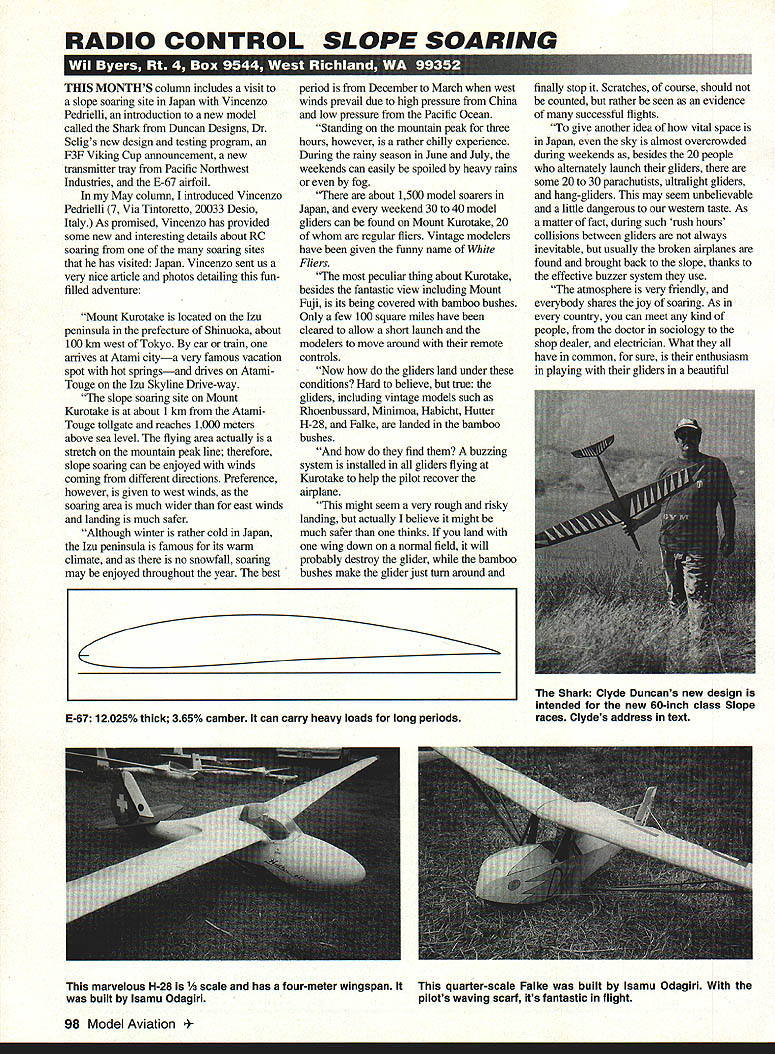
E‑67 Airfoil
In the last column I introduced the E‑66 section. The E‑66 is part of a family of airfoils Dr. Richard Eppler developed for RC sailplanes, including the E‑66, E‑67, and E‑68.
- E‑66: 11.01% thickness, camber 3.977% — capable of good CL but has a fairly negative pitching moment (Cm).
- E‑67: a thicker, decambered sibling — 12.025% thickness, camber 3.65% — still provides good CL but with less negative Cm than the E‑66.
These E-series sections are not designed to be speed burners. However, they are well suited to carrying the loading of large, high-aspect-ratio scale models or any large model, and they should climb very well while the speed-focused sections stay low.
Happy soaring this summer!
Transcribed from original scans by AI. Minor OCR errors may remain.

