

Radio Control: Slope Soaring
Mark Triebes 20794 Kreisler Ct. Saratoga, CA 95070
Richland Update
The 1989 AMA NATS will be held in Richland, WA, July 15–24. Plans include a thermal site, an F3B site, and a slope site — this could give slope soaring a real boost. I do not know if there will be an official slope competition, but Wil Byers and the Tri-City Soarers will likely showcase what slope soaring has to offer. Plan on attending to show the rest of the modeling community our commitment to this segment of RC modeling.
Plans for the next Scale Slope Soaring Fun-Fly are well under way. Last year’s event was probably the soaring event of the year, and this year’s looks even better. The fun-fly may be extended to four days and include a hobby expo. For more information about upcoming happenings in Richland, contact:
- Wil Byers, 632 Meadows Drive E., Richland, WA 99352
Sailplanes International
In my first column I included a couple of photos from the Solent Sailplanes catalog and received many requests about how to obtain a copy. The U.S. supplier is no longer in business, but with help from Dan Danrich I located the original supplier in England. For those interested:
- Sailplanes International
Unit 6, Cwmtillery Industrial Estate Abertillery, Gwent NP3 1LZ This organization offers sailplanes ranging from simple built-up trainers to some truly gorgeous all-glass scale ships.
The Penetrator
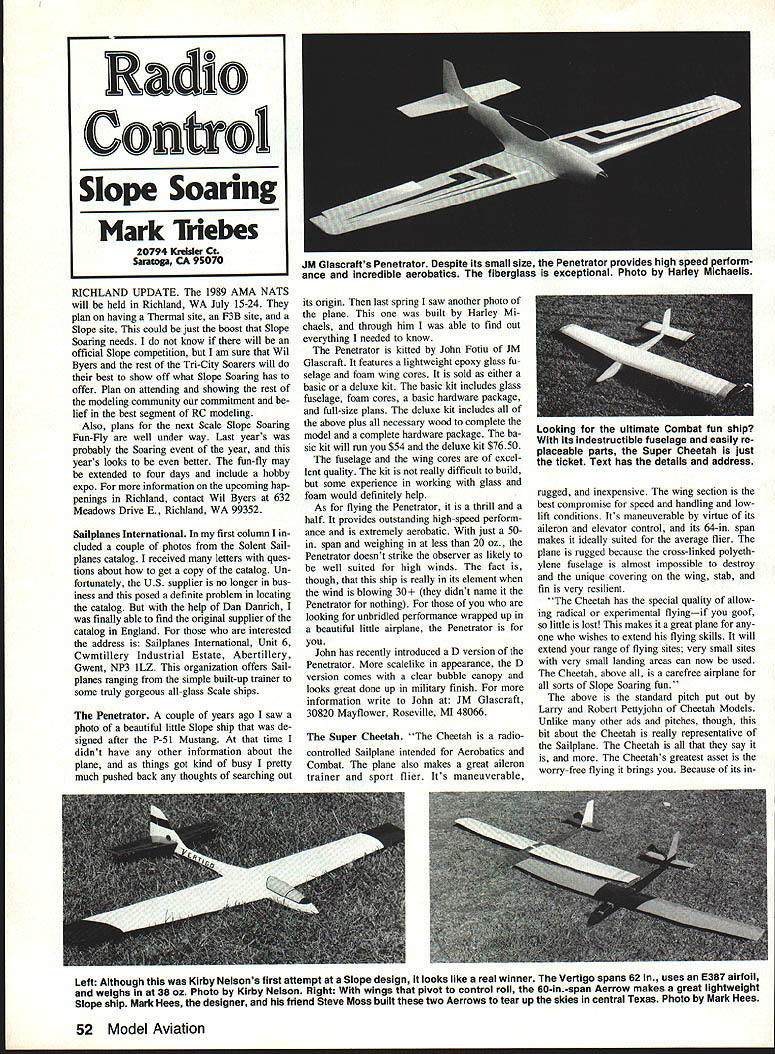
A couple of years ago I saw a photo of a beautiful little slope ship modeled after the P-51 Mustang. Later I discovered the plane was built by Harley Michaels and kitted by John Fotiu of JM Glascraft. The Penetrator features a lightweight epoxy/fiberglass fuselage and foam wing cores and is sold as either a basic or a deluxe kit.
- Basic kit (about $54): glass fuselage, foam cores, basic hardware package, full-size plans.
- Deluxe kit (about $76.50): everything in the basic kit plus all necessary wood to complete the model and a complete hardware package.
The fuselage and wing cores are high quality. The kit is not difficult to build, but some experience working with glass and foam helps.
Flying the Penetrator is a thrill — outstanding high-speed performance and highly aerobatic. With a 50 in. span and weighing less than 20 oz., it may not look suited for high winds, yet it excels in 30+ mph conditions. John has recently introduced a "D" version with a clear bubble canopy for a more scale appearance. For more information:
- JM Glascraft, 30820 Mayflower, Roseville, MI 48066
The Super Cheetah
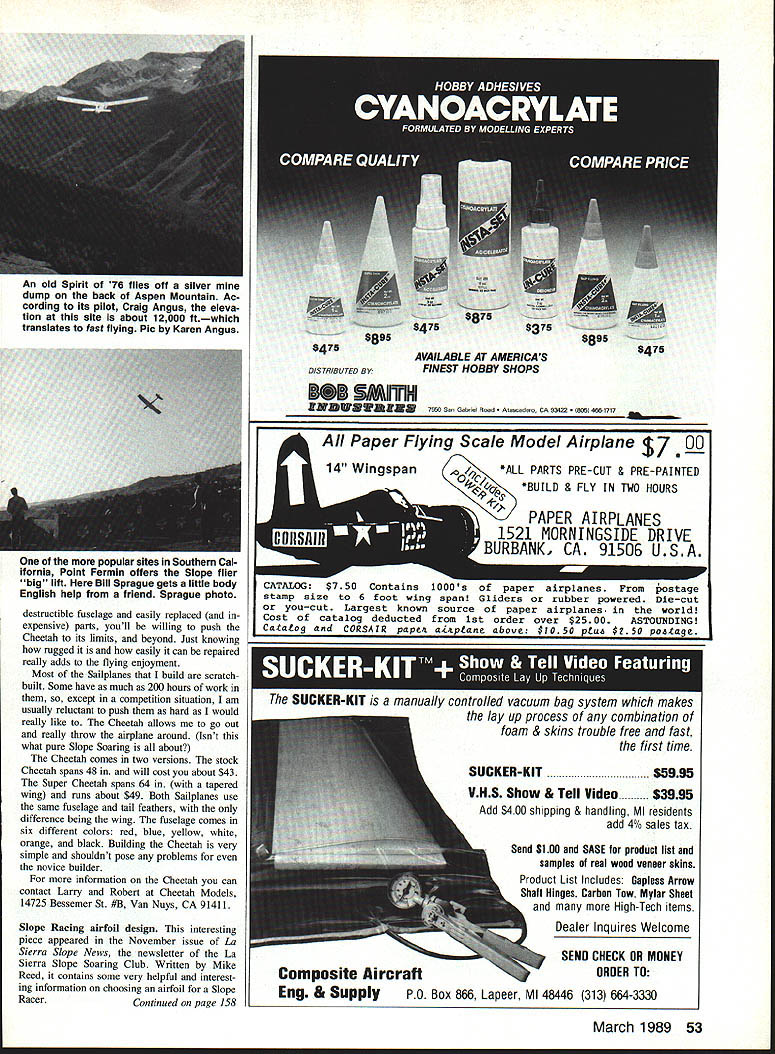
The Cheetah is an RC sailplane intended for aerobatics and combat; it also makes a great aileron trainer and sport flier. Key features:
- Maneuverable (ailerons and elevator control)
- Rugged (cross-linked polyethylene fuselage and resilient covering on wing, stab, and fin)
- Inexpensive and easy to repair — encourages radical or experimental flying
The Cheetah’s forgiving durability makes it ideal for pushing flying skills and using smaller or tighter sites. The model comes in two versions:
- Stock Cheetah: 48 in. span, about $43
- Super Cheetah: 64 in. span (tapered wing), about $49
Both use the same fuselage and tail surfaces. Fuselage colors include red, blue, yellow, white, orange, and black. Building is simple and suitable for novice builders.
For more information:
- Cheetah Models, 14725 Bessemer St. #B, Van Nuys, CA 91411
Slope Racing Airfoil Design
"As Slope Racers we demand more from our models than any other form of soaring. Slope gliders must be clean to retain aerodynamic efficiency — the lift-to-drag ratio (L/D) should be as high as possible. Structurally, slope ships must withstand high-G maneuvers, occasional glancing collisions with other aircraft, and landings on unforgiving, rock-infested terrain.
It is not difficult to design a sailplane that is fast in slightly level flight, but slope racers must execute 180° turns at each end of the course. For slope racing, few design factors are as important as airfoil selection. A 15%-thick, high-camber airfoil provides a lot of lift and may require several ounces or pounds of ballast to trim. That airfoil is great for turns but too slow on the long straight sections. Conversely, a very thin airfoil (for example, 6% thickness) may be faster in straight flight but will require much higher angle of attack in tight turns, generating more drag as flow separation moves forward. Highly loaded models with thin, low-camber airfoils may "mush-out" or tip-stall in a turn, often ending the race for that sailplane.
When a slope glider banks, the wing must generate more lift to counteract inertia: a 60° bank requires about 2 G, and an 85° bank about 9 G. A thicker, more cambered airfoil usually needs less angle of attack for the same turn, producing less drag and less speed reduction. Keep this in mind when selecting an airfoil for a slope racer.
Another factor is the type of lift available at the slope site. A model optimized for one slope can be a disaster at another. If you plan to use one model at many different slopes, seek a happy medium; if flying at a single, consistent slope, you can optimize the design for that location."
Variable Sweep Wings
Envision variable sweep: wings extended for low-speed stability and turning ability; wings swept back for high-speed stability and straight-line speed. Designing a sailplane to excel at both low-end and top-end performance is difficult; variable sweep could help but would introduce considerable complexity. The mechanism would need to:
- Sweep wings forward and backward reliably
- Shift ballast forward and backward to maintain CG as sweep changes
- Be strong enough to handle heavy loads encountered by slope racers
- Be compact and light enough for a sailplane installation
This is presented as a challenge to engineers interested in revolutionizing RC sailplanes.
Pivoting-Wing "Aerrow"
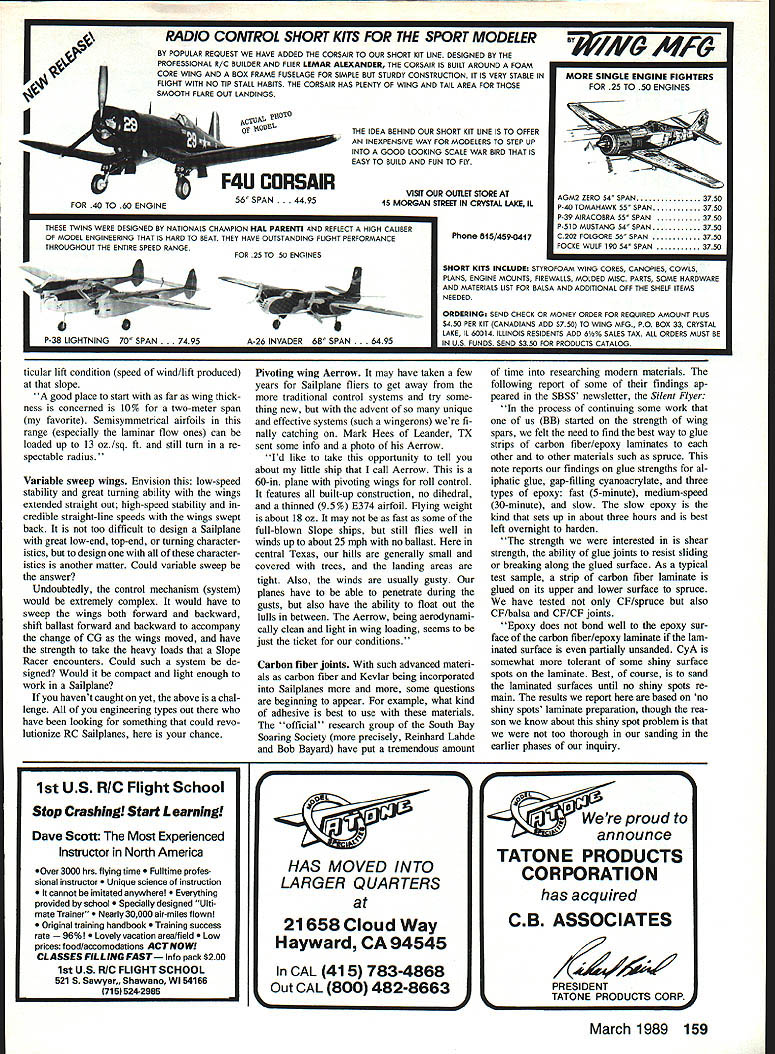
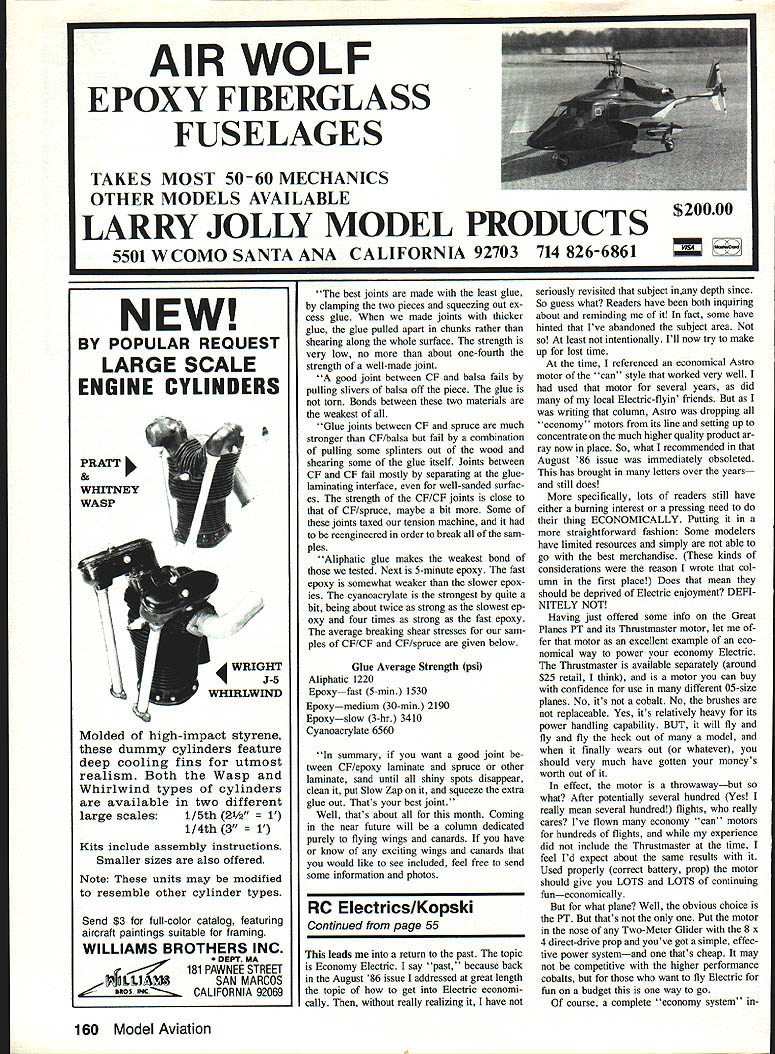
Mark Hees of Leander, TX, sent information about his plane called "Aerrow." Details:
- 60 in. span with pivoting wings for roll control
- All built-up construction, no dihedral
- Thinned (9.5%) E374 airfoil
- Flying weight about 18 oz.
- Flies well in winds up to about 25 mph with no ballast
He describes local conditions in central Texas: small, tree-covered hills, tight landing areas, and gusty winds. The Aerrow’s clean aerodynamics and light wing loading allow it to penetrate gusts and float during lulls, suiting those conditions.
Carbon Fiber Joints
As carbon fiber and Kevlar are used more in sailplanes, questions arise about adhesives and joint strength. The South Bay Soaring Society (Reinhard Lahde and Bob Bayard) conducted tests on glue strength for carbon-to-carbon (CF/CF), carbon-to-wood (CF/spruce, CF/balsa, CF/plywood), and epoxy-to-epoxy joints. Key findings:
- The strength of interest was shear strength (resistance to sliding or breaking along the glued interface).
- Epoxy does not bond well to a cured epoxy surface unless that surface is first abraded (sanded) to provide mechanical keying.
- Sanding and thorough cleaning of the cured epoxy surface markedly improve bond strength. Applying a thin film of fresh epoxy to the sanded surface before assembly sometimes improved results.
- Cyanoacrylate (CA) is somewhat more tolerant of shiny surfaces and can be used where access is limited, but it is not as consistent as epoxy for structural joints.
- Properly prepared epoxy joints (sanded, cleaned, and bonded with an appropriate epoxy system) approached the strength of the wood itself.
Careful surface preparation and selection of the appropriate epoxy system yielded the best and most consistent results.
Transcribed from original scans by AI. Minor OCR errors may remain.

