
RADIO CONTROL SLOPE SOARING
Wil Byers, Rt. 4, Box 9544, West Richland, WA 99352
I received several interesting items of news over the past couple of months; in this month's column I'll pass them along.
ES Designs & Models
A new company in Sandy, Utah has moved into the model business: ES Designs & Models. Its specialty is precision industrial models and patterns, and it is especially suited to building all sorts of models, including model gliders. ES is owned by Ed Skorepa, a master modeler and pattern maker.
Ed is a truly phenomenal model builder. I had the opportunity to visit his establishment and was awed by his display of craftsmanship. Previously, Ed offered his services only to commercial model and pattern making; he is now expanding his business to encompass his passion for model gliders. He is offering his services in the form of specialty wing kits and will bid custom jobs on request.
ES currently offers kits for six wing planforms and a couple of stabilizer planforms. The ES flyer states, "Our top-of-the-line wings and tails feature:"
- A composite spar, wing rod carrier system, and root rib installed.
- A composite-molded leading edge installed and completely finished.
- A trailing edge and hinge line with carbon-fiber reinforcement.
- Flaps and ailerons cut, faced, beveled, and completely finished.
- An anti-flutter carbon-fiber torsional reinforcement installed.
- Servo wells routed out with servo cover mounting rails installed under the skin.
ES wings are made in special presses that result in exact wing shapes and planforms. ES is offering these wings with different airfoils, including the RG-15, SD-8020, and others. "Available soon are more wing and tail planforms, different airfoils, a complete line of fine fiberglass fuselages, and complete kits," the company says.
ES Designs also has one of the finest-crafted foam-cutting machines I have seen. It is similar to most cutting machines offered by other manufacturers, except that it has been refined into a complete system of table, bow, and cutter. The system isn't cheap, but if you are serious about the hobby or have a business, you might consider the ES system.
A point about the bow system to go with the foam cutter: it is engineered to a high standard, well thought out for adjustment and wire tension.
For more information, contact ES Designs at 510 West 9460 South, Sandy, UT 84070. To expedite an information pack, call ES at (801) 567-9542.
Dry-Set Model Markings
Dry-Set Model Markings sent me a sample of dry-transfer markings. They were fantastic, and I instantly thought of a number of uses for them in my modeling.
Dry-transfer markings are similar to decals, only better. They are thin, bond well, and conform to the contour and texture of the model's surface. They readily adhere to painted finishes or iron-on coverings, and they will withstand the solvents in a clear coat. Dry-Set markings are accurate in detail, color, definition, and resolution.
These dry transfers are just what modelers have been looking for—especially scale buffs. Dry-Set appears to offer about 200 different transfers and can assist vintage, modern, and PSS scale builders/fliers.
For an information package, write or call Dry-Set at 7029 Sanger Avenue, Waco, TX 76710; Tel.: (800) 437-9738; Fax: (817) 741-0335.
Gus Morfis — Lockheed U-2 Plans
I received a nice letter from Gus Morfis: "I am interested in the PSS segment of the hobby. It seems to me that anyone who is into this specialized segment of RC model must at one time or another have considered modeling the Lockheed U-2! It is a natural. I have designed the enclosed U-2." He enclosed a very nice set of plans featuring a 65-inch wingspan with a wing area of 556 square inches. The model's aspect ratio is 10.2. Gus didn't specify the airfoil, but he said he'd be glad to pass that information along if you contact him.
Gus is offering the plans to anyone interested in building one. Write or drop Gus a line at 4709 Green Meadows Ave., Torrance, CA 90505-5507; Tel.: (310) 378-5679.
Quality Fiberglass — Eppler 203 and the DFS Habicht
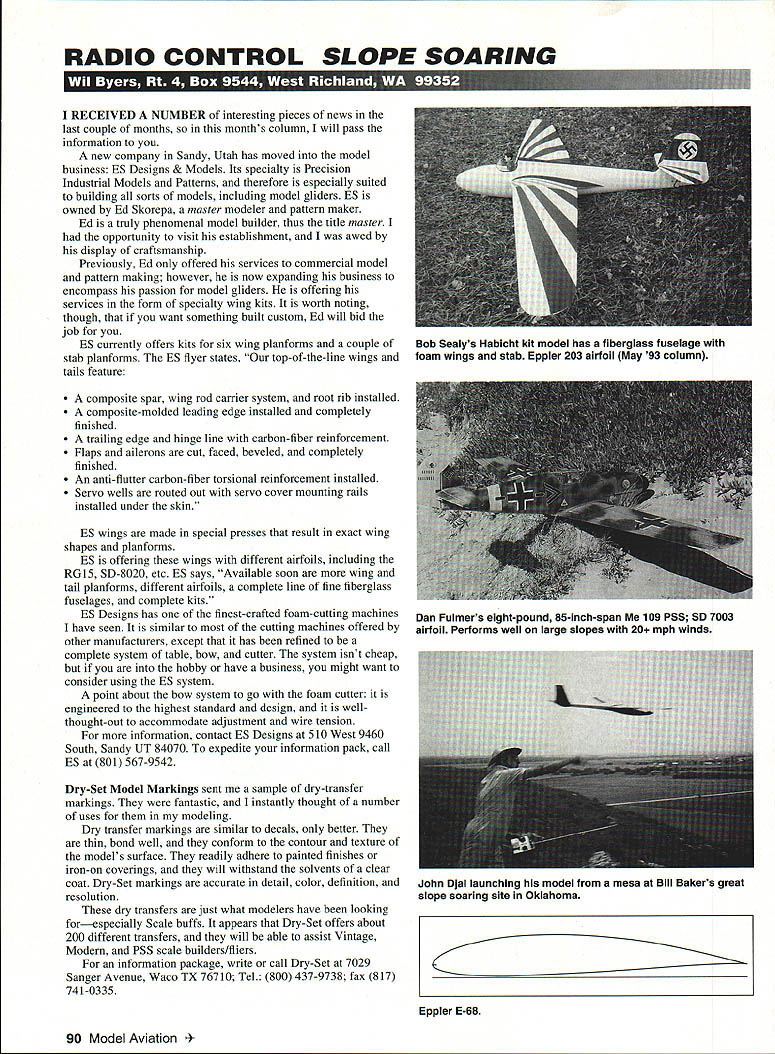
Bob Sealy of Quality Fiberglass (2530 Zeb Warren Road, Cookeville, TN 38501) sent an interesting letter responding to my mention of the Eppler 203 airfoil.
"I just received the March issue of Model Aviation. In your column, you noted the Eppler 203 as the airfoil of the month. You asked for any feedback on this airfoil. Well, guess what? This is the airfoil I chose for our latest scale design, a quarter-scale version of the DFS Habicht.
"At a flying weight of 10 pounds and a wing loading of 16 ounces per square foot, the E-203 performs beautifully. I have been very satisfied with its wide speed range and its thermalling ability.
"The Habicht has been flown both on the slope and in flat-land thermalling. Despite the large size, turning is a breeze with the large ailerons. The spoilers are functional, but due to the small scale size, they do not drop you out of the sky as fast as spoilers on a small two-meter design.
"To make landings on the slope a little easier, I have the ailerons set up for reflex ability. Definitely not a scale function, but I feel the full-size never had to land in an area as small as I do."
Bob's Habicht is available immediately in semi-kit form. The quarter-scale RC sailplane kit is $175. The kit includes an epoxy/fiberglass fuselage and canopy, wing cores, stab cores, rudder cores, plans, and instructions.
If you would like to call Bob, his number is (615) 526-4770.
SMaL Enterprises — F3B Eagle
Steve Lewis of SMaL Enterprises sent a press release stating that the F3B Eagle manufacturing rights have been purchased.
"SMaL Enterprises has obtained all rights to the F3B Eagle from Allen Development. The F3B Eagle is an all-molded composite sailplane designed to win F3B events. It has proven itself at the last two F3B World Championships by taking first and second at the 1991 Championships and recently taking second at the 1993 Championships."
Specifications for the F3B Eagle:
- Wingspan: 112.5 inches
- Wing area: 935 square inches
- Airfoil: RG-15 (SD-7003 optional)
- Aspect ratio: 13.5:1
- Stabilizer area: 100 square inches
- Weight minimum: 75–80 ounces
- Wing-loading maximum: 24 ounces per square foot
If you are interested in purchasing an Eagle, contact SMaL Enterprises at 2191 Rancho McCormick Blvd., Santa Clara, CA 95050; Tel.: (408) 554-8539.
Foam Cutting Tips from John Rimmer
I received a letter from John Rimmer, who had read my May '93 column on cutting foam cores. John offered several insights based on his experience cutting mostly with a cutting machine.
John's comments and tips:
- When constructed as shown, the templates cause the wing to be cut in the inverted position. This method is best because the hot wire can climb up over the smaller radius of the bottom of the wing easier than it could climb up and over the larger radius of the top of the wing.
- Make the templates conform exactly to the paper airfoil plot, except where the hot wire will start up and over the bottom of the airfoil at the leading edge. Round this corner to a small radius. Take care here, because this is a likely place for the hot wire to stall.
- Run your fingers over the template and look at it from one end held close to your eye; remove any imperfections you might see or feel. Make sure you have a good conformation to the airfoil and that the edge finish has no scratches. Small scratches can cause the hot wire to begin vibrating, creating a washboard surface on the core.
- A little Teflon lubricant sprayed on the core or on the Formica templates will help decrease friction.
John provided a complete set of instructions for his cutting method, and they are quite good. His pointer about rounding the leading edge is especially helpful, since a steep leading edge radius can cause the wire to stick. His caution about making the templates smooth is also important: any imperfections in the template will be passed on to the foam. In the past I have even waxed my templates with good results—the goal is to reduce friction between the wire and the template.
If you need help with foam cutting or are just beginning, contact John at 2308 Rosebud, Victoria, TX 77901.
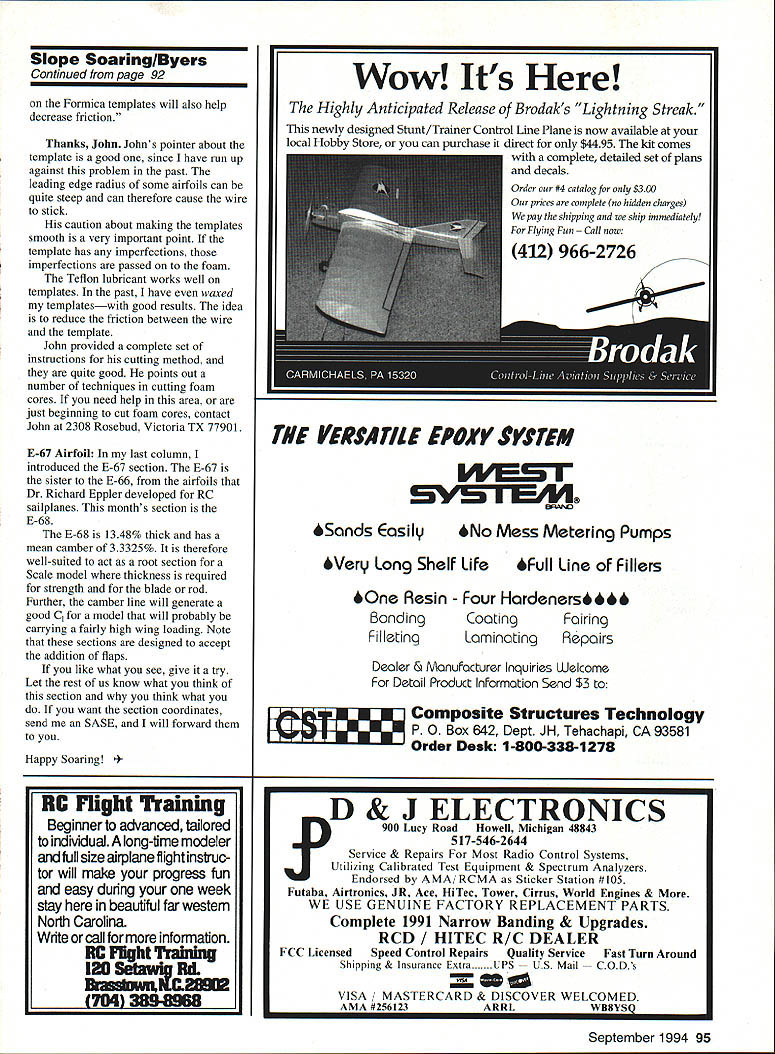
E-68 Airfoil
In my last column I introduced the E-67 section. The E-67 is a sister to the E-66, both developed by Dr. Richard Eppler for RC sailplanes. This month's section is the E-68.
The E-68 is 13.48% thick and has a mean camber of 3.3325%. It is well-suited to act as a root section for a scale model where thickness is required for strength and for the blade or rod. The camber line will generate a good Cl for a model that will likely be carrying a fairly high wing loading. Note that these sections are designed to accept the addition of flaps.
If you want the section coordinates, send me an SASE and I will forward them to you. Let the rest of us know what you think of this section and why.
Happy soaring!
Transcribed from original scans by AI. Minor OCR errors may remain.

