
RADIO CONTROL SLOPE SOARING
Wil Byers, Rt. 4, Box 9544, West Richland, WA 99352
Do you remember what it was about aviation that first stimulated your interest and enthusiasm? What sparked your interest in modeling? Whatever it was, I'm glad you're reading this magazine and that you have a keen interest in this great hobby/sport. One question that plagues modelers is how to get new people involved — specifically, how to involve children. Considering today's alternatives to aviation, it's a tough question to answer. Nonetheless, it's a question modelers and clubs should address.
Some may wonder whether we should try to involve new people. Getting people involved is the right thing to do. Introducing people to modeling benefits everyone — not least because it will make you feel good. You'll enjoy helping others become involved and have fun. The involvement process may even assist a youngster in making a responsible recreational choice in our challenging society.
I'll share an insight from an individual who is new to RC Soaring. My friend Eric Chien had long been interested but until recently the time wasn't right. In spring 1994 he made the plunge and has good things to say about the hobby:
When his son Chris turned thirteen, they decided to try RC Soaring. They located a nearly new Olympic II sailplane with radio gear and made the purchase. Their greatest fear the first time out at slope soaring was that Chris would rapidly destroy the new glider. After four or five outings they were happy to report no significant repairs were required. The presence of a competent instructor gave Eric immense confidence and allowed them to take chances and learn rapidly. Last time out Chris was able to launch, soar, and land solo several times and felt a real sense of accomplishment. Even with Chris away part of the summer, he progressed to soaring the glider 10–15 minutes with only minimal assistance.
Soaring is exhilarating because of the peace and quiet. Slope locations in our area overlook great expanses of wheat fields and small towns — picturesque views that sometimes inspire regret when we forget the camera. Time spent soaring is a welcome relief from job stress and demands. Eric and Chris also find great satisfaction in learning a new hobby together; opportunities for a parent and child to share common interests are getting harder to find. At this point, soaring is still a great adventure — everything is new.
Airfoil of the month: The E231
The Eppler 231 (E231) is a section designed by Dr. Eppler for RC Soaring enthusiasts who like to go fast. It has a thickness of 12.34% of chord and features an especially low-drag bucket for angles of attack between −2° and +3°. It was designed to operate at Reynolds numbers between 50,000 and 1,000,000. The E231 has a moment coefficient, Cmo, of approximately −0.04.
FAMILY, YOUTH, AND THE FUTURE OF SOARING
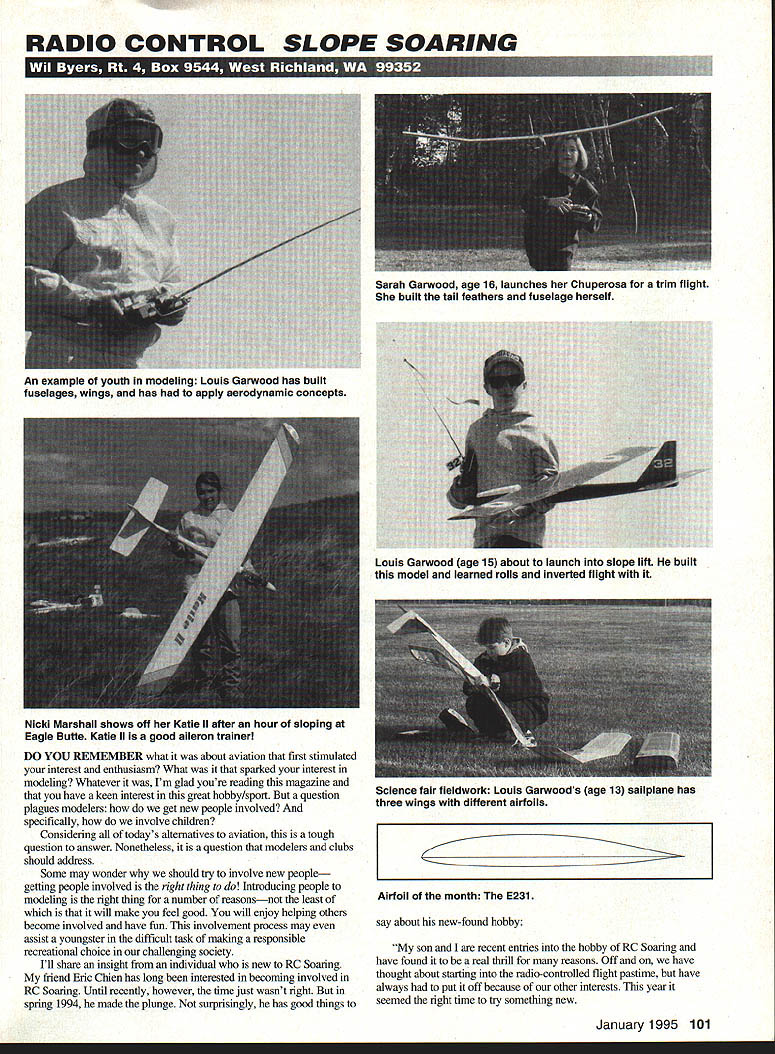
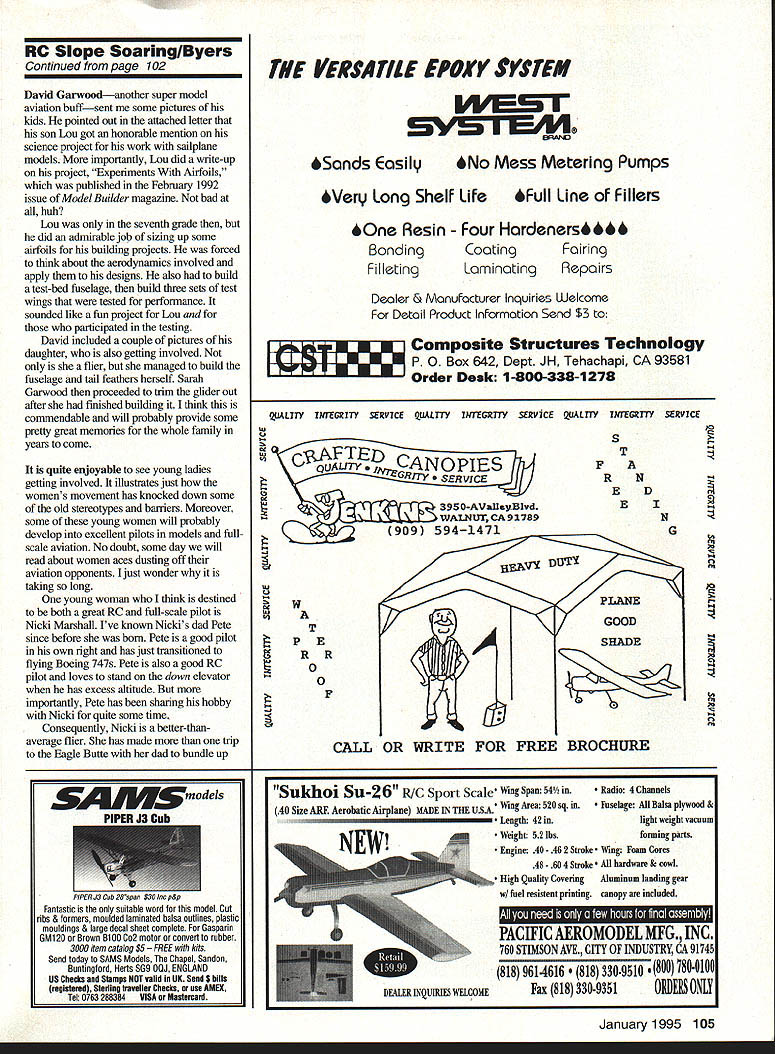
David Garwood sent pictures of his kids and related how his son Lou received an honorable mention for a science project on sailplane models. Lou's project, "Experiments With Airfoils," was published in Model Builder (February 1992). In seventh grade he sized up airfoils, thought about aerodynamics, built a test-bed fuselage, and tested three sets of wings — a great hands-on learning experience.
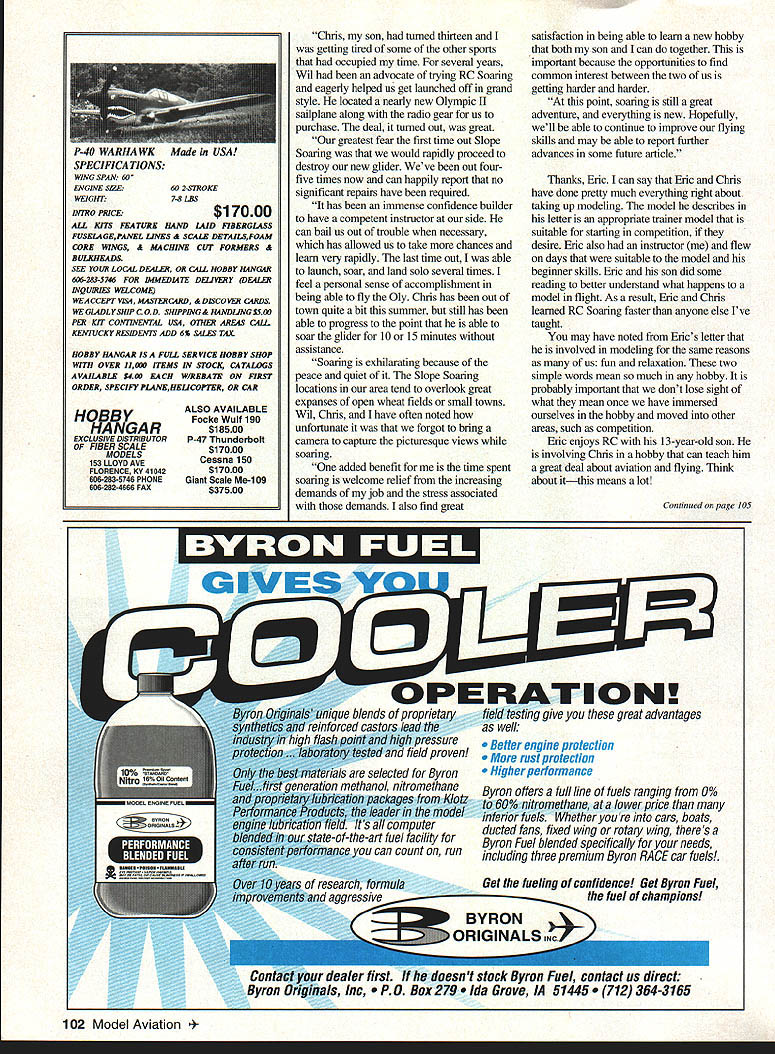
David's daughter Sarah also got involved: she built the fuselage and tail feathers herself and then trimmed the glider out. It's commendable and will create lasting family memories.
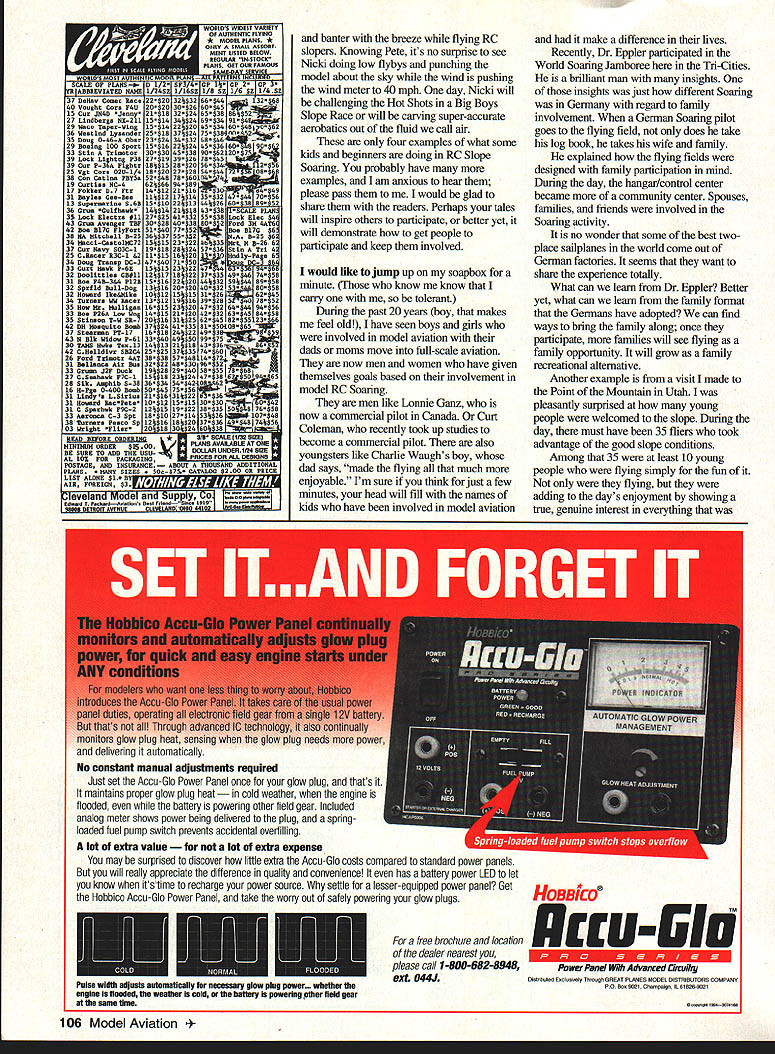
It's enjoyable to see young women getting involved; the old stereotypes and barriers are breaking down. Some of these young women will likely become excellent model pilots and eventually full-scale pilots. One promising example is Nicki Marshall. Her father Pete, a good pilot who now flies Boeing 747s, has shared the hobby with Nicki from an early age. Nicki is already a better-than-average flier, flying in challenging conditions and performing low flybys and energetic maneuvers. One day she may be challenging the Hot Shots in a big slope race or carving super-accurate aerobatics.
These are only a few examples of what kids and beginners are doing in RC slope soaring. You probably have many more examples — please pass them along. Sharing these tales can inspire others and demonstrate ways to attract and retain new participants.
Why family involvement matters
Over the past 20 years I’ve seen boys and girls involved in model aviation with their parents move into full-scale aviation and set meaningful goals based on their model experience. Examples include men who became commercial pilots and youngsters who gained lifelong enthusiasm for flying. If you think for a few minutes, you’ll recall names of kids whose lives were influenced by model aviation.
Dr. Eppler, who participated in the World Soaring Jamboree here in the Tri-Cities, observed how different soaring is in Germany with regard to family involvement. When a German soaring pilot goes to the field he often takes his wife and family. Flying fields there are designed with families in mind; the hangar/control center becomes more of a community center where spouses, families, and friends participate. It’s no wonder some of the best two-place sailplanes come from German factories — they share the experience totally.
What can we learn from this family format? Find ways to bring the family along. Once families participate, more will see flying as a family recreational option.
A visit to the Point of the Mountain in Utah was encouraging: about 35 fliers took advantage of good slope conditions, and at least 10 young people were flying simply for the fun of it. I don't know exactly what the Intermountain Silent Flyers did to attract these young people, but whatever it was, it worked.
Nearby, the Moses Lake R/C Modelers of Washington used club funds to buy a trainer system for potential fliers and members. A trainer can be expensive to build, operate, and repair, so this club's commitment impressed me. It shows an investment of time and money to support modeling and bring new people in.
The level of effort to attract new participants doesn't matter — it's worthwhile. While modeling may not receive large corporate sponsorship like some sports, modeling can still make a difference in a young person's life by offering positive recreational alternatives. As youth crime and social problems increase, perhaps we should view modeling as a constructive alternative — not about being the best flier, but being generous enough to give someone a chance to participate and discover a new way to relax and enjoy themselves.
I'll step off the soapbox and invite anyone with more ideas for bringing young people into modeling to write to MA. Your thoughts are important to all of us.
RESOURCES
If you decide to help someone get involved, provide them with reading materials. Wise Owl Worldwide Publications (WOW) offers books and magazines that help newcomers learn the hows and whys of the hobby.
Some useful titles and magazines:
- Radio Control Gliding (basics and advanced concepts of RC soaring)
- Molding & Glass Fiber Techniques
- Flying Radio Control Aerobatics
- Covering Model Aircraft
- Silent Flight (specialty magazine dedicated to RC soaring)
- Quiet Flight (specialty magazine dedicated to RC soaring)
Contact: Wise Owl Worldwide Publications, 4314 West 238th Street, Torrance, CA 90505-4509; Tel.: (310) 375-6258; Fax: (310) 375-0548.
If you have success stories, club initiatives, or ideas for involving youth and families in RC soaring, please send them in — they'd be valuable to other readers. Thanks.
Transcribed from original scans by AI. Minor OCR errors may remain.

