
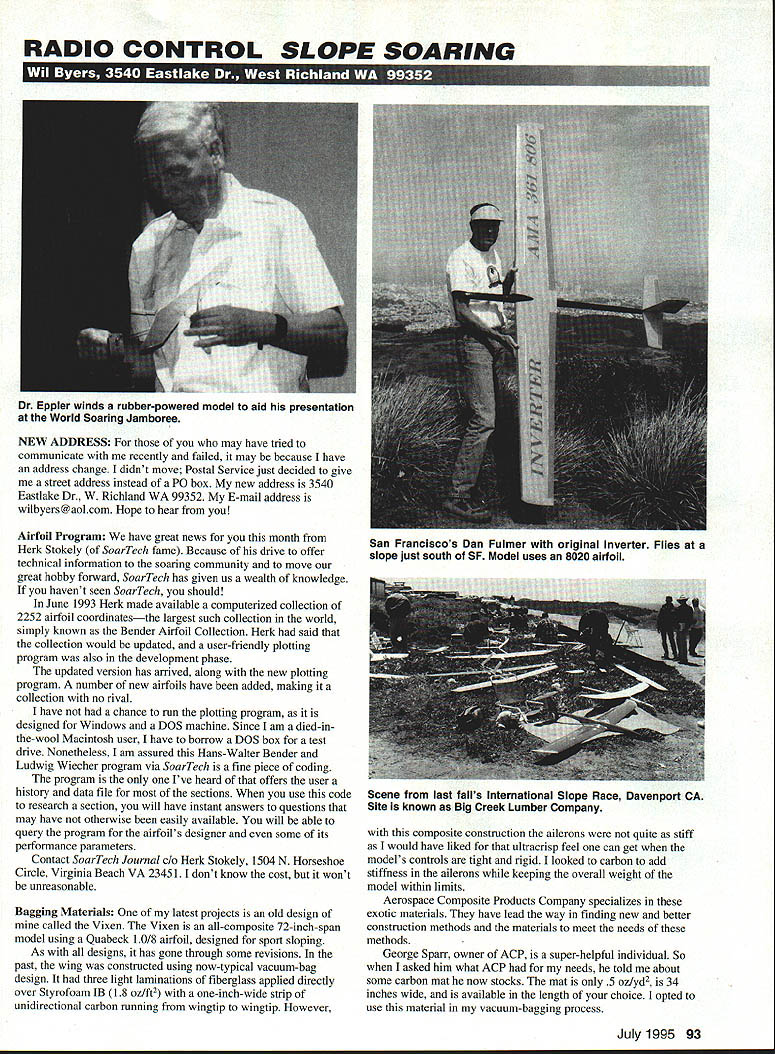
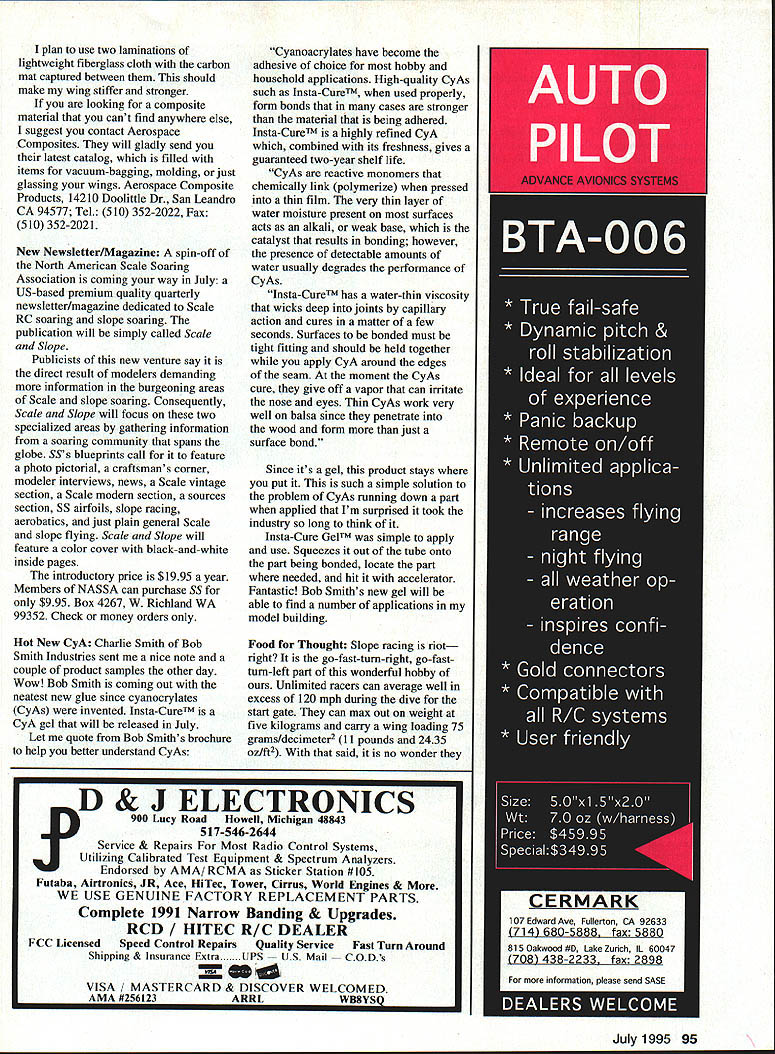
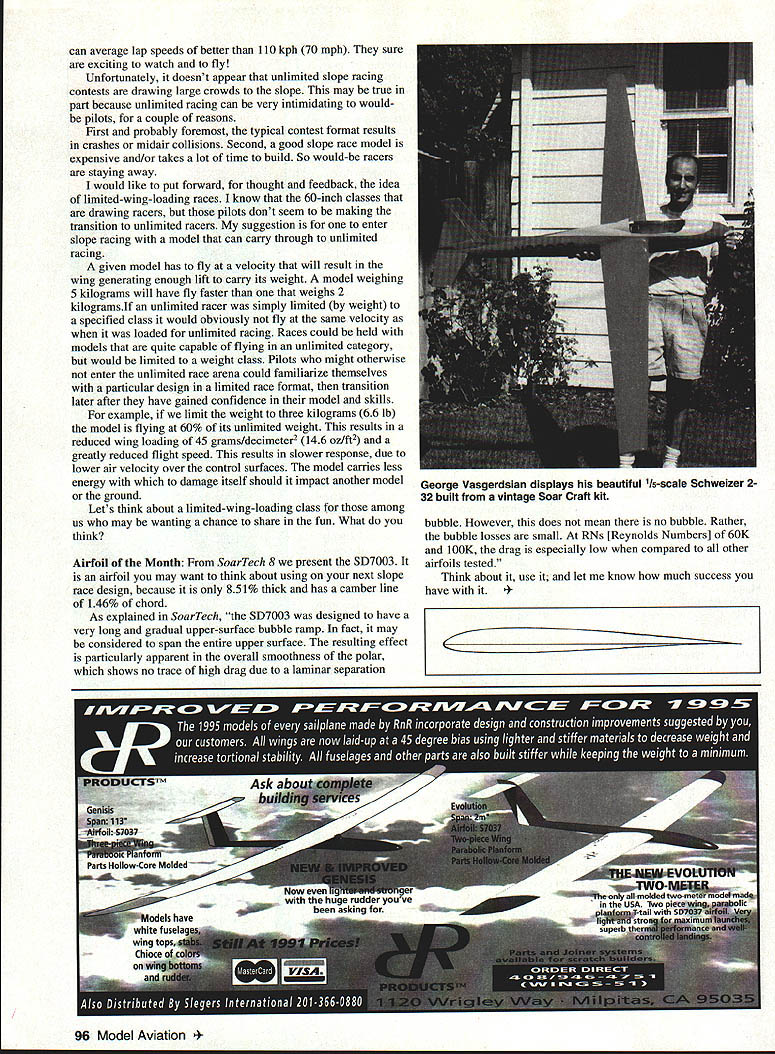
RADIO CONTROL SLOPE SOARING
Wil Byers, 3540 Eastlake Dr., West Richland WA 99352
New address
For those of you who may have tried to communicate with me recently and failed, it may be because I have an address change. I didn't move; the Postal Service just decided to give me a street address instead of a P.O. box. My new address is 3540 Eastlake Dr., W. Richland WA 99352. My E-mail address is wilbyers@aol.com. Hope to hear from you!
Airfoil program
We have great news this month from Herk Stokely (of SoarTech fame). Because of his drive to offer technical information to the soaring community and to move our great hobby forward, SoarTech has given us a wealth of knowledge. If you haven't seen SoarTech, you should!
In June 1993 Herk made available a computerized collection of 2,252 airfoil coordinates — the largest such collection in the world, simply known as the Bender Airfoil Collection. Herk had said that the collection would be updated, and a user-friendly plotting program was also in the development phase.
The updated version has arrived, along with the new plotting program. A number of new airfoils have been added, making it a collection with no rival.
I have not had a chance to run the plotting program, as it is designed for Windows and DOS. Since I am a die-hard Macintosh user, I have to borrow a DOS box for a test drive. Nonetheless, I am assured this Hans-Walter Bender and Ludwig Wiecher program via SoarTech is a fine piece of coding. The program is the only one I've heard of that offers the user a history and data file for most of the sections. When you use this code to research a section, you will have instant answers to questions that may not otherwise be easily available. You will be able to query the program for the airfoil's designer and even some of its performance parameters.
Contact:
- SoarTech Journal c/o Herk Stokely, 1504 N. Horseshoe Circle, Virginia Beach VA 23451. I don't know the cost, but it won't be unreasonable.
Bagging materials
One of my latest projects is an old design of mine called the Vixen. The Vixen is an all-composite 72-inch-span model using a Quabeck 10/8 airfoil designed for sport sloping. As with all designs, it has gone through some revisions. In the past, the wing was constructed using now-typical vacuum-bagging design. It had three light laminations of fiberglass applied directly over Styrofoam IB (1.8 oz/ft^2) and a one-inch-wide strip of unidirectional carbon running from wingtip to wingtip. However, with this composite construction the ailerons were not quite as stiff as I would have liked for that ultra-crisp feel one can get when the model's controls are tight and rigid. I looked to carbon to add stiffness in the ailerons while keeping the overall weight of the model within limits.
Aerospace Composite Products Company specializes in these exotic materials. They have led the way in finding new and better construction methods and the materials to meet the needs of these methods.
George Sparr, owner of ACP, is a super-helpful individual. So when I asked him what ACP had for my needs, he told me about some carbon mat he now stocks. The mat is only 5 oz/yd^2, is 34 inches wide, and is available in the length of your choice. I opted to use this material in my vacuum-bagging process. I plan to use two laminations of lightweight fiberglass cloth with the carbon mat captured between them. This should make my wing stiffer and stronger.
If you are looking for a composite material that you can't find anywhere else, I suggest you contact Aerospace Composite Products. They will gladly send you their latest catalog, which is filled with items for vacuum-bagging, molding, or just glassing your wings.
Contact:
- Aerospace Composite Products, 14210 Doolittle Dr., San Leandro CA 94577
- Tel: (510) 352-2022
- Fax: (510) 352-2021
New newsletter/magazine
A spin-off of the North American Scale Soaring Association is coming your way in July: a US-based premium-quality quarterly newsletter/magazine dedicated to Scale RC soaring and slope soaring. The publication will be simply called Scale and Slope.
Publicists of this new venture say it is the direct result of modelers demanding more information in the burgeoning areas of Scale and slope soaring. Consequently, Scale and Slope will focus on these two specialized areas by gathering information from a soaring community that spans the globe. SS's blueprints call for it to feature a photo pictorial, a craftsman's corner, modeler interviews, news, a Scale vintage section, a Scale modern section, a sources section, SS airfoils, slope racing, aerobatics, and general Scale and slope flying. Scale and Slope will feature a color cover with black-and-white inside pages.
Subscription:
- Introductory price: $19.95 a year.
- NASSA members: $9.95 a year.
- Mail: Box 4267, W. Richland WA 99352. Check or money orders only.
Hot new CyA
Charlie Smith of Bob Smith Industries sent me a nice note and a couple of product samples the other day. Wow! Bob Smith is coming out with the neatest new glue since cyanoacrylates (CyAs) were invented. Insta-Cure™ is a CyA gel that will be released in July.
From Bob Smith's brochure:
"Cyanoacrylates have become the adhesive of choice for most hobby and household applications. High-quality CyAs such as Insta-Cure™, when used properly, form bonds that in many cases are stronger than the material that is being adhered. Insta-Cure™ is a highly refined CyA which, combined with its freshness, gives a guaranteed two-year shelf life."
"CyAs are reactive monomers that chemically link (polymerize) when pressed into a thin film. The very thin layer of moisture present on most surfaces acts as an alkali, or weak base, which is the catalyst that results in bonding; however, the presence of detectable amounts of water usually degrades the performance of CyAs."
"Insta-Cure™ has a water-thin viscosity that wicks deep into joints by capillary action and cures in a matter of a few seconds. Surfaces to be bonded must be tight fitting and should be held together while you apply CyA around the edges of the seam. At the moment the CyAs cure, they give off a vapor that can irritate the nose and eyes. Thin CyAs work very well on balsa since they penetrate into the wood and form more than just a surface bond."
Since it's a gel, this product stays where you put it. This is such a simple solution to the problem of CyAs running down a part when applied that I'm surprised it took the industry so long to think of it.
Insta-Cure Gel was simple to apply and use. Squeeze it out of the tube onto the part being bonded, locate the part where needed, and hit it with accelerator. Fantastic! Bob Smith's new gel will be able to find a number of applications in my model building.
Food for thought
Slope racing is a riot—right? It is the go-fast-turn-right, go-fast-turn-left part of this wonderful hobby of ours. Unlimited racers can average well in excess of 120 mph during the drive for the start gate. They can max out on weight at five kilograms and carry a wing loading of 75 grams/decimeter^2 (11 pounds and 24.35 oz/ft^2). With that said, it is no wonder they can average lap speeds of better than 110 kph (70 mph). They sure are exciting to watch and to fly!
Unfortunately, it doesn't appear that unlimited slope racing contests are drawing large crowds to the slope. This may be true in part because unlimited racing can be very intimidating to would-be pilots, for a couple of reasons.
First and probably foremost, the typical contest format results in crashes or midair collisions. Second, a good slope race model is expensive and/or takes a lot of time to build. So would-be racers are staying away.
I would like to put forward, for thought and feedback, the idea of limited-wing-loading races. I know that the 60-inch classes are drawing racers, but those pilots don't seem to be making the transition to unlimited racers. My suggestion is for one to enter slope racing with a model that can carry through to unlimited racing.
A given model has to fly at a velocity that will result in the wing generating enough lift to carry its weight. A model weighing 5 kilograms will fly faster than one that weighs 2 kilograms. If an unlimited racer was simply limited (by weight) to a specified class it would obviously not fly at the same velocity as when it was loaded for unlimited racing. Races could be held with models that are quite capable of flying in an unlimited category, but would be limited to a weight class. Pilots who might otherwise not enter the unlimited race arena could familiarize themselves with a particular design in a limited race format, then transition later after they have gained confidence in their model and skills.
For example, if we limit the weight to three kilograms (6.6 lb) the model is flying at 60% of its unlimited weight (assuming 5 kg unlimited). This results in a reduced wing loading of 45 grams/decimeter^2 (14.6 oz/ft^2) and a greatly reduced flight speed. This results in slower response, due to lower air velocity over the control surfaces. The model carries less energy with which to damage itself should it impact another model or the ground.
Let's think about a limited-wing-loading class for those among us who may be wanting a chance to share in the fun. What do you think?
Airfoil of the month
From SoarTech we present the SD7003. It is an airfoil you may want to think about using on your next slope race design, because it is only 8.51% thick and has a camber line of 1.46% of chord.
As explained in SoarTech, "The SD7003 was designed to have a very long and gradual upper-surface bubble ramp. In fact, it may be considered to span the entire upper surface. The resulting effect is particularly apparent in the overall smoothness of the polar, which shows no trace of high drag due to a laminar separation bubble." However, this does not mean there is no bubble. Rather, the bubble losses are small. At Reynolds numbers (Re) of 60K and 100K, the drag is especially low when compared to all other airfoils tested.
Think about it, use it; and let me know how much success you have with it.
Transcribed from original scans by AI. Minor OCR errors may remain.

