
Radio Control: Slope Soaring
By Wil Byers
3540 Eastlake Dr., West Richland, WA 99352
Historic context
Historically, slope soaring hasn't produced large-participation competitions or events. Organizers are often inhibited by the nature of the flying environment: slope soaring's total dependence on wind to generate lift isn't conducive to scheduling. If the wind doesn't blow, a slope event becomes a thermal affair.
Consequently, standout slope-soaring events are few. Memorable events include:
- International Slope Races
- Torrey Pines Scale Fun Fly
- Mid-Columbia Slope Races
- Tri-Cities Scale Fun Flies
- World Soaring Jamboree
The Los Banos Slope Scale Soar-In
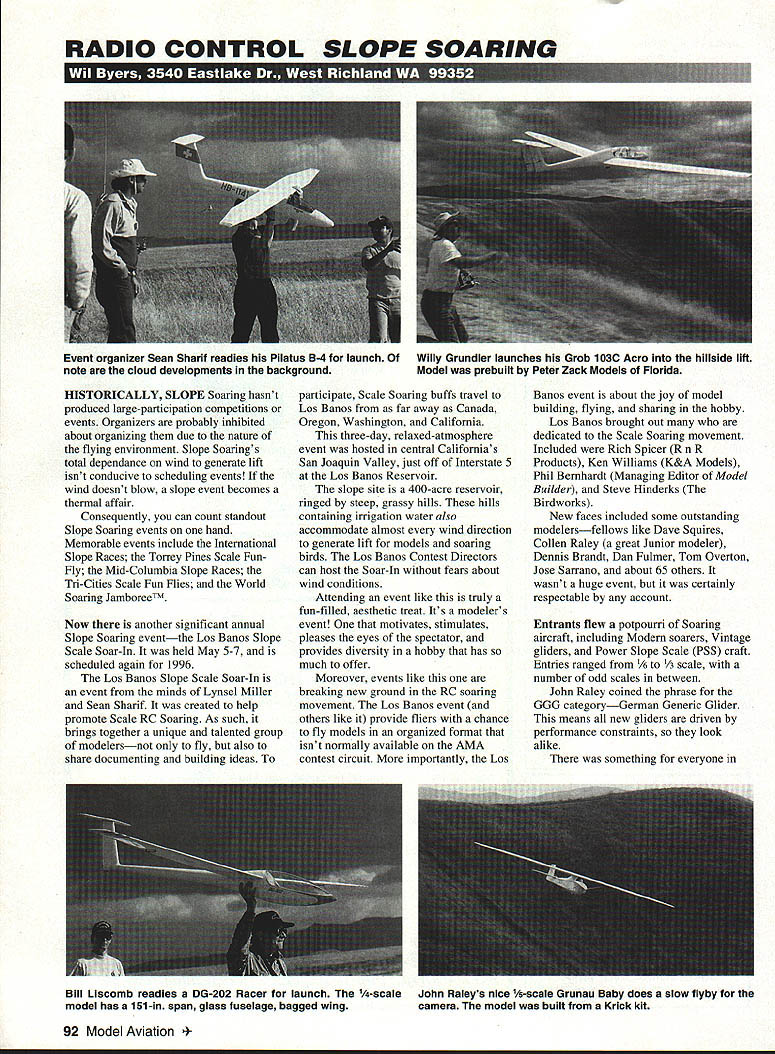
Now there is another significant annual slope-soaring event — the Los Banos Slope Scale Soar-In. The meet described here was held May 5–7 and is scheduled again for 1996. Created by Lynsel Miller and Sean Sharif, it was intended to promote scale RC soaring. The event brings together a unique and talented group of modelers to fly, share, document, and build ideas. Participants travel to Los Banos from as far away as Canada, Oregon, Washington, and across California.
This three-day, relaxed-atmosphere event was hosted in central California’s San Joaquin Valley, just off Interstate 5 at the Los Banos Reservoir.
The site
The slope site is a 400-acre reservoir ringed by steep, grassy hills. These hills, containing irrigation water, accommodate almost every wind direction to generate lift for models and soaring birds. Because of the site's geography, the Los Banos directors can host the Soar-In without fears about wind conditions.
Attending an event like this is a fun, aesthetic treat — a modeler’s event that motivates, stimulates, pleases the eye, and provides diversity in a hobby that has much to offer. Events like this are breaking new ground in the RC soaring movement by providing organized flying opportunities not normally available on the AMA contest circuit. More importantly, the Los Banos event is about the joy of model building, flying, and sharing in the hobby.
Participants and notable attendees
Los Banos attracted many dedicated to the scale-soaring movement, including:
- Rich Spicer (R & R Products)
- Ken Williams (K & A Models)
- Phil Bernhardt (Managing Editor of Model Builder)
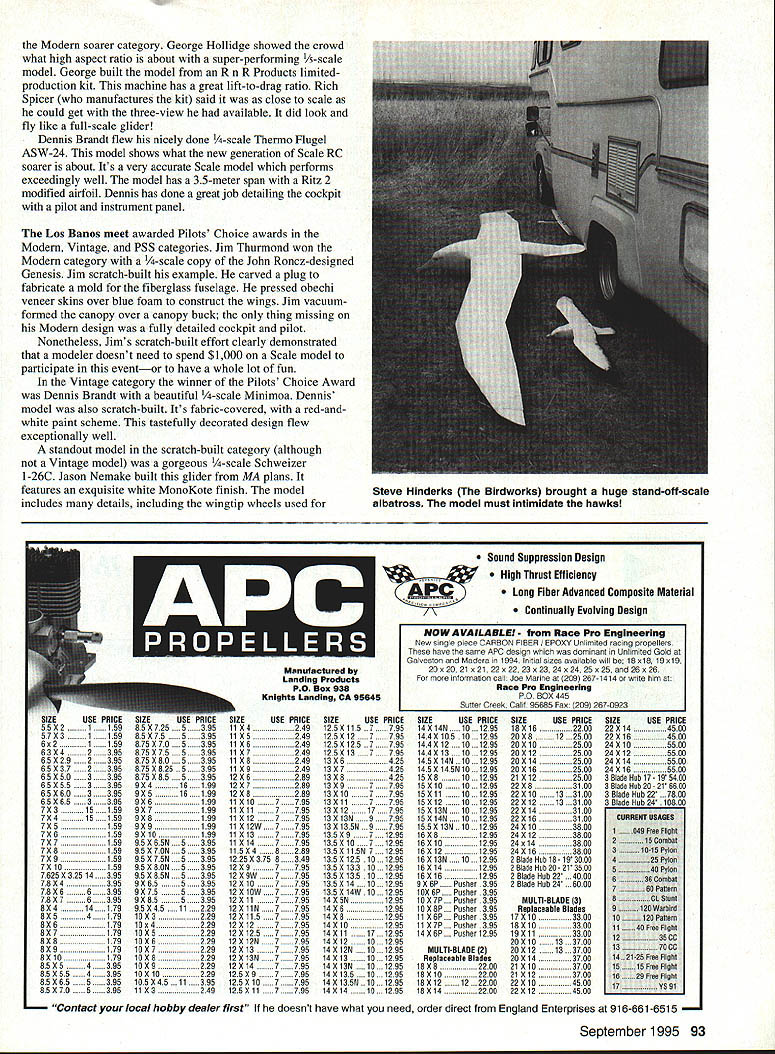
- Steve Hinderks (The Birdworks)
New faces and outstanding modelers included:
- Dave Squires
- Collen Raley (a promising junior modeler)
- Dennis Brandt
- Dan Fulmer
- Tom Overton
- Jose Sarrano
- About 65 other entrants
It wasn't a huge event, but it was certainly respectable.
Categories and entries
Entrants flew a potpourri of soaring aircraft, including modern soarers, vintage gliders, and Power Slope Scale (PSS) craft. Entries ranged from 1/6 to 1/3 scale, with a number of odd scales in between.
John Raley coined the phrase GGG — German Generic Glider — to describe how many new gliders, driven by performance constraints, tend to look alike.
#### Modern soarers
- George Hollidge showed what a high aspect ratio can do with a super-performing 1/5-scale model built from an R & R Products limited-production kit. The model had an excellent lift-to-drag ratio; Rich Spicer (who manufactures the kit) noted it was as close to scale as possible given the available three-view.
- Dennis Brandt flew a nicely done 1/4-scale Thermo Flugel ASW-24. This very accurate scale model performs exceedingly well. The model has a 3.5-meter span with a Ritz 2 modified airfoil. Dennis detailed the cockpit with a pilot and instrument panel.
The Pilots' Choice award in the Modern category went to Jim Thurmond for a 1/4-scale copy of the John Roncz–designed Genesis. Jim scratch-built his example: he carved a plug to fabricate a mold for the fiberglass fuselage, pressed obeche veneer skins over blue foam wings, and vacuum-formed the canopy over a canopy buck. The only major omission was a fully detailed cockpit and pilot. Jim’s scratch-built effort demonstrated that a modeler doesn't need to spend $1,000 on a scale model to participate and have fun.
#### Vintage
- Dennis Brandt won the Pilots' Choice Award in the Vintage category with a beautiful 1/4-scale Minimoa. The scratch-built model is fabric-covered with a red-and-white paint scheme and flew exceptionally well.
A standout scratch-built (non-vintage) model was a gorgeous 1/4-scale Schweizer 1-26C built by Jason Nemake from MA plans. It features an exquisite white MonoKote finish and many details, including wingtip wheels used on the full-scale version for ground handling.
Jason’s 1-26C specifics:
- Wingspan: 120 inches
- Weight: 6 pounds
- Total wing area: 1,560 in²
- Wing loading: 9 oz/ft²
- Radio: five-channel
I witnessed one aerotow flight: after release the model climbed until it dotted out, descended to within 20 feet of the ground, found a thermal, and climbed back out — an impressive performance.
#### Power Slope Scale (PSS)
There were many entrants on the PSS side. Highlights include:
- Jose Sarrano — Winner with an A-6 Intruder. Built from a Larry Jolly Models fuselage, Jose sheeted foam-core wings with balsa. The 42-inch wing uses an all-balsa full-flying stabilizer with a 3021 airfoil. The A-6 has an all-up flying weight of only 2 pounds (wing loading ~16 oz/ft²). At that weight it flew well in light air and penetrated well when winds increased.
- Dan Fulmer — Brought notable PSS models including a Bell Kingcobra and a P-38 Lightning. The Kingcobra: 70-inch span, SD-8000 airfoil, 7 pounds, wing loading ~22 oz/ft². The P-38: 106-inch span, 3021 airfoil, 7.5 pounds, wing loading ~12 oz/ft² (a light-wind airplane).
- K & A Models — Showed a complete line of PSS gliders: P-38 Lightning, Curtiss P-40 Warhawk, and P-51 Mustang. All are nicely done in glass and foam.
- P-38: 50-inch span, 42 ounces
- P-40: 38-inch span, 30 ounces
- P-51: 36-inch span, 28 ounces
Contact: K & A Models, 60659 Faculty Ave., Lakewood, CA 90712; Tel: (310) 804-0006.
- Tom Overton — Built one of the biggest PSS models at Los Banos, a Messerschmitt Bf 110 from a Dwight Warner kit. Specs: 126-inch wingspan, 30 pounds, all-composite construction (fiberglass fuselage, glassed wings). Tom launches it with a bungy-catapult system; winds need to be at least 35 mph. When flown it cruised at about 40 mph. Parked next to Lynsel’s big Bf 109, it looked like war was about to break out.
Many models stood out, but the overall Pilots' Choice award went to an Albatros built by Steve Hinderks. The aircraft was nearly as big as Steve's motorhome. It did not get off the ground while I was there, but it must be impressive in flight.
Aerotowing
One particularly interesting part of the event was aerotowing. When there was no wind, organizers arranged for a couple of tugs to launch models. One tug was a WACO UPF-7 using a stock Precision Eagle gas engine; even while pulling a glider, with Dick Miller at the controls the tug climbed effortlessly. The other tug was a 1/4-scale Super Cub; like the WACO, it pulled gliders without trouble.
Conclusion
All in all, the Los Banos Slope Scale Soar-In was great fun; I plan to attend next year. The organizers did a fine job planning the event, and the wind was as cooperative as can be expected. Most importantly, the entrants had a fun time and everyone in attendance learned something. You may want to mark this event on your calendar for next year. See you there!
Transcribed from original scans by AI. Minor OCR errors may remain.

