
Radio Control: Slope Soaring
By Wil Byers
3540 Eastlake Dr., West Richland, WA 99352
Introduction
About four weeks ago I received a call from an enthusiastic beginner who wanted to know what kind of model to purchase for the transition to slope soaring. We discussed the issues related to the kind of flying he wanted to do and arrived at what I hope was a good decision for him. Afterward, this flier encouraged me to share my insights with other modelers who might also be in the same predicament.
Current project: 1/4-scale Robbe ASH-26
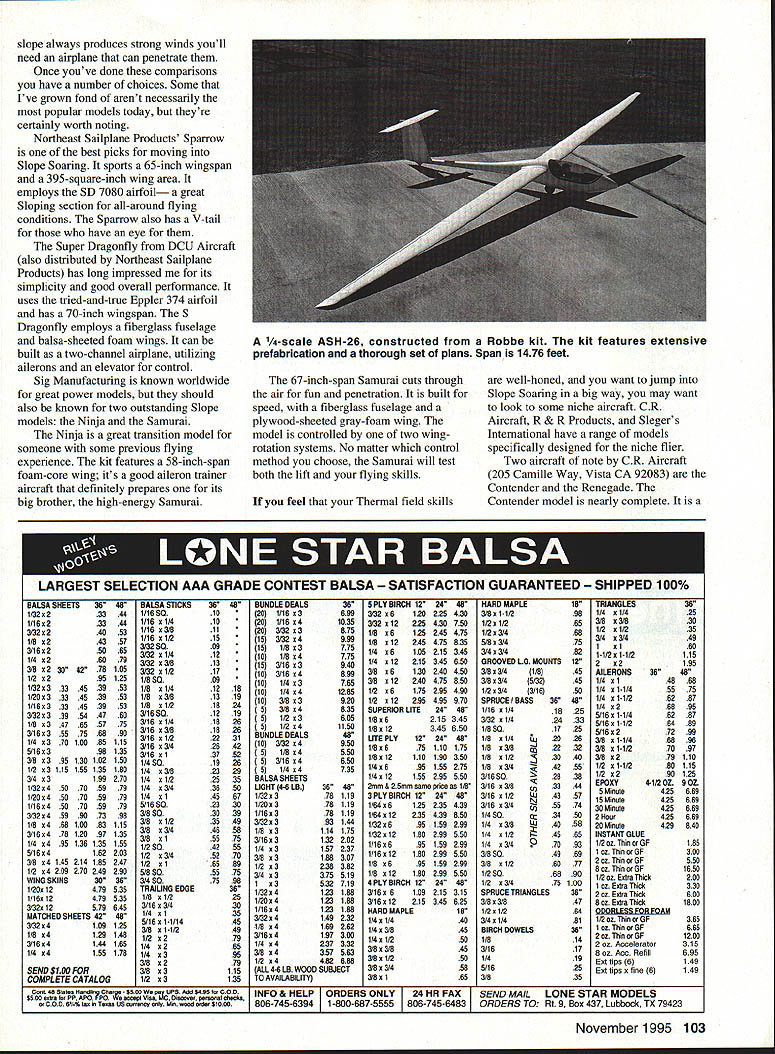
I purchased a 1/4-scale Robbe ASH-26 from Hobby Hangar (153 Lloyd Ave., Florence, KY 41042; Tel.: (606) 283-5746) a few months back for a very good price. When the model arrived I was quite impressed by the quality and completeness of the kit. I was excited about building a model with an aspect ratio of 28 and a glide angle to match.
After more months than I care to mention, I finally finished the ASH-26. It was an easy kit to build because of its extensive prefabrication and the thorough plan set. I'm looking forward to doing some cross-country flying with it.
Covering the ASH-26 and the Coverite iron
One task I always seem to get stuck on is covering. It's funny, because once I start the task I generally enjoy the process, but getting started can be a chore. Anything that helps me get into the process can be a real motivator. An item that does just that is the 21st Century covering iron I received about a year ago from Jeff Troy at Coverite.
Since a covering iron is not a tool a modeler uses every day, it's somewhat maligned. As I covered my ASH-26 I realized just how much I had taken my iron for granted. I've learned the error of my ways and now recognize just how special the Coverite iron is — it is quite simply the best I have ever used. It has several handy features, including a great heat control, nice contours for getting around tough corners, a built-in stand, and the best nonstick surface I've ever used. The Coverite iron made covering the 14.76-foot wings of my ASH-26 a breeze (and fun too!).
Coverite products are available through hobby distributors or Coverite's catalog. Their 21st Century Film is one of the best coverings ever made. For a copy of their catalog write to Coverite at 420 Babylon Rd., Horsham, PA 19044.
Choosing a transition model for slope soaring
I've seen and flown many different RC sailplanes — from an all-foam ready-to-fly "throw-away" model to a 1/3-scale all-glass super sailplane. Some of the most fun I've had is with inexpensive intermediate models. These serve well as slope transition models and introduce the modeler to a whole new world of soaring.
A model with elevator and rudder control should be at the top of the list for a new slope-soaring modeler. Such models encompass a variety of aircraft; two that stand out are:
- Great Planes Spirit 100
- Goldberg Gentle Lady
Other solid choices include:
- Olympic 100
- Sagitta 600
Some of these are a bit dated, but as long as they get new modelers into the hobby they're serving their purpose. New pilots will become discouraged if they wreck a beautiful but hard-to-control super airplane on their first trip to the slope. Beginners and transition fliers should learn the basics with a good rudder-and-elevator model before moving on to a slope "hot rod."
For thermal fliers moving into slope soaring
If you're a reasonably accomplished thermal flier looking to move into slope soaring, decide what kind of sloping you want to do:
- Aerobatics
- Racing
- Speed runs
- Scale
- Power slope soaring (PSS)
- Float around in light air
Match available models to your conditions and skills. Analyze the slope where you intend to fly — an all-glass airplane won't last long landing on rocks, trees, or bushes.
Some models I like that aren't necessarily the most popular today but are worth noting:
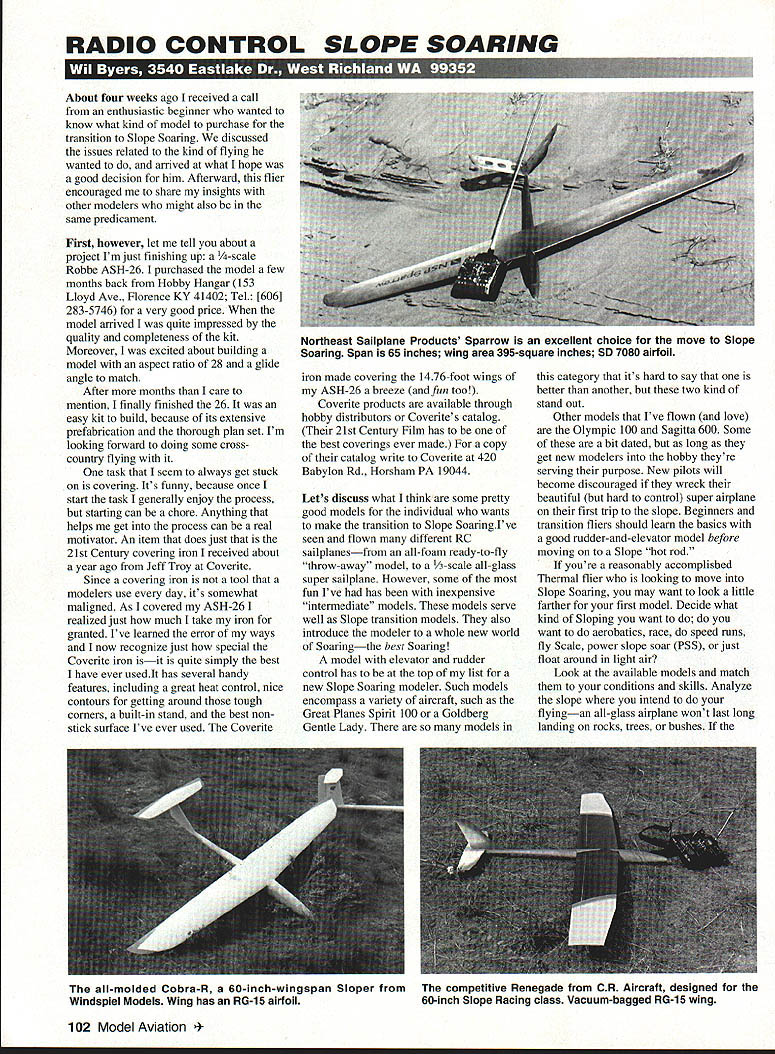
- Northeast Sailplane Products Sparrow: 65-inch wingspan, 395 sq. in. wing area, SD 7080 airfoil, V-tail — a great all-around sloping section.
- Super Dragonfly (DCU Aircraft, distributed by Northeast Sailplane Products): Eppler 374 airfoil, 70-inch wingspan, fiberglass fuselage with balsa-sheeted foam wings; can be built as a two-channel airplane.
Sig Manufacturing offers two standout slope models:
- Ninja: 58-inch-span foam-core wing; aileron trainer that prepares pilots for higher-energy models.
- Samurai: 67-inch span, fiberglass fuselage, plywood-sheeted gray-foam wing; built for speed and penetration, controlled by one of two wing-rotation systems.
Niche and high-performance models
If your thermal-field skills are well-honed and you want to jump into slope soaring in a big way, consider niche aircraft from C.R. Aircraft, RnR Products, and Slegers International.
C.R. Aircraft (Charlie Richardson)
Address: 205 Camille Way, Vista, CA 92083; Tel.: (619) 630-8775
Notable models:
- Contender: A near-complete two-meter design and a wing-rotator that will test your ability to perform four-point rolls and speed maneuvers. Uses a transition-modified 3016 airfoil, 420 sq. in. wing area, and a claimed wing loading of 17–24 oz per sq. ft.
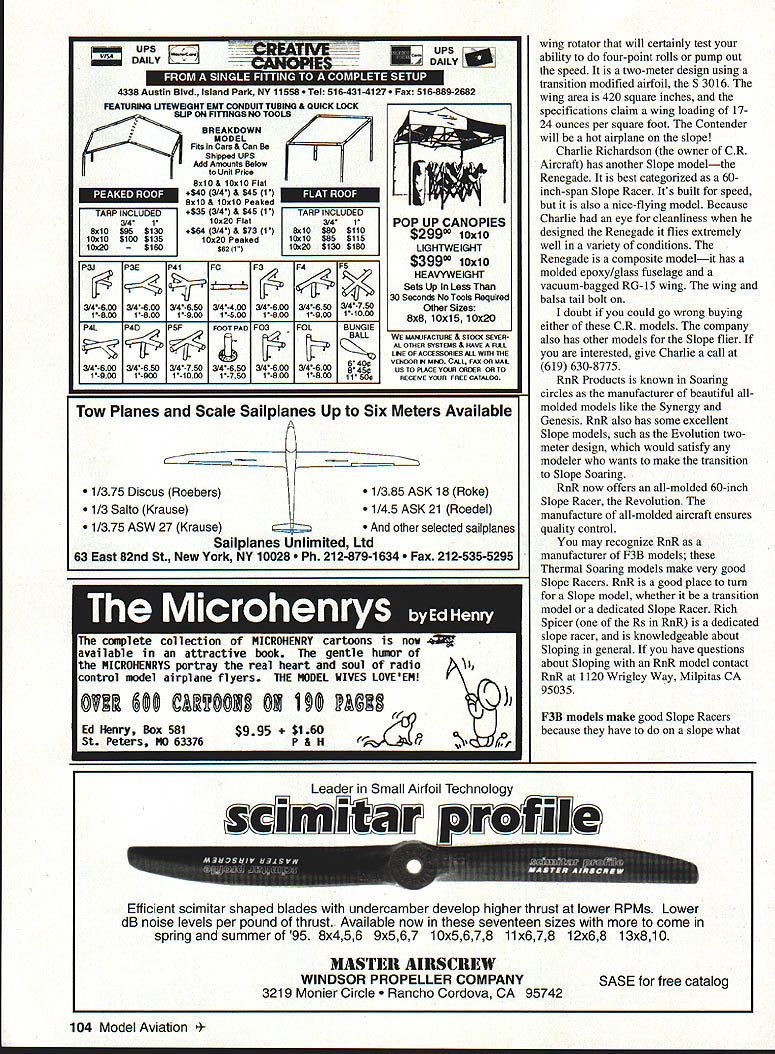
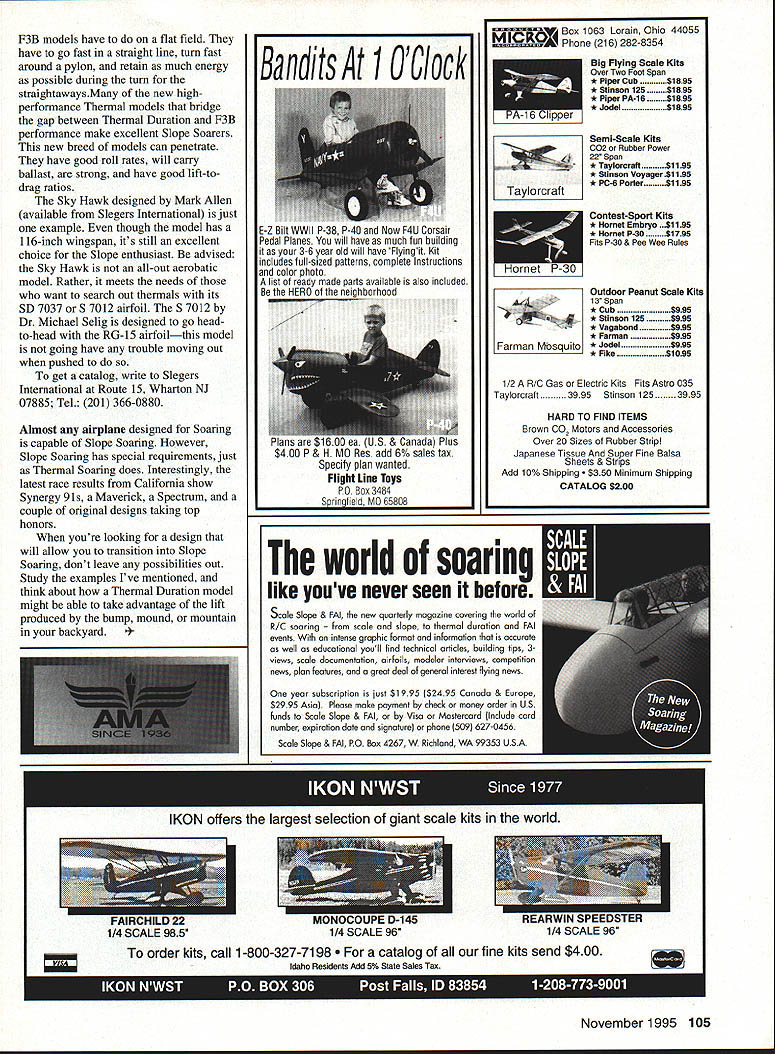
- Renegade: A 60-inch-span sloper racer built for speed with a molded epoxy/glass fuselage and a vacuum-bagged RG-15 wing. The wing and balsa tail bolt on; it flies extremely well in a variety of conditions.
RnR Products
Address: 1120 Wrigley Way, Milpitas, CA 95035
RnR is known for beautiful all-molded models like the Synergy and Genesis and offers excellent slope models:
- Evolution: A two-meter design suitable for transition to slope soaring.
- Revolution: An all-molded 60-inch slope racer.
RnR also produces F3B models, which make very good slope racers because they must perform like slope racers — fast straightaways, quick pylon turns, and energy retention through turns. Rich Spicer at RnR is a dedicated slope racer and a good resource for questions about using RnR models on slopes.
Slegers International — Sky Hawk
Address: Route 15, Wharton, NJ 07885; Tel.: (201) 366-0880
- Sky Hawk (designed by Mark Allen): A larger model with a 116-inch wingspan that meets the needs of those who want to search out thermals. It uses SD7037 or S7012 airfoils (S7012 by Dr. Michael Selig is designed to compete with the RG-15) and will move out when pushed.
Final advice
Almost any airplane designed for soaring is capable of slope soaring, but slope flying has special requirements just as thermal soaring does. Recent race results in California show a mix of Synergy 91s, a Maverick, a Spectrum, and a couple of original designs taking top honors.
When choosing a design to transition into slope soaring, don't leave any possibilities out. Study the examples above and consider how a thermal-duration model might take advantage of the lift produced by the bump, mound, or mountain in your backyard.
Transcribed from original scans by AI. Minor OCR errors may remain.

