
RADIO CONTROL: SLOPE SOARING
Wil Byers, 3540 Eastlake Dr., West Richland WA 99352
Servos are wonderful miniature electromechanical devices — the power behind any RC system. Simply put, servos are the little motors that control our models. JR Radio Control has recently introduced a new servo dedicated to the glider/sailplane community: the microservo model 351.
The design of the 351 came about from a conversation between a JR sales representative and Ed Sleger of Slegers International. As the story goes, Slegers International was selling more JR 341 microservos than any other hobby distributor in the U.S., and JR wanted to know why. Ed explained that sailplaners use microservos in the wings for ailerons, flaps, and elevator control.
JR asked what they could do to increase sales volume. Ed said, "Put metal gears in the 341." JR did, and now we all benefit. JR also took other suggestions on board — for example, Ed suggested having the lead wire come out of the bottom of the servo. Great ideas make great products when someone is listening.
JR also offers the 7000 Super Servo. The 7000 is a very low-profile servo, only 1.02 inches high, and it produces 60.8 oz·in of torque. JR engineers redesigned the 7000 for better resolution, less deadband, and improved power delivery.
The new 7000-series servos pulse at more than 2,200 Hz (2,200 pulses per second). Conventional servos operate at a much lower frequency (about 60 Hz) and tend to need large deflection (as much as 20° off center) to provide full torque. The 7000 delivers near-maximum torque almost immediately around its center point and accelerates to maximum speed and power approximately five times quicker than conventional servos.
In my assessment, the 7000 would make an ideal elevator servo for demanding slope models. Used on the elevator, it gives a rock-hard feel; paired with 351s in the wings, you'll get excellent performance. JR servos are available from Horizon Hobby Distributors, Inc., Box 6029, Champaign, IL 61826-6029.
While reviewing JR's flyer "Understanding Servos," I noticed a chart comparing servo performance on four- and five-cell power. Five-cell systems show distinct advantages in speed and torque. For example, a model 341 servo powered by five cells instead of four changes speed from 0.24 seconds to 0.17 seconds for a 60° traverse — an increase of 41%. Torque increases from 31.9 oz·in to 38.0 oz·in — an increase of 19%. Not bad for adding one more battery cell to your airborne pack.
If battery manufacturers could make packs more shapely, they'd fit model noses much better!
If the RC hobby is going to survive and grow, it must attract new fliers. This is a vexing problem with no simple answers, but one thing is certain: beginners need beginner models. Too often new fliers buy the wrong gliders to learn on, crash their high-performance models, and soon drop out of the hobby.
I've often recommended that new fliers purchase a Gentle Lady, a Sig Riser 100, a MiniMax 700, or similar trainer gliders. In the past I would have recommended an Aquila, a Drifter, an Olympic II, or a Sagitta — all good gliders that gave their owners hours of enjoyment.
Recently I spoke with Bob Renaud of Airtronics. He told me Airtronics has recognized the need for entry-level, inexpensive, fun gliders and will soon reintroduce the legendary Olympic II and the Sagitta. That's great news — Airtronics makes some of the best glider kits in the world.
Estes Industries (Box 227, Penrose, CO 81240) has released a new line of Free Flight rubber-powered models and gliders. Seeing them restored visions of the early days of model aviation and gave me a warm, nostalgic feeling. I haven't seen Estes' new Light Gliders yet, but they should be impressive. More importantly, they will give millions of kids the opportunity to enjoy gliders and rubber-powered flight.
I still remember a friend's Free Flight model "dot out" in a thermal after a modest hand toss — I think it was about 1960 in a schoolyard next to my grandmother's yard. That flight (and many since) kept me coming back for more.
Foameron
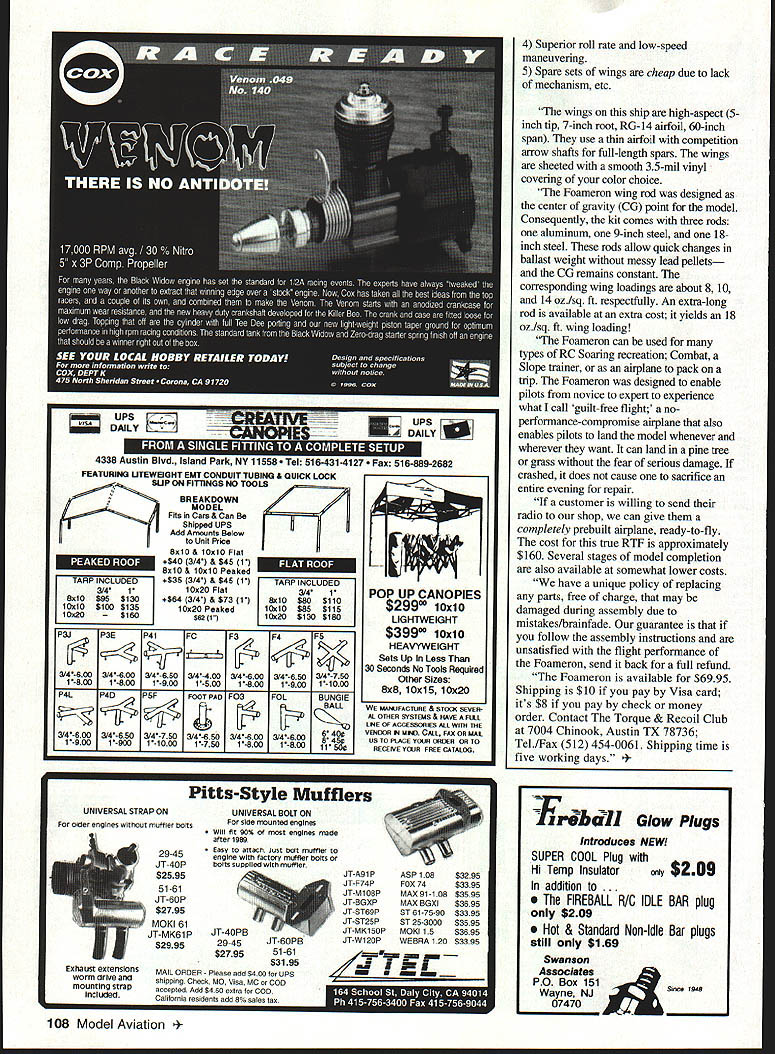
Foameron is a new slope model kit from Joe Galletti. Joe provided this short review of his design:
"The Foameron is a full-tilt slope airplane that is basically crashproof. It looks and flies like a composite airplane, but unlike composite it won't cost you many more dollars and precious building/repairing time.
"A Foameron kit comes with everything you need to complete it: blue foam cores and fuselage, six-ply plywood pieces, 3M tape adhesives and vinyl, hardened-aluminum and machined-steel wing rods and linkages, and Rocket City joints and connectors.
"The Foameron model builds without any glue, silicone, or balsa. You only need a knife and a Dremel tool to finish the kit. Assembly time varies from 4 to 10 hours depending on the builder's skill level.
"The Foameron control surfaces are wingeron and elevator; however, it does not require special radio gear. Standard $15 servos will work fine with any wing loading you ballast the Foameron to, thanks to its unique interchangeable wing rods system. A standard receiver fits in the fuselage with room to spare for a switch. A 600 mAh flat battery pack is required (smaller packs work, too), and we recommend a five-cell pack for maximum response.
"The Foameron uses the wingeron control configuration (wings pivot, no ailerons). The advantages are as follows:"
- Wings remove in seconds — no wires.
- No mechanisms, control surfaces, or servos to break in wings.
- No expensive microservos needed in wings.
Transcribed from original scans by AI. Minor OCR errors may remain.

