
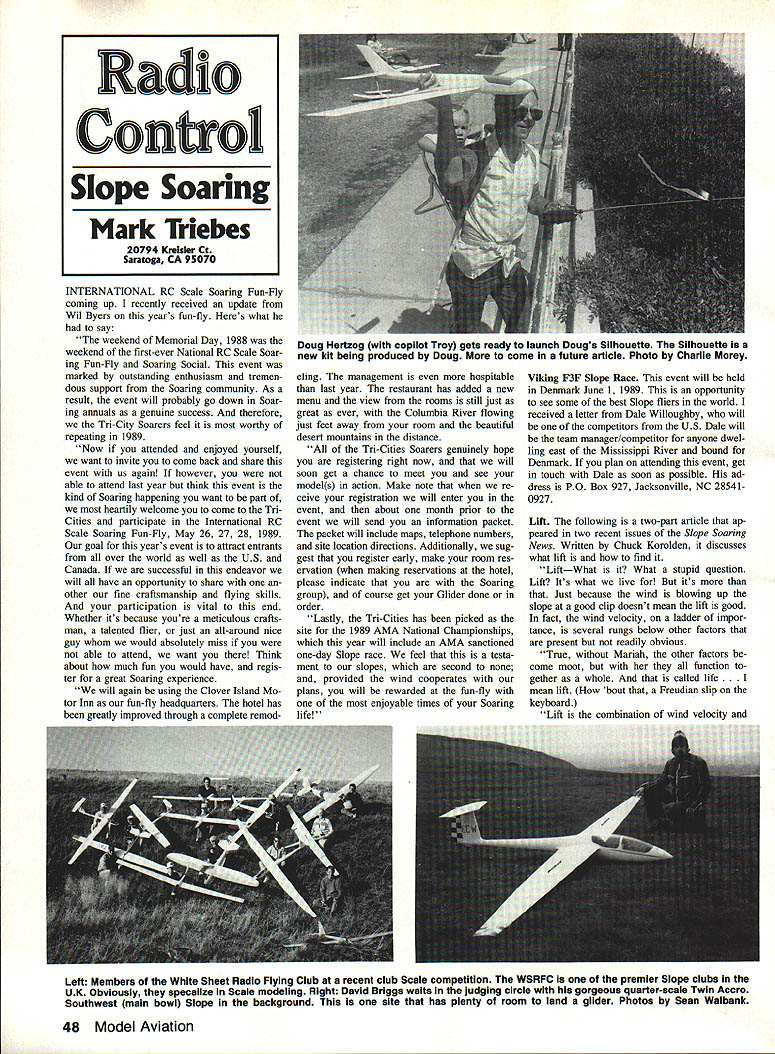
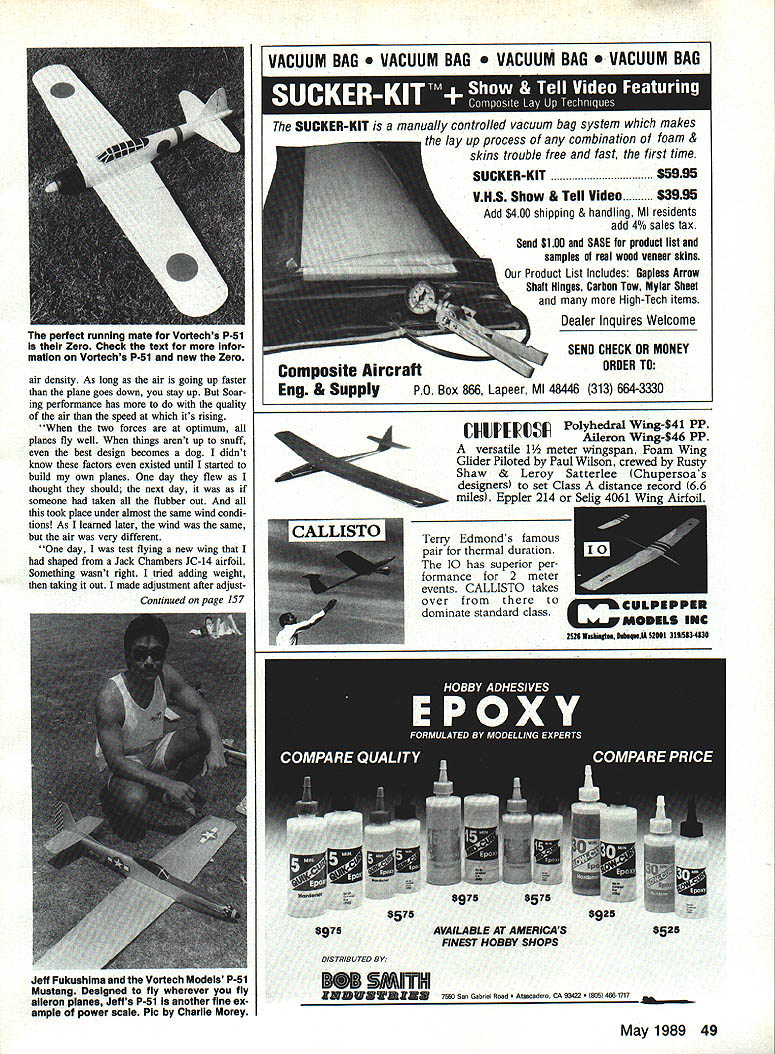
Radio Control: Slope Soaring
Mark Triebes 20794 Kreisler Ct. Saratoga, CA 95070
International RC Scale Soaring Fun-Fly
INTERNATIONAL RC Scale Soaring Fun-Fly coming up. I recently received an update from Wil Byers on this year's fun-fly. Here's what he had to say:
The weekend of Memorial Day, 1988 was the weekend of the first-ever National RC Scale Soaring Fun-Fly and Soaring Social. This event was marked by outstanding enthusiasm and tremendous support from the soaring community. As a result, the event will probably go down in soaring annuals as a genuine success, and therefore we the Tri-City Soarers feel it is most worthy of repeating in 1989.
If you attended and enjoyed yourself, we want to invite you to come back and share this event with us again! If, however, you were not able to attend last year but think this event is the kind of soaring happening you want to be part of, we most heartily welcome you to come to the Tri-Cities and participate in the International RC Scale Soaring Fun-Fly, May 26, 27, 28, 1989.
Our goal for this year's event is to attract entrants from all over the world as well as the U.S. and Canada. If we are successful in this endeavor we will all have an opportunity to share with one another our fine craftsmanship and flying skills. Your participation is vital to this end. Whether it's because you're a meticulous craftsman, a talented flier, or just an all-around nice guy whom we would absolutely miss if you were not able to attend, we want you there! Think about how much fun you would have, and register for a great soaring experience.
We will again be using the Clover Island Motor Inn as our fun-fly headquarters. The hotel has been greatly improved through a complete remodeling. The management is even more hospitable than last year. The restaurant has added a new menu and the view from the rooms is still just as great as ever, with the Columbia River flowing just feet away from your room and the beautiful desert mountains in the distance.
All of the Tri-Cities Soarers genuinely hope you are registering right now, and that we will soon get a chance to meet you and see your model(s) in action. Make note that when we receive your registration we will enter you in the event and then about one month prior to the event we will send you an information packet. The packet will include maps, telephone numbers, and site location directions. Additionally, we suggest that you register early, make your room reservation (when making reservations at the hotel, please indicate that you are with the Soaring group), and of course get your glider done or in order.
Lastly, the Tri-Cities has been picked as the site for the 1989 AMA National Championships, which this year will include an AMA-sanctioned one-day slope race. We feel that this is a testament to our slopes, which are second to none; and, provided the wind cooperates with our plans, you will be rewarded at the fun-fly with one of the most enjoyable times of your soaring life!
Viking F3F Slope Race
This event will be held in Denmark June 1, 1989. This is an opportunity to see some of the best slope fliers in the world. I received a letter from Dale Willoughby, who will be one of the competitors from the U.S. Dale will be the team manager/competitor for anyone dwelling east of the Mississippi River and bound for Denmark. If you plan on attending this event, get in touch with Dale as soon as possible.
Dale Willoughby P.O. Box 927 Jacksonville, NC 28541-0927
Lift
The following is a two-part article that appeared in recent issues of Slope Soaring News. Written by Chuck Korold, it discusses what lift is and how to find it.
#### Lift — What is it?
"Lift—What is it? What a stupid question. Lift? It's what we live for! But it's more than that. Just because the wind is blowing up the slope at a good clip doesn't mean the lift is good. In fact, wind velocity is of lesser importance than other factors which are not as readily obvious. True, when the wind is strong the other factors become moot, but they all function together as a whole. And that is called lift. (How 'bout that, a Freudian slip on the keyboard.)
Lift is the combination of wind velocity and air density. As long as the air is going up faster than the plane goes down, you stay up. Soaring performance has as much to do with the quality of the rising air as its velocity. Two forces determine optimum performance; planes fly well when things are right, but if things aren't up to snuff the best design becomes a dog.
I didn't know these factors existed until I started building my own planes. One day I flew what I thought was a good wing; the next day someone had taken the flubber out and put it back under almost the same wind conditions. As I learned later, the wind may be the same but the air is very different.
One day I was test flying a new wing that I had shaped from a Jack Chambers JC-14 airfoil. Something wasn't right. I tried adding weight, then taking it out. I made adjustment after adjustment and flew again and again. Nothing seemed to help. I was about to give up and donate the wing to the junk pile when up walked Jim Slatt.
"Jim is one of the slope masters," I told him what was happening to the plane and he looked it over. He suggested a very small amount of reflex in the trailing edge. I was skeptical, but I tried it and the wing flew beautifully. A tiny change in section or twist can make a dramatic difference.
One of the worst problems is tip-stall. A wing that wants to tip-stall at low speed will usually benefit from more washout in the tip, but if washout doesn't cure it the root incidence should be checked. I once added washout and the tip-stall persisted; finally I discovered the root had too much negative incidence. Reducing the negative incidence cured the tip-stall.
These little cures are often the difference between a model that flies well and one that simply won't cooperate. Experience, careful observation and small, thoughtful changes are the keys.
#### Lift — What To Look For
There are four main factors involved in creating lift:
- Air density.
- Entry path to the slope.
- Wind direction in relation to the slope.
- Size and shape of the slope.
- Air density
This is the most misunderstood and ignored aspect of lift dynamics. There are two main influences that dictate what the density of the air will be—temperature and humidity. These two factors can turn a small breeze into booming lift, or take the punch out of a good strong wind.
When the air is hot and humid, it's less dense, especially when it's foggy. Some people might think that with all that water in the air it has to be thicker; in fact, added water vapor makes the air less dense because the water molecules displace heavier air molecules. This isn't a complete physical explanation, but it's sufficient for practical purposes.
Why is this important? Not everyone flies at a place with great conditions. If one day you find yourself sweating through aerobatic maneuvers that were easy a few days earlier, and the wind is blowing hard and from the right direction, it might be because of a change in the density of the air. To recap: dry and cool is good; hot and wet is bad.
- Entry path to the slope
This refers to what the wind has to go over on its way to the slope—water, ground, or objects of size. If the wind comes right over water, it will develop no turbulence and therefore generate smooth lift. If it blows in over the ground, no matter how smooth and unobstructed, it will have turbulence associated with it. The closer obstructions are to the slope, the worse it gets.
If there are trees, houses, or other objects in the way, the turbulence they create can be felt for thousands of yards past the obstacle that spawned them. An example is apparent at Long Beach Bluff Park. At around 11 a.m. or noon the wind is usually coming straight in, and the lift is good. Then at about 1 p.m. it will switch a few degrees; that puts it in line with some offshore oil rigs that are at least 500 yards away. The lift gets very patchy until it switches a little more and clears the oil rigs. Then it smoothes out, and the flying is good again.
- Wind direction in relation to the slope
A slope will react differently to winds from different directions. A slope that works well with a wind 20 degrees off will not necessarily work well with a wind 10 degrees off. Small changes in wind direction can change the lift quality dramatically. When the wind is more squarely on the slope, the lift will be stronger and smoother. When it is angled, the lift tends to be weaker and more turbulent.
- Size and shape of the slope
A big, rounded slope tends to produce smoother, more laminar lift than a small, sharp bluff. Gentle, long slopes allow the air to rise gradually and create a broader band of useful lift. Steep, abrupt slopes can produce strong lift in a narrow band but are more prone to turbulence and rotor on the lee side.
Putting it all together, the best flying conditions are cool, dry air, with the wind coming over water or open ground directly onto a broad, rounded slope. Conditions that are hot and humid, with wind crossing obstacles or striking a small, sharp bluff, will usually give poor, turbulent lift.
In practice, watch the surface: flags, grass, and tree tops will tell you a lot. Also, be aware that conditions change during the day as the sun and sea breezes shift. Learning the local microclimate of your flying site is one of the best things you can do to improve your slope flying.
Next month I'll cover setup tips for different slope conditions, wing planform considerations, and some practical trimming techniques to get your glider performing its best.
Transcribed from original scans by AI. Minor OCR errors may remain.

