

RADIO CONTROL: SLOPE SOARING
By Wil Byers 3540 Eastlake Dr., West Richland, WA 99352 E-mail: wilbyers@aol.com
My project: a 1/3‑scale Salto
Flying scale sailplanes at the slope is my favorite form of fun. I love watching a scale sailplane or glider fly by—it truly emulates full‑scale soaring. My latest project is a scale, aerobatic glider: a 1/3‑scale Salto (Salto means "somersault" in German).
The full‑scale Salto
- Span: 13.6 meters
- Designer: Ursula Hänle (single‑seat aerobatic glider)
- Fuselage: fixed, faired wheel; V‑tail
- Rough‑air redline speed: 149 mph
- Wing aspect ratio: 21.6
- Stall speed: 42 mph
- Best L/D: 35 at 56 mph
The model Salto kit
The model Salto was manufactured by Krause in Germany and imported by Sailplanes Unlimited, Ltd., 63 East 82nd St., New York, NY 10028; Tel.: (212) 879‑1634. Kit highlights:
- Span: 4.5 meters (177 inches)
- Fiberglass fuselage, gel‑coated
- Quabeck 3.0/14 wings presheeted with obeche wood; spoilers installed
- Superb canopy
- Very complete hardware pack (includes wheel and a strong joiner rod)
Building the kit
Having built many kits, I initially put the Salto aside, but when I finally started building I discovered how easy and well engineered it is. Krause has taken much of the guesswork out of assembly:
- Spoilers and wing joiner tubes are preinstalled; attachment points are predrilled.
- After gluing on leading edges and tip blocks, the parts largely plug together.
- The wing joiner tube that glues into the fuselage is cut to the exact length and the installation location is marked by a molded recess—drill and glue with confidence.
- Rear locator pins set wing incidence very accurately; I only adjusted the fuselage acceptor hole by less than 1/64 inch.
- Elevators in the V‑tail mated perfectly to the tailboom when drilled at the marked mounting pins.
- The fiberglass canopy frame fits precisely; I rough‑sanded the frame, trimmed the canopy, and glued it with Wilbold R/C‑56 glue. Krause also molded a small fairing for the tailboom end.
A kit like this is a tribute to the German craftsmen who fabricated it and to Sailplanes Unlimited for importing quality kits.
Industry note
Importers and manufacturers who bring high‑quality kits to the hobby should be rewarded; their efforts help RC soaring—and especially scale soaring—grow and gain respect within the hobby industry.
Laser Pacs (Bob Holman)
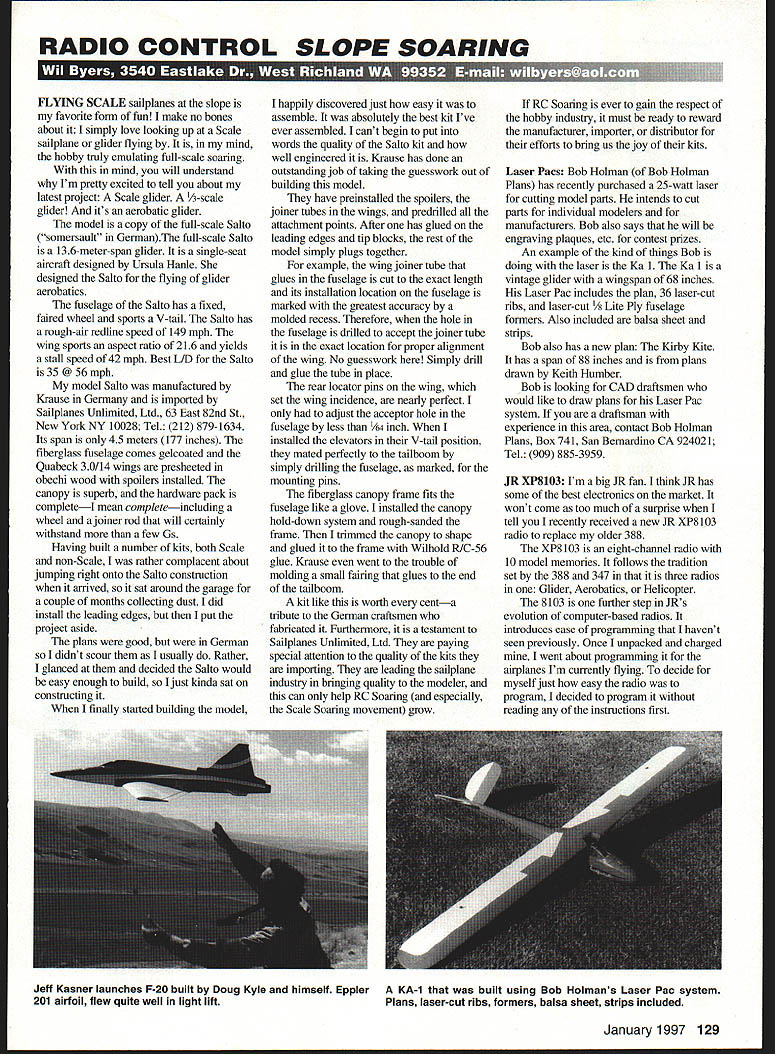
Bob Holman of Bob Holman Plans has recently purchased a 25‑watt laser for cutting model parts. He intends to cut parts for individual modelers and for manufacturers, and to engrave plaques for contest prizes.
Example offerings:
- Ka‑1 vintage glider (68‑inch span): plan plus 36 laser‑cut ribs and laser‑cut 1/8" lite‑ply fuselage formers; includes balsa sheet and strips.
- New plan: Kirby Kite (88‑inch span), plans drawn by Keith Humber.
Bob is looking for CAD draftsmen experienced in this area to draw plans for his Laser Pac system. Contact: Bob Holman Plans, Box 741, San Bernardino, CA 92402; Tel.: (909) 885‑3959.
JR XP8103 (Jeff Kasner)
I'm a big JR fan and recently received a JR XP8103 radio to replace my older 388. The XP8103 is an eight‑channel transmitter with 10 model memories. It follows the tradition of JR radios (388 and 347) with preset modes for Glider, Aerobatics, or Helicopter.
Key impressions and features:
- Very easy programming; I programmed my aircraft without reading the manual and only referred to it a couple of times.
- Large LCD screen on top of the transmitter displays more programming information at once, reducing abbreviations and making mixes easier to understand.
- Mix curves are displayable, removing much of the guesswork—you can see exactly how much mix is applied.
- Any channel can be slaved to any other and mixed in any ratio (e.g., elevator with flaps, flaps with ailerons) quickly and easily.
Overall, the XP8103 is a solid step forward in JR's line of computer radios.
Transcribed from original scans by AI. Minor OCR errors may remain.

