
RADIO CONTROL SLOPE SOARING
David Sanders, 34455 Camino El Molino, Capistrano Beach CA 92624
WOW! WHAT A GIG! I'm flattered to follow some true soaring giants in this slot, and hope I can live up to your expectations.
I've been an aeromodeler for about 20 years and have played with just about every kind of flying machine imaginable, with the exception of RC helicopters. I'm glad to have been exposed to so many facets of model aviation. If you can't see a clear path to a solution for a particular problem, your answer can often be readily gained by talking to those who fly other disciplines and learning from their experiences.
My slope soaring activities have been primarily concentrated in the last five or six years, and are definitely my current passion and avocation. That said, I'll go right ahead and move into the meat-and-potatoes of our little corner of the sport.
Slope Racing: sport and contest
Few things stir the soul more than the aggressive pursuit of raw speed, and if two kids with fast machines meet up, it'll usually result in a race. This is no less true in slope soaring, and the good-natured braggadocio of a spontaneous speed contest is something many of us witness or participate in on a regular basis. Sure, it's fun, but for those who really want to know who's the hottest on the hill, a real contest has to be had.
So is slope racing alive or dead? You'd be surprised how divergent the opinions are on this.
If you're talking about local fliers on local hills in Anytown USA getting together to run on a quickly laid-out course, then no, it will never die. But if you're talking about official contests, where people come from faraway places to meet up with another region's best fliers and engineers, that's a much more delicate matter.
How to make official slope racing events more popular
Could official slope racing events be made more popular in the US? I think so, if some steps are taken:
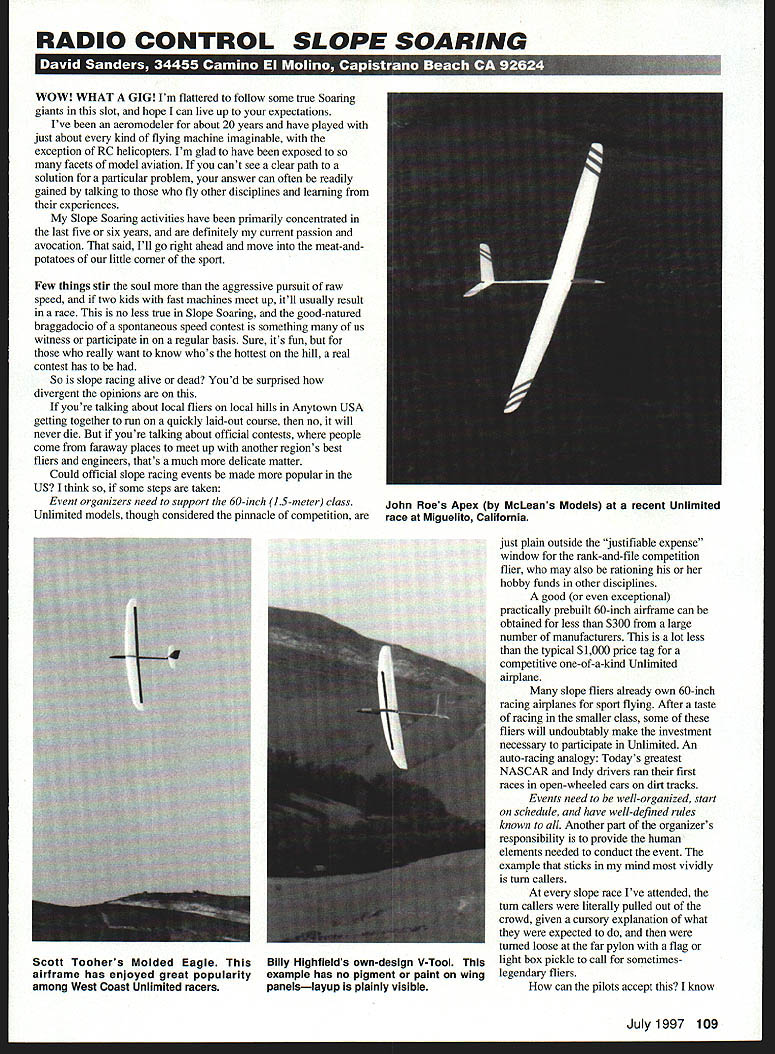
- Support the 60-inch (1.5-meter) class. Unlimited models, though considered the pinnacle of competition, are just plain outside the "justifiable expense" window for the rank-and-file competition flier, who may also be rationing hobby funds in other disciplines. A good (or even exceptional) practically prebuilt 60-inch airframe can be obtained for less than $300 from a large number of manufacturers. This is a lot less than the typical $1,000 price tag for a competitive one-of-a-kind Unlimited airplane.
- Encourage pilots to try racing in the smaller class. Many slope fliers already own 60-inch racing airplanes for sport flying. After a taste of racing in the smaller class, some of these fliers will undoubtedly make the investment necessary to participate in Unlimited. An auto-racing analogy: today's greatest NASCAR and Indy drivers ran their first races in open-wheeled cars on dirt tracks.
- Run events professionally. Events need to be well-organized, start on schedule, and have well-defined rules known to all.
- Provide skilled course personnel. Organizers must supply the human elements needed to conduct the event, especially turn callers.
Turn callers and course personnel
At every slope race I've attended, the turn callers were literally pulled out of the crowd, given a cursory explanation of what they were expected to do, and then turned loose at the far pylon with a flag or light box to call for sometimes-legendary fliers. The pilots know how much space it takes to make an efficient turn and anticipate it properly, just barely breaking the vertical plane of the pylon. At the far end, our amateur callers are instructed to drop the flag or push the light button when the aircraft crosses the plane of the pylon. If the caller's reflexes are less than perfect, they could be calling the turns quite late—or early, incurring cuts for our defenseless flier!
A pilot who relies on the caller's signal alone will typically overshoot the far pylon by about 30 feet, creating a 60-foot extension of distance on each lap. After eight far-end turns in a typical race, this can add more than 400 feet to the total distance flown!
At 60 mph (88 feet per second) an extra 400 feet costs you more than four seconds. These races can be decided by times much less than that, so it would seem good to have a caller who is at least on the ball, and at best signaling your turns early so the aircraft just makes the pylon, as it does at the pilot's end of the course.
In the formal F3F format, which is practiced in Europe, the pilots stand at the middle of the course with callers at both ends. Understandably, they put a premium on highly experienced course personnel. Shouldn't we?
Mentorship and beginner classes
One of the reasons that thermal duration events remain popular is that a spirit of mentorship is always present, and often special events, strictly aimed at beginners, are held to attract and capture new inductees to the discipline. This is obviously lacking in racing, at least on the West Coast.
I hear many launch the trial balloon of beginner- or budget-class racing, but very few organizers grab its string and ride it up. At every thermal duration event I've been to, even the highest-level pilots were willing to answer a newcomer's questions—no matter how elementary. The contestants and officials were shaved (well, usually), they smelled good, and they smiled a lot. This may seem trivial, and I'm certainly being a little hyperbolic, but this can have a real effect on approachability in the eyes of the uninitiated.
These may sound like tough indictments, but they're tempered with genuine affection. I think most of us would like to see racing thrive—it yields large dividends to us in many ways. Our entire 1997 US F3B team was raised on the slopes. Many of the most popular high-performance modern airframes can trace their roots to racing. Designers of racing airframes often take the lead in developing new technologies and methods—molded airplanes are one very notable example.
Trends and the future
Then there are the good trends, which will likely continue: most of the Unlimited events are going to be time-trial format, as opposed to man-on-man. With varying lift conditions this can be a spoiler, but most of the racers seem to agree that the reduced carnage from midairs is worth the risk of poor lift.
Sixty-inch is still being run man-on-man, and those who seek the extra adrenaline rush of close-proximity flying have kept their home there.
The future of slope racing is up to the very few who are willing to take the initiative to knuckle down and run the events properly. Can it happen for us? We'll soon know for sure, and there are some fine people out there trying to make it happen. Let's lend them our support and encouragement!
Transcribed from original scans by AI. Minor OCR errors may remain.

