


RADIO CONTROL SLOPE SOARING
David Sanders, 34455 Camino El Molino, Capistrano Beach, CA 92624
"TAKEOFFS ARE OPTIONAL; LANDINGS are compulsory," is perhaps one of the oldest and most poignant aviation truisms. You're not risking your life in your models, but that isn't much solace when you're gluing or glassing back together an airplane that looks like a Gerhard Marcks sculpture. (I like his works, except that they don't fly.) There are basically three ways in which slope airplanes are damaged:
- Midair collisions—they happen.
- Stupidity. You knew that there wasn't enough altitude left for that last big loop right on the ridge!
- Landings. You can gain almost total control here, especially on your home slope.
Let's take a look at the most delicate slope task: landings. I think of three forms of landing approaches: the backfield, the ridgeline, and the slope-face.
Landing protocol is probably established on your home slope, though vociferous camps may argue about which technique is best; that often has to do with the type and size of airplanes being flown. (Ridgeline landings are the norm at my local slope because the site is more suitable for them.)
Backfield landings
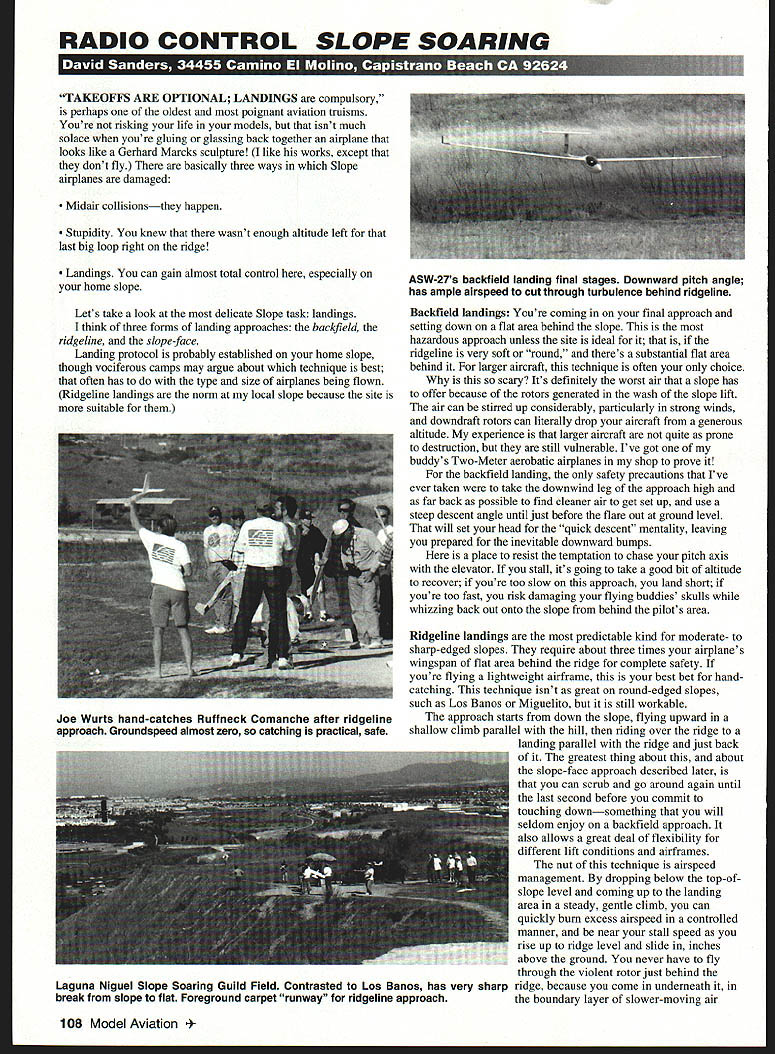
You're coming in on your final approach and setting down on a flat area behind the slope. This is the most hazardous approach unless the site is ideal for it; that is, if the ridgeline is very soft or "round," and there's a substantial flat area behind it. For larger aircraft, this technique is often your only choice.
Why is this so scary? It's definitely the worst air that a slope has to offer because of the rotors generated in the wash of the slope lift. The air can be stirred up considerably, particularly in strong winds, and downdraft rotors can literally drop your aircraft from a generous altitude. My experience is that larger aircraft are not quite as prone to destruction, but they are still vulnerable. I've got one of my buddy's two-meter aerobatic airplanes in my shop to prove it!
For the backfield landing, the only safety precautions that I've ever taken were to take the downwind leg of the approach high and as far back as possible to find cleaner air to get set up, and use a steep descent angle until just before the flare out at ground level. That will set your head for the "quick descent" mentality, leaving you prepared for the inevitable downward bumps.
Here is a place to resist the temptation to chase your pitch axis with the elevator. If you stall, it's going to take a good bit of altitude to recover; if you're too slow on this approach, you land short; if you're too fast, you risk damaging your flying buddies' skulls while whizzing back out onto the slope from behind the pilot's area.
Ridgeline landings
Ridgeline landings are the most predictable kind for moderate- to sharp-edged slopes. They require about three times your airplane's wingspan of flat area behind the ridge for complete safety. If you're flying a lightweight airframe, this is your best bet for hand-catching. This technique isn't as great on round-edged slopes, such as Los Banos or Miguelito, but it is still workable.
The approach starts from down the slope, flying upward in a shallow climb parallel with the hill, then riding over the ridge to a landing parallel with the ridge and just back of it. The greatest thing about this, and about the slope-face approach described later, is that you can scrub and go around again until the last second before you commit to touching down—something that you will seldom enjoy on a backfield approach. It also allows a great deal of flexibility for different lift conditions and airframes.
The nut of this technique is airspeed management. By dropping below the top-of-slope level and coming up to the landing area in a steady, gentle climb, you can quickly burn excess airspeed in a controlled manner, and be near your stall speed as you rise up to ridge level and slide in, inches above the ground. You never have to fly through the violent rotor just behind the ridge, because you come in underneath it, in the boundary layer of slower-moving air.
Didn't bleed enough speed on the way up? No problem—you're at launch height, and you have plenty of altitude to turn back out into the wind (instant airspeed), and you can go around and try again.
Do you feel as if you've slowed too much? Level out, make a couple more passes along the slope to get some altitude back, and shoot the approach one more time.
Did you get low and the lift quit? That takes you to the third option.
Slope-face landings
I like the slope-face landing for two kinds of conditions—"no-lift" and "oh-my-gawd" lift. This approach seems risky on the surface, but after practice and familiarization with your airplane, it can become second nature. The object is to have your airplane climbing up the face of the slope, contouring it closely, then doing a 180° stall-turn to a touchdown pointed back down-slope (into the wind).
When the lift has quit and you are hopelessly low on the hill, the slope-face landing is a good way to achieve a safe landing on the face of the slope. This method is good in big air since it gives you maximum opportunity for recovery to normal flight if you are coming in too hot, and it keeps you completely out of the rotor behind the ridge, since you never go there during the procedure. Ideally, you end up with your airplane pointing down the hill and positioned within a short distance of the top of the ridgeline.
The slope-face is, by far, my favorite approach on round-edged hills. On windy days, you'll be able to hover down the last few feet to a feather-soft touchdown right on the ridge, by gently "working" the airplane with judicious use of the elevator (and flaps or crow mode, if you're so equipped). This is so much fun that you may extend your time to enjoy your airplane hovering in complete control with zero groundspeed right on the ridge, only a few feet away from you.
On hills that are new to me, I watch the locals to see what their approaches look like, and I gauge my judgment on that. If no locals are around, I decide mostly based on the shape of the hill and on the obstacles. With slope-face landings, nearly any hill becomes flyable, even if there are trees right on the ridgeline and I'm flying an airplane in which I'm comfortable doing low-altitude stall turns (or a foamy).
The best cure for surprises is practice. Try to shoot consistent and accurate approaches. Habituation to good technique will save you when a real emergency happens.
Recommended video
Have you ever tried to express the spirit of radio control soaring to a friend or relative, but couldn't quite put it into words? The Endless Lift video, produced by Paul Naton of Encinitas, CA, can do the talking for you. The film chronicles Paul's 1996 trip around the United States looking for new and unusual places to fly—boy, did he find 'em!
Paul is a champion slope and hand-launch pilot. He demonstrates his skills beautifully on the tape, and he gives some excellent tips and suggestions for exploring unlikely flying sites that you might never have considered. The tape may inspire even the most jaded slopehead, and will amaze the uninitiated. The digitally edited imagery is stunning; it's professionally produced, with an excellent soundtrack, and it is capably narrated by Paul himself.
The $39.95 video is available through:
- Northeast Sailplane Products, 16 Kirby Lane, Wilmington, VT 05495; Tel: (802) 658-9482
- C.R. High Performance Products, 205 Camille Way, Vista, CA 92083
- Direct from Paul Naton, 3491 Ocean View, Encinitas, CA 92024; Tel: (619) 634-2438
Transcribed from original scans by AI. Minor OCR errors may remain.

