
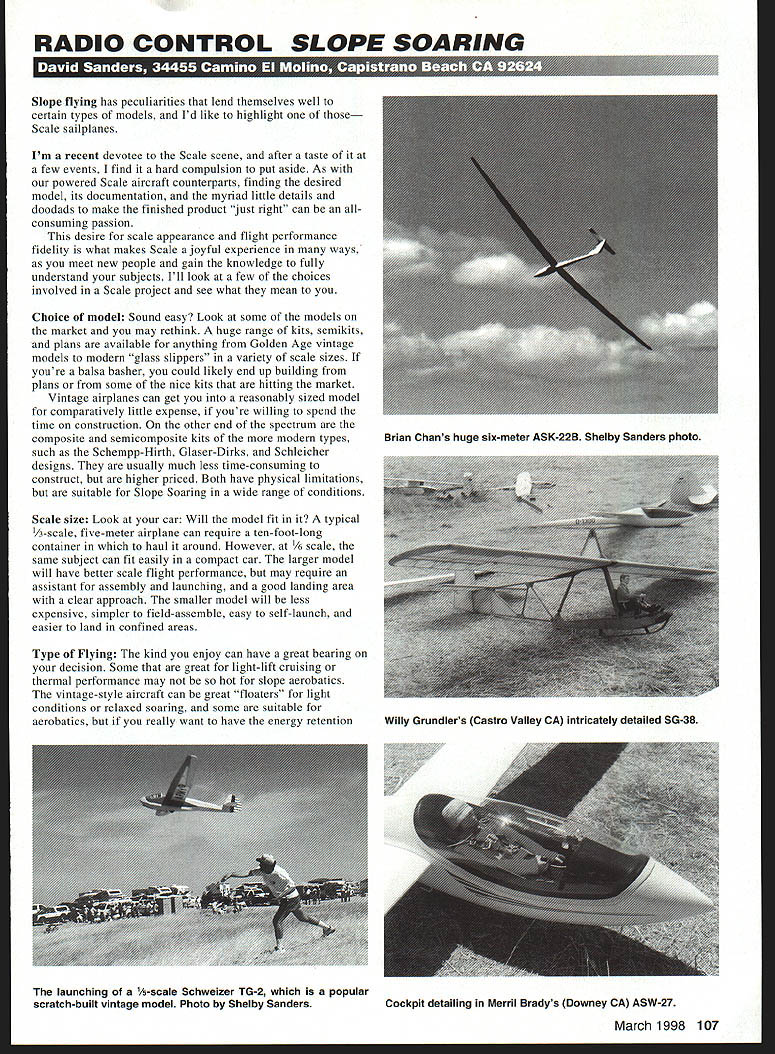
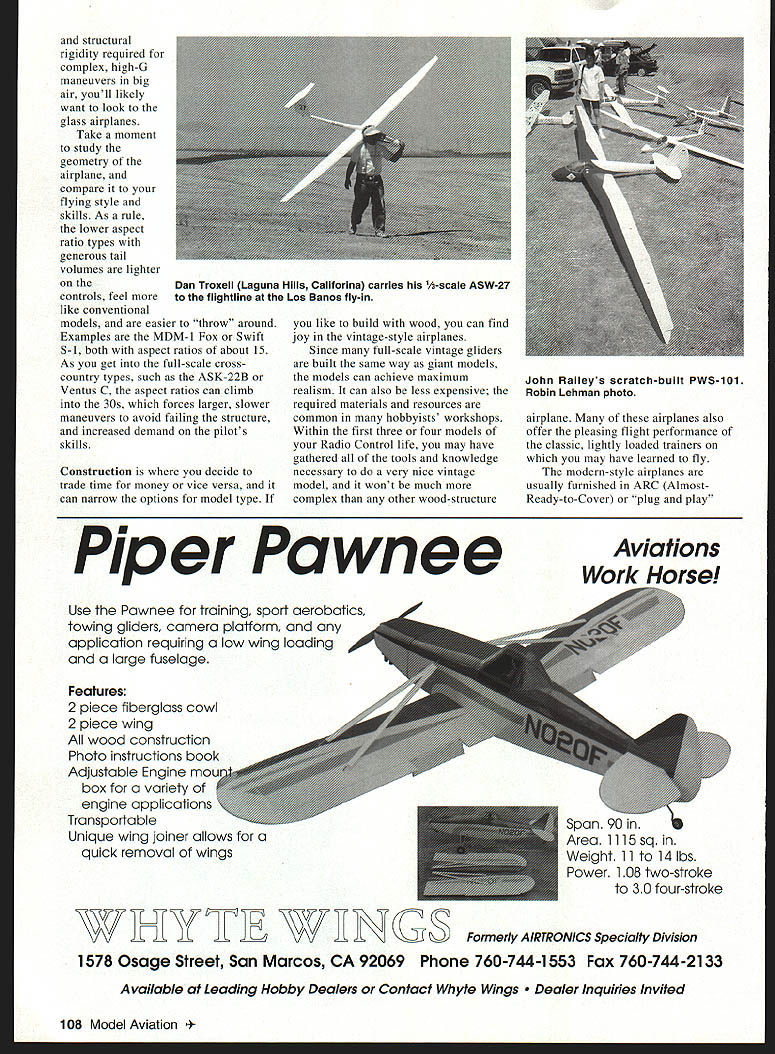
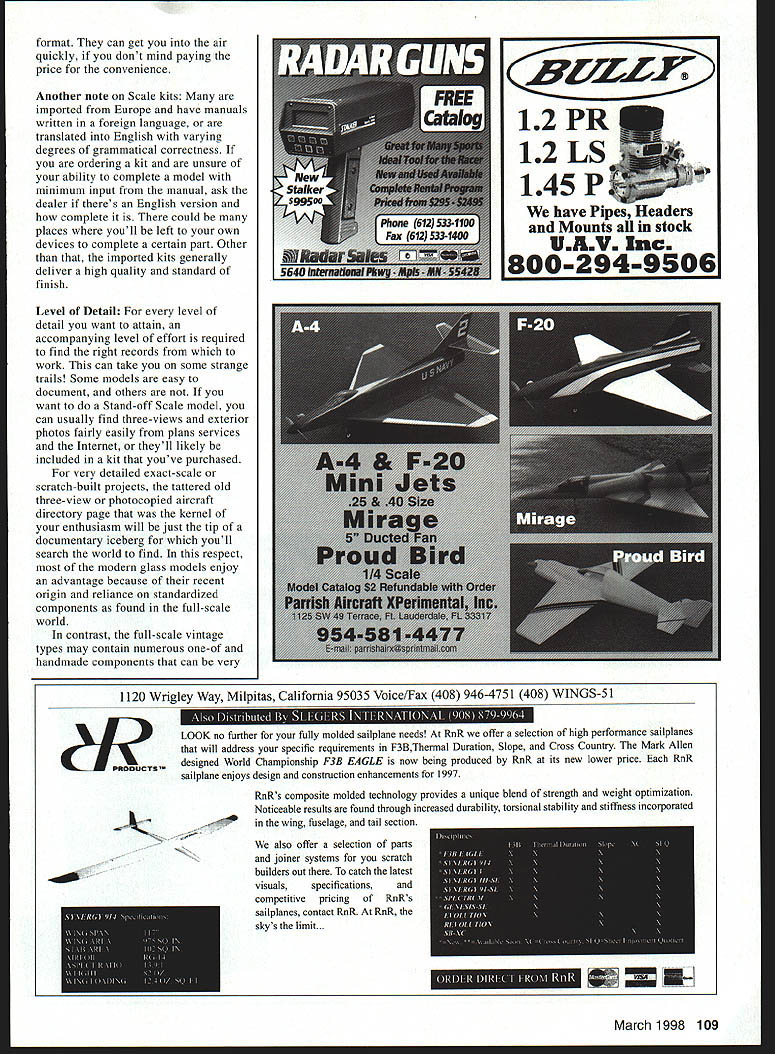
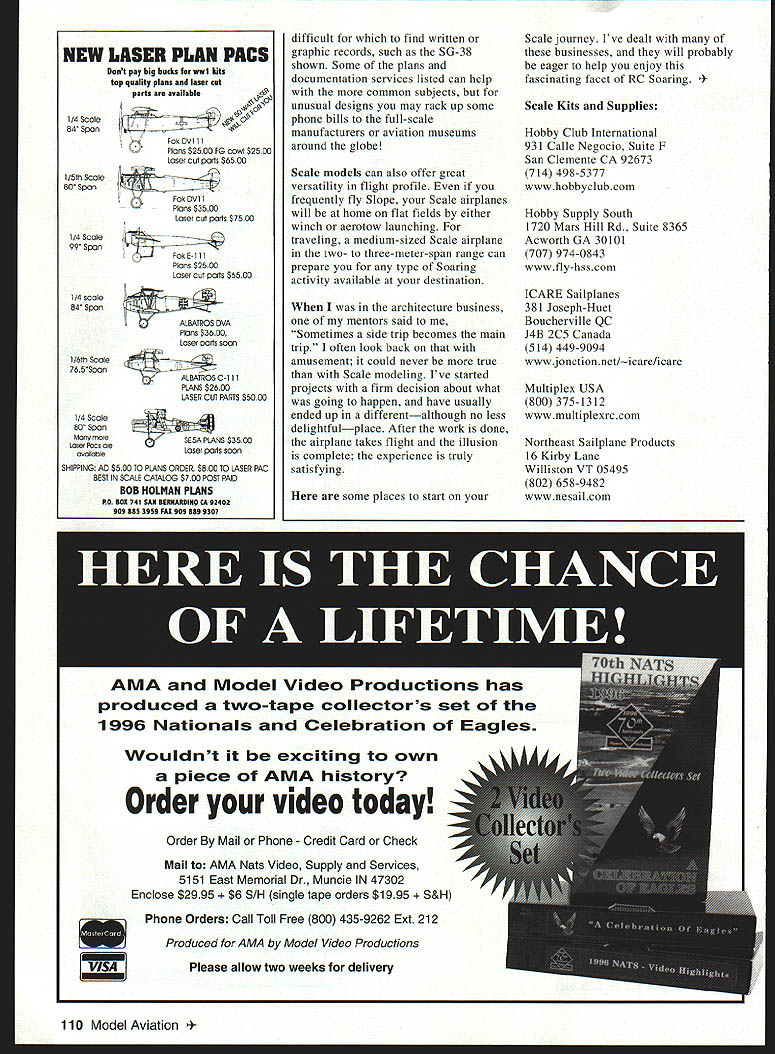
Radio Control: Slope Soaring
David Sanders, 34455 Camino El Molino, Capistrano Beach CA 92624
Slope flying has peculiarities that lend themselves well to certain types of models, and I'd like to highlight one of those—scale sailplanes.
I'm a recent devotee to the scale scene, and after a taste of it at a few events, I find it a hard compulsion to put aside. As with our powered-scale aircraft counterparts, finding the desired model, its documentation, and the myriad little details and doodads to make the finished product "just right" can be an all-consuming passion.
This desire for scale appearance and flight-performance fidelity is what makes scale a joyful experience in many ways, as you meet new people and gain the knowledge to fully understand your subjects. I'll look at a few of the choices involved in a scale project and see what they mean to you.
Choice of model
Sound easy? Look at some of the models on the market and you may rethink. A huge range of kits, semikits, and plans are available for anything from Golden Age vintage models to modern "glass slippers" in a variety of scale sizes. If you're a balsa basher, you could likely end up building from plans or from some of the nice kits that are hitting the market.
Vintage airplanes can get you into a reasonably sized model for comparatively little expense, if you're willing to spend the time on construction. On the other end of the spectrum are the composite and semicomposite kits of the more modern types, such as the Schempp-Hirth, Glaser-Dirks, and Schleicher designs. They are usually much less time-consuming to construct, but are higher priced. Both have physical limitations, but are suitable for slope soaring in a wide range of conditions.
Scale size
Look at your car: will the model fit in it? A typical 1/3-scale, five-meter airplane can require a ten-foot-long container in which to haul it around. However, at 1/6 scale, the same subject can fit easily in a compact car. The larger model will have better scale flight performance, but may require an assistant for assembly and launching, and a good landing area with a clear approach. The smaller model will be less expensive, simpler to field-assemble, easy to self-launch, and easier to land in confined areas.
Type of flying
The kind you enjoy can have a great bearing on your decision. Some that are great for light-lift cruising or thermal performance may not be so hot for slope aerobatics. The vintage-style aircraft can be great "floaters" for light conditions or relaxed soaring, and some are suitable for aerobatics, but if you really want the energy retention to perform aerobatics and the structural rigidity required for complex, high-G maneuvers in big air, you'll likely want to look to the glass airplanes.
Take a moment to study the geometry of the airplane, and compare it to your flying style and skills. As a rule, the lower-aspect-ratio types with generous tail volumes are lighter on the controls, feel more like conventional models, and are easier to "throw" around. Examples are the MDM-1 Fox or Swift S-1, both with aspect ratios of about 15. As you get into the full-scale cross-country types, such as the ASK-22B or Ventus C, the aspect ratios can climb into the 30s, which forces larger, slower maneuvers to avoid failing the structure and increases demand on the pilot's skills.
Construction and materials
Construction is where you decide to trade time for money or vice versa, and it can narrow the options for model type. If you like to build with wood, you can find joy in the vintage-style airplanes.
Since many full-scale vintage gliders are built the same way as giant models, the models can achieve maximum realism. It can also be less expensive; the required materials and resources are common in many hobbyists' workshops. Within the first three or four models of your radio-control life, you may have gathered all of the tools and knowledge necessary to do a very nice vintage model, and it won't be much more complex than any other wood-structure airplane. Many of these airplanes also offer the pleasing flight performance of the classic, lightly loaded trainers on which you may have learned to fly.
The modern-style airplanes are usually furnished in ARC (Almost-Ready-to-Cover) or "plug and play." They can get you into the air quickly, if you don't mind paying the price for the convenience.
Another note on scale kits: many are imported from overseas and have manuals written in a foreign language, or are translated into English with varying degrees of grammatical correctness. If you are ordering a kit and are unsure of your ability to complete a model with minimum input from the manual, ask the dealer if there's an English version and how complete it is. There could be many places where you'll be left to your own devices to complete a certain part. Other than that, the imported kits generally deliver a high quality and standard of finish.
Level of detail and documentation
For every level of detail you want to attain, an accompanying level of effort is required to find the right records from which to work. This can take you on some strange trails! Some models are easy to document, and others are not. If you want to do a stand-off scale model, you can usually find three-views and exterior photos fairly easily from plans services and the Internet, or they'll likely be included in a kit that you've purchased.
For very detailed exact-scale or scratch-built projects, the tattered old three-view or photocopied aircraft-directory page that was the kernel of your enthusiasm will be just the tip of a documentary iceberg for which you'll search the world to find. In this respect, most of the modern glass models enjoy an advantage because of their recent origin and reliance on standardized components as found in the full-scale world.
In contrast, the full-scale vintage types may contain numerous one-of-a-kind and handmade components that can be very time-consuming to reproduce, and difficult to find written or graphic records for (such as the SG-38). Some of the plans and documentation services listed can help with the more common subjects, but for unusual designs you may rack up some phone bills to the full-scale manufacturers or aviation museums around the globe!
Scale models can also offer great versatility in flight profile. Even if you frequently fly slope, your scale airplanes will be at home on flat fields by either winch or aerotow launching. For traveling, a medium-sized scale airplane in the two- to three-meter-span range can prepare you for any type of soaring activity available at your destination.
When I was in the architecture business, one of my mentors said to me, "Sometimes a side trip becomes the main trip." I often look back on that with amusement; it could never be more true than with scale modeling. I've started projects with a firm decision about what was going to happen, and have usually ended up in a different—although no less delightful—place. After the work is done, the airplane takes flight and the illusion is complete; the experience is truly satisfying.
Scale kits and supplies
- Hobby Club International
931 Calle Negocio, Suite F San Clemente CA 92673 (714) 498-5377 www.hobbyclub.com
- Hobby Supply South
1720 Mars Hill Rd., Suite 8365 Acworth GA 30101 (707) 974-4034 www.fly-hss.com
- ICARE Sailplanes
381 Joseph-Huet Boucherville QC J4B 2C5 Canada (514) 449-9094 www.jonction.net/~icare/icare
- Multiplex USA
(800) 375-1312 www.multiplexrc.com
- Northeast Sailplane Products
16 Kirby Lane Williston VT 05495 (802) 658-9482 www.nesail.com
Transcribed from original scans by AI. Minor OCR errors may remain.

