
RADIO CONTROL: SLOPE SOARING
David Sanders
34455 Camino El Molino, Capistrano Beach, CA 92624
Foamies! I promised I'd talk about 'em. You love 'em, you hate 'em, etc. They are real, and they'll be around until something comes along to replace them. This is evolution—the laws of nature—an irresistible force; an airplane that, for all practical purposes, is unbreakable! It's an amazing thing—something once thought by many to be an impossibility. It's understandable why they're so popular.
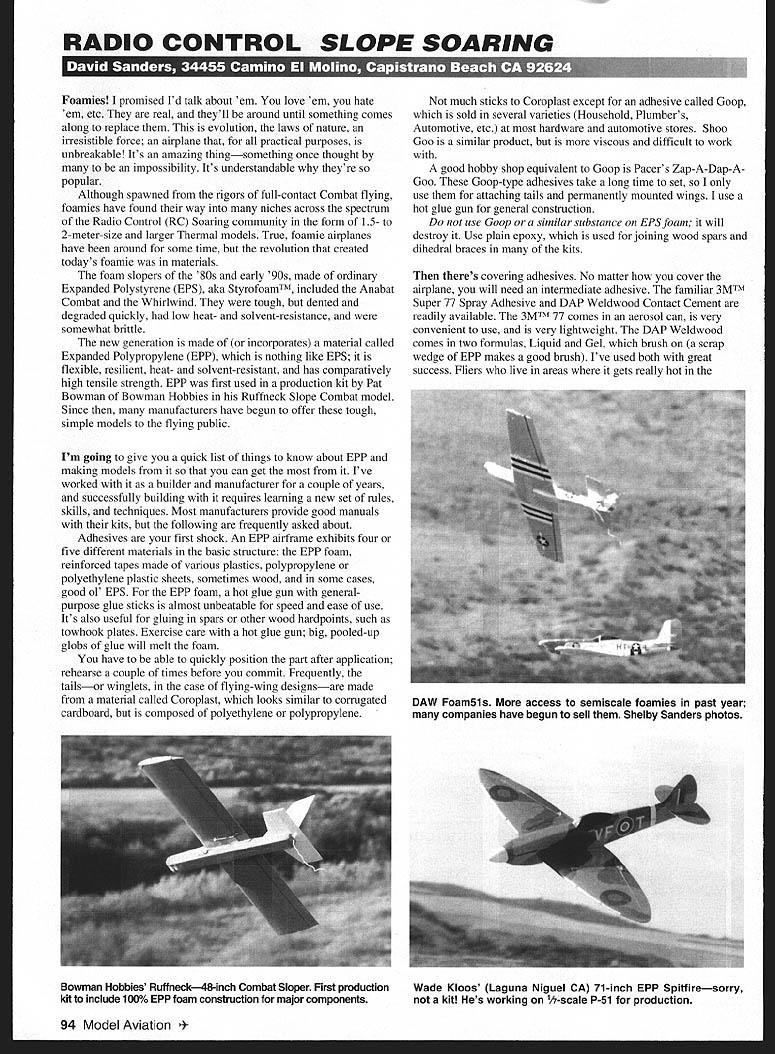
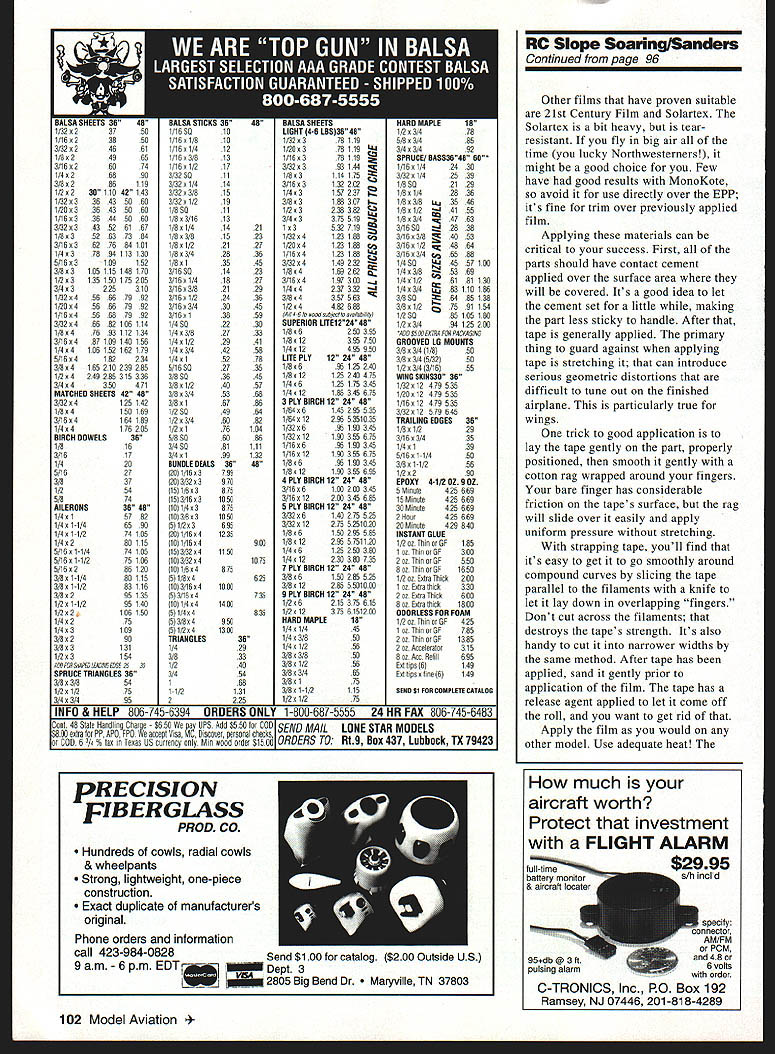
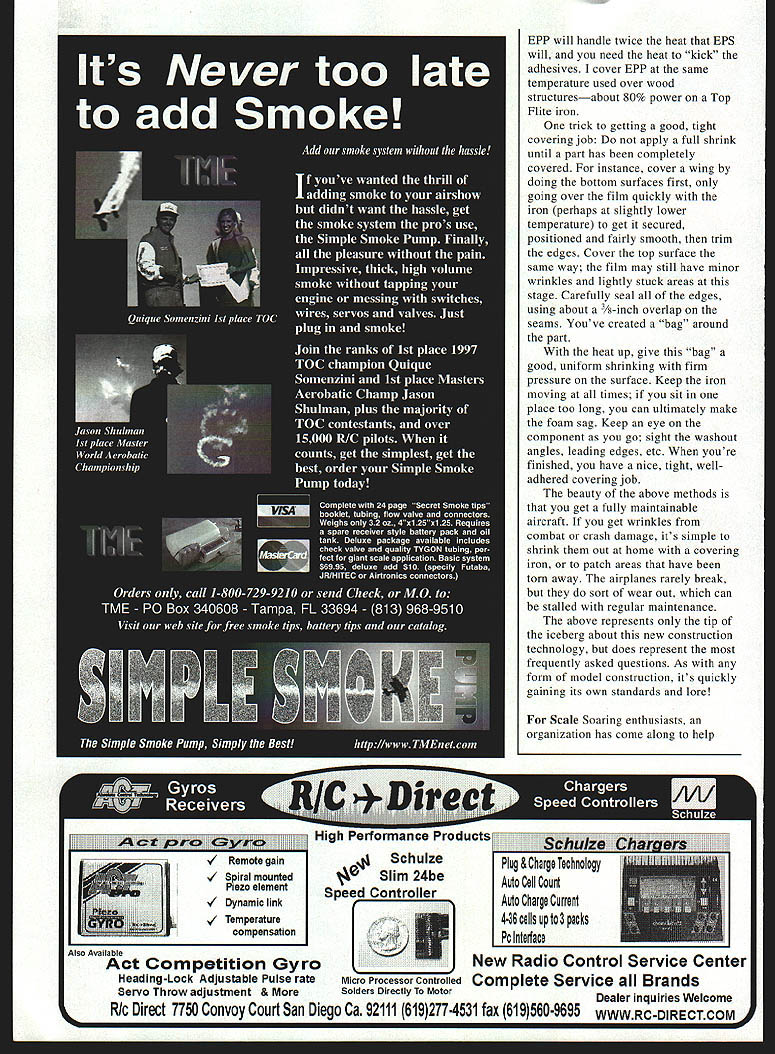
Although spawned from the rigors of full-contact Combat flying, foamies have found their way into many niches across the Radio Control (RC) soaring community, in the form of 1.5- to 2-meter-size and larger thermal models. True foamie airplanes have been around for some time, but the revolution that created today's foamie was in materials.
EPS vs EPP
The foam slopers of the '80s and early '90s, made of ordinary Expanded Polystyrene (EPS), aka Styrofoam™, included the Anabat Combat and the Whirlwind. They were tough, but dented and degraded quickly, had low heat- and solvent-resistance, and were somewhat brittle.
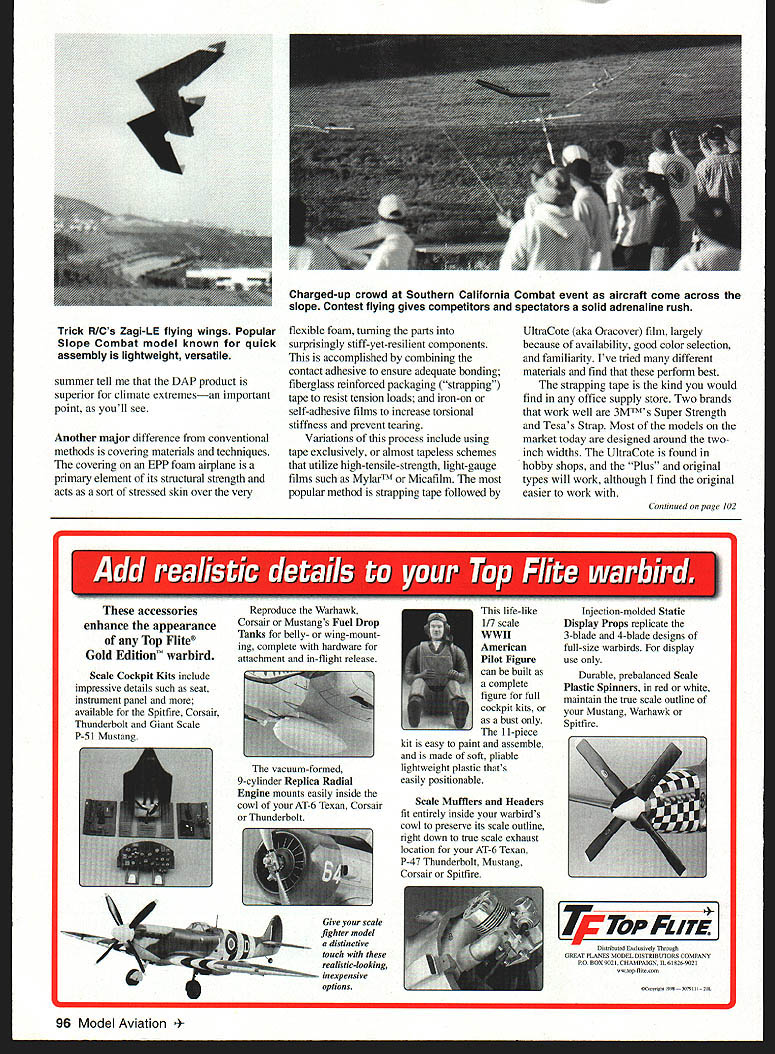
The new generation is made of (or incorporates) a material called Expanded Polypropylene (EPP), which is nothing like EPS; it is flexible, resilient, heat- and solvent-resistant, and has comparatively high tensile strength. EPP was first used in production kit by Pat Bowman of Bowman Hobbies in his Ruffneck Slope Combat model. Since then, many manufacturers have begun offering these tough, simple models to the flying public.
I'm going to give you a quick list of things to know about EPP and making models from it so that you can get the most from it. I've worked with it as a builder and manufacturer for a couple of years, and successfully building with it requires learning a new set of rules, skills, and techniques. Most manufacturers provide good manuals with their kits, but the following are frequently asked about.
Adhesives and structure
An EPP airframe often incorporates four or five different materials in the basic structure: the EPP foam, reinforced tapes made of various plastics, polypropylene or polyethylene plastic sheets, sometimes wood, and in some cases, good ol' EPS.
- Hot glue gun (general-purpose glue sticks) is almost unbeatable on EPP for speed and ease of use. It's also useful for gluing in spars or other wood hardpoints, such as towhook plates. Exercise care with a hot glue gun; big pooled globs of glue will melt the foam. You must be able to position the part quickly after application—rehearse a couple of times before you commit.
- Tails or winglets (on flying-wing designs) are frequently made from Coroplast (looks like corrugated cardboard but is polyethylene or polypropylene). Not much sticks to Coroplast except for an adhesive called Goop, sold in several varieties (Household, Plumber's, Automotive, etc.) at hardware and automotive stores.
- Shoo Goo is a similar product but more viscous and harder to work with. A hobby-shop equivalent is Pacer's Zap-A-Dap-A-Goo.
- Goop-type adhesives take a long time to set, so use them for attaching tails and permanently mounted wings. Use hot glue for general construction.
- Do not use Goop or similar substances on EPS foam; it will destroy it. Use plain epoxy for joining wood spars and dihedral braces in many kits.
Covering adhesives
No matter how you cover the airplane, you'll need an intermediate adhesive.
- 3M™ Super 77 Spray Adhesive (aerosol) — very convenient and lightweight.
- DAP Weldwood Contact Cement — comes in Liquid and Gel formulas, brush-on. Use a scrap wedge of EPP as a brush. DAP tends to be superior in very hot climates.
Both have worked well for me; if you live in a hot area, consider the DAP product for climate extremes.
Covering materials and techniques
The primary structural element is a stressed skin over very flexible foam—turning parts surprisingly stiff yet resilient. This is accomplished by combining:
- A contact adhesive to ensure adequate bonding.
- Fiberglass-reinforced packaging strapping tape to resist tension loads.
- Iron-on self-adhesive films to increase torsional stiffness and prevent tearing.
Variations include tape-only methods or almost tapeless schemes using high-tensile-strength, light-gauge films such as Mylar™ or Micafilm. My preferred method is strapping tape followed by UltraCote (aka Oracover film) because of availability and color selection.
- Strapping tape: the kind from office-supply stores. Two brands that work well are 3M's Super Strength and Tesa's Strap. Most models are designed around two-inch widths.
- UltraCote: found in hobby shops; both "Plus" and original types work, though the original is easier to handle.
- Other suitable films: 21st Century Film and Solartex. Solartex is a bit heavy but tear-resistant (good for "big air"). MonoKote has had few good results directly over EPP—avoid it for direct application; it can be used as trim over previously applied film.
Application tips
Applying these materials correctly is critical.
- Apply contact cement over the surface area to be covered and let it set a bit so the part is less sticky to handle.
- Apply tape carefully—avoid stretching it, which can introduce geometric distortions, especially on wings.
- Lay the tape gently in position, then smooth it with a cotton rag wrapped around your fingers. The rag slides easily and applies uniform pressure without stretching; your bare finger has too much friction.
- For compound curves, slice the tape parallel to the filaments with a knife to create overlapping "fingers" so it lays smoothly. Do not cut across the filaments—doing so destroys the tape's strength.
- You can cut tape into narrower widths by the same parallel-filament method.
- After tape application, sand it gently before applying film. The tape has a release agent; sanding removes that.
- Apply the film as you would on any other model. Use adequate heat—the EPP will handle about twice the heat EPS will, and you need the heat to "kick" the adhesives. I cover EPP at the same temperature used over wood structures—roughly 80% power on a Top Flite iron.
One trick for a tight covering job:
- Do not apply full shrink until the part is completely covered. For example, cover the bottom of a wing first, going over the film quickly with the iron (possibly at slightly lower temperature) just to secure and position it, then trim the edges.
- Cover the top the same way. At this stage the film may have minor wrinkles and lightly stuck areas.
- Carefully seal all edges with about a 3/8-inch overlap on seams—creating a "bag" around the part.
- With the iron heated, give the "bag" a good, uniform shrinking with firm pressure, keeping the iron moving at all times. Sitting in one place too long can make the foam sag.
- Sight washout angles, leading edges, and control components as you go.
When finished, you should have a tight, well-adhered covering job.
Maintenance and repairs
The beauty of these methods is a fully maintainable aircraft. If you get wrinkles from combat or crash damage, you can often shrink them out at home with a covering iron or patch torn areas. The airplanes rarely break, but they do wear out; regular maintenance can extend their life.
Scale soaring and ISSA
For scale soaring enthusiasts, the International Scale Soaring Association (ISSA) provides information and conducts scheduled events for scale sailplanes.
I've been a member for more than a year. For my $15 annual dues I receive a bimonthly newsletter featuring articles by scale all-stars such as Erik Eiche, John Derstine, Ron Gustin, Dennis Brandt, and others. The newsletter includes a calendar of events hosted by ISSA and other organizations. This group has been a considerable aid to me on my scale odyssey. If you found the last column on scale interesting, ISSA membership is for you.
Contact for ISSA membership info:
- ISSA c/o Gary Fogel
- 3615 Watseka Ave. #101
- Los Angeles, CA 90034
- (310) 838-6068
- gfogel@ucla.edu
Until next time: land the crunchy ones smooth and the foamie ones—uh—however. I have a huge list of foamie manufacturers that's too lengthy to include here, but if you'd like one, mail a SASE to me and I'll send one to you.
Transcribed from original scans by AI. Minor OCR errors may remain.

