

RADIO CONTROL: SLOPE SOARING
David Sanders, 34455 Camino El Molino, Capistrano Beach, CA 92624
Introduction
In recent years, One Design (OD) classes have seen expanding participation in many forms of competition, including full-scale aerobatic aircraft. For instance, the much-modeled DR-107 OD is being used by the International Aerobatic Club for entry-level competition. This comparatively inexpensive kit aircraft can be constructed by home-builders utilizing midpriced power plants.
OD concepts have also appeared in the modeling world—specifically in Radio Control (RC) soaring. The Nostalgia class Thermal Duration (TD) events were born of modelers' desires to create a more level playing field in TD by specifying fixed designs from yesteryear that are inexpensive to build, thanks to largely wood-framed construction.
In RC pylon racing, the AT-6 class Madera racers and Quickie 500 classes have become accepted entry points to higher levels of competition. So what about on the slope? Slope racing seemed a natural prospect for an OD format. Advances in technology and rising costs for state-of-the-art 60-inch and Unlimited airplanes made competitive slope racers a sizable investment for the average modeler.
Background: problem and solution
Speed is an obsession in racing, and high-tech materials and equipment give skilled fliers an advantage. As a result, the rookie is often thrown into a field of seasoned pilots flying incredibly well-tuned, expensive machines. The 60-inch class was envisioned as an introductory class, but experienced Unlimited fliers began to participate and pushed 60-inch machines toward high-tech, costly designs.
To break down the skill/cost barrier, a class requiring low-tech materials and a fixed set of geometric criteria would allow modelers to use inexpensive off-the-shelf kits specifically designed for the event or to scratch-build models that meet the rules.
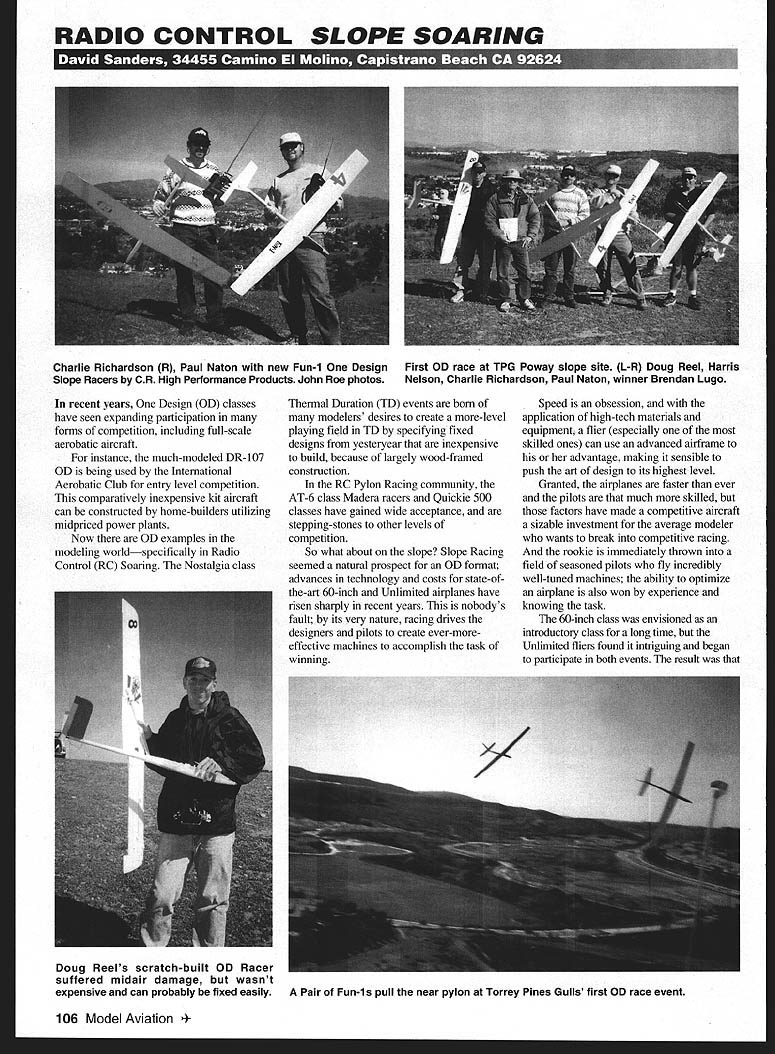
The progressive Torrey Pines Gulls (TPG) of San Diego, California, rose to the challenge. Among the pioneering members, expert slope racer Paul Naton decided the time had come for an OD slope racing class. With help from veteran slope designer Charlie Richardson of C.R. High Performance Products, Paul developed specifications for the club's OD racer.
TPG OD Racer specifications
- Wingspan: 60 inches
- Root chord: 7 inches
- Tip chord: 5 inches
- Wing planform: single taper only (no compound tapers)
- Airfoil: SD 6060, minimum 9.5% thickness
- Wing area: 360 square inches (wings checked against template)
- Ailerons: 20 inches long; maximum chord 1-1/4 inches; cut starting 3 inches inboard from the tips
- Aircraft flying weight: minimum 25 ounces, maximum 35 ounces
- Materials: noncomposite materials preferred; composite wing skins allowed but composite leading-edge materials are prohibited
- Tail geometry: no restrictions (conventional and V tails permitted)
- Fuselage length: maximum 36 inches, minimum 32 inches
- Fuselage minimum circumference: 6 inches at widest girth (usually in front of the wing leading edge)
- Construction restrictions:
- Wing construction limited to balsa, obeche, tape-and-film over foam; EPP (expanded polypropylene) foam is legal
- Plywood and composite wing skins are allowed (except composite leading edges)
- Spar construction restricted to established legal materials and methods
- Fuselage may be fiberglass, Kevlar, wood, or EPP; carbon fiber is prohibited except for minor field repairs
- Ballast must be enclosed inside the fuselage; ballast tubes in the wing are prohibited
- Radio and control:
- Radio equipment limited to three channels (servos: one for elevator, two for ailerons)
- Differential aileron mixing and stick-activated camber changing are allowed
- Camber-to-elevator mixing is prohibited
- Any flaperon function must be manually controlled on the transmitter's left stick
Spirit and purpose of the class
The intent is to create a spirit for the rules: inexpensive aircraft for a fun-oriented racing format that encourages participation by beginning racers and downward mentorship from experts in airframe setup, ballasting, and flying technique. Paul indicated the specification would remain in flux during the first year to ensure it achieves the desired goal.
This OD format could revitalize slope racing and provide a basis for fun, low-tech but speedy sport slope models.
Models: Fun-1 vs. Vindicator
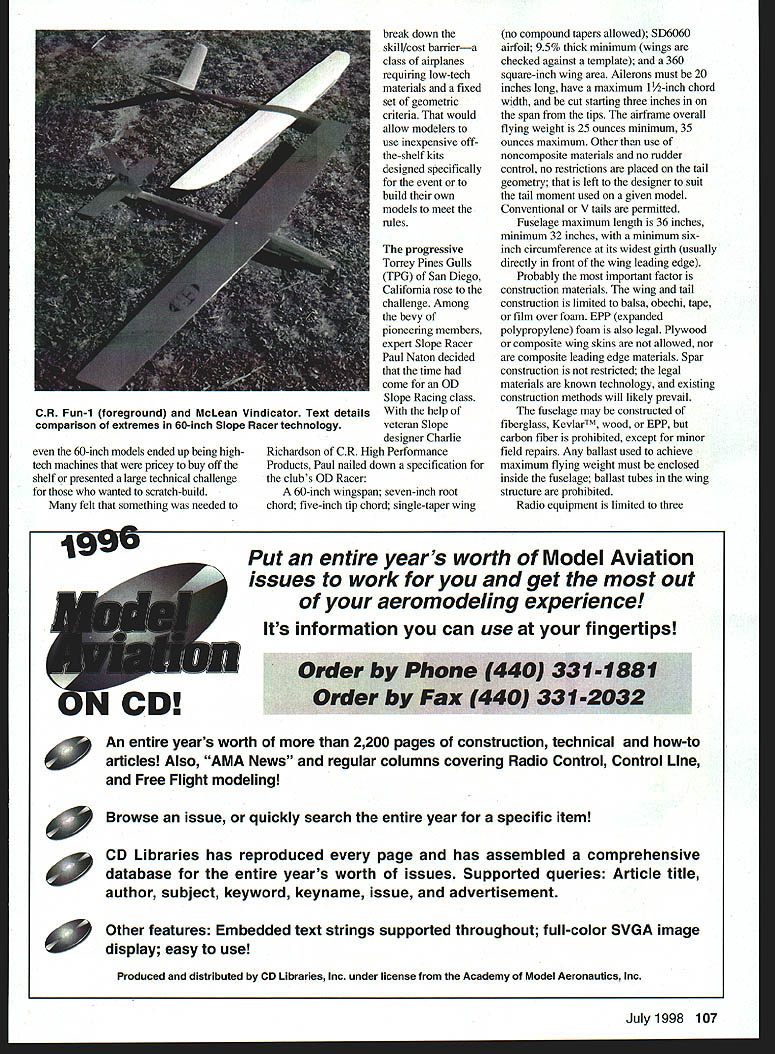
The Fun-1 by C.R. High Performance Products is already in use by TPG members in monthly races and has set the standard for the OD class models. The Fun-1 uses a balsa-sheeted wing over styrene foam, a glass/Kevlar fuselage, and a balsa tail group. Its fuselage is similar to Charlie Richardson's Blazer, but the Fun-1 uses a conventional tail rather than the Blazer's V tail.
A comparison with a state-of-the-art Brian McLean Vindicator highlights the differences:
- Wing planform and construction:
- Vindicator: triple-taper wing planform, labor-intensive (six separate cutting operations per wing); foam core/composite tail; vacuum-bagged with high-strength carbon and glass skins
- Fun-1: single-taper planform (about one-third the labor of the Vindicator); simple-shaped balsa tail; balsa-sheeted wing with ordinary film covering
- Fuselage finish:
- Vindicator: fuselage prepainted in the mold
- Fun-1: unpainted fuselage (saves a step and reduces QC failures related to finish)
- Radio and servos:
- Vindicator: six-servo onboard system with computerized mixing (ruddervator, elevator/camber mixing); requires small high-torque servos due to high speeds and aerodynamic loads
- Fun-1: designed to operate with only three servos (simple HS-85s are sufficient), since its limited weight and top speed reduce control forces
Pricing and availability
- Vindicator price: approximately $300 (prefabricated, high-end)
- Fun-1 price: $80 for the presheeted kit; $150 for a prebuilt airframe (add $5 shipping and handling for mail orders and California sales tax if applicable)
- The Fun-1 exhibits exceptional quality and craftsmanship at a much lower cost.
Events and contacts
The Torrey Pines Gulls are running a monthly series of races for all classes, including OD, for the 1998 season. If you're in Southern California, consider trying slope racing or rediscovering it.
- TPG website: www.TorreyPinesGulls.org
- Ron Schark, TPG president: (619) 454-4900
For information on the OD specs:
- Paul Naton: pnaton@cts.com or (760) 634-2348
To get a Fun-1 presheeted kit or prebuilt airframe:
- Charlie Richardson, C.R. High Performance Products
205 Camille Way, Vista, CA 92083 Tel: (760) 630-8775
Until next time, see you on the slopes!
Transcribed from original scans by AI. Minor OCR errors may remain.

