
RADIO CONTROL SLOPE SOARING
David Sanders, 34455 Camino El Molino, Capistrano Beach, CA 92624
I'm an optimist, so I know that any day spent at the slope is a good day—even when the wind stinks! A fun way to challenge yourself and your machines on such a day is by finding and utilizing unconventional forms of lift.
Three primary factors are involved in having a good time on light-lift days:
- Atmospheric/geographic analysis
- Airframe selection
- Flying technique
Many of my most rewarding (if not necessarily thrilling) sessions are on these days. If you're at an event or on vacation, you may have to take what you can get. Following are some things to ponder about the above factors for your next light-lift slope-flying experience.
Don’t assume there’s no lift
Just because the general wind is weak or a bit off-direction to the slope doesn't mean there is no lift. There may not be any true, general wind-driven slope lift, but there's still likely to be an abundant (or at least usable) amount available through other means—especially on a sunny day when any general wind present is at least near the correct direction for the slope. There are very few days when there's no lift; you just need to know where to look for it.
Thermals
Primary among alternate sources of lift are thermals; however, many slope soarers fail to appreciate and take advantage of thermal lift because they don't make the association. I never gave it much thought until I started flying more regularly with Thermal Duration (TD) pilots. Some of the more skilled and experienced pilots could routinely work seemingly impossible air and develop amazing energy for speed runs or aerobatics along the ridgeline.
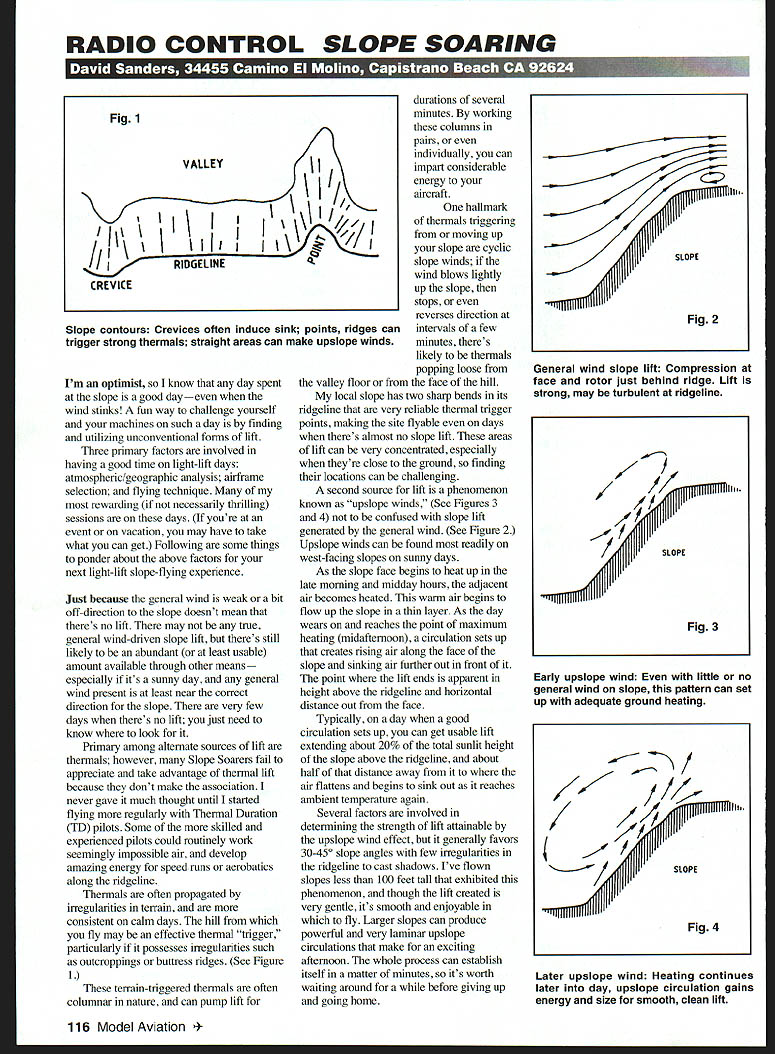
Thermals are often propagated by irregularities in terrain, and are more consistent on calm days. The hill from which you fly may be an effective thermal "trigger," particularly if it possesses irregularities such as outcroppings or buttress ridges (see Figure 1). These terrain-triggered thermals are often columnar in nature, and can pump lift for durations of several minutes. By working these columns in pairs, or even individually, you can impart considerable energy to your aircraft.
One hallmark of thermals triggering from or moving up your slope are cyclic slope winds; if the wind blows lightly up the slope, then stops, or even reverses direction at intervals of a few minutes, there's likely to be thermals popping loose from the valley floor or from the face of the hill.
My local slope has two sharp bends in its ridgeline that are very reliable thermal trigger points, making the site flyable even on days when there's almost no slope lift. These areas of lift can be very concentrated, especially when they're close to the ground, so finding their locations can be challenging.
Upslope winds
A second source for lift is a phenomenon known as "upslope winds" (see Figures 3 and 4) and not to be confused with slope lift generated by the general wind (see Figure 2). Upslope winds can be found most readily on west-facing slopes on sunny days.
As the slope face begins to heat up in the late morning and midday hours, the adjacent air becomes heated. This warm air begins to flow up the slope in a thin layer. As the day wears on and reaches the point of maximum heating (midafternoon), a circulation sets up that creates rising air along the face of the slope and sinking air further out in front of it. The point where the lift ends is apparent in height above the ridgeline and horizontal distance out from the face.
Typically, on a day when a good circulation sets up, you can get usable lift extending about 20% of the total sunlit height of the slope above the ridgeline, and about half of that distance away from it to where the air flattens and begins to sink as it reaches ambient temperature again.
Several factors determine the strength of lift attainable by the upslope wind effect, but it generally favors 30–45° slope angles with few irregularities in the ridgeline to cast shadows. I've flown slopes less than 100 feet tall that exhibited this phenomenon, and though the lift created is very gentle, it's smooth and enjoyable to fly in. Larger slopes can produce powerful and very laminar upslope circulations that make for an exciting afternoon. The whole process can establish itself in a matter of minutes, so it's worth waiting around for a while before giving up and going home.
Sizing up a site in light air
- Take note of ground features that may act as thermal triggers—especially if the air feels like it's cycling.
- Look for long, well-lit sections of slope for possible upslope circulation patterns.
- Test the air and have the right tool for the job—your trusty hand-launch model comes along.
There are several inexpensive, well-built HLGs (hand-launched gliders) on the market that are excellent light-lift slope machines when built with slope flying in mind (that means tough). Even a well-used former competition HLG can be rejuvenated into an excellent lift tester for slope use.
If you can get your hands on a 50- to 70-inch-span model that is reasonably clean and flying at 5–6 ounces per square foot wing loading, you've got an excellent driving rod for elusive lift in your slope quiver.
Recommended HLG characteristics:
- Strong construction (able to withstand frequent down-slope landings and aggressive launches)
- Tough, sacrificial "ugly duckling" attitude—expect it to take a beating while you discover what makes the slope tick
- Foamies can be particularly useful for durability
After determining where, how powerful, and in what form lift exists on the slope, you can move into your slick glass aircraft and use the air to maximum advantage. The lift you discover by alternative means could be energetic, so if you find spots on the ridge that consistently take the HLG up and out quickly, you might be able to get some good stick time on a cleaner, larger, higher-loaded airplane than you expect.
Technique
The first step in deciding how a day is going to be is to launch your favorite lift-testing model and check the spots that are known lift generators on hills that you're familiar with, or check around ground features that look as if they might trigger lift on hills with which you're unfamiliar.
This is where the HLG is handy: you can get at least a 30° or 40° foot-launchable advantage right off the bat by being able to launch high, giving yourself a chance to finish a full pass across the ridge or check trigger zones at considerable distance without actually hiking down the hill.
If you hit spots that make the HLG rise with reasonable authority, there's probably enough lift for a modern composite Slope Racer to stay up unballasted. During your test throws, it's also a good idea to return to landing by shooting across the ridgeline, well above stall speed if possible, and watching the reaction of the aircraft as it rides in closer to the slope.
If you have an upslope wind circulation setting up (which will be very snug against the face of the hill and won't extend very far high), you'll see it as soon as the airplane hits this lift; its glide slope will flatten considerably and the wing closest to the slope may rise slightly. This is a good sign: this circulation will most likely strengthen, particularly if it stays sunny and the general wind never really turns on.
If you are able to stay flying consistently, try ballasting slightly (increase wing loading in about 1/2 ounce per square foot increments) and launch again. This will give you a feel for the ultimate amount of energy to be extracted.
When you know where the lift is popping, grab your higher-performance airplane and concentrate on flying smoothly and not "hacking" (making sudden turns or large control deflections). If thermals are triggering, make a few circles and try to gain some height; you may even climb right then and there. Stay with the thermal; it won't be going straight up, but it will drift downwind. If you've noticed an upslope wind, stay tight on the ridgeline and use the energy saved by smooth flying to gain altitude.
After a few passes, you may gain considerable height, which allows you to store the most energy possible in the mass of your aircraft. The upslope wind effect in particular will require you to fly very close to the hill and control it accurately.
Watch for holes in the air; places where the ridge falls back, such as crevices or the lee side of projections or buttresses, are hazard areas. The circulation can be interrupted, or even create sink; one spot on my club's hill is famous for this, wryly referred to as the "Valley of Death." Airplanes get sucked down there and don't readily suck back up!
With a little preparation and the right equipment, you can get the most out of your trips to the hill, and never be stuck sitting around waiting for the wind. Figuring out how to find the air where there apparently is none is a real kick, and in the process you'll learn so much about your airplanes and yourself as a pilot; you just gotta have faith!
Recommended reading
I heard that Dave Thornburg's classic, The Old Buzzard's Soaring Book, is being reprinted a third (and, they say, last) time! This is one of the all-time great books about radio control soaring, and it discusses a wide variety of topics in Dave's inimitable style.
The book covers flying techniques for all sorts of conditions and flight regimes, and can greatly increase your understanding of the atmosphere, allowing you to find and take advantage of lift most effectively no matter where or what you fly. The information is useful for beginners and experts.
Books are available from Taylor Collins at Soaring Stuff:
- Soaring Stuff, 9140 Guadalupe Trail N.W., Albuquerque, NM 87114
- Tel/Fax: (505) 898-8281
- Web: www.soaringstuff.com
- Price: $16.95 + $3 shipping and handling in the U.S.
That's all for this month. Be patient and perseverant, and you will be rewarded!
Transcribed from original scans by AI. Minor OCR errors may remain.

