
Radio Control: Slope Soaring
Mark Triebes 20794 Kreisler Ct. Saratoga, CA 95070
SR BATTERIES
Just how important are batteries? Very important, of course. Yet many modelers seldom think about the age or overall quality of their battery packs. When it comes time to replace old packs, you might as well get the best. In the opinion of most modelers, SR Batteries offers some of the best around.
To give an idea of SR's reputation: the company makes packs for major aerospace firms and has been chosen to make packs for the Space Shuttle program. The packs sold to modelers are built and tested to the same standards as those for the aerospace industry.
SR provides flight-pack batteries ranging from 50 mAh to 4,000 mAh in a variety of configurations. Prices are reasonable, and packs are available with virtually all known connectors. For more information, write: SR Batteries, Box 287, Bellport, NY 11713.
Minicraft Lynx 140
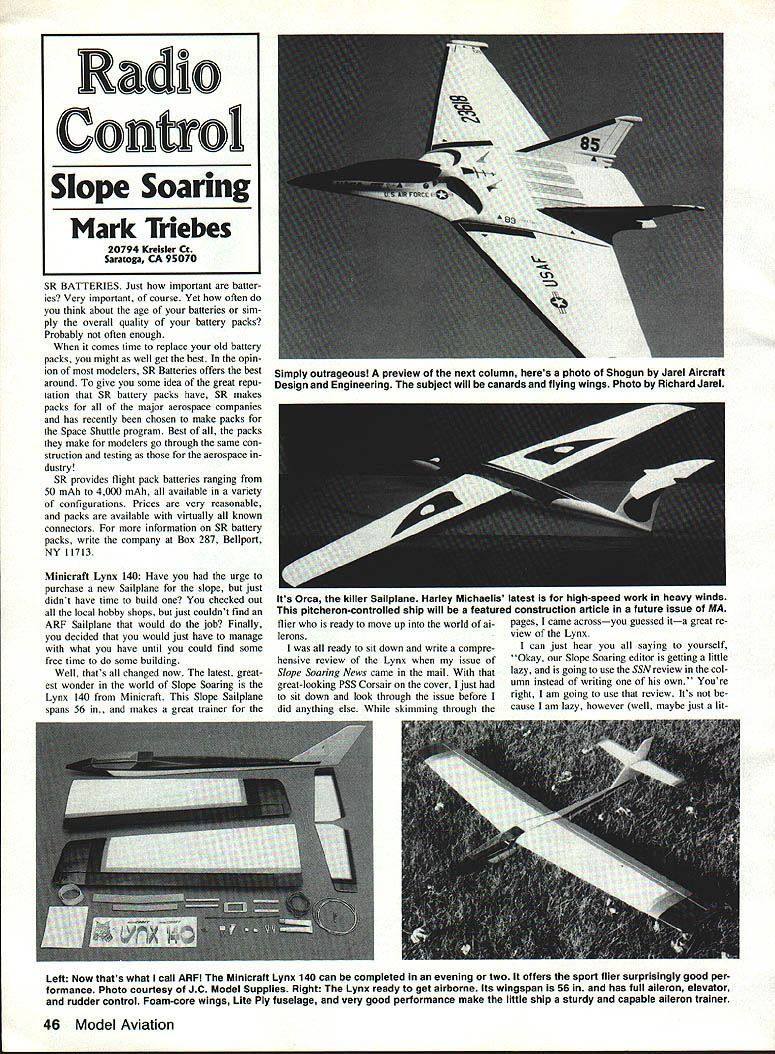
Have you wanted a new sailplane for slope flying but lacked the time to build one? The Minicraft Lynx 140 fills that need. The slope sailplane spans 56 in., is essentially an ARF, and makes a great trainer for sport fliers and those transitioning to aileron-equipped ships. Its foam-core wings and Lite-Ply fuselage provide good performance and durability.
Charlie Morey reviewed the Lynx for Slope Soaring News; his observations follow.
First test flight
Standing alone on the Long Beach bluff with a shiny new Lynx 140 and a Futaba Conquest transmitter, Charlie made a shoulder toss when there was almost no wind. The Lynx flew straight out about 20 ft, then slightly steepened as the glide picked up speed. A gentle pull on the stick brought it to a flat, level, slow, smooth glide. Charlie was pleasantly surprised.
The test model carried a full-sized Futaba Conquest flight pack and three servos (ailerons, elevator, rudder) and weighed 29 oz. With 297 sq in of wing area, wing loading is about 10 oz/ft², making it a floater. It stays up in light lift and also handles stronger wind well. Turns are smooth using ailerons, with large sweeping S-turns; landings are gentle.
Trimming and flying
A couple of hand tosses on a park lawn trimmed the model from the original 0°/0° wing/stab setting to about +2° wing stab incidence for very light conditions. The Lynx is easy to trim via radio adjustments. It is difficult to stall, easy to recover, and can fly very slowly or handle brisk slope conditions. It is quite aerobatic but not a plane designed for very high-speed slope runs — it will move out sufficiently for most fliers but is not a "Fast Slope" design.
A three-axis setup (ailerons, elevator, rudder) is enjoyable: coordinated turns, stall turns, and hammerheads are readily performed.
Assembly
Assembling the (made-in-Thailand) Lynx 140 should be straightforward. Major parts are largely finished: the two wing halves are vacuum-formed and covered; the owner epoxies the halves together, routes control cables, trims and mounts the clear canopy, and installs the radio flight pack. Five-minute epoxy makes it a one-evening job in ideal cases.
Factory workmanship issues
Charlie encountered several factory assembly problems that made his build a two-evening job and required more shop skill than expected for an ARF:
- Some hinges were glued solid in places, while one hinge was missed completely and came loose during the first flight with lift.
- A glue joint down the lower right side of the fuselage was omitted, while the opposite side had a broad fillet.
- The brass bushing installed midway up the vertical stab (for the full-flying horizontal stabilizer) was crooked.
These issues are correctable, but an ARF customer should not have to redo factory work.
Recommended fixes for the crooked bushing
For equipped shops: remove the crooked bushing, install a dowel, glue, then drill a new, square hole. If you lack brass tubing, you can fashion a new bushing from a threaded control-cable end and glue it in place.
For less-equipped builders, follow this suggested procedure:
- Carefully cut and peel back the covering around the bushing area.
- Cut through the vertical stab ahead of and behind the bushing with an X-Acto knife, leaving it attached to the tail boom.
- Insert the hinge pin or wire, pivot it square, and reglue the bushing.
- Check squareness from top and front views, tack the area as needed, then glue.
- Touch up the ends and glue joint with a small sanding block, then reapply the covering.
Charlie suggested these complaints be relayed to the factory in hopes of improved attention to detail.
Overall impression and recommendation
Despite the assembly flaws, the Lynx 140 is an amazingly capable flier and would make a good all-around trainer for pilots moving from rudder/elevator to aileron/elevator planes. It handles light lift and stronger slope wind, is aerobatic, easy to recover from stalls, and provides full afternoons of flying fun. For those short on building time, buying a $130 ARF like the Lynx is a good option.
The Lynx is available in many larger hobby shops. For kit inquiries contact: Jesse Chase, J.C. Model Supplies, P.O. Box 2406, Fullerton, CA 92633.
For those interested in Slope Soaring News, a one-year subscription is $15.95. Contact Charlie Morey at 2601 E. 19th St., #29, Signal Hill, CA 90804.
Slopar
Mike Reed designed the Slopar to fill the need for a light-air slope glider. Key points:
- Carefully built, the Slopar weighs about 14 oz — ideal for low-lift beaches and calm inland slopes with winds of 9–12 mph.
- The glider can be ballasted to 28 oz for normal wind conditions.
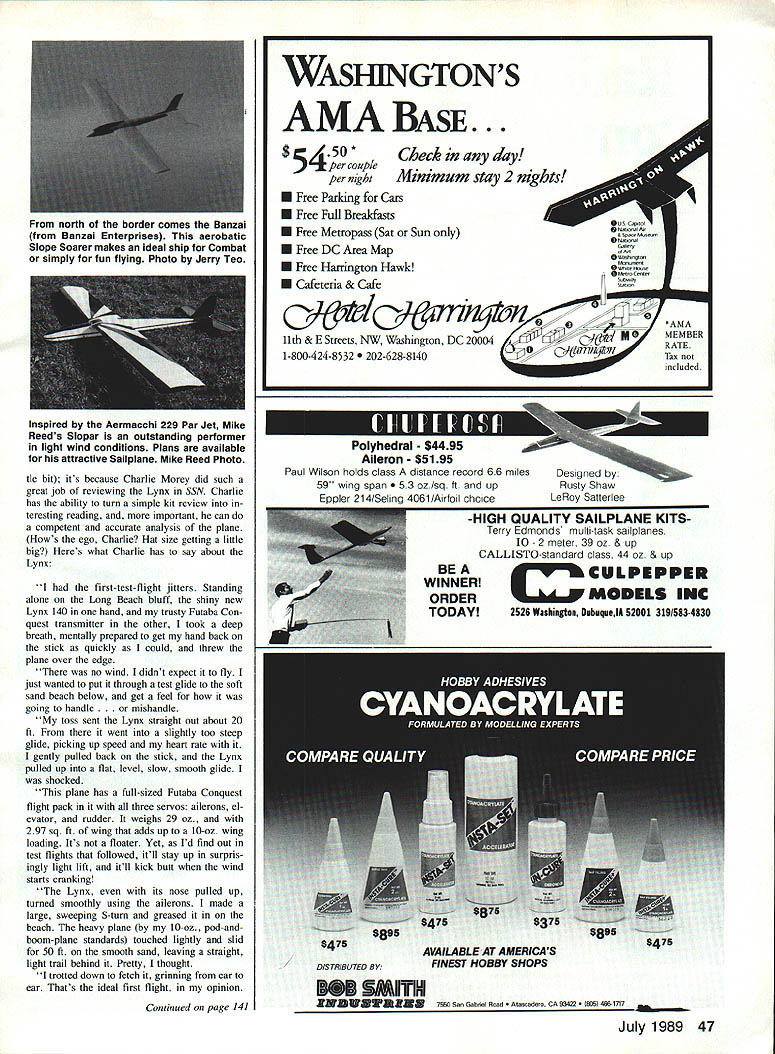
- The basic shape was inspired by the Aermacchi 229 Par Jet; the goal was a small, efficient, clean-design slope ship that performs well in very light lift and supports slow closed loops.
- Designed for small radio gear (e.g., Futaba four-channel with S-33 servos), but the fuselage can be built to suit standard servos.
- The Selig 3021 airfoil provides sparkling performance. Construction is balsa with a fully sheeted wing.
Plans are available from Mike Reed: folded plans for $7 or rolled plans for $11 (money orders only). Mail to: Mike Reed, 1775 Dumitry Way #B, Corona, CA 91720.
Banzai
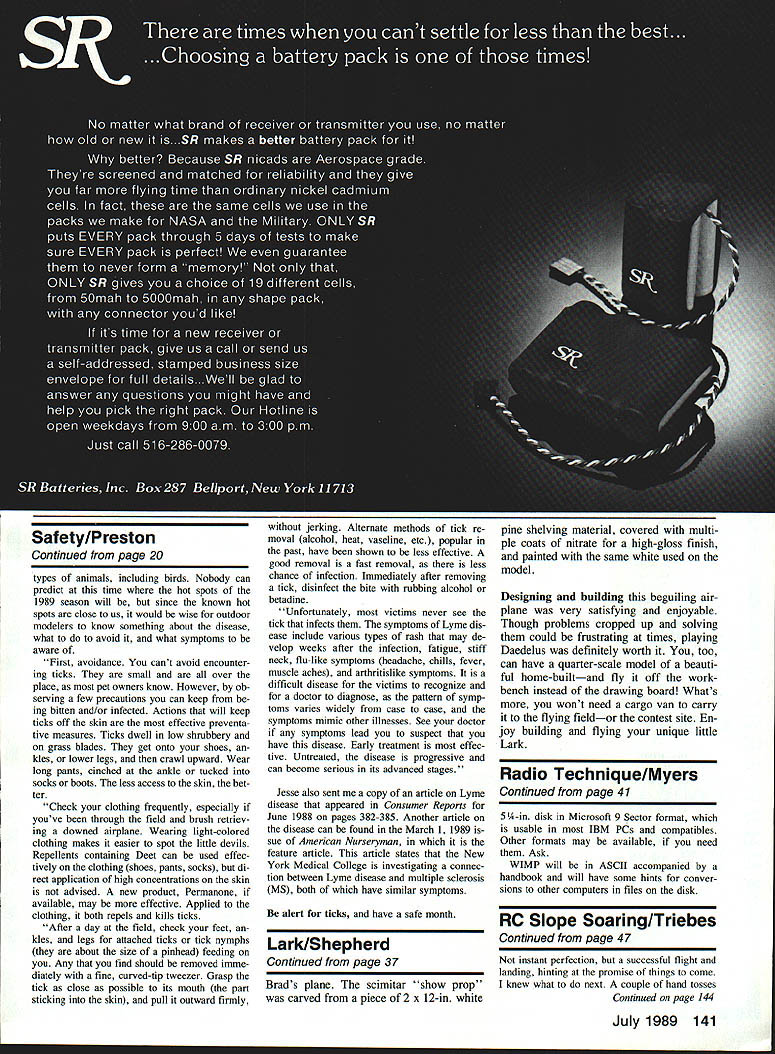
Slope soaring is alive in Canada. Jerry Toe of Banzai Enterprises in British Columbia designed the Banzai slope soarer. Highlights:
- Purpose: a quick-building, durable, aerobatic slope soarer suitable for strong west-coast ocean breezes where thermal floaters perform marginally.
- Airfoil: Eppler 374 — provides good penetration, excellent slow-speed characteristics, and smooth inverted performance.
- Wing: 60-in. foam-core wing covered with Kromekote (a glossy, dimple-resistant covering that substitutes for balsa sheeting and offers strength and durability).
- Controls: Ailerons for quick, smooth roll response; flaperons can be added.
- Fuselage: 1/8-in. light plywood, built like the "Ugly Stik" style — preshaped bottom crutch, pre-cut bulkheads, machine-sanded sides — results in a perfectly aligned fuselage that takes about 15 minutes to glue using cyanoacrylate adhesives. Balsa triangle stock and top sheeting add strength. Tail surfaces are pre-cut and sanded. Rudder control can be added but is not required.
- Kit options:
- Basic kit: precision-cut foam cores, wing sheeting, LE/TE, aileron stock, sanded fuselage sides, bottom crutch, bulkheads, tail surfaces, nose block, hatch cover, balsa top covering, dowels, and instruction sheets. A scale drawing is included (not a full-size plan) because of prefabrication.
- Deluxe kit: same as basic plus a complete hardware package.
- Flight characteristics: very aerobatic, excellent penetration, gentle landings, responsive, flies well in light lift, and will thermal-soar under suitable conditions. A 72-in. version is available for improved thermal performance. Durable in combat; easy and quick to rebuild if severely damaged.
The Banzai sounds like a strong challenger to other slope designs such as the Cheetah.
Transcribed from original scans by AI. Minor OCR errors may remain.

