

Radio Control: Slope Soaring
Mark Triebes 20794 Kreisler Ct. Saratoga, CA 95070
Canards and flying wings
As you can tell from a quick glance at the photos, this month we're going to look at two exotic model designs: canards and flying wings. These configurations are unquestionably interesting to look at and definitely attention grabbing. But is there something more to them than simply their looks? Do these unique configurations offer advantages that can't be found in conventional designs?
I'll discuss a few of the ideas and theories behind the canard and the flying wing, and take a look at a few planes available that incorporate these ideas.
The flying wing
To most people, the flying wing is mildly intriguing and a nice diversion from the ordinary, but to some of us it is much more. Seeing one fly makes the heart beat a little faster, and thoughts of the available performance make the head swim. What makes these models so special?
The answer is drag—or more precisely, the lack of drag. I'm not saying flying wings produce no drag at all (obviously some is created by skin friction, and there's induced drag from the airfoil), just that the amount is relatively low. The true flying wing (or all-flying wing) has no surface other than the wing itself. This means the modeler has no concerns about wing-to-fuselage, stab-to-fuselage, or fin-to-fuselage joints—or about the shape of the fuselage. Factors that are of prime concern to the designer of a low-drag conventional airplane become, at least with the true flying wing, virtually nonexistent. In the few examples of modified flying wings that incorporate vertical fins, however, the effects of drag must be considered in the overall design.
What is it about having an insignificant amount of drag that produces such a significant advantage?
Other factors being equal, the less drag an aircraft has the faster it will go. For example, level speeds of flying wings are impressive — a 2/3-size Javelin was recently clocked at 102 mph. I know sailplane speed capabilities are impressive; trust me, this really moves. Keep in mind a 2/3-size Javelin measures about a 1-meter span and weighs around 18 oz.
Another characteristic of a low-drag design is its ability to conserve energy. In simple terms this means holding or maintaining speed. Take a standard Olympic II — put it in a dive, level off and watch it slow down; speed burns off quickly due to drag. A modern low-drag design will be able to hold its speed much longer and/or convert energy into something useful — altitude, aerobatics, etc. An aircraft able to convert altitude to speed and efficiently conserve energy has a clear advantage.
A second issue is span loading. Span loading is exactly what the term implies: loading the aircraft along its span. In conventional designs a major part of the weight is located in the fuselage, parallel to the centerline of the wing. The center portion of the wing must be extremely strong to accommodate the loads imposed. That's why planes are built with beefed-up center sections — fiberglass, steel rods, etc. Span loading works by redistributing weight traditionally located in the center of the aircraft evenly throughout the wing along its span. The result is a much better distribution of imposed loads and a much stronger airframe that requires less reinforcement.
Anyone involved in slope racing will, at one time or another, have observed a flier load the fuselage overflowing with lead and consequently have to add weight out on the wingtips to trim for launch or turn. Long ballast tubes placed in the wings of high-performance sailplanes enable the flier to prevent this problem. They're a simple, effective way to span-load. The ballast concept — span loading — certainly isn't limited to flying wings. Aircraft manufacturers have utilized span loading for years; it's the lack of a fuselage, however, that gives the flying wing its inherent ability to span-load.
Is there a negative side to the flying wing concept? Unfortunately, yes. The major gripe has been a lack of stability. Many problems can be severe, but designers have come up with several solutions.
- Add a vertical stab/keel. This works great, but a true flying wing aficionado will instantly reject any such aberration. Nothing can ruin the clean lines of a flying wing quicker than a vertical surface.
- Twist the wing to build in a significant amount of washout. By enabling the wing to track along a straight line, this achieves stability around the vertical axis. Unfortunately, the great gains in stability are counteracted by increased drag and accompanying loss of speed.
- Use reflexed control surfaces (elevons) to augment stability. Rather than building a permanent twist into the wing, reflex the elevons slightly higher than normal to achieve essentially the same effect.
Don't reflexed elevons produce the same negative effects as the twisted wing? Yes and no. Although reflexing elevons on a wing will produce almost as much drag, when the wing is in its normal configuration, as a twisted wing, the problem can be mitigated by moving the center of gravity (CG) toward the back to eliminate a little of the reflex. Move the CG back a little farther, and a little more reflex is removed. Go back a bit more—and, oops, too far! You want to be really careful when adjusting the CG on a flying wing. The things they'll do when the CG is too far back are truly amazing — it kind of looks like a leaf in a dust devil.
As long as you move the CG back in gradual increments and take the time to learn the different flying characteristics at each step, you can eliminate almost all of the reflex in the elevons. Performance with an aft CG is quite improved over a more conservative location (as with all aircraft). Just remember it carries a built-in risk: it is much easier to find yourself on the edge of the envelope and beyond.
The canard
When the subject of canards comes up, most people mention such craft as the Rutan Vari-Eze or the Beech Starship. Although many people believe that the canard is a new development in aviation, nothing could be further from the truth. Many early pioneers in aviation, including the Wright brothers, used the canard configuration, and as we all know had great success with it.
Other than the obvious difference in appearance, the canard actually deviates from a conventional airplane in only one respect—the fact that, technically speaking, an airplane in this configuration cannot be stalled. Does a canard's performance bear this out?
If you consider a stall to be a loss of lift on the aircraft's main wing (the rear wing in canards), then the canard, at least in theory, cannot be stalled. The forward wing (the canard) is attached so that it will always be at a higher angle of attack than the main wing. Thus as the aircraft approaches a stalling condition, the forward wing will invariably stall first. This causes the nose of the aircraft to drop and further decreases the angle of attack of the main wing. Consequently, the main wing of the canard will never reach an angle of attack sufficient to produce a stall, and control can always be maintained (the ailerons are located on the main wing). The fact that the stall occurs in the forward wing rather than the main wing obviously benefits performance to some degree.
How does this idiosyncrasy affect the canard as a model? Basically, the canard configuration produces a great speed range, is inherently clean, and looks exciting. Beyond that, though, the design isn't greatly different from a conventional aircraft.
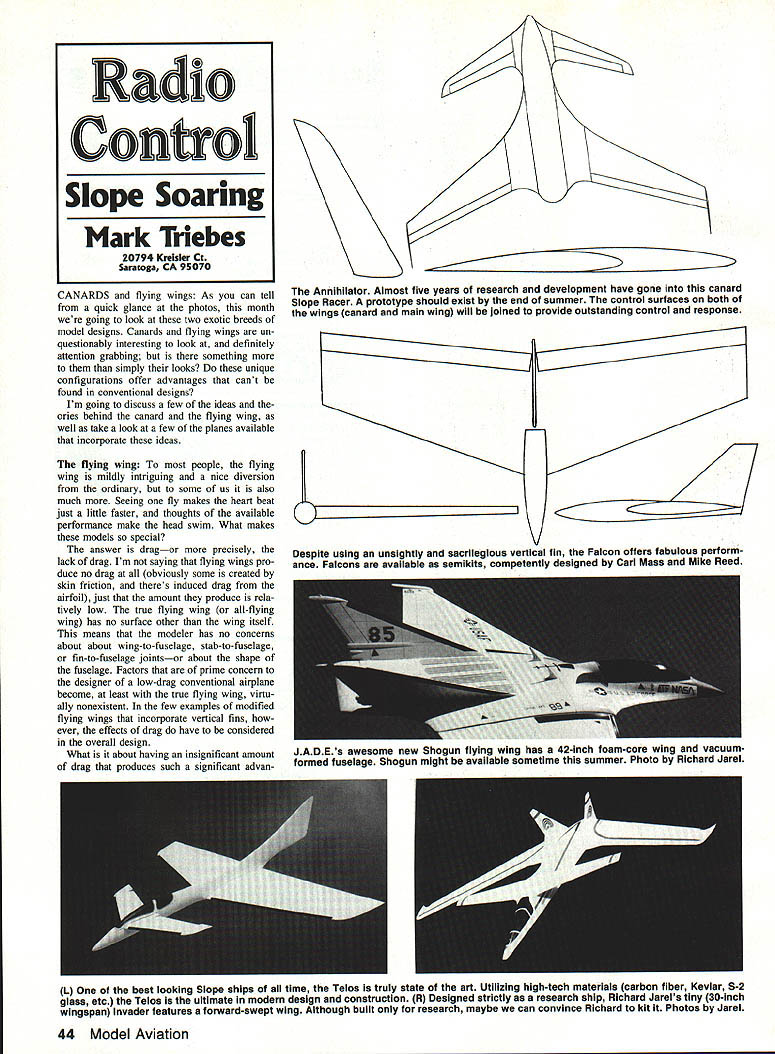
Want to design your own flying wing or canard? Good luck. Seriously, both are a bit more difficult to design than a conventional sailplane. After more than five years of work getting my Annihilator Slope Racer to the prototype stage, I can attest to this.
Probably the most important factor in the design of a canard or flying wing is the choice of airfoil(s). Since surprisingly few conventional-design airfoils work effectively with either the flying wing or the canard, a number of airfoils have been created specifically for these two configurations.
If any of you designer types out there have been successful with either a flying wing or a canard, I would really like to see the results (as would your fellow readers). For those who want to bypass the design stage, quite a few kits for both flying wings and canards are available. There's every reason to expect many more will be offered over the next few years.
The Telos and the Shogun
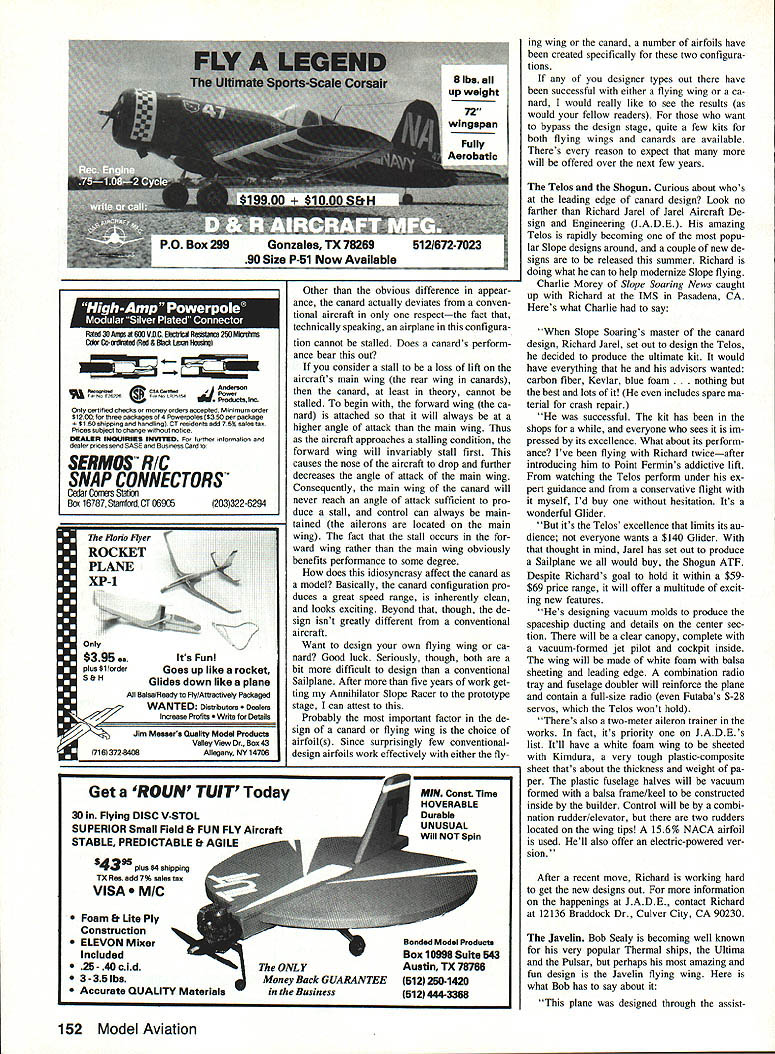
Curious about who's at the leading edge of canard design? Look no further than Richard Jarel of Jarel Aircraft Design and Engineering (J.A.D.E.). His Telos is rapidly becoming one of the most popular slope designs around, and a couple of new designs are to be released this summer. Richard is doing what he can to help modernize slope flying.
Charlie Morey of Slope Soaring News caught up with Richard at the IMS in Pasadena, CA. Here's what Charlie had to say:
"When Slope Soaring's master of the canard design, Richard Jarel, set out to design the Telos, he decided to produce the ultimate kit. It would have everything that he and his advisors wanted: carbon fiber, Kevlar, blue foam—nothing but the best and lots of it! (He even includes spare material for crash repair.)
"The kit was successful. The kit has been in the shops for a while, and everyone who sees it is impressed by its excellence. What about its performance? I've been flying with Richard twice—after introducing him to Point Fermin's addictive lift, he has taken the Telos to perform under his expert guidance and from a conservative flight test; I fly it myself. I'd buy one without hesitation. It's a wonderful glider.
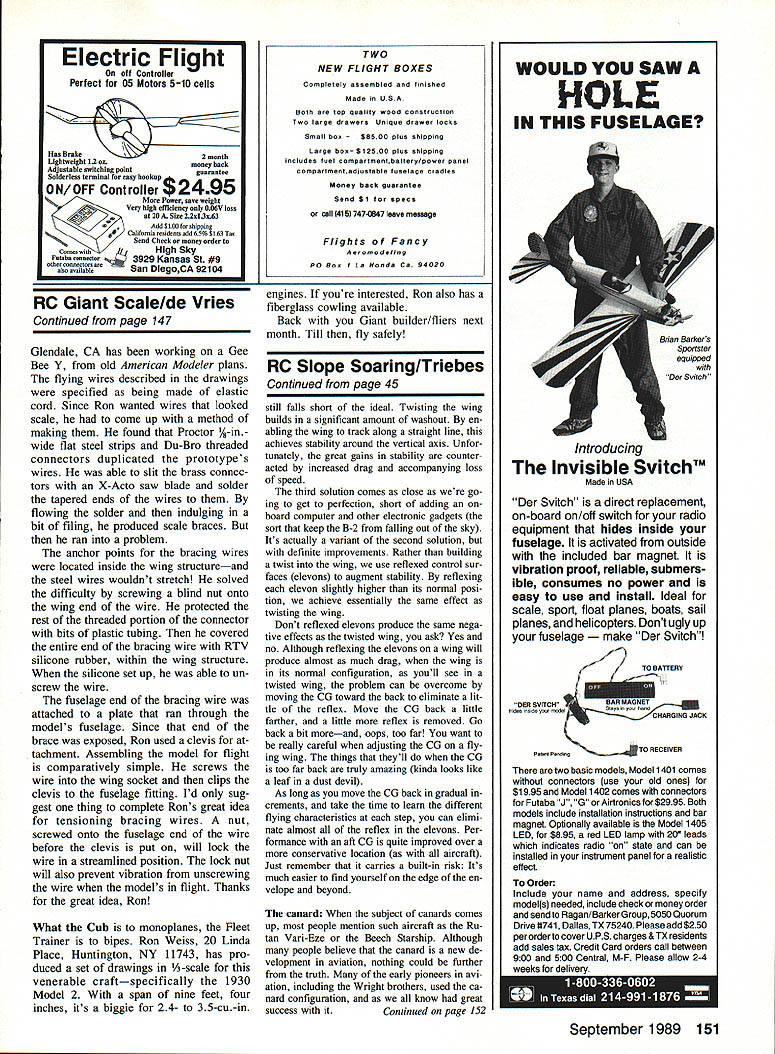
"But it's the Telos' excellence that limits its audience; not everyone wants a $140 glider. With that thought in mind, Jarel has set out to produce a sailplane as well as the Telos. The Shogun, despite Richard's goal to hold it within a $59–$69 price range, will offer a multitude of exciting new features.
"He's designing vacuum molds to produce the spaceship ducting and details on the center section. There will be a clear canopy produced along with a vacuum-formed jet pilot and cockpit inside. The wing will be molded in two halves from glass with a carbon/graphite spar and leading edge. A combination of vacuum bagging and fuselage doublers will reinforce the plane and contain a full-size rudder (even Futaba's S-28 servos, which the Telos won't hold).
"There's also a two-meter aileron trainer in the works. In fact, it's pretty cool on J.A.D.E.'s list. It'll have a white foam wing to be skirted with Kimura, a very tough plastic composite sheet that will take the bulk of the weight and abuse. The plastic fuselage halves will be vacuum-formed with a balsa keel; wheel pant fairings will clean up the appearance. It will be a true sailplane and will be built with the pilot in mind. The Telos will also offer an electric-powered version."
After a recent move, Richard is working hard to get the new designs out. For more information on the happenings at J.A.D.E., contact Richard Jarel, 12136 Braddock Dr., Culver City, CA 90230.
The Javelin
Bob Sealy is becoming well known for his popular thermal ships, the Ultima and the Pulsar, but perhaps his most amazing and fun design is the Javelin flying wing. Here is what Bob has to say about it:
"This plane was designed with the assistance of Mr. Ken Bates, a true expert in the field of flying wings. Contrary to what you might think, the plane is not difficult to fly. It is very stable, makes very smooth and controlled turns, and should be able to be flown by anyone who has used ailerons before.
"At a wing loading of 6 to 8 oz. per sq. ft., the Javelin flies at about the same speed as most typical designs ballasted to 10 to 12 oz. per sq. ft. This increase in performance is attributed to the low-profile drag. If racing is your cup of tea, ballast the Javelin to a 10-oz. per sq. ft. loading and be ready to leave the competition at the starting gate."
"Construction of the Javelin is very simple. It'll probably be the fastest-built plane that you've attempted to make in some time. After all, once you finish building the wing, you are done!"
Additional specifics on the Javelin are as follows:
- Wingspan: 56 in.
- Wing area: 560 sq. in.
- Weight: 24–36 oz.
- Wing loading: 6–10 oz. per sq. ft.
- Airfoil: Eppler 168
- Construction: foam core with balsa sheeting
Since I've been flying a Javelin for quite a while now, I can attest that it's a truly remarkable design. It's loads of fun in a variety of conditions, and best of all it only costs $39 (including shipping). Contact Bob Sealy at 521 96th Lane NE, Blaine, MN 55434; tel. 1-612-780-2377.
The Klingberg Wing
Similar to the Javelin, the Klingberg Wing offers the modeler a true flying wing (i.e., with no vertical surfaces) that delivers outstanding performance. What distinguishes the Klingberg Wing from the Javelin is the method of obtaining stability. The Javelin employs the reflex elevator technique, while the Klingberg Wing uses wing twist. Simplifying the task of achieving the proper wing twist is a unique building jig that's included with the kit. When built, the Klingberg Wing spans 78 in., has 659 sq. in. of wing area, and weighs in at about 20 oz.
Now that the Klingberg Wing is enjoying considerable success, Rollin Klingberg is pursuing a couple of new designs that slope fliers will find interesting. I'm sure anyone who follows aviation even casually is aware of the recent roll-out of the B-2 Stealth Bomber. Many fliers, upon first seeing this impressive bomber, must have envisioned the possibility of making one for slope use. Well, Rollin does more than fantasize about it. At this year's IMS show in Pasadena, he unveiled a fabulous rendition of the B-2. The prototype was 1/60-scale, made of fiberglass and foam, and weighed about four pounds. Though there's a possibility that the kit version, when available, will be designed for power flight (ducted fan), I'm hoping Rollin will stick with the glider.
Rollin's other new ship is a small X-wing canard that will be called the X-cel. Both upper and lower wings have a 36-in. span, and the total weight should be about 20 oz. Construction will be balsa and ply, and the price should start at about $40. We can expect to see the X-cel available later in the year. For more information, contact Rollin Klingberg at Future Flight, 1256 Prescott Ave., Sunnyvale, CA 94089; tel. 1-408-735-8260.
The Falcon
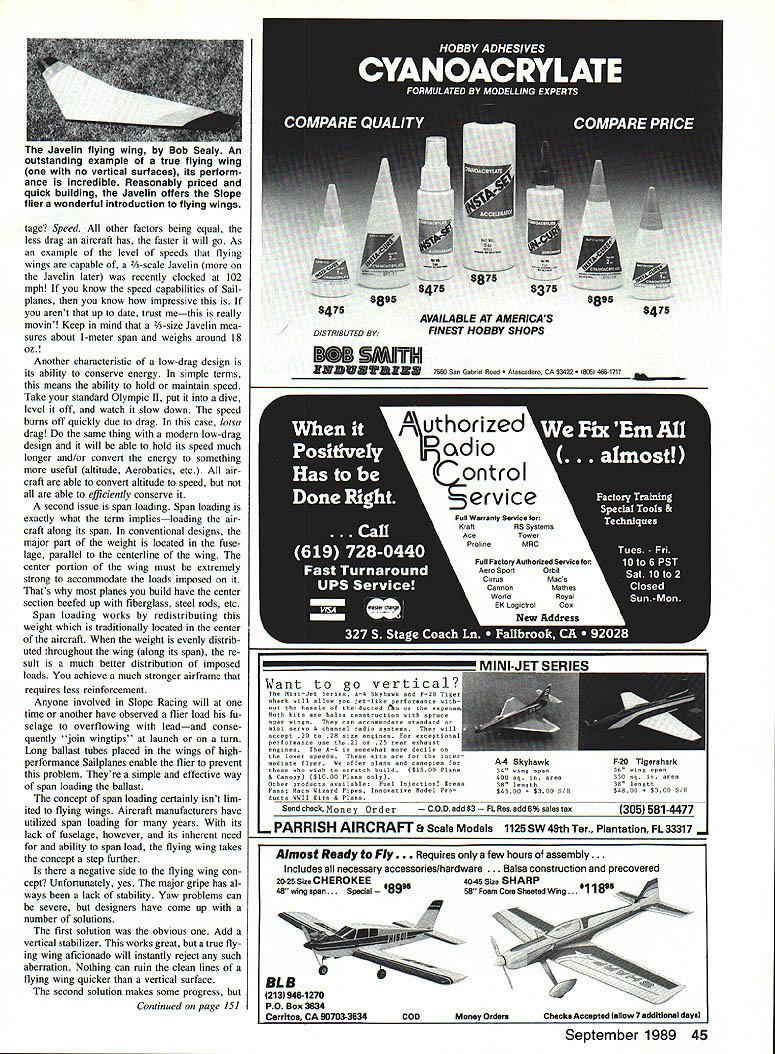
Two of southern California's better-known slope sailplane designers are Carl Mass and Mike Reed. Carl's Viper and Mike's Sloper have been pictured in previous columns. Now the duo has collaborated on a new, interesting flying wing. Even though the plane commits a severe breach of etiquette by adding a vertical fin, the plane's performance makes up for any possible sin. Capable of consecutive inside and outside maneuvers (thanks to a symmetrical airfoil developed by its designers), the Falcon offers the slope flier as much acrobatic performance as could be hoped for.
The Falcon features:
- Wingspan: 49 in.
- Length: 23 in.
- Wing area: 442 sq. in.
- All-up weight: 22–32 oz. (depending on the radio)
For $20 you get foam wing cores, plans and instructions, and a template sheet. Contact Mike Reed at 1775 Dumitru Way #B, Corona, CA 91720.
For the time being, that's about all I have to say on the subject of flying wings and canards. Coming in future columns: Jerry Bridgeman's incredible Slope Racer, the Snipe; Chris Fouquet's amazing aileron-equipped aerobatic ship; a look at Slope Soaring at the Nats (by the time you read this, the Nats will have been held — and for the first time ever, Slope Soaring will be part of it); and a look at my new Scimitar RS Slope Racer.
Transcribed from original scans by AI. Minor OCR errors may remain.

