
Radio Control: Slope Soaring
Mark Triebes 20794 Kreisler Ct. Saratoga, CA 95070
Banzai Update
A couple of columns ago I pictured and talked about the Banzai, a slope soarer being kitted by Jerry Teo. Since that time the Banzai has undergone a number of changes and is now being kitted as the Banzai Mk II.
Notable changes to the original design:
- Fuselage has plywood-reinforced 1/8-in. balsa sides.
- Wing includes a spruce spar for durability and resistance to flex damage.
- The kit now features better instructions and scale drawings.
According to Jerry, the kit retains the high quality of prefabrication and materials that it's had all along. Introductory price is $28 U.S., plus $3.50 per kit for shipping and handling.
Banzai Enterprises is also planning several more kits. Designs in progress include:
- Combat
- Aerobatic Delta Wing
- Pattern-like FAI ship
- BD-5
- F-20 semiscale Tigershark
- Unlimited and One-Meter Slope Racers
If you'd like to see these kits produced, write to: Banzai Enterprises 2997 Anderson Ave. Port Alberni, British Columbia V9Y 2V3 Canada
Photo Mix-up
The captions for two photos in the July column were mixed up. The captions for Mike Reed's Slopar and Banzai Enterprises' Banzai were inadvertently reversed. Apologies to all concerned and confused.
Torrey Pines Scale Fun-Fly
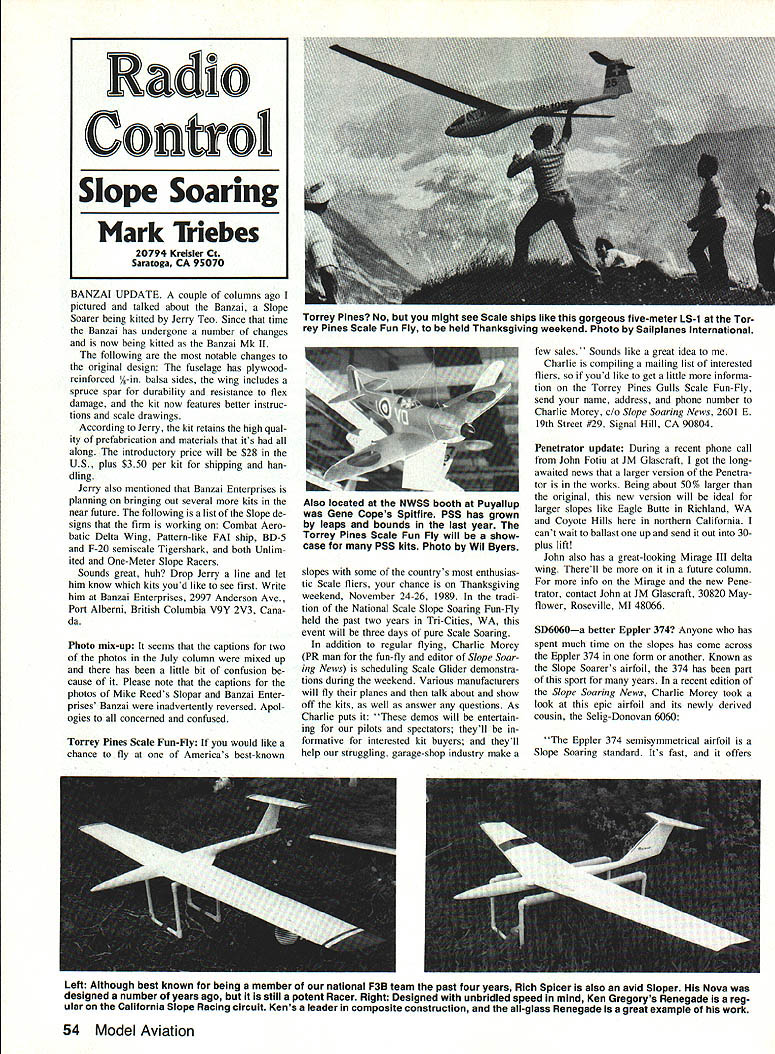
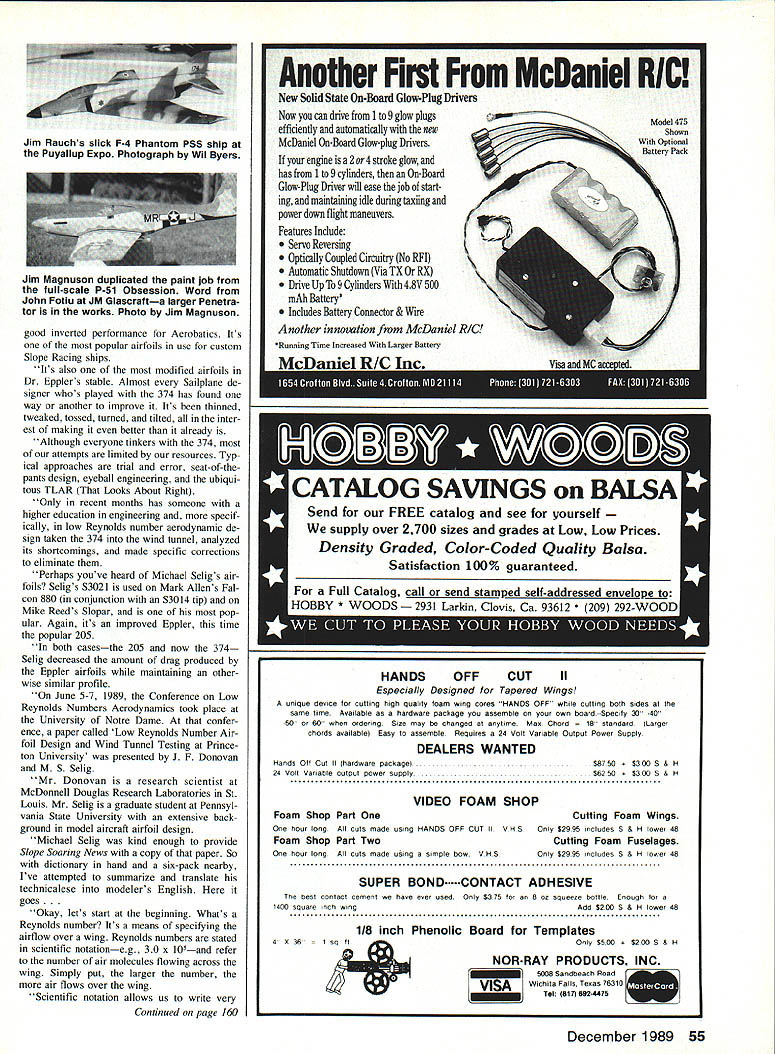
If you'd like a chance to fly at one of America's best-known slopes with some enthusiastic scale fliers, the Torrey Pines Gulls Scale Fun-Fly will be held Thanksgiving weekend, November 24–26, 1989. In the tradition of the National Scale Slope Soaring Fun-Fly held the past two years in Tri-Cities, WA, this event will be three days of pure scale soaring.
Charlie Morey (PR for the fun-fly and editor of Slope Soaring News) is scheduling scale glider demonstrations during the weekend. Manufacturers will fly their planes, talk about and show off kits, and answer questions. As Charlie puts it, the demos will entertain pilots and spectators, be informative for interested kit buyers, and help the struggling garage-shop industry make a few sales.
Charlie is compiling a mailing list of interested fliers. Send your name, address, and phone number to: Charlie Morey c/o Slope Soaring News 2601 E. 19th Street #29 Signal Hill, CA 90804
Penetrator Update
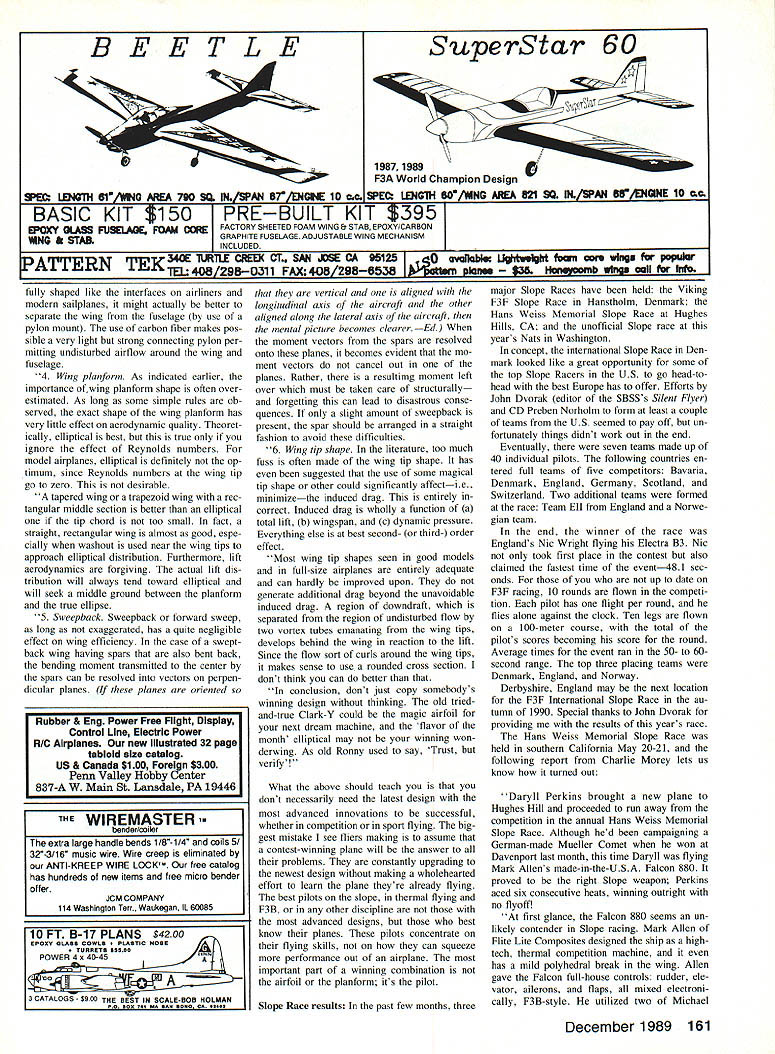
John Fotiu at JM Glascraft reports that a larger version of the Penetrator is in the works. About 50% larger than the original, this new version will be ideal for larger slopes such as Eagle Butte (Richland, WA) and Coyote Hills (northern California). It should perform well ballasted in strong lift.
John also has a Mirage III delta wing design waiting; more on that in a future column. Contact: JM Glascraft 30820 Mayflower Roseville, MI 48066
SD6060 — A Better Eppler 374?
Anyone who's spent much time on the slopes has come across the Eppler 374 in one form or another. Known as the slope soarers' airfoil, the 374 has been popular for years: it's fast and offers good inverted performance for aerobatics. Many designers have modified it in search of improved performance.
At the Conference on Low Reynolds Number Aerodynamics (University of Notre Dame, June 5–7, 1989), J. F. Donovan and M. S. Selig presented "Low Reynolds Number Airfoil Design and Wind Tunnel Testing at Princeton University." Michael Selig's work produced the Selig-Donovan 6060 (SD6060), a modification of the Eppler 374 intended to reduce drag at low Reynolds numbers.
What is the Reynolds number?
- Defined as R = V * c / ν, where V is velocity, c is chord length, and ν is the kinematic viscosity of air.
- Low Reynolds numbers are those of 500,000 or less. Wind tunnel tests referenced low-Re conditions at 60,000, 100,000, and 300,000.
The problem at low chord Reynolds numbers (Re ≈ 5.0 x 10^5 and below) is the formation of an extensive laminar separation bubble on the wing surface. On the Eppler 374, airflow breaks away just past the high point and reattaches near the trailing edge, with a turbulent bubble in between. This bubble increases drag.
Selig's approach:
- Reshaped the 374 slightly to decrease the size of the bubble and move its reattachment point forward.
- Resulted in decreased drag and improved airfoil performance in wind-tunnel tests.
Other findings:
- Square trailing edges increase drag; the best trailing-edge shape is sharp.
- Applicability to very small model chords (typical slope ship chords are 6–8 in.) is uncertain, since Reynolds numbers there are lower than many test conditions. Builders and fliers should try SD6060 on their ships and report results.
TLAR (That Looks About Right)
A few practical notes and context:
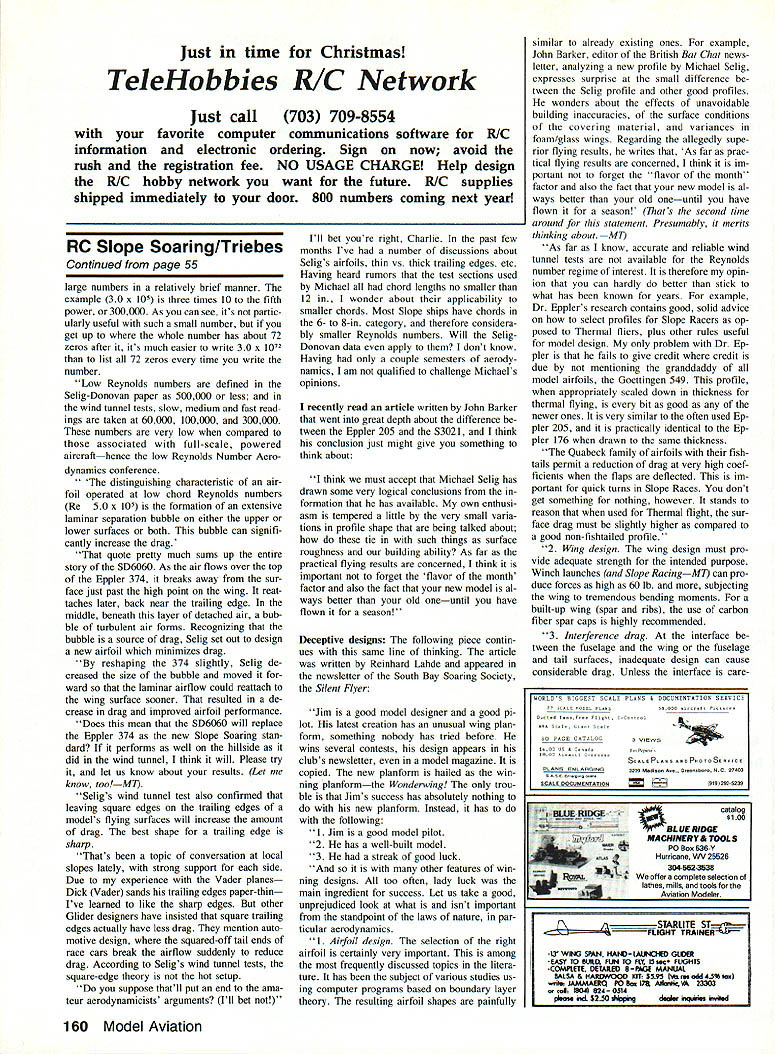
- Michael Selig's S3021 (often used at the root with an S3014 tip) is already popular — used on Mark Allen's Falcon 880 and Mike Reed's Slopar. Selig's modifications to Eppler profiles (e.g., the 205 → S3021) decreased drag while keeping broadly similar shapes.
- The Donovan & Selig paper was technical; the essential takeaway for slope fliers is attention to laminar separation behavior and clean, sharp trailing edges.
Deceptive Designs (Reinhard Lahde)
Reinhard Lahde (The Silent Flyer) warns against assuming a new planform is the sole reason for a design's success. Factors that actually affect performance:
- Airfoil design
- Important, but many new profiles are only slightly different from existing good profiles.
- Building accuracy, surface roughness, and covering materials can diminish theoretical gains.
- Reliable wind-tunnel data for the exact Reynolds number ranges of interest are limited.
- Wing design
- Must provide adequate strength for the intended purpose; slope racing and launches can create very high loads.
- For built-up wings, carbon fiber spar caps are recommended.
- Interference drag
- Poorly faired interfaces between fuselage and wing or tail surfaces cause losses.
- In some cases, separating the wing on a pylon (enabled by carbon fiber structures) can reduce interference and preserve airfoil shape.
- Wing planform
- Theoretical optimum (elliptical) ignores Reynolds number effects and may not be best for model aircraft.
- Tapered or trapezoidal wings with a reasonable tip chord, or even straight rectangular wings with washout, are often better and simpler.
- Sweepback
- Moderate sweepback or forward sweep has negligible effect on efficiency, but structural implications can be significant. Keep spars straight if sweep is slight to avoid complex bending moments.
- Wing tip shape
- Induced drag is primarily a function of total lift, wingspan, and dynamic pressure. Tip-shape modifications are generally marginal improvements.
Conclusion of Lahde's piece: Don't copy a winning design blindly. The "flavor of the month" effect and pilot familiarity often explain apparent performance gains. The most important part of a winning combination is the pilot — know your plane and concentrate on flying skills.
Slope Race Results
In recent months three major slope races were held:
- Viking F3F Slope Race, Hanstholm, Denmark
- Hans Weiss Memorial Slope Race, Hughes Hills, CA
- An unofficial slope race at this year's Nats in Washington
Hanstholm (Viking F3F)
- Seven teams, 40 pilots. Full teams from Bavaria, Denmark, England, Germany, Scotland, and Switzerland; additional teams from England and Norway.
- Winner: Nic Wright (England) flying an Electra B3. Fastest time: 48.1 seconds.
- Format: 10 rounds; each pilot flies alone against the clock on a 100-meter course; ten legs per flight; totals determine round scores.
- Average times: 50–60 seconds.
- Top teams: Denmark, England, Norway.
- Possible next venue: Derbyshire, England (autumn 1990).
U.S. events and the Nats
- Daryl Perkins dominated an F3F-style slope race at the Nats, taking first place in both classes. Perkins' smooth, consistent flying and versatility with different ships make him hard to beat.
- At other events, Mark Allen, Mark Grand, Don Edberg, Tony Martin, and Jason Perrin placed well in various contests.
- Jerry Bridgeman won the Pilots' Choice trophy for losing the most planes (a dubious honor).
- Special thanks to Contest Director Ray Kuntz for organizing events and to Chuck Allen (Chuck's Model Shop, Hawthorne) for the trophies.
Final Notes / Coming Next Time
What the above should teach you is that you don't necessarily need the latest design to be successful. Avoid constant upgrading without learning your current plane. Pilot skill and familiarity matter most.
Next time: a look at the connection between slope flying and F3B — similarities in disciplines, planes, and pilots.
Transcribed from original scans by AI. Minor OCR errors may remain.

