

Radio Control: Slope Soaring
Mark Triebes 20794 Kreisler Ct. Saratoga, CA 95070
International Soaring RC Scale Fun Fly
The 1990 edition of this exciting fun fly in Tri-Cities, WA, is slated for May 25–27. This year's event will be the best yet, with a number of activities planned. Besides flying on one of the best slopes in the country and hangar-flying with other scale enthusiasts, here's what to look forward to:
- Friday night: Slope Soaring News is sponsoring a catered Washington wine tasting and social evening.
- Saturday: Banquet dinner followed by guest speaker Michael Selig discussing the recent Selig-Donovan wind-tunnel tests, and a manufacturer-supported raffle. The raffle has become legendary for large numbers of quality prizes from Airtronics, JR Radios, Sig, Beemer, RC West, and American Sailplane Designs.
Pre-registration is required. To include yourself in the fun, contact the Tri-City Soarers, 632 Meadows Dr., E. Richland, WA 99352; tel. 1-509/627-5224 or 1-509/525-7066.
Flying buddies
Charlie Morey, Slope Soaring News, recounts a memorable encounter:
There were two of them—peregrine falcons—darting and diving together over the oceanside cliff at Point Fermin. Only Bennie seemed to know much about them; he said they must be mates since falcons of the same sex aren't particularly friendly toward one another.
These two seemed to enjoy flying as much as we do, and they were much better at it. They'd fly apart—going far out toward the distant horizon to rouse some pigeons from a phone line or send a gull scurrying for cover to the beach below—then charge back over the ridge to cavort together in the lift.
Generally, they ignored the brightly colored gliders sharing airspace with them. But a few natural-colored planes got their attention, among them my gray Cliff Hanger Models F-20.
My little F-20 is no slouch. I'll tell you right now, no match for the fastest bird in the world. The peregrines took interest—cruised over and just hammered through a 100-ft stall turn, locked just about a foot above the tail. "Okay," I thought. "Let's see what comes next." I put the F-20 into a steep dive; the bird held its distance, exactly tucking its wings slightly to match the terminal velocity of the dive. Tracking the model? Jet-kid stuff. The predator snatches its live, highly motivated—not-to-become-meal—quarry.
Out on the day-bottom dive, I pulled up into a steep climb. No problem. The falcon extended its wingtips slightly, drawn along a visible string, and maintained its 12-inch distance. "Let's see if I can split-S," I thought, and rolled the F-20 inverted; the falcon backed off slightly, sizing up the situation. The plane screamed through its downward arc, too; rolled, reattached himself just behind the tail. The little hawk was much faster and quicker turning than the glider; the F-20 would have made a tasty lunch. I heard Bennie chuckling behind. "He's got servo feathers," he said, laughing, anxious to see what the falcon would do next—hopefully a short snatching out of the sky with those powerful talons—but apparently it became bored, flicked its amazing wings, and was gone in search of a better sport, leaving to play with the breeze other earthbound amateurs.
Anyone who has the opportunity to fly with the real thing can relate to Charlie's story. Nothing can match grace.
Slope Racing tips
With contest season approaching, Pat Chewning (Portland Area Sailplane Society) offers advice for novice and expert racers alike.
- Dive into the wind:
- If the wind is not perpendicular to the course, the downwind leg can be very quick and the upwind leg very slow. Treat altitude as your fuel source. Alter speed on each leg: dive (gain speed at the expense of altitude) on the upwind leg and pull up (conserve altitude) on the downwind leg.
- Chewning developed equations for time around the course and for altitude used given dive angle and flying speed. He notes a missing equation—the flying speed as a function of dive angle—which must be determined empirically. He doesn't present a fancy proof but the approach seems reasonable.
- Use the prestart flight time:
- Use prestart time not only to gain altitude but to find the best lift zones along the slope, which may lie beyond the ends of the course and vary with altitude.
- Gain distance upwind so you can reduce your crab angle during the race and drift back toward the slope with the wind.
- Trim the aircraft for fast flight during prestart. Chewning prefers slightly too much down-trim rather than too little; it's easier to add up-stick during the race than to apply down-stick.
- Get a good start:
- Have plenty of altitude and be well away from the slope (upwind). Fly with up-stick to conserve altitude until the start.
- At about 10 seconds before start, cross the start line in the opposite direction to set a reference. At 5 seconds, initiate a 180° turn toward the finish and dive to increase speed. Avoid huge dives that burn off too much altitude early; drop just enough to cross the line at high speed.
- Aim to cross the start just after it's been announced. If early, fly away from the slope; if late, dive slightly. Being slightly late is better than being early and having to recross.
- Turning:
- Turn quality greatly affects lap times. Don't anticipate turns early; be ready to turn at the flag and wait for the call. Use another pilot's signal to anticipate if needed. If you're ahead, don't risk a missed turn. Consistent flagger/caller behavior allows slight anticipation of late-race turns.
- Use of altitude:
- Adjust dive angles so you end up at the proper altitude by the race end. Rather than trimming during the race, use climbing or diving turns to manage energy.
- With significant wind parallel to the course, use climbing turns on the upwind leg and diving turns on the downwind leg to let the wind help shorten or minimize overshoot.
- Find and use any obvious slot of good air near the top of the slope during the early laps to speed through and descend into the slot.
- For the finish, dive well below the top of the slope on the final leg for the fastest finish.
Fixing the Mariah
Mark Triebes designed a small aerobatic slope ship called the Mariah (Model Aviation, June 1988, plan #588). Many builders had mixed results. Dave Kurth (Pikes Peak Soaring Society, the Spoiler) reports his experience and fixes:
- Initial problems:
- Severe roll rates due to short, thin wings and sensitive ailerons—solved by reducing aileron throw.
- Poor lift/need for very strong winds—helped by moving the center of gravity rearward.
- Wing modification:
- Kurth and a friend made larger wings to lower wing loading. He used the Selig 3021 airfoil, stretched the wing to 27.7 in., made the leading edge parallel to the trailing edge using the root rib shape out to the tip, fully sheeted the wing, and added a Quabeck tip. With identical ribs, construction was easy and the result was about twice the original wing area.
- Looping problem and solution:
- The plane would quit halfway through a loop and tumble. Kurth theorized the tail was too close to the wing; at high angles of attack, disturbed airflow from the wing reduced elevator effectiveness. He lengthened the fuselage, moving the tailplane about four inches further back from the plans. After this change, the Mariah looped fine.
- Kurth noted he made the change after a crash left the fuselage in two pieces, and half-jokingly cited altitude/air-pressure differences at 7,000 ft (about 75% of sea level) as justification for lengthening the fuselage.
- Performance note:
- The longer fuselage cured the looping problem, though the plane now flies a bit slower; further flights will determine if performance can be further improved.
Triebes comments that many Slopers fly on the California coast where smooth, dense air can mask design issues. Designers who fly primarily at sea level may inadvertently optimize for those conditions. The lesson: small modifications can adapt a design to local conditions or pilot style—experimenting is a valuable part of the sport.
The Silhouette
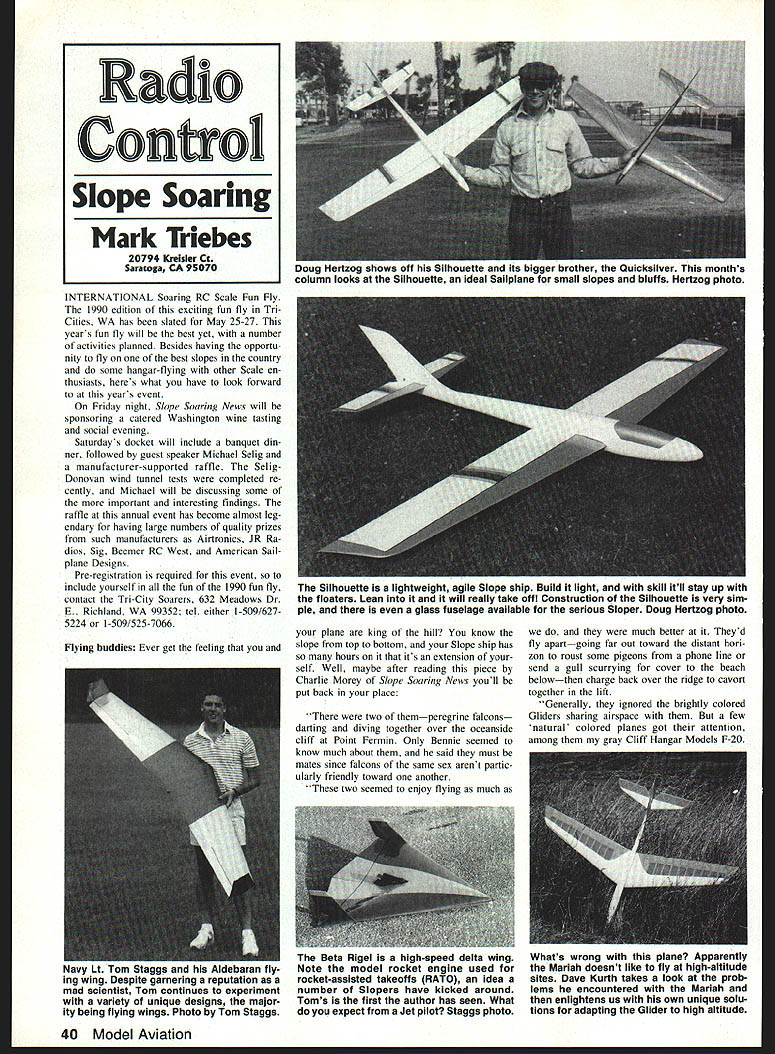
Douglas Aircraft produces the Silhouette, a small slope glider that Mark Triebes tested for Doug Hertzog.
- Specs:
- Span: 43 in.
- Airfoil: modified Eppler 374
- Wing loading: about 10 oz./sq. ft.
- Requires a two-channel radio with mini or micro servos.
- Kit contents:
- Machined-cut plywood and balsa parts, foam-core wings, plans and instructions, and a hardware package.
- Doug Hertzog says:
- "The Silhouette is an aerobatic slope glider designed specifically for speed, energy retention, and maneuverability. This ship displays very clean landing characteristics both upside-down and right-side-up. It is capable of outside as well as inside maneuvers, limited only by your imagination. Its simple fuselage construction and the balsa-sheathed foam-core wing provide even the less experienced modeler with the opportunity to build a superior aircraft with a minimum of effort."
- Notes:
- Small and light, the Silhouette doesn't need much wind to fly. In 15–25 mph winds it really comes alive, and it's well suited to smaller slopes or low-wind days.
- A larger sibling, the Quicksilver, was due for release later in the year. It uses a modified Selig 6060 airfoil (about 8% thickness at the root) and will accommodate full-size radios and a 500-mAh battery.
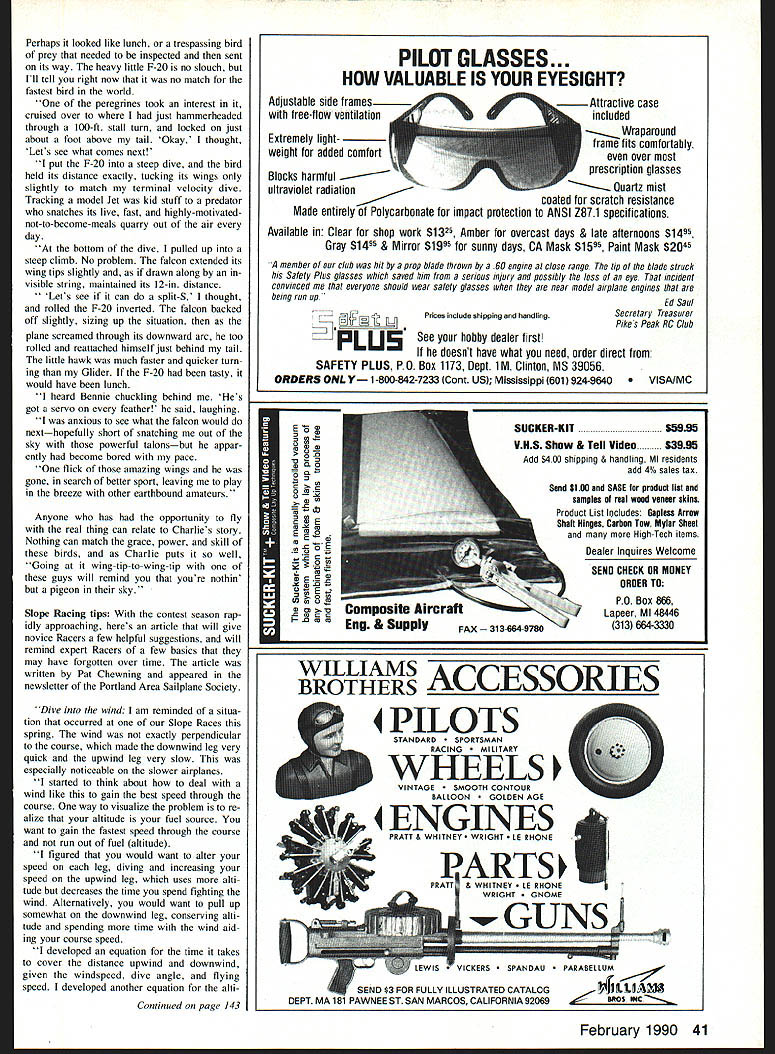
For information, contact Douglas Aircraft, P.O. Box 92472, Long Beach, CA 90809; phone 1-213/498-1737.
Mad scientists?
If you like tinkering with unique designs and have a "mad scientist" reputation, you're not alone. Navy Lt. Tom Staggs has experimented extensively with flying wings. With a mechanical engineering background and experience flying EA-6Bs, Tom has developed unique and interesting ideas.
If you experiment with flying wings and would like to trade ideas, failures, and successes, contact Lt. Tom Staggs, VAQ-129 E/W, NAS Whidbey Island, Oak Harbor, WA 98278-6100.
Transcribed from original scans by AI. Minor OCR errors may remain.

