

Radio Control: Soaring
Dan Pruss
WHEN THE National Soaring Society (NSS) made the decision to limit the Standard Class to wingspan only, the Board of Directors realized that some controversy was bound to follow. That the hue and cry would be of Bacchanalian proportions was not expected, however. Just a year earlier, the East Coast Soaring Society—forerunner to the NSS—established the Standard Class as a sailplane limited to two functions and a wing spread of 100 inches or less. The criticism for this decision came fast, but it came from a different group of competitors. Any praise for the decision at that time just did not exist. Truly, many on the ECSS Board of Directors at that time felt the decision was wrong. But, the die was cast—for the year 1974 anyway.
For those of you just getting into our sport and to refresh the memory of others, some background into the Standard Class concept is presented:
In 1970 the first RC Soaring Nationals was held. The early interest in RC Sailplanes was already growing at a rapid pace, and to establish rules and categories for a National contest left the planners with several unanswered questions. What would be the age spectrum of the competitors? What experience levels? And, should different categories be assumed and established? Remember, the soaring rules concerning tasks that were available then
Radio Control: Soaring
were only FAI Provisional and the only task was one of ten-minute duration.
Very few domestic kits were available then, and the market was dominated by the foreign manufacturers. If one studies the catalogs of that year, a marked price increase occurred at about the 100" wingspan sized sailplane regardless of source. The wing area then was most consistently proportional to span, and as a compromise, two classes of competition were announced: Standard Class—total area of horizontal stab and wing of 750 square inches or less; and "Open Class"—over 750 square inches (total wing and horizontal stab).
The planners then felt that combining wing and stab areas took them "off the hook" just in case someone showed up with a flying wing—swept or not, or any other design not necessarily following the aerodynamic profiles of a hawk. The contest was a mild success, and no criticism of the then two class concept was experienced by those hosting the contest.
By 1971 and another RC Soaring Nationals, the two class concept evolved into two categories as follows: Open Class—any size wingspan; and Standard Class—a wingspan of 100" or less.
All rules were still unofficial and the above two categories were accepted. Note that no further restrictions were imposed on either category.
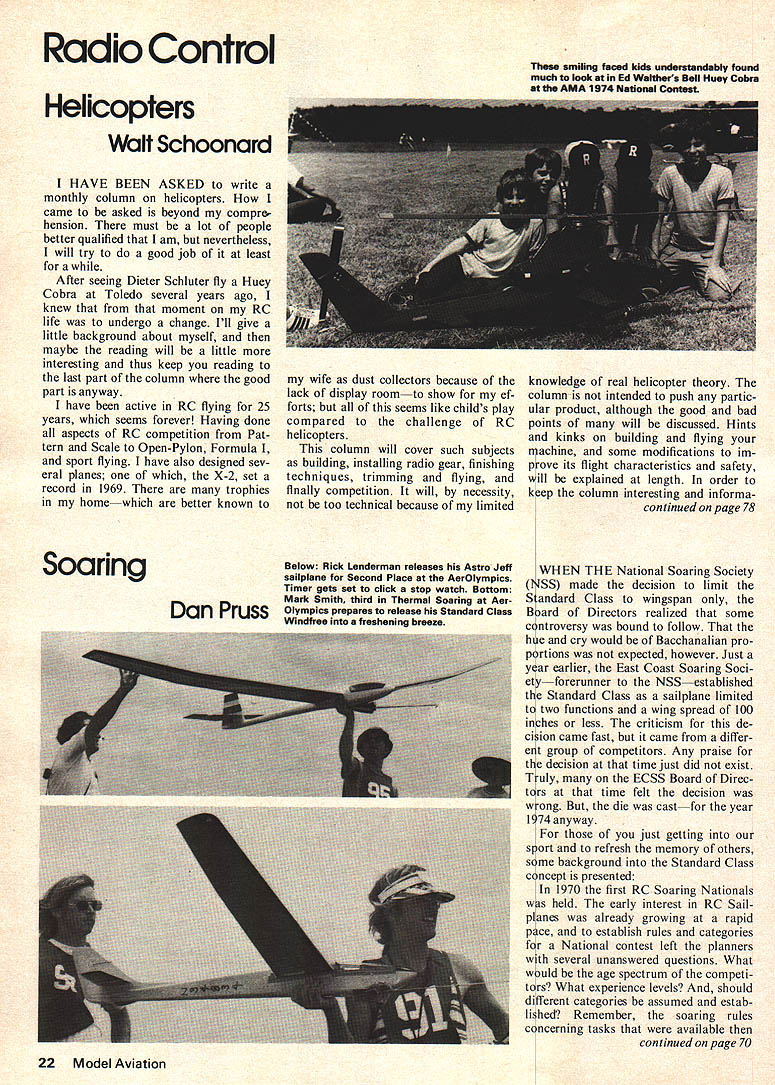
The overall winner of the contest—in a fly-off—was Mark Smith with a Standard Class sailplane (two functions).
For the following three RC Soaring Nationals, the competition tasks varied as did age classification. However, the two-class concept remained unchanged, and the most significant fact is that, in spite of no restrictions except for wingspan on the Standard Class, nearly all Standard Class competitors flew two-function—rudder/elevator—only sailplanes. In the 1973 Nationals, three out of the top five in the overall standings were contestants in the Standard Class! In 1974, the second place winner was Dave Shadel flying a Standard Class two function ship—and missing first place by a mere 30 flight points! Otto Heithecker was first by a margin of slightly more than one percentage point. He flew a ship that bore rudder, elevator, spoiler, and flap functions. A thermal sniffer was also used.
During these same five years, contests of all sizes were held. In some cases, no distinction in classes was made, and in many cases, the Standard Class ship won out. It should be pointed out that in the majority of contests where the two-class concept is recognized—a ratio of two to one—Open Class versus Standard Class exists. In 1973 at the ECSS Board of Directors meeting as mentioned earlier—the decision to restrict the Standard Class was two functions was made. Reasons to restrict this decision included giving the neophyte a chance to compete and to establish a simple class. Not realizing, of course, that it could also create a class in which the already expert could excel.
Chastising for the decision was immediate! The cry of stifling progress was heard along with accusations of catering to manufacturers. After all, years had passed with no restrictions on this smaller class. Competition grew and contests got larger. Integrating the two classes didn't even prove that one class was better and surely experience alone didn't always win one a laurels.
For example, in 1973 Jeff Melik—then 12 years old—beat out 124 other competitors, most of these "old men" had spent more time during their competition days picking thermals than flying and landing zones than Jeff had spent in the air. Practice—he did—for two months prior to the Nationals, methodically—yet with different planes and launching devices. The result, besides best overall, was a 5th, 6th, and 3rd in the two-minute precision, 15-minute accumulative and 10-minute duration tasks respectively.
Last November, when the NSS made its decision to lift the restrictions from the Standard Class, the wraith of the critics was again felt. Destroying the beginners class (did it exist?); catering to manufacturers (again?) are only two of the bits of criticism that have been hurled since.
Where do we go from here?
First, the decision by the NSS for Standard Class should stand until the next Board of Directors meeting. In the meantime, proposals should be channeled through the NSS rules committee (see the "Sailplane," the voice of the NSS, for details). The two-class concept—whatever the restrictions—has, so far, been treated as an option with regards to competition.
After a pulse is usually taken by various contest hosts, a decision is made whether to conduct a two-class contest. In many cases, the contests—and many times large contests—are a one-class affair. Those with Standard Class sailplanes compete and more often than not become "giant killers." Treating the Standard Class as an option has been healthy for the sport. The option has not only provided for more manageable contests but has prevented smaller contests from becoming diluted.
Secondly, if there are two factions so strongly opposed within the Standard Class, the natural move would be to the establishing of a third class. However, it would be safe to say that if a contest were to have only one class it would combine all three classes and the chance of a contest being restricted to only the "two" Standard Classes would be slim. Dilution of competition would become common if class competition became mandatory, and it could even discourage the promoting of contests.
Third, the two-class concept could have the wingspan restriction lifted in both cases and have one class revert to the rudder/elevator only concept—just a thought.
Fourth, the two-meter size—which is getting quite popular, low cost, quick to build and easy to fly—will have to be considered and will eventually expect further status.
Fifth—and before you solicit the services of a lynch mob—just ponder over the idea of whether a one-class concept wouldn't have its merits. Remember, the U.S.A. is the only country now that breaks down the thermal soaring into size classes. Yet, in international competition, in 1971 and 1974, both contests were won by foreign competitors flying sailplanes with two functions only. Not to mislead the reader, these planes were of the unlimited category by our standards but only slightly larger than the 100-inch span—but rudder/elevator only.
RC Soaring has many things in its favor. Included is the fact that no age group, experience level, or sex (remember the 1972 LSF tournament and the winner—Barbara Heron?)—a woman also won the South African Nationals in December of 1974. Sorry about that guys. And for that matter no particular sailplane dominates the contest scene. These factors have been most healthy for our sport. Couple this with the task flexibility we have and we can expect the competitive aspect of this sport to just get more and more exciting. There will always be controversy over rules, no matter how often they're modified. It is somewhat ironic, though, that while the class rules were provisional, they were quite acceptable, but since the attempt to make them official has been made, all sorts of faults have surfaced.
Ideas and photos are needed for this column. Send to Dan Pruss, Rt. 2 Box 490, Plainfield, Ill. 60544.
Transcribed from original scans by AI. Minor OCR errors may remain.

