
Soaring
Dan Pruss
AT THE APRIL FAI meeting in Paris, the rescheduling of the R/C Sailplane World Championships was announced for 1977. Originally scheduled for April of 1976, the FAI decided that due to the number of other World Championships that are scheduled for 1976 the rescheduling would lessen the burden on the Aero-Clubs involved in 1976.
This gives us—the U.S.A.—another year to decide on a team, and the method of team selection. Rod Smith, President of the National Soaring Society (N.S.S.), has appointed Otto Heitbecker as chairman for a committee to design a method of team selection. Ideas to date include a "Masters" type of contest which would include those in the top standings from the N.S.S. championship standings, the S.O.A.R. Nationals, the L.S.F. Tournaments, the soaring event at the AMA Nationals, and the previous qualifiers for the 1974 AerOlympics at Lakehurst. Plans include a Master site—possibly Albuquerque—since its field elevation of 5300 feet approximates the South African site. Details of a team selection proposal for AMA approval will probably be finalized and announced at the N.S.S. meeting at the S.O.A.R. Nationals in July.
This extra year perhaps can provide the time required to resolve the inequities that still exist in the various launching devices namely the hand tow, high start, and winch. At the AerOlympics last July, winch launches were only considered to the point that the winches were available. The high-start with surgical tubing that had a 7X stretch factor was the most favored means of launching. However, under the rules as they were then, contest management was not without its problems.
As a result of the critique of the 1974 AerOlympics, a FAI ruling was made in December that states: The total length of towlines used for hand towing or winching must not exceed 150 meters. For high start devices using elastic members, the Unstretched length must not exceed 150 meters and the length of the elastic member—unstretched—must not exceed 50 meters and the maximum stretched length shall not exceed 200 meters and one end shall be attached to the ground during launching. Running space for hand towing shall be limited to a maximum length of 150 meters.
The intent of that last sentence is not to test the athletic prowess of the hand tower but to minimize the time on the hill while still getting an effective launch.
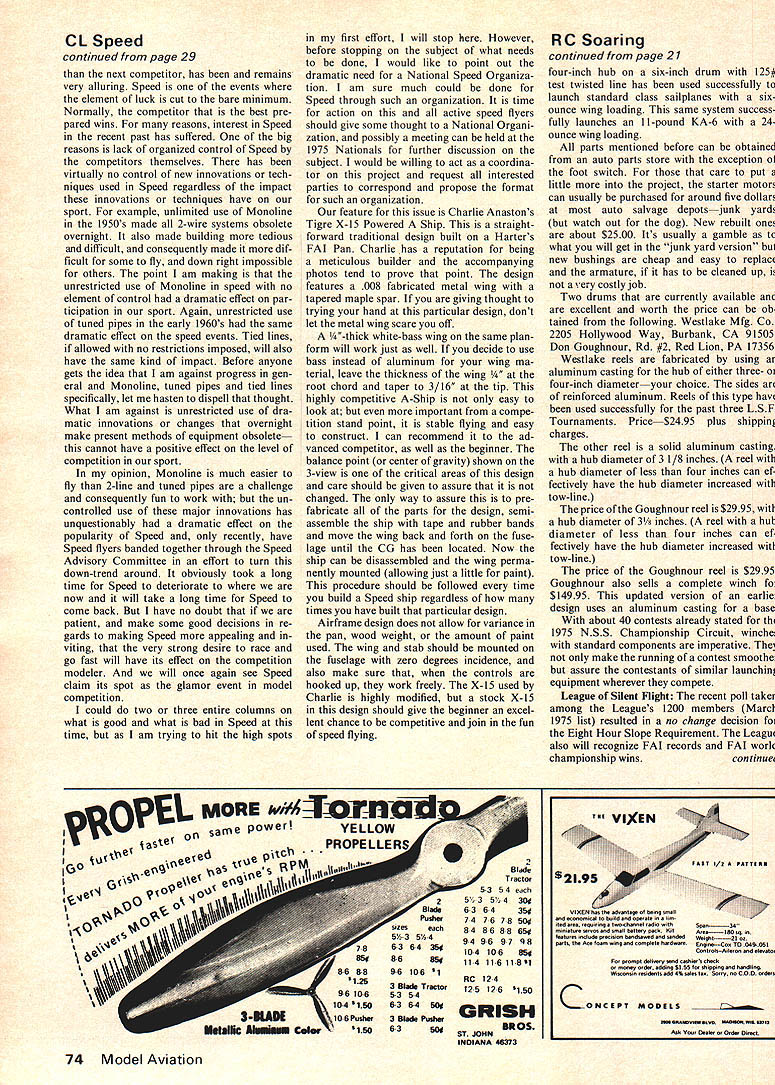
Although the winch is the most popular type of launching device in the U.S., when the managing of contests is considered, this same popularity doesn't exist in Europe and in most other parts of the glider world, the exceptions being Canada and South Africa. Seems as though Henry Ford made several million long-shaft 12-volt motors just perfect for sailplane winches. Henry, however, installed several million automobiles about ten years ago. Maynard Hill took one of the motors and harnessed it to a box—plugged in 6 volts and fashioned a drum and a 1000 foot line on the long shaft and launched his Bong Boomer.
12-Volt Ford Starter—1965-1966 (Ford also made a long-shaft motor between 1956 and 1959 but these are harder to find).
6-Volt Starter Solenoid Foot Switch—Radio Shack #44-610 or Lafayette #99H15810. Battery—6 Volts 105 Amp hours (the 105-amp hour battery has the capacity to provide about 160 launches).
While a few have successfully fabricated their own line reels or drums, many have failed. The failure comes as a result of not realizing the tremendous force that is built up as line is taken in. Winch line, while under tension from the model, is reeled in and the forces from each layer upon layer of wound up line exert enough pressure to crush the hub or axle of the reel or burst out the sides. This has been experienced using 1/8" flat aluminum for sides and it's happened using wood. Some modelers have tried using 1/4" or 5/16" carriage bolts about six inches long clustered to form a three- or four-inch hub. Wind line on this cluster of bolts collapsed down on the starter shaft under the load.
Enough of what not to use.
Two years ago the E.C.S.S., now the N.S.S., solicited winch information among its membership in order to come up with a standard winch. The intent was not to dictate what standard should be, but to show what the majority of flyers were using and to encourage others building winches to treat the result of the survey as a set of guidelines. To no one's surprise the Ford starter motor was incorporated in nearly all of the winches. Line reels varied in hub diameters from two to four inches. Since that survey, it's generally accepted by modelers that hub diameters of three to four inches are acceptable diameters to provide ample line speed. Lighter ships must be launched with a degree of gentleness; larger, heavier wing-loaded ships have the power required to get the same level of air.
While six volts is the "standard" that has been accepted, a winch that has 6- or 12-volt capabilities is much more versatile. Twelve volts can be used for larger ships, when the air is calm, or a slight tailwind is experienced, and a change of launch direction isn't practical.
SAILPLANE WINCH SCHEMATIC 6-12 VOLT SYSTEMS
6 VOLT TO 12 VOLTS A. REMOVE "+" CABLE FROM BATTERY NO. 1 AND CONNECT IT TO "+" TERMINAL OF BATTERY NO. 2. B. INSTALL A SHORT JUMPER CABLE BETWEEN "+" TERMINAL OF BATTERY NO. 1 AND "-" TERMINAL OF BATTERY NO. 2.
RC Soaring
four-inch hub on a six-inch drum with 125 ft of twisted line has been used successfully to launch standard-class sailplanes with a six-ounce wing loading. This same system successfully launches an 11-pound KA-6 with a 24-ounce wing loading.
All parts mentioned before can be obtained from an auto parts store with the exception of the foot switch. For those that care to put a little more into the project, the starter motor can usually be purchased for around five dollars at most auto salvage depots—junk yards (but watch out for the dogs). New rebuilt ones are about $25.00. It's usually a gamble as to what you will get in the "junk yard version" but new bushings are cheap and easy to replace and the armature, if it has to be cleaned up, is not a very costly job.
Two drums that are currently available and are excellent and worth the price can be obtained from the following: Westlake Mfg. Co., 12025 Hollywood Way, Burbank, CA 91505; Don Goughnour, Rte. #2, Red Lion, PA 17356. Westlake reels are fabricated by using aluminum casting for the hub of either three-inch or four-inch diameters—your choice. The sides are of reinforced aluminum. Reels of this type have been used successfully for the past three L.S.F. Tournaments. Price—$24.95 plus shipping charges.
The other reel is a solid aluminum casting with a hub diameter of 3 1/8 inches. (A reel with a hub diameter of less than four inches can effectively have the hub diameter increased with a two-line.)
The price of the Goughnour reel is $29.95. Goughnour also sells a complete winch for $149.95. This updated version of the design uses an aluminum casting for a base.
With about 40 contests already started for the 1975 N.S.S. Championship Circuit, standard components are imperative. They will not only make the running of a contest smoother but assure the contestants of similar launching equipment wherever they compete.
League of Silent Flight: The recent poll taken among the League's 1,200 members (March 1975 list) resulted in a no-change decision for the Eight Hour Soarable Requirement. The League also will recognize FAI records and FAI world championship wins.
Radio Control: Soaring
The annual L.S.F. Tournament is scheduled for late August. Bob Hahn and John Donelson will co-direct the event. As in the past, pre-registration is required and order of acceptance will be from members with the highest level of achievement on down—Level V to Level I.
With the League's ever expanding membership, plans are under way to establish Tournament '76. This contest would be held on the same week-end in four locations—California, Dallas, Elmira, and Detroit. The same tasks would be flown at all four sites. Winners from each of the sites would undoubtedly figure into the fly-off for the first FAI World Championship.
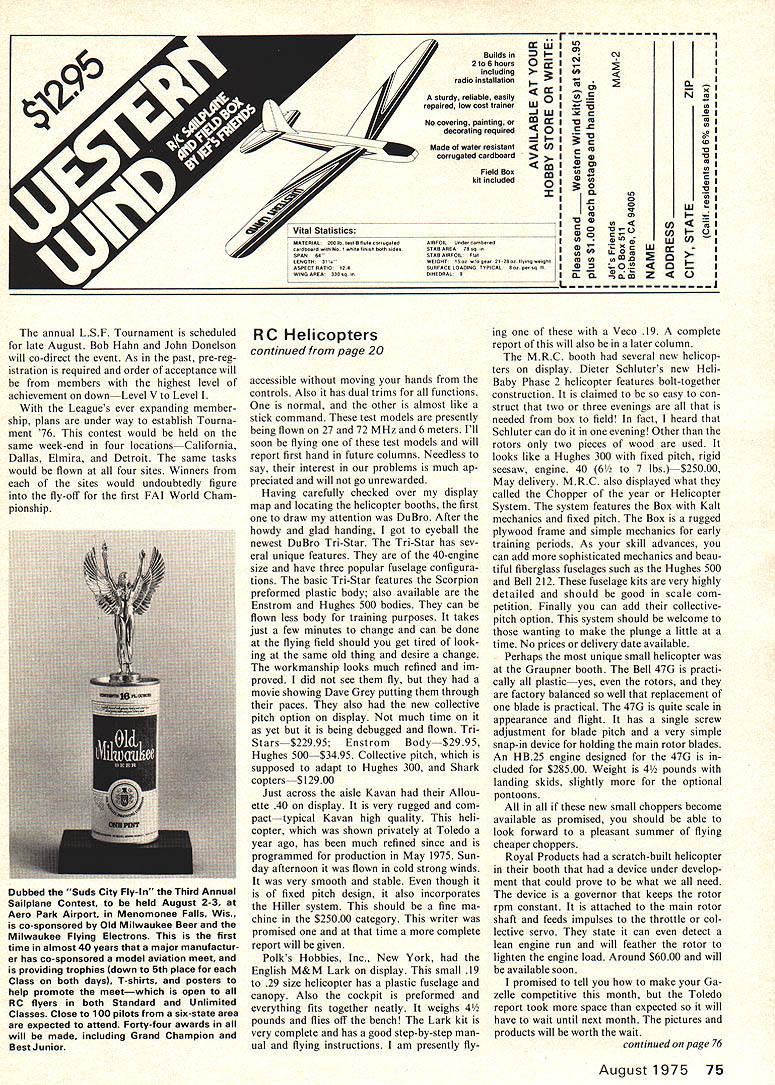
Dubbed the "Suds City Fly-In," the Third Annual Sailplane Contest, to be held August 2-3 at Aero Park Airport in Menomonee Falls, Wis., is co-sponsored by Old Milwaukee Beer and the Milwaukee Flying Electrons. This is the first time in almost 40 years that a major manufacturer has co-sponsored a model aviation meet, and is providing trophies (down to 5th place for each class on both days), T-shirts, and posters to help promote the meet—which is open to all RC flyers in both Standard and Unlimited Classes. Close to 100 pilots from a six-state area are expected to attend. Forty-four awards in all will be made, including Grand Champion and Best Junior.
Transcribed from original scans by AI. Minor OCR errors may remain.

