
Radio Control: Soaring
Dan Pruss
IN THE JANUARY column it was mentioned that the variations in task design by clubs and individuals is one of the factors that has kept competition in soaring challenging and exciting. Innovations with regards to tasks are usually a departure from the official rule book. The thin line that separates rule infraction from deviation can't be defined. However, so long as the basic rules are adhered to with regards to sailplane size and weight restrictions, the modifications of tasks are not only practical in most instances but healthy for our sport.
The Fifth Annual North-South Challenge Meet proved this.
This contest, an annual affair between northern and southern California, has developed into one of the roughest fought events in RC Soaring. When one realizes that some of this country's best fliers are concentrated in the Golden State—to the north and to the south—an almost Martin-and-McCoy feud is bound to exist. That this hasn't developed into World War III or their thunder hasn't caused a sudden land shift into Balboa's pond is a relief to all of us but a mystery to a few seismographers.
Rick Pearson and Tom Williams of the San Fernando Valley Silent Flyers came up with a system for running this fifth annual bash, a thermal event, that is just possibly the most revolutionary concept in contest managing to come along in years.
At a contest, how many times have you been a victim of a launch into "down air"? Or, how many times have you seen a flier being pointed to a "sandbagger"? This year's meet all but eliminated the above gripes, which probably are the most common at soaring events.
This is what Messrs. Pearson and Williams came up with:
Four winches were used for launching. The idea was to launch four sailplanes at one time. For reasons of safety, winch numbers one and three would launch—two and four. This would enable all four fliers to launch into the same air. The task was of ten-minute duration; however, the first plane to land scored 25 points, the second—50, the third—75, and the last to land or longest duration flight earned 100 points. Whether the air was "up" or "down," the above system for scoring was used and the ten-minute max producing boomer earned no more for the flier than the downer that rendered, say, three minutes for its best of four fliers.
At the end of the first round the scoreboard showed the contestants broken down into four groups each with 100, 75, 50, or 25 points.
Then, because of a unique scorecard system that Williams devised, the next round was quickly arranged. Each scorecard was a small tile-like square which bore the contestants' name and frequency and contained a space for the scoring of each round. The beauty of this system was the fact that the scorecard hung on a master scoreboard for the instant posting of scores.
To set up round two, all fliers with scores of 100 had their cards shuffled. At random the cards were again arranged in groups of four with consideration for eliminating frequency conflict being the only concern. This man-on-man or one-on-one idea was repeated for the other three groups with scores of 75, 50, and 25.
It can readily be seen that this group with scores of 100 would be reduced by 75 percent at the end of round two. Conversely, the winners of the round two 75-, 50-, and 25-point categories would earn 100 points and a chance to better their standings.
As the rounds progressed, those with perfectly scored rounds diminished in number and by the end of round five—on the second day—man-on-man (somehow, flying person-on-flying-person doesn't have the same ring) competition only one remained on top—Rick Pearson.
In talking to Tom Williams since the meet, his "Monday morning" analysis was that since this is a new concept in contest management, perhaps a more equitable means of scoring could be considered. Normalizing the scores of each in a group of four would allow the second, third, and fourth fliers to earn scores more relative to the winner's. This has merit especially when the four fliers are only seconds apart. It has further merit when the high time flier ends up minutes ahead of the other three.
As for sandbagging, the fact that names and sequence for flying are posted well in advance should eliminate any cause for a contestant to make a last-minute adjustment on his Thermal Sniffer or spoiler cables or have to look for a lost frequency clip.
At the North-South Meet you were called to fly and launch. If you weren't available, you could expect zero for a score. No zeros were posted.
Kinda amazin' how suddenly sailplanes are staying in a ready-to-fly status.
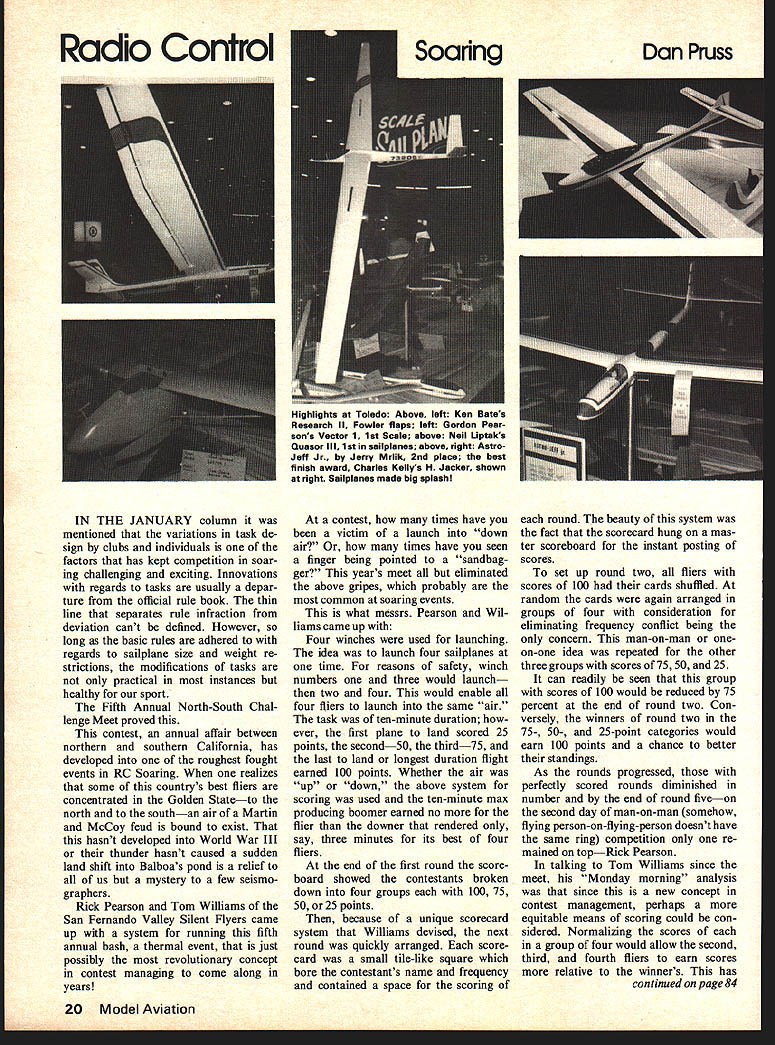
TOLEDO—1976: The name Toledo has become synonymous with trade show and the Toledo Weak Signals for the 22nd year can take a bow. The sailplane display was a collection of the finest workmanship and design ever and no pictures will do these birds justice. Do hope that the builders/fliers cover enough territory this summer or all of soaring can benefit.
Of the dozen or so sailplanes displayed, the top five fared this way:
1st Neil Liptak Quasar III 2nd Jerry Mrlik Astro-Jeff, Jr. 3rd Ken Bates Research II, V.G. 4th Ken Bonnema Antiquarian 5th Ed Purdy Skip Jack
Scale 1st Gordon Pearson Vector I 2nd Kevin Pearson Kestral 19 3rd Barry Killick Slingsby T-53B
Best Finish Award (This was the best finish in the show!) Charles Kelley Hi Jacker
Liptak's Quasar III features an aspect ratio of 26.7:1. Wingspan is 170 in. and in three pieces. The center six-foot section contains three servos for flaps, ailerons, and spoilers. The 49 in. outboard sections plug in and clevises link the aileron linkage.
The "V" tail has rudder-vators—"Grand Esprit" style. Wing area is 1083 sq. in. and weight is 4.5 lbs. The bird is all white with red and blue trim and esthetically speaking it's 14 feet of sailplane poetry.
Mrlik's Astro Jeff, Jr.—or son of Astro Jeff—is a proven design having been flown and tested all last season. Engineering features that were proven over the years on his many award winning Astro Jeffs are now on the Junior.
Wingspan is 100 in. with 936 sq. in. Weighting 50 oz., wing loading comes out at .7 oz. per sq. ft. The floor-glass fuselage and plans are available direct from: Jerry Mrlik, 6730 Halyard Rd., Birmingham, MI 48010.
Ken Bates' Research II, 100 in. bird had the cleverest of all mechanical features of the sailplanes, full-span Fowler flaps, on a polyhedral wing. While on display, the fully retracted to fully extended cycle repeated itself for three days, drawing the attention of all that passed by.
Fowler flaps, while extending downward, also move aft which actually increases the wing chord which in turn increases the wing area. Now aren't you C.D.s all glad there's no wing area class? Bonnema's Antiquarian was a masterpiece of building. A design that was reminiscent of the mid-1930's Albatross and Condor designs and very close to Fillon's Champ of 1946, the Antiquarian's only straight lines were the leading and trailing edges of the flying surfaces. Huge ribs blended fuselage to wing while many of the over 1000 (!) pieces were used to construct the fillets in a curved egg-crate type structure.
All of these pieces were left to the observers to admire since the whole plane was covered in silk (sorry about that Sid) and dope. Truly a masterpiece.
Ed Purdy's Skip Jack, largest of all on display, was 14 ft. 4 in. tip to tip. It featured a Wortmann style airfoil and with an area of 1850 sq. in. and a weight of 8 to 11 lbs., the wing loading will vary from 10 to 13.7 oz. per sq. ft.
Gordon Pearson's Vector I—a Stan Hall design—is, in the full-scale version, literally worn by the pilot. A combination of hang glider and winged leisure suit, the pilot's legs actually hang below
Transcribed from original scans by AI. Minor OCR errors may remain.

