
Radio Control: Soaring
Dan Pruss
AMA Nationals — reminder and volunteer request
Just in case the word slipped by you during the past few months: the AMA Nationals will be held at Westover AFB in Chicopee, MA. The Soaring event will be on the grounds of the Smith & Wesson plant (as it was in 1983). Dates: July 27 through August 4.
Soaring Event Director Jeff Troy is requesting some part-time help. A staff of key workers has already been contacted, but Jeff needs additional volunteers for tasks that will not cause contestants to miss their turns on the flight line.
- Roles needed:
- Transmitter impound area attendants
- Winch station order keepers
- Other part-time support roles
If you can help, contact Jeff at: Allied Hobbies Y-12 King of Prussia Plaza King of Prussia, PA 19406 Phone: (215) 337-9737
If you’ve attended the Experimental Aircraft Association (EAA) convention at Oshkosh, WI, you know that member volunteers make the event run. The same is true of the AMA Nats — the membership makes it work.
Toledo show highlights
The Toledo show offered a wide variety of kits and ready-to-fly sailplanes. Highlights included:
- Gnome (Midway Model Co.)
- 60 in. span, one of the few F3B kits on the market
- Proven competitor in thermal duration contests
- Kit should weigh about 12–15 oz. when built
- Airfoil: Eppler 205
- Available from Midway Model Co., P.O. Box 9, Midway City, CA 92655
- Lazy Bird (Midwest)
- Around for over a year and still popular
- Foam construction with wood reinforcements
- Two-meter span model has a one-piece bolt-on wing
- Gentle Lady (Carl Goldberg) and Antares (Top Flite)
- Gentle Lady: Two-meter class
- Antares: 100-in. class
- Both are established favorites at many flying fields
- Graupner and Robbe (Germany)
- Kits with ready-to-finish fuselages and covered foam wings
- Many semi-scale models, kits include most hardware
- Distributed by Hobby Lobby (Brentwood, TN) and Wilshire Hobbies (Los Angeles)
- Zimbabwe Model Products
- Operates out of Oak Ridge, TN as well as Zimbabwe
- Specializes in ready-to-fly models (currently for powered planes)
- Produces three sailplane kits: Nova 2000 (80 in.), Voyager 2000 (80 in.), Sunbird (110 in.)
The list above only skims the surface of what was at Toledo. Whatever your modeling interest, the show likely offered something to spark it — I even went home with a Phantom Flash for $6.95.
ASW-20 — wing assembly options and a better two-piece joint
In May’s column I showed and described a quarter-scale ASW-20, an almost-ready-to-fly model with several useful features worth passing along.
Wing construction options (pros and cons):
- One-piece wing
- Strongest structurally
- Impractical for transport
- Three-piece wing
- One-piece center section with plug-in tips
- Easier to transport than a single-piece wing
- Two-piece wing (most common)
- Practical for manufacturers and scratch-builders
- When joined to the fuselage, usually requires rubber bands, springs, or tape to hold wings securely
The ASW-20 uses a different two-piece tube-type assembly that yields one-piece solidity without rubber bands or tape:
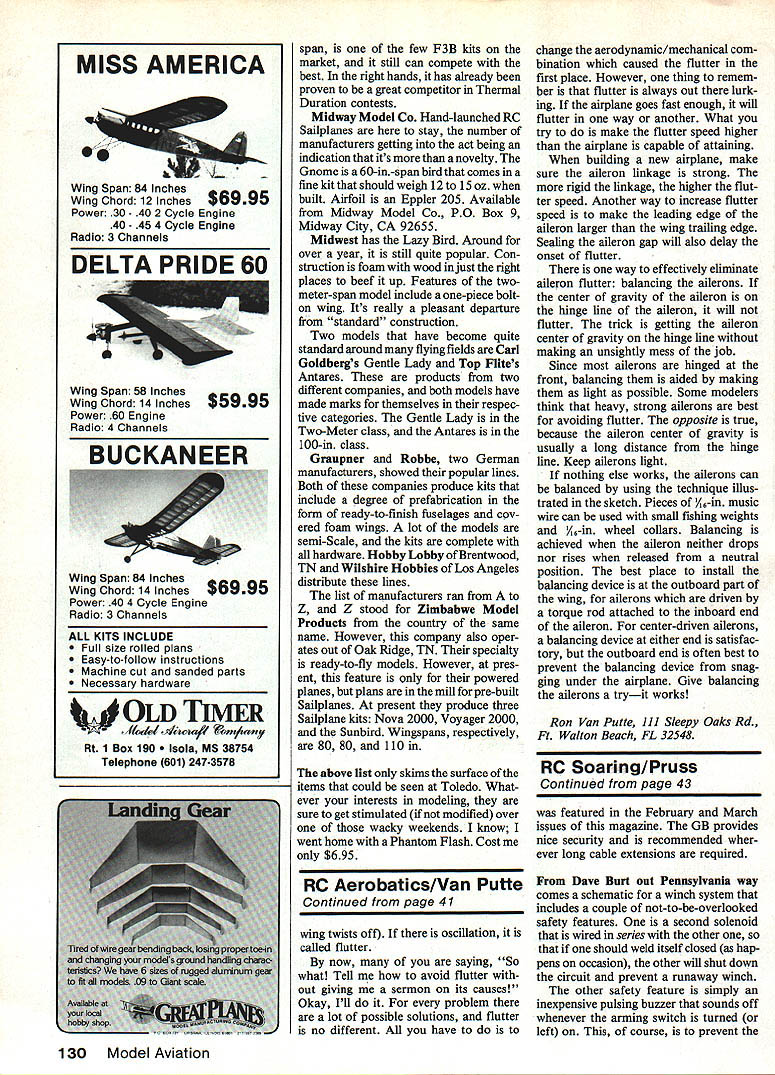
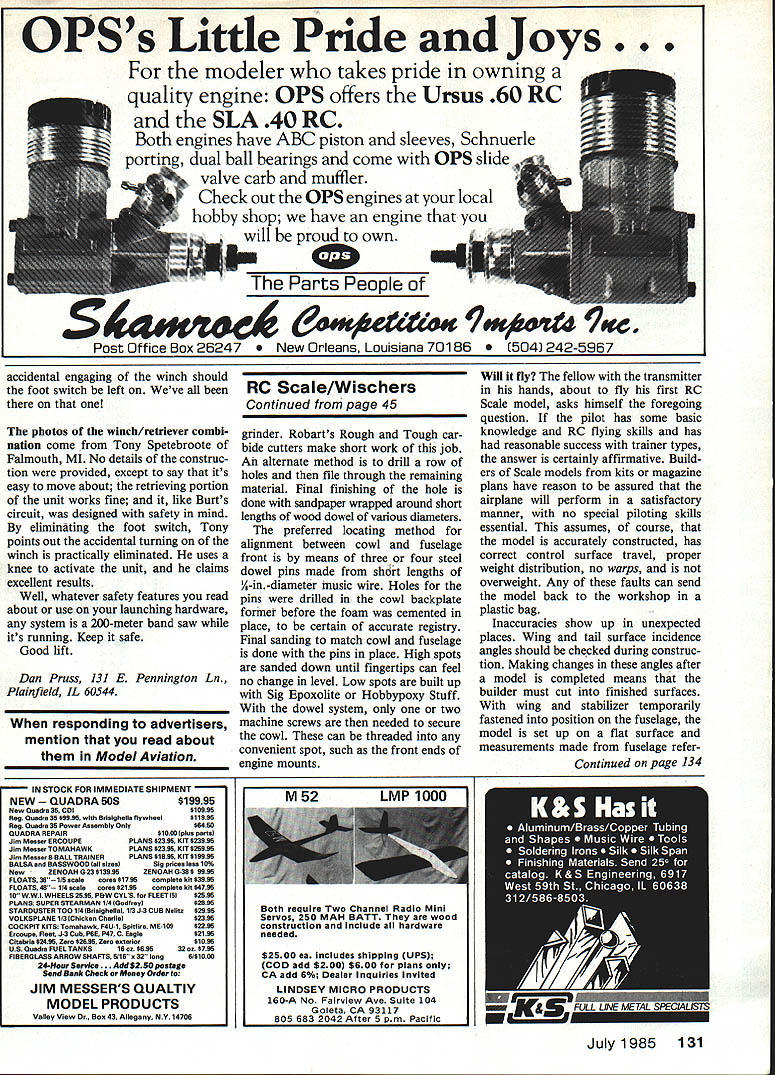
- Each wing half has a tube with machined ends permanently mounted; these ends protrude from the wing.
- The fuselage contains a bare tube running through an aluminum block. Both the bare tube and the block have a longitudinal slot.
- The wing tubes fit into the fuselage tube/block assembly.
- Allen screws tighten the assembly. As the screws are turned they squeeze the slotted tube, clamping it tightly around the two wing tubes.
- Result: a joint as solid as a one-piece wing, with a neat, reliable installation and no elastic or taped fasteners to worry about.
Elevator control and the Glitch Buster
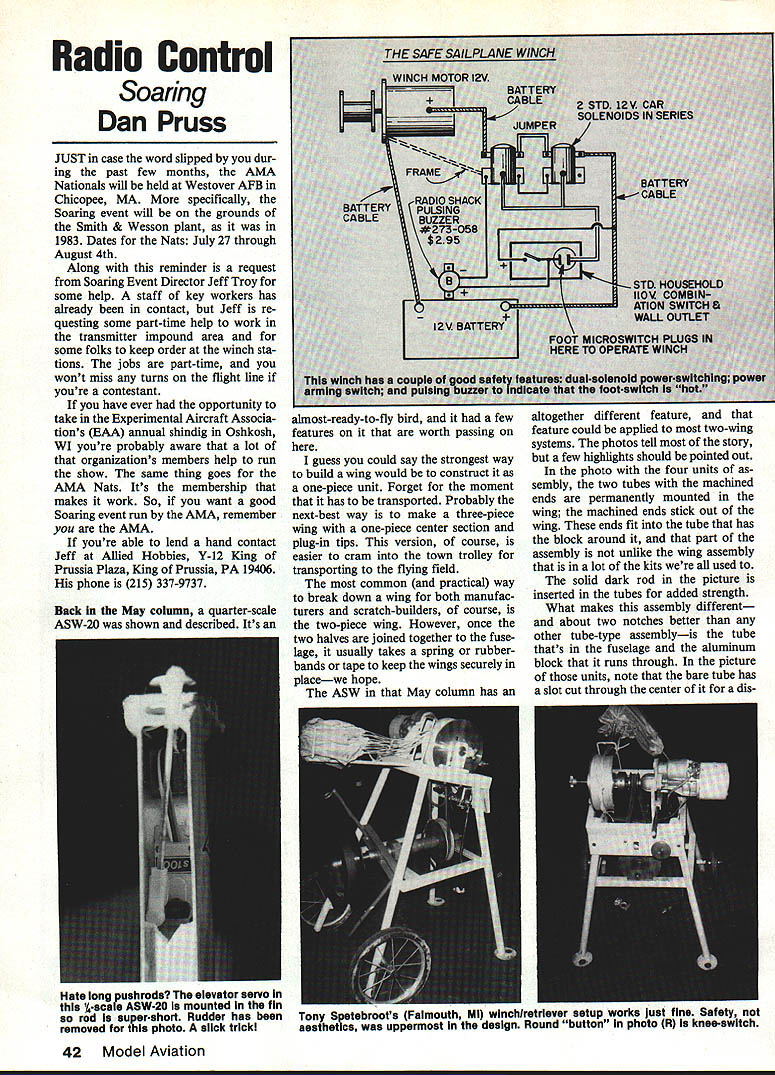
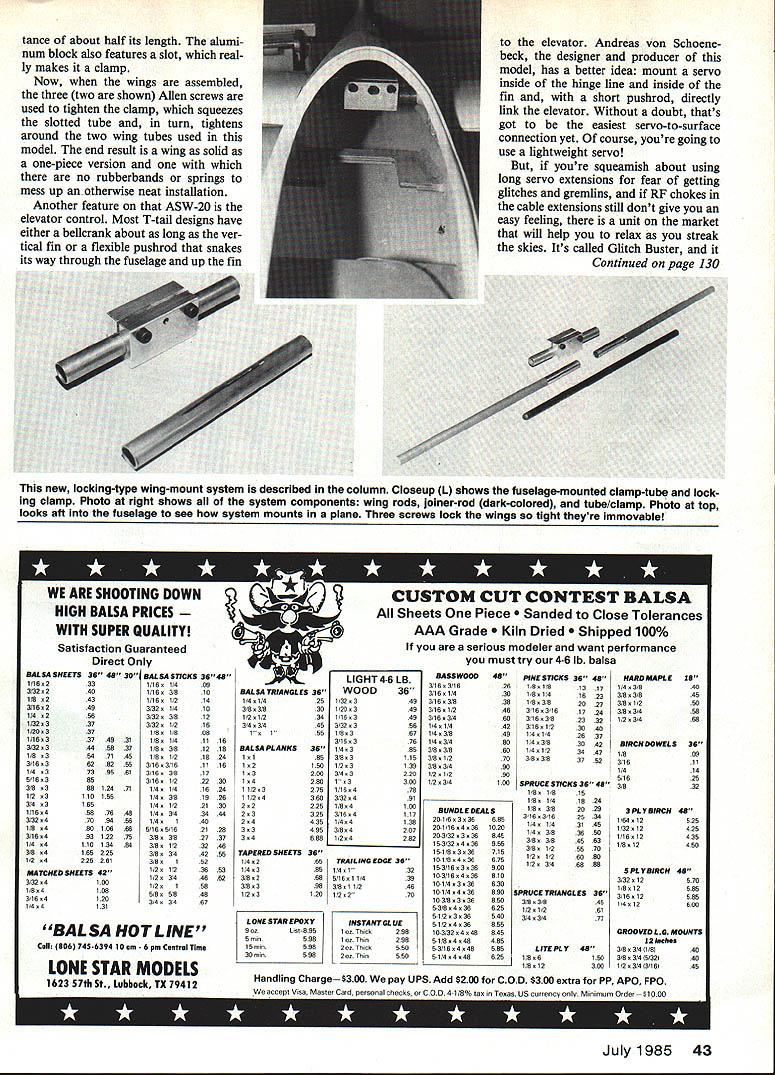
Most T-tail designs either use a bellcrank on the vertical fin or a flexible pushrod routed through the fuselage and up the fin to the elevator. Andreas von Schoenebeck, designer/producer of the ASW-20 model, used a simpler approach:
- Mount the servo inside the fin, within the hinge line.
- Use a short pushrod to directly link the servo to the elevator.
Advantages:
- Easiest servo-to-surface connection yet
- Short pushrod reduces linkage complexity and potential slop
If you prefer lightweight servos but worry about long servo extensions causing glitches, RF issues, or other problems, consider using an in-line device marketed as the "Glitch Buster" to reduce anxiety about extension-related issues.
Transcribed from original scans by AI. Minor OCR errors may remain.

