

Radio Control: Soaring
Dan Pruss
Surprise!
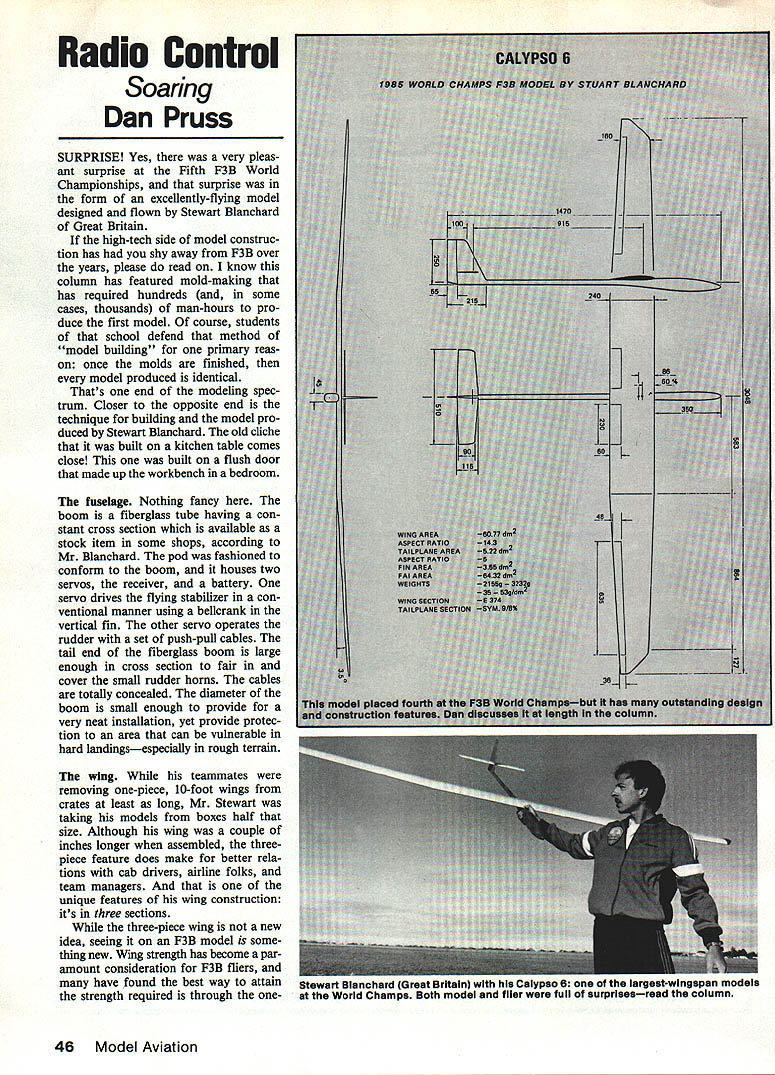
SURPRISE! Yes, there was a very pleasant surprise at the Fifth F3B World Championships, and that surprise was in the form of an excellently flying model designed and flown by Stewart Blanchard of Great Britain.
If the high-tech side of model construction has had you shy away from F3B over the years, please read on. This column has featured mold-making that has required hundreds (and, in some cases, thousands) of man-hours to produce the first model. Of course, students of that school defend that method of "model building" for one primary reason: once the molds are finished, then every model produced is identical.
That's one end of the modeling spectrum. Closer to the opposite end is the technique for building—and the model produced—by Stewart Blanchard. The old cliché that it was built on a kitchen table comes close! This one was built on a flush door that made up the workbench in a bedroom.
The fuselage
Nothing fancy here. The boom is a fiberglass tube having a constant cross section which is available as a stock item in some shops, according to Mr. Blanchard. The pod was fashioned to conform to the boom, and it houses two servos, the receiver, and a battery. One servo drives the flying stabilizer in a conventional manner using a bellcrank in the vertical fin. The other servo operates the rudder with a set of push-pull cables. The tail end of the fiberglass boom is large enough in cross section to fair in and cover the small rudder horns. The cables are totally concealed.
The diameter of the boom is small enough to provide a very neat installation, yet large enough to protect an area that can be vulnerable in hard landings—especially on rough terrain.
The wing
While his teammates were removing one-piece, 10-foot wings from crates at least as long, Mr. Blanchard was taking his models from boxes half that size. Although his wing was a couple of inches longer when assembled, the three-piece feature does make for better relations with cab drivers, airline folks, and team managers.
One of the unique features of his wing construction is that it is in three sections. While the three-piece wing is not a new idea, seeing it on an F3B model is something new. Wing strength has become a paramount consideration for F3B fliers, and many have found the best way to attain the required strength is through the one-piece wing. That one-piece wing is impractical on three-meter wings, as are the space requirements for construction and transportation.
Stewart's wing has:
- A center section with no dihedral that houses the servo actuators and a pair of trailing-edge speed brakes.
- Outer sections that plug in using steel blade joiners. Panels fit a 3° dihedral angle.
- Outer panels with ailerons.
- A simple bolting of the center panel fittings to the fuselage for joining.
Construction details
Construction: foam covered with fiberglass, then covered with obechi wood; final finish Solarfilm. Airfoil used: Eppler 374. That's worth repeating—Eppler 374.
Tailplane (flying stab) slightly less—nine percent of wing area. Airfoils: NACA symmetrical sections .0009 root, .0006 tip.
Now it seems like an easy-to-build-and-fly, no-nonsense type bird, right? After construction, it isn't too far from what a lot of folks have already used in sport, low-key types of flying models. Some kits feature some of the construction methods noted.
Competition performance
Not only is the construction for this model straightforward, but its performance was noteworthy. And, just in case you thought this model is just the whim of the designer (after all, it was the only one of this type at the World Championships), consider the following: it placed fourth. That was no simple accomplishment, since the contest was the longest ever held. The event ran for seven rounds, which means 21 flights were logged. That also means 21 opportunities to do well or blow a couple of flights. Had there been no throwaway round, Stewart Blanchard would have finished in third place!
How would he have done it? As the other top finishers did, he maxed in all seven distance flights—that's getting 12 laps in each flight. In Speed, if you discard his worst flight, Stewart averaged 20.1 seconds for the best average of all fliers! If you average all of the individuals' Speed times, Blanchard still has the best average time.
A couple of weak Duration flights netted him an average of only 5:49.2 out of a possible perfect six-minute average and a 100-point landing score. But F3B is a tough league.
The model, Calypso 6, was picked in midweek by the modeling press for the "Outstanding Achievement" award, which was well deserved. Stewart Blanchard had finally proven either the model or himself.
Ralf Decker's variable-span wing
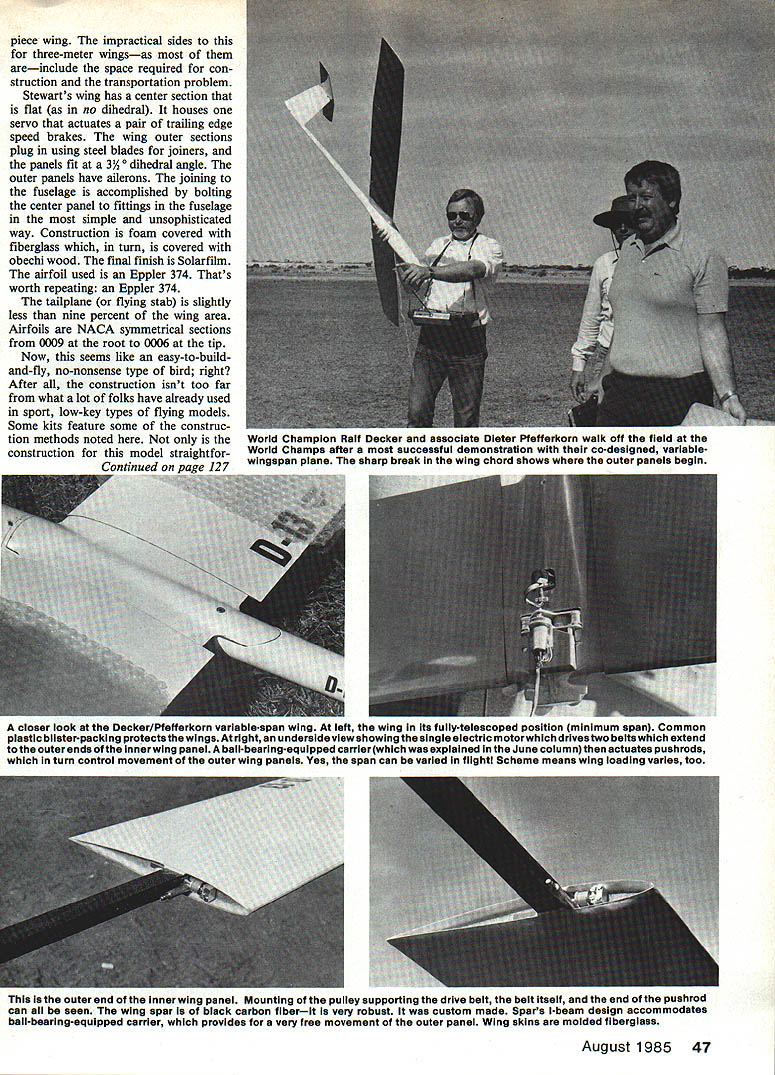
There were other models considered for the award, but they didn't come close in the voting. However, another plane on the scene would have given the voters fits had it flown in the competition: Ralf Decker's latest masterpiece. The June column featured three-view drawings of this plane; this month we can give you a few of its nuts and bolts.
This model has a variable-span geometry wing. The wing can vary in span from 128 inches down to 91 inches—and it does so flawlessly. Ralf, with Dieter Pfefferkorn (the latter responsible for all the engineering details), answered all questions put to them on the faithful drawings of the different components.
Ralf didn't fly the new bird in competition for a couple of reasons. One being: why interfere with success? After all, he was in Waikerie to defend his title as World Champion, and what better way to do it than with the plane that helped him to that title in the first place? But he did demonstrate the new bird to the modeling press after the competition ended—and what a show!
With the wings extended to their maximum of 3.24 meters, Ralf gave the bird a contest-type launch. It climbed into lift, and the thermal was played with for about three minutes—long enough to get to a good height to demonstrate a Speed run.
Then, the wing outer panels were telescoped over the main panel, reducing the span to only 2.32 meters for a wingspan reduction of over three feet! The Speed run was only simulated, because the sighting devices had been removed for other flight demonstrations. Even so, two factors rang out: the plane is fast and it is quiet.
A sign of things to come? Maybe for the team of Decker and Pfefferkorn. Pfefferkorn claimed they aren't sure they have all of the answers correct—mainly because the model came out much too heavy. However, one can be sure that they are on the right track.
Earlier in the week, Pfefferkorn was paying his compliments to Blanchard on the Calypso's fine design. He added that, with unlimited laps in Distance on the horizon, the design trend will be that which Mr. Blanchard has taken.
Herr Pfefferkorn must know of what he speaks. Just compare the three views of the two models (in this month's and last month's issues).
Start building—and good lift!
Dan Pruss 131 E. Pennington Ln., Plainfield, IL 60544
Transcribed from original scans by AI. Minor OCR errors may remain.

