
Radio Control: Soaring
Dan Pruss
Introduction
Last month this column highlighted a few subjects seen at the Australian F3B World Championships. There was also a feature article in the same issue that covered the event in more depth. Judging from the phone calls and questions about performance details, many readers wanted a further breakdown of the scoring.
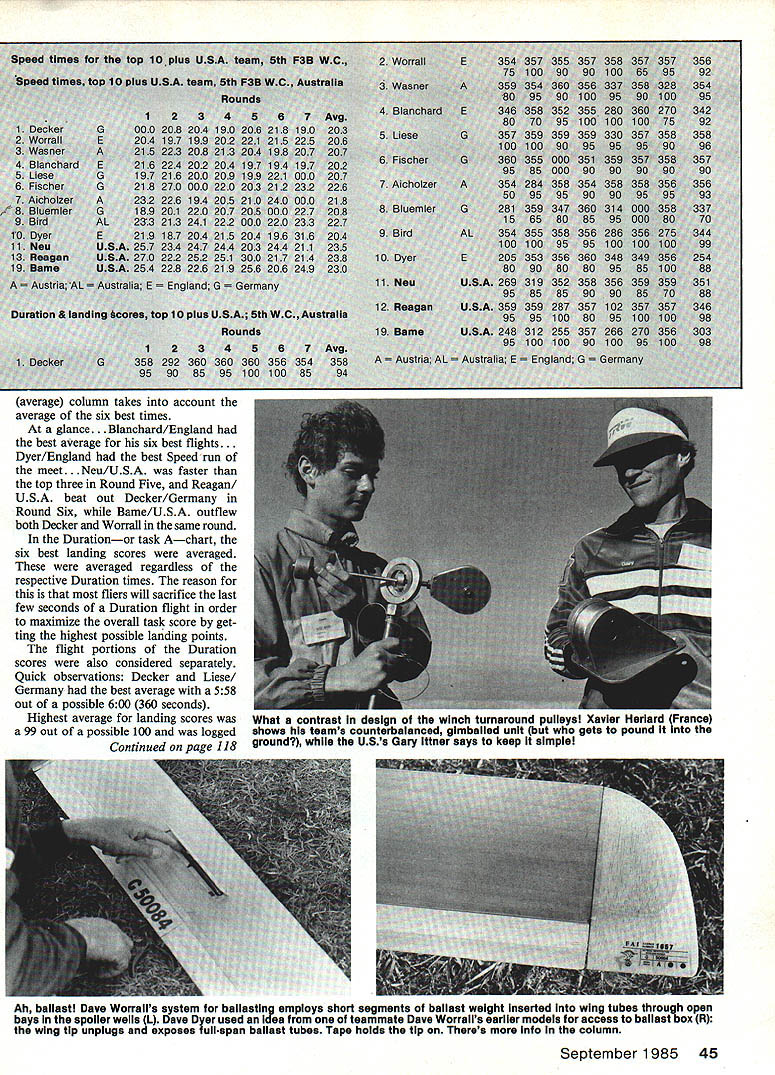
Details of each round fill nearly 50 pages of tabulations, including listings of each flier's raw and final scores for every task—far too much to print here. A much-condensed version is presented below showing what the top 10, along with the U.S.A. fliers, did in the Speed and Duration tasks.
Speed and Distance summary
A chart depicting Distance scores was purposely omitted because, out of the top 10 overall finishers, only three fliers failed to get 12 laps in one of their seven flights. That means 67 out of 70 flights were perfect. Bird (Australia), Dyer (England) and Liese (Germany) were the three who were one flight short of perfect. For the U.S.A., Neu and Reagan each had six out of seven perfect scores, and Bame had four out of seven.
The Speed (task C) chart shows only the time flown in seconds. The AVG column takes into account the average of the six best times.
Quick Speed observations:
- Chard (England) had the best average of his six best flights.
- Dyer (England) had the single best Speed run of the meet.
- Neu (USA) posted the fastest top three times.
- Round Five: Reagan (USA) beat out Decker (Germany).
- Round Six: Bame (USA) outflew both Decker and Worrall in that round.
Duration and Landing scores
The Duration (task A) chart uses the six best landing scores averaged, regardless of the respective Duration times. Fliers often sacrifice the last few seconds of a Duration flight to maximize landing points and thus overall task score. Flight portions of Duration scores are considered separately.
Quick Duration observations:
- Decker and Liese (Germany) logged the best average—558 out of a possible 600 (360 seconds).
- Highest average landing scores of 99 out of 100 were recorded.
- Bird (Australia) led landing averages, with Bame and Reagan right behind at 98 points each. These averages indicate great consistency; note that F3B landing tapes are divided into five-point-per-meter increments.
- Decker and Blanchard were the only two in the top 10 with perfect 60/100 landing scores.
- Bird had five out of seven 100-point landings; Bame had four out of seven.
If you like to play with numbers, try rechecking the final results listed last month and see what the placings would be if the "throwaway round" provision were removed. The changes are surprising and affect both individual placings and team standings across the five F3B World Championships.
Weather and the "Wall"
If anyone has complaints about early performances at the World Championships, blame the "Wall." The calm week before the event likely lulled many into expecting near-ideal conditions. Coupled with similar practice conditions at home, that 25-mile-an-hour wall on the first day was more than a mental barrier for some. The British team claimed the weather was their secret weapon—and they brought it with them. Their only complaint was they thought it would be a six-round championship and therefore their weather left for home a day too early.
Plustak (Dave Worrall)
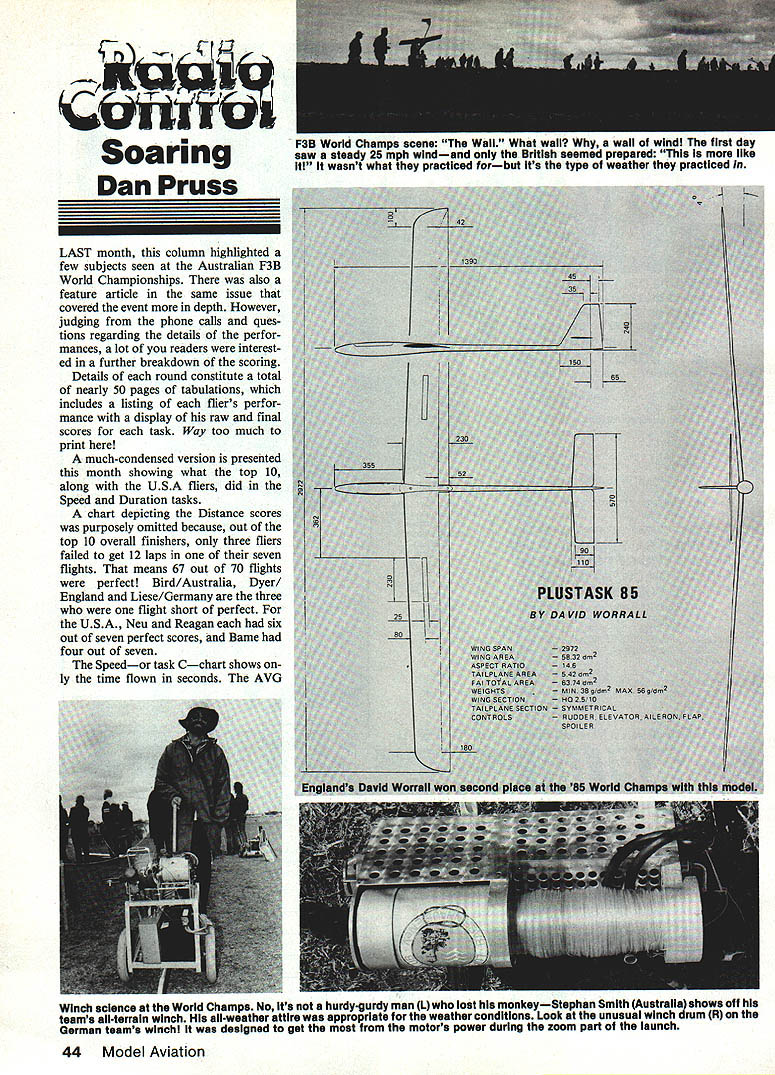
This month’s three-view drawing is of Dave Worrall's Plustak, the plane he flew to within one percentage point of first place at this year's F3B World Championships. Interesting features include:
- One-piece wing
- Full-span flaperons
- Wingspan just under three meters
- Ballast compartment accessed through the spoiler bays (a change from the wing-tip access used in earlier designs)
Ballast access (Dave Dyer)
Dave Dyer still uses the wing-tip method to access the ballast compartment. Features of his system:
- Full-span tubes run to the parting line of the wing tip.
- The tip is removed and slugs of ballast are slid down to the wing-root area via the tubes.
- Any voids are filled with varying lengths of balsa dowels (depending on the amount of ballast) to prevent shifting.
- The tip plugs back in and the joint is taped over.
Drawbacks and notes:
- With tapered wings, tip thickness can limit maximum tube diameter, restricting size compared to near the root.
- Dyer compensates by using Quabeck airfoil sections that increase from 8.5% thickness at the root to 10.0% at the tip, offsetting some effects of chord taper.
- Hollow tubes create a somewhat non-standard building situation, whether the construction uses a foam core or is built-up.
Winches
Two contrasting winch designs were photographed this month.
Australian design (Stephan Smith):
- An "all-terrain" winch cart carrying battery, a winch toolbox, and a turnaround; fitted with pneumatic tires.
- Winch secured high on the frame so the towline clears the ground.
- Turnaround pulley staked high to minimize line wear during winching and retrieving.
- Motor: Lucas M50 (designed as a truck starter motor).
German design:
- Simpler, straightforward layout using a Bosch motor (starter for a Mercedes Benz 300 diesel).
- Line drum carries about 400 meters of line; drum is about 2 inches in diameter and 8 inches wide.
- Australian drum dimensions: about 4 inches wide and 6 inches in diameter.
- The German design provided smooth but rapid accelerations during the zoom part of the launch.
Turnarounds
Turnaround designs varied by team. In one photo, Xavier Heriard of France compares the French team's gimbal-mounted pulley with an American design.
- French design: pulley can incline freely in any direction during launch.
- American design: simpler and smooth; Gary Ittner (USA) said, "If you know how to launch straight ahead, you can use ours," demonstrating the version used by Mike Bame and Mike Reagan.
Conclusion
As in auto racing and other high-tech sports, the research and development at the top level make life easier for those downstream. The innovations seen at the F3B World Championships have relevance to other types of soaring, and we will pass more ideas on in future columns.
Good lift.
Dan Pruss 131 E. Pennington Ln. Plainfield, IL 60544
Transcribed from original scans by AI. Minor OCR errors may remain.

