
Radio Control: Soaring
Dan Pruss
Monitor at the F3B World Championships
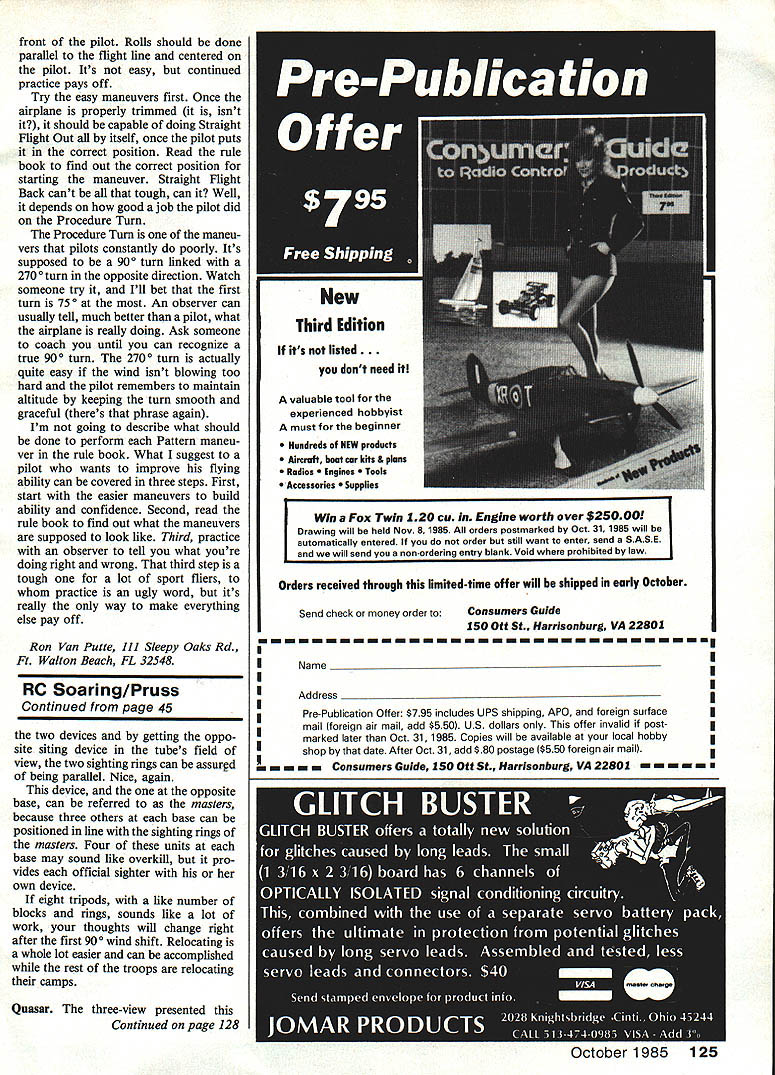
NEAT! A small monitor proved very useful throughout the F3B World Championships in Australia. It is small enough to sit comfortably on an 8 1/2 x 11 sheet of paper. Labeled the "AOR Communications Receiver," model AR 2001, it is manufactured by AOR Ltd. of Japan.
Features:
- Covers frequencies from 25 through 550 MHz.
- 20-memory scan feature, allowing a whole band (for example, 72 MHz) to be programmed.
- Cost about 250 Australian Dollars, making it ideal for serious-minded clubs.
The only problem is we haven't located a U.S. source (perhaps a reader can help). If you find a supplier, please forward the address to this column.
Improved sighting device for F3B Distance and Speed
Back in the June 1983 column, construction steps were presented for a simple sighting device for the F3B Distance and Speed events. An improved version seen in Australia would serve well as a backup system.
Design improvements:
- Start with a perfectly square block and cut off the top two corners at 45° angles (bottom corners may be cut for aesthetics and to blend with the tripod mount).
- Drill two holes perpendicular to the 45° faces and parallel to the sides.
- Insert a wire hoop into the holes; with the wire hoop in place the sighting tube will always be at 90°.
- The wire hoop need not be permanently secured—when inserted it guarantees a 90° alignment with the sighting tube.
Operation and deployment:
- The sighting tube is the master tool; an identical unit at the opposite base allows two sighters to look through tubes simultaneously.
- By getting the opposite sighting device into the tube's field of view, the two sighting rings can be assured of being parallel.
- Each base can have one master and three additional units positioned in line with the master’s sighting ring, providing each official sighter with a device (four units per base).
- Although eight tripods (four at each base) may sound like overkill, they make relocating after a large wind shift much easier.
Flying tips
It's easy — continued practice pays off. Start with easy maneuvers. Once the airplane is properly trimmed, it should be capable of doing Straight Flight Out by itself once the pilot positions it correctly. Read the rule book to find the correct starting position.
- Straight Flight Back depends on how well the pilot trimmed and positioned the airplane.
- Procedure Turn maneuvers are often done poorly. The procedure turn is supposed to be a 90° turn linked to a 270° turn in the opposite direction. Observers can usually tell better than the pilot whether the turns are correct. Have someone coach you until you can recognize a true 90° turn. The 270° turn is fairly easy if the wind isn't strong and the pilot maintains altitude and keeps the turn smooth.
Karl Wasner, Jr. design
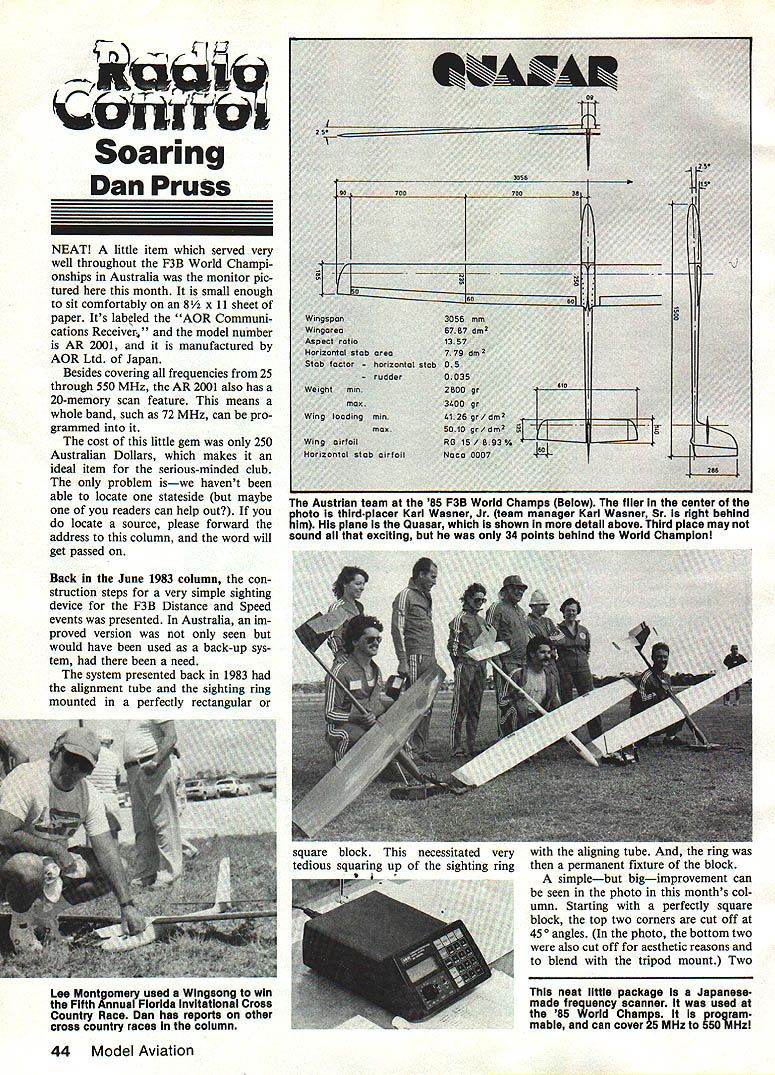
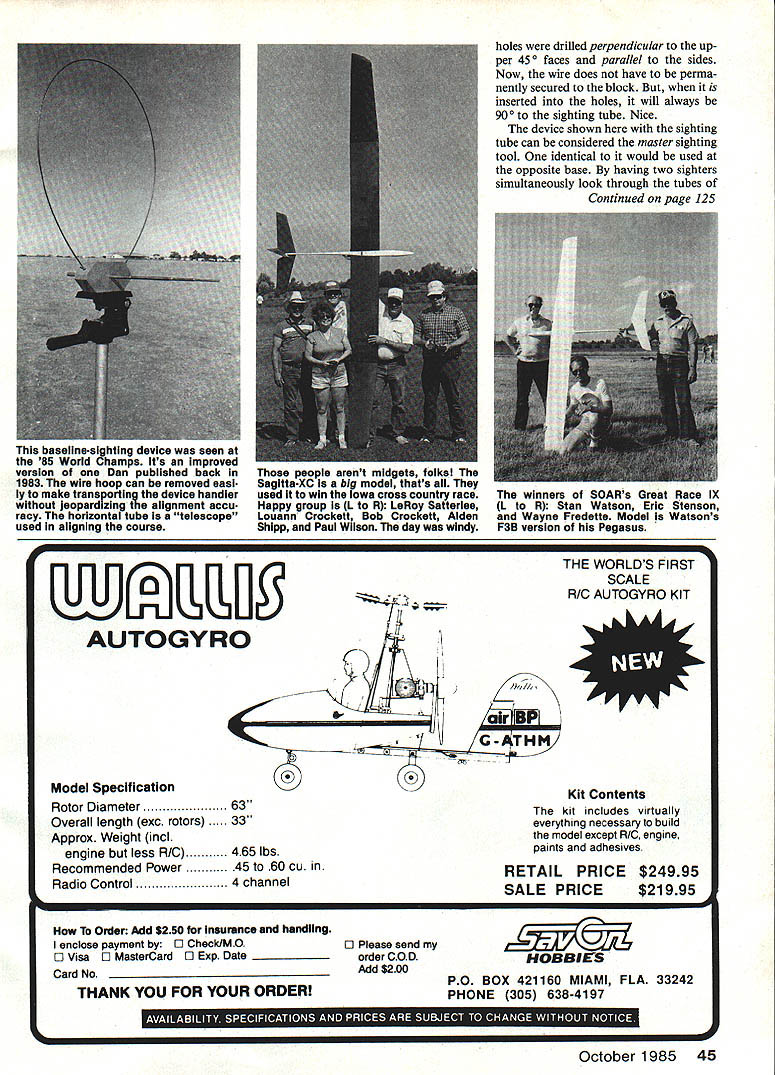
Karl Wasner, Jr., placed third in the 1985 World Championships in Australia. Although third place isn't first, it's notable that Wasner was only 33.4 points out of first place (the winner scored 17,425 points). The specifications and three-view drawing reveal much of the design.
- The wing airfoil was designed by Rolf Girsberger, Switzerland.
- Wasner's two teammates used different airfoils: Meissl used an Eppler 205 and Aichholzer used a Quabeck. Aside from the airfoil choices, their designs were similar, and together the team finished third.
Cross-country news
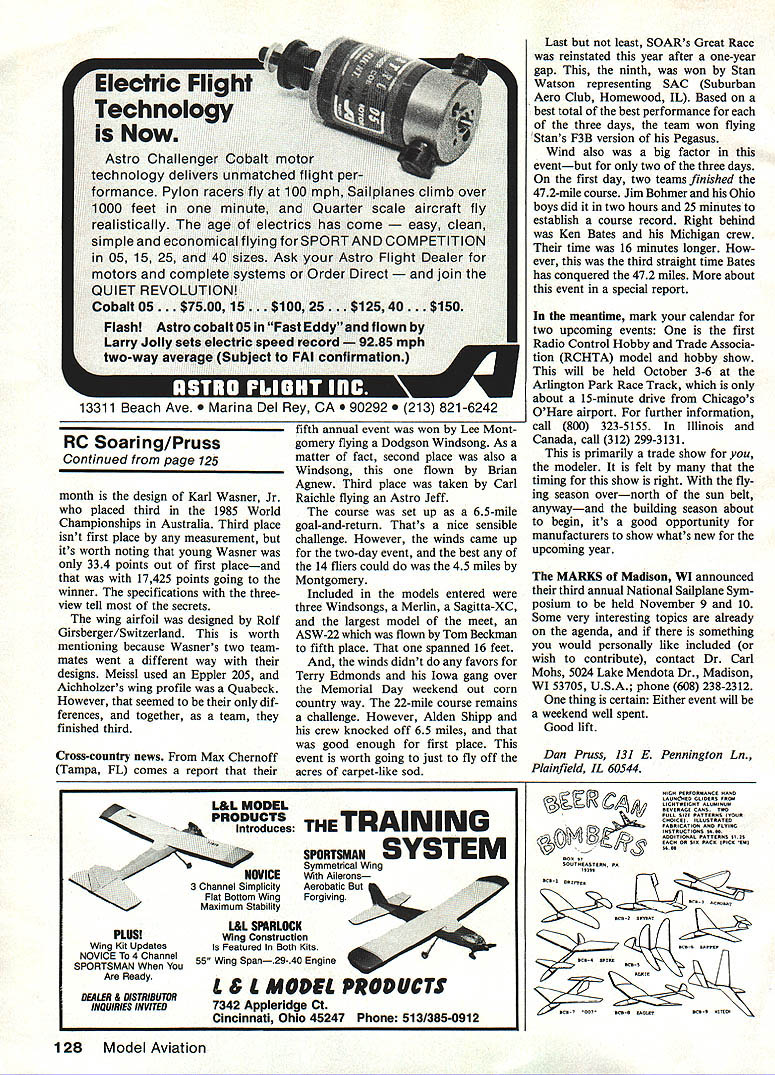
From Max Chernoff (Tampa, FL): their fifth annual cross-country event was won by Lee Montgomery flying a Dodgson Windsong. Second place was Brian Agnew (also flying a Windsong). Third place was Carl Raiche flying an Astro Jeff.
- Course: 6.5-mile goal-and-return. Winds limited the best distance to 4.5 miles (Montgomery).
- Models entered included three Windsongs, a Merlin, a Sagitta-XC, and an ASW-22 flown by Tom Beckman (fifth place). The ASW-22 had a 16-foot span.
Terry Edmonds and his Iowa group flew a 22-mile course over Memorial Day weekend. Winds were unfavorable; Alden Shipp and his crew managed 6.5 miles for first place. The event is notable for flying off acres of carpet-like sod.
SOAR's Great Race was reinstated this year after a one-year gap. The ninth Great Race was won by Stan Watson representing Suburban Aero Club (SAC), Homewood, IL. Based on the best total of each day's best performance over three days, the team won flying Stan's F3B version of his Pegasus.
- Wind was a big factor for two of the three days. On the first day two teams finished the 47.2-mile course:
- Jim Bohner and his Ohio team set a course record of 2 hours 25 minutes.
- Ken Bates and his Michigan team finished 16 minutes later. This was Bates's third straight time completing the 47.2 miles.
- More about this event will appear in a special report.
Upcoming events
- Radio Control Hobby and Trade Association (RCHTA) model and hobby show
- Dates: October 3–6
- Location: Arlington Park Race Track (about a 15-minute drive from Chicago O'Hare)
- Info: call (800) 323-5155; in Illinois and Canada call (312) 299-3131
- This is primarily a trade show timed for the off-season north of the Sun Belt and is a good opportunity for manufacturers to show what's new.
- MARKS of Madison, WI — Third annual National Sailplane Symposium
- Dates: November 9–10
- Contact: Dr. Carl Mohs, 5024 Lake Mendota Dr., Madison, WI 53705, U.S.A.; phone (608) 238-2312
- If you have topics you would like included or wish to contribute, contact Dr. Mohs.
Good lift.
Dan Pruss 131 E. Pennington Ln. Plainfield, IL 60544
Transcribed from original scans by AI. Minor OCR errors may remain.

