
Radio Control: Soaring
Dan Pruss
AOR Communications Receiver (AR 2001)
Neat! A small monitor that proved very useful throughout the F3B World Championships in Australia is the AOR Communications Receiver, model AR 2001, manufactured by AOR Ltd. of Japan. It is compact enough to sit comfortably on an 8½ x 11 sheet of paper.
Key features:
- Coverage: 25 through 550 MHz.
- 20-memory scan feature (you can program an entire band, e.g., 72 MHz).
- Price: 250 Australian Dollars.
This makes the AR 2001 an ideal item for the serious-minded club. The only problem is we haven't been able to locate a stateside source. If any reader can find one, please forward the address to this column so the word can be passed on.
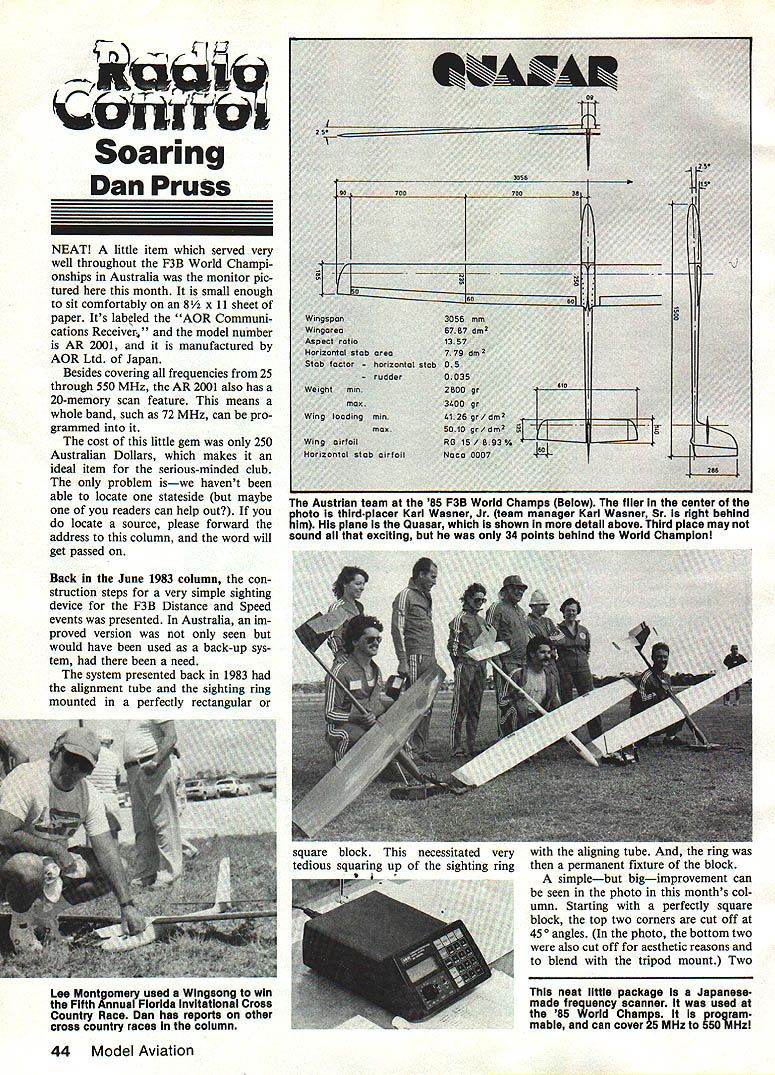
Improved sighting device for F3B Distance and Speed
Back in the June 1983 column I presented construction steps for a simple sighting device used in the F3B Distance and Speed events. In Australia I saw an improved version that would have served well as a backup system.
The original system mounted the alignment tube and the sighting ring in a perfectly rectangular or square block, which required tedious squaring of the sighting ring with the aligning tube and left the ring permanently fixed to the block. The improved version simplifies alignment and allows the ring (wire) to be removable while still ensuring perfect squareness.
Construction overview:
- Start with a perfectly square block.
- Cut off the top two corners at 45° angles. (In the photographed example the bottom two corners were also cut off for aesthetic reasons and to blend with the tripod mount.)
- Drill two holes perpendicular to the 45° faces and parallel to the sides.
- Insert the sighting wire into the holes. When the wire is inserted (and can be secured if desired), it will always be at 90° to the sighting tube.
Notes:
- The sighting tube acts as the master alignment reference; an identical unit is used on the opposite base so two sighters can simultaneously look through the tubes.
- The wire does not have to be permanently secured; when inserted it will still be perpendicular to the sighting tube.
Deployment and advantages
The two units with sighting tubes are the masters. At each base, three additional units are positioned in line with the master sighting rings, giving four units per base so each official sighter has his or her own device. While eight tripods and corresponding blocks and rings may seem like overkill, the setup proves its worth during a 90° wind shift — relocating is much faster and easier, allowing officials to move quickly while others relocate their camps.
Transcribed from original scans by AI. Minor OCR errors may remain.

