
Radio Control: Soaring
Dan Pruss
THINK about this: I don't know if history recorded the first time someone hand-tossed an RC sailplane with the idea of hooking a thermal and maxing out. For that matter, is there anyone who knows who can lay claim to the first model designed for the sole purpose of accomplishing the above efforts?
Back in 1977, Dave Thornburg was wowing the crowd with some show-stopper types of flights. It was at an afternoon bar-b-q hosted by the Pretoria Aero-Club in South Africa for some of the attendees at the first Soaring World Championships. That also served as a first-time exposure to a "hand-tossing for fun and profit" display.
While the lone winch was being used by others and only mediocre times being unofficially logged, Dave heaved his Bird of Time, hooked a riser, and casually logged 10 minutes! The flight ended with Dave catching the Bird in a manner as effortless as turning off his radio. The crowd went wild. It was the first time anyone on the scene had witnessed such a demonstration.
And, to show his efforts were no fluke, Dave repeated the toss, the max, and the catch.
Two years later, Dave showed up at the second World Championships in Belgium with his (by then) well-known Sunbird. This was truly a design for the hand-launch category, even though that class didn't officially exist. With the elevator and rudder servos mounted in tandem and the receiver sandwiched between the balsa fuselage sides, Dave showed a good part of the modeling world what was to come.
That same year, 1979, Chris Adams brought his hand-tosser to the LSF Tournament out in the Midwest, and it seemed like anyone who had a couple of minutes between rounds was throwing their arms out of joint and having fun doing it.
Since that time, at least a half-dozen kits have hit the market, and there are at least that many fairly good-size contests around the country devoted only to the hand-launching clan.
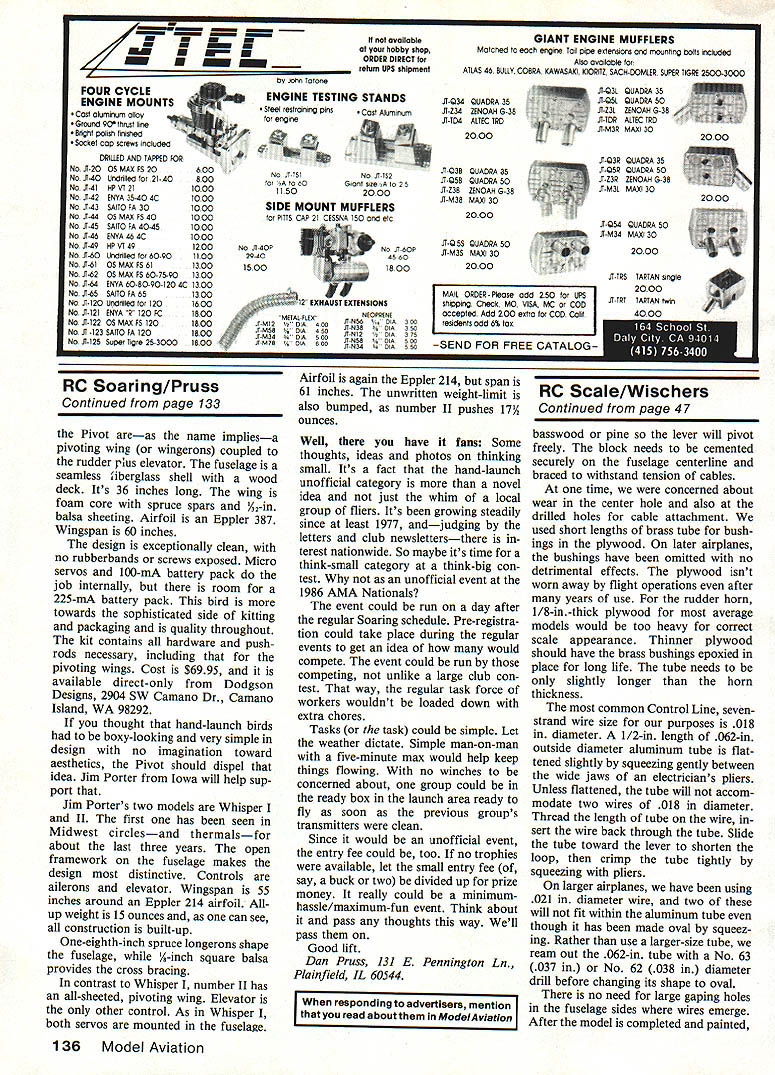
Most kit designs follow the basic polyhedral, one-piece wing layout. Slab-sided fuselages aren't unlike some of the designs of the Two-Meter and Standard class kits most of us have built.
There aren't any specific rules for hand-launched designs, nor are there any for the contests in which they fly. However, after a few years of sorting out the basic—and still unofficial—design parameters, they have resolved into only two simple restrictions:
- Wingspan 60 inches or under.
- Total weight under 16 ounces.
That's about as simple as any category can get, and it ought to be kept that way.
Contests and tasks
As for contests, they, too, have been kept simple. Again, no official rules are in print—and, for that matter, there's no record as of this date of any being proposed. Among the contest rules used, tasks have included:
- Two-minute maxes with as much time as one can accumulate in a 10-minute period; relaunching permitted.
- Mano-a-mano, with the last one down getting 1,000 points; other scores prorated on the winner's.
Advantages to a hand-launch class or category are obvious to anyone who has ever attended or run a contest. With arms being the only kind of launching devices allowed, winch masters can take the weekend off. Field conditions don't have to match the local country club's practice green. And winds can be as fickle as a Contest Director's heart.
There are other advantages worth pondering:
- Group scoring is a natural, and group size doesn't have to be restricted to the number of winches available.
- As far as number of flights is concerned, there's a good chance a flier would log more flights—or at least have the opportunity to—than at a conventional winch-provided contest.
As long as rules are still in the formative stages, why not permit fliers to use an assistant to do the launching? Let's face it; there are more than a few fliers in Soaring who are closer to qualifying for a Senior Citizen's card than for one from the AMA for Senior Class. Before you yell "foul" to the above suggestion, name all the major league pitchers you know who are over 40.
Having an assistant, however, also opens up new possibilities for father/son acts, the kid next door, or other kids who might not have the opportunity to get exposed to modeling. An indirect approach, perhaps, but exposure nevertheless.
And, before someone comes up with a list of inequities to such a suggestion, it is granted that all arms aren't created equal. But throwing lightweight, low wing-loaded models straight up does seem to have its own equalizing effect. So, until someone employs the services of some javelin thrower from the University of Mars, maybe we ought to give the system a try.
Featured designs
While on the subject of hand-toss gliders, here are a couple of subjects somewhat removed from the simple design approach mentioned above.
#### Pivot (Bob Dodgson)
The Pivot is a real departure from only rudder-and-elevator-control designs. The Pivot is—as the name implies—a pivoting wing (or "wingeron") coupled to the rudder plus elevator. The fuselage is a seamless fiberglass shell with a wood deck. It's 36 inches long. The wing is foam core with spruce spars and 1/16-inch balsa sheeting. Airfoil is an Eppler 387. Wingspan is 60 inches.
The design is exceptionally clean, with no rubber bands or screws exposed. Micro servos and a 100-mAh battery pack do the job internally, but there is room for a 225-mAh battery pack. This bird is more toward the sophisticated side of kiting and packaging and is quality throughout. The kit contains all hardware and pushrods necessary, including those for the pivoting wing. Retail is $69.95, and it is available direct-only from Dodgson Designs, 2004 SW Camano Dr., Camano Island, WA 98292.
If you thought that hand-launch birds had to be boxy-looking and very simple in design with no imagination toward aesthetics, the Pivot would dispel that idea.
#### Whisper I and II (Jim Porter)
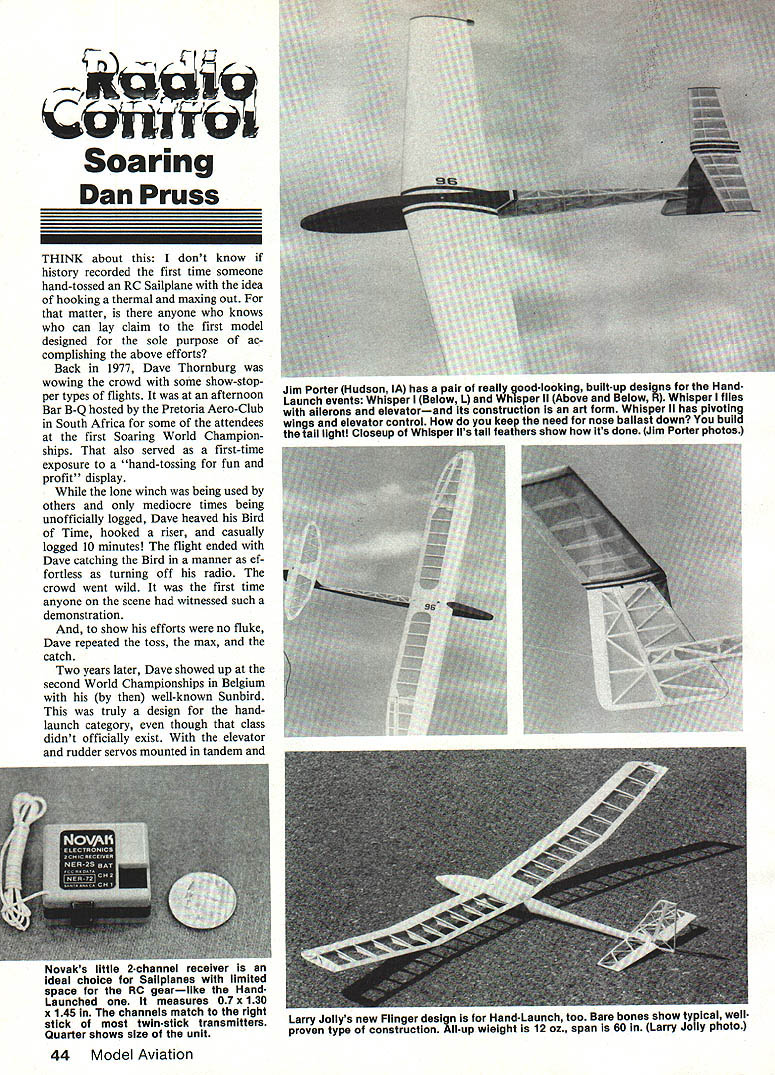
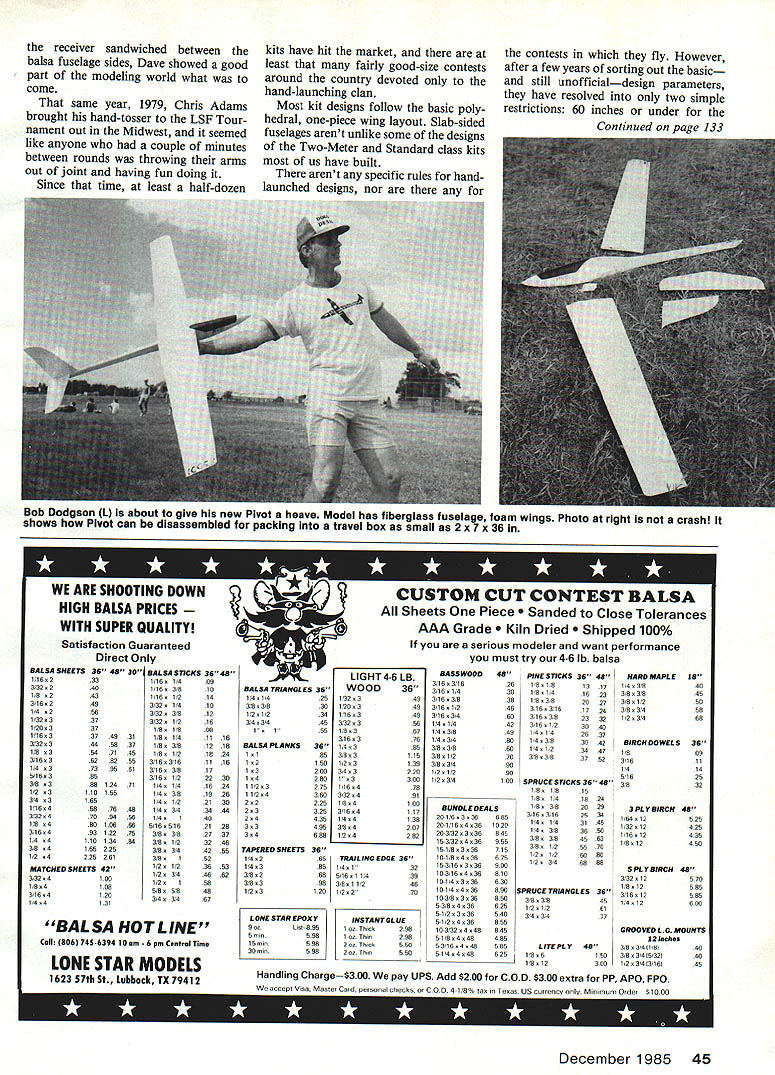
Jim Porter's two models are Whisper I and II. The first has been seen in Midwest circles—and thermals—for about the last three years. The open framework on the fuselage makes the design most distinctive. Controls are ailerons and elevator. Wingspan is about 55 inches around an Eppler 214 airfoil. All-up weight is 15 ounces, and construction is built-up.
One-eighth-inch spruce longerons shape the fuselage, while 1/16-inch square balsa provides the cross bracing.
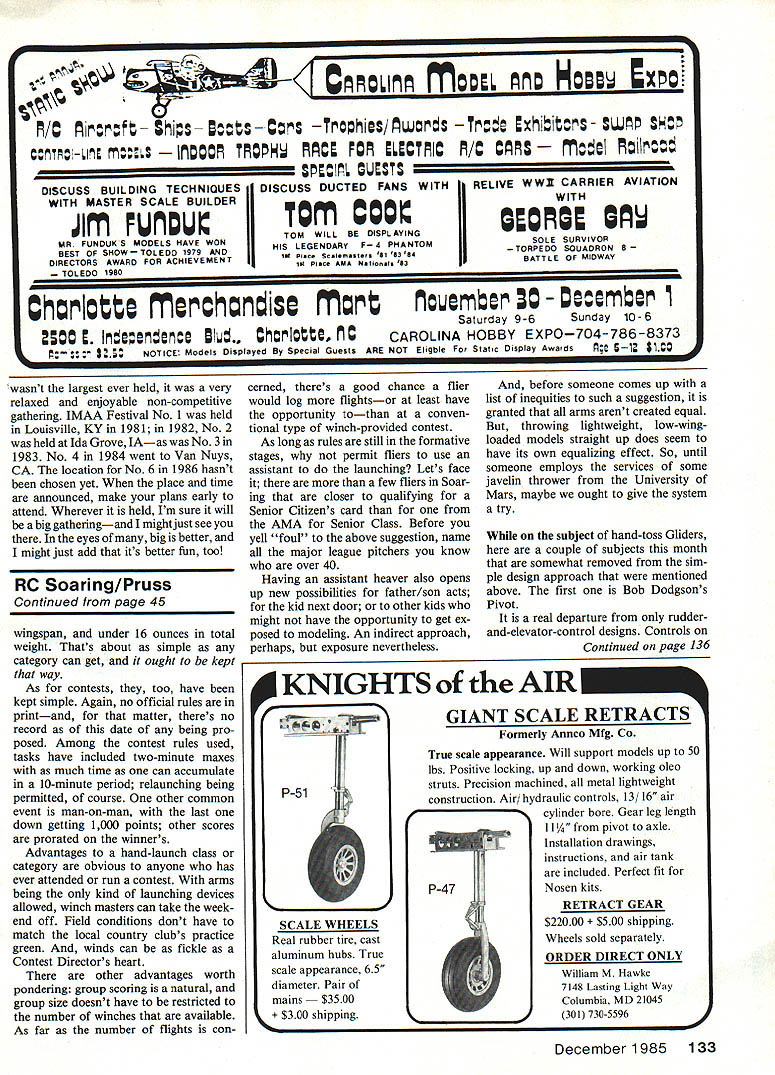
In contrast, Whisper II has an all-sheeted, pivoting wing. Elevator is the only other control. As in Whisper I, both servos are mounted in the fuselage. The airfoil is again the Eppler 214, but span is 61 inches. The unwritten weight limit is also bumped, as number II pushes 17-1/2 ounces.
Closing thoughts
Well, there you have it, fans: some thoughts, ideas and photos on thinking small. It's a fact that the hand-launch unofficial category is more than a novel idea and not just the whim of a local group of fliers. It's been growing steadily since at least 1977, and—judging by the letters and club newsletters—there is interest nationwide. So maybe it's time for a think-small category at a think-big contest. Why not as an unofficial event at the 1986 AMA Nationals?
The event could be run on a day after the regular Soaring schedule. Pre-registration could take place during the regular events to get an idea of how many would compete. The event could be run by those competing, not unlike a large club contest. That way, the regular task force of workers wouldn't be loaded down with extra chores.
Tasks (or the task) could be simple. Let the weather dictate. Simple man-on-man with a five-minute max would help keep things flowing. With no winches to be concerned about, one group could be in the ready box as the launch area is readied for flight as soon as the previous group's transmitters were clear.
Since it would be an unofficial event, the entry fee could be, too. If no trophies were available, let the small entry fee (of, say, a buck or two) be divided up for prize money. It really could be a minimal-hassle, maximum-fun event. Think about it and pass any thoughts this way. We'll pass them on.
Good lift,
Dan Pruss 131 E. Pennington Ln., Plainfield, IL 60544
Transcribed from original scans by AI. Minor OCR errors may remain.

