
Radio Control: Soaring
Dan Pruss
Just about the time I think this column is happily covering all corners of the sailplane field, letters come in commenting on some of that coverage — such as: "I'm a three-channel sport flier, and if you write one more item about F3B you'll never see your loved ones again; worse yet, I'll tell everyone that your daughter MonoKotes all your models."
In contrast to that, other letters reflect the attitude that "I'm only a two-channel flier who flies for fun and only on warm Saturday afternoons. Keep reporting on the hi-tech stuff. I really like seeing what guys on the other side of the tracks are up to."
Well, folks, if you're from either of the above camps (or somewhere in between), there are a couple of subjects this month that might have you "foiled again."
Helmut Lelke's "Heidi" and the Electrostatic Autopilot
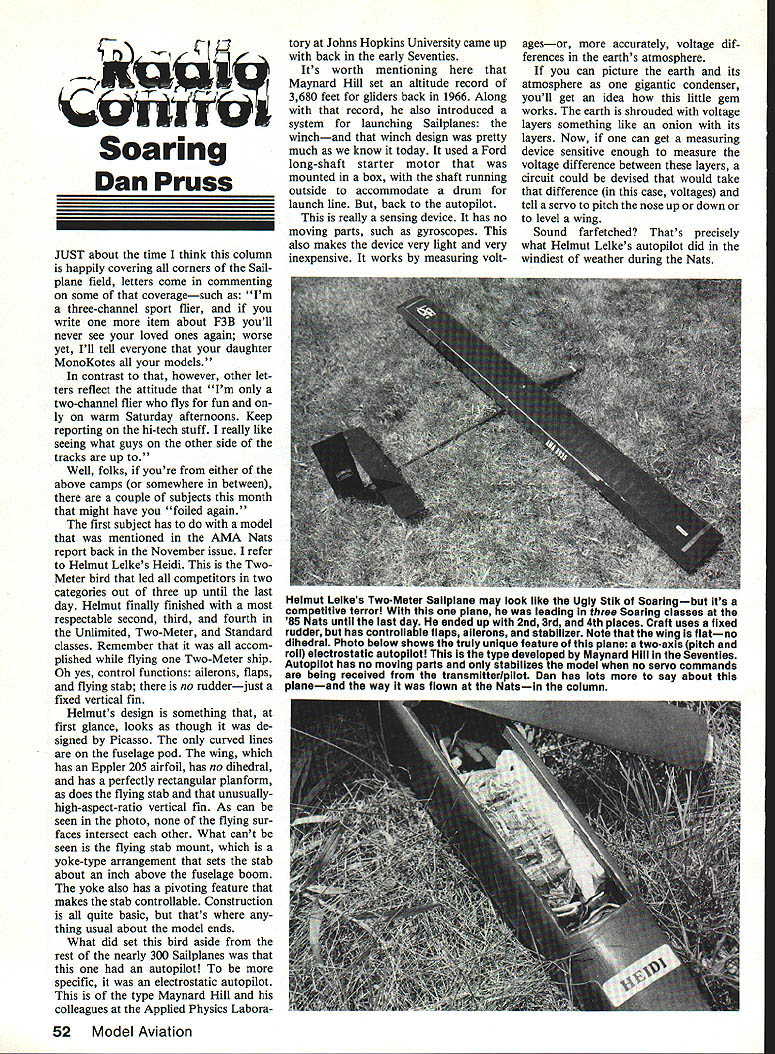
The first subject concerns a model mentioned in the AMA Nats report in the November issue: Helmut Lelke's Heidi. This two-meter ship led competitors in two out of three categories until the last day, finally finishing a very respectable second, third, and fourth in the Unlimited, Two-Meter, and Standard classes — all while flying one two-meter ship. Control functions: ailerons, flaps, and a flying stab; there is no rudder — just a fixed vertical fin.
At first glance Helmut's design looks like something Picasso might have drawn. The only curved lines are on the fuselage pod. The wing, using an Eppler 205 airfoil, has no dihedral and is a perfectly rectangular planform, as are the flying stab and an unusually high-aspect-ratio vertical fin. As seen in the photo, none of the flying surfaces intersect. The flying stab is mounted on a yoke that sets it about an inch above the fuselage boom; the yoke pivots to make the stab controllable. Construction is basic, but that's where anything usual about the model ends.
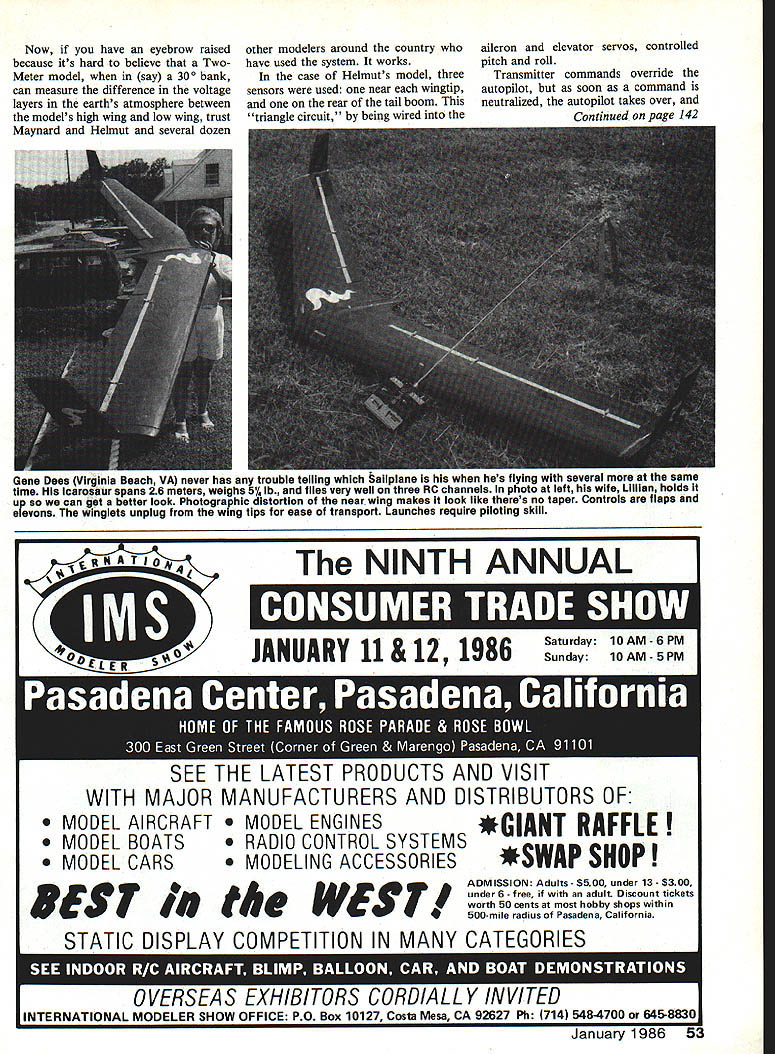
What set this bird apart from nearly 300 sailplanes was that it had an autopilot — specifically, an electrostatic autopilot of the type Maynard Hill and colleagues at the Applied Physics Laboratory, Johns Hopkins University, developed in the early 1970s.
Maynard Hill is worth mentioning: he set an altitude record of 3,680 feet for gliders in 1966 and introduced a sailplane launching winch that influenced later designs. The electrostatic autopilot itself is a sensing device with no moving parts (no gyros), which makes it very light and inexpensive. It works by measuring voltage differences in the earth's atmosphere.
If you picture the earth and its atmosphere as one gigantic capacitor, you'll get the idea. The earth is shrouded with voltage layers like an onion. A sensitive measuring device can detect voltage differences between those layers; a circuit can then use those differences to tell servos to pitch the nose up or down or to level a wing.
It sounds farfetched, but that's precisely what Lelke's autopilot did in some very windy conditions during the Nats. The system can detect small voltage differences between a model's high wing and low wing even in a 30° bank. Lelke, Maynard, and several dozen other modelers around the country have used the system successfully.
In Lelke's model, three sensors were used: one near each wingtip and one on the rear of the tail boom. This "triangle circuit," wired into the aileron and elevator servos, controlled pitch and roll. Transmitter commands override the autopilot, but as soon as a command is neutralized, the autopilot resumes control and returns the model to the preset attitude (e.g., straight and level).
Maynard demonstrated his unit on the slopes at Cumberland in 1972: rolling inverted, the plane righted itself when the transmitter sticks were released; the same happened from a tight spiral — wings leveled first, then the nose came up to level flight.
Why did Lelke do so well at the Nats? On windy days, his flights were pure poetry. Off tow, he'd turn downwind and head for a tree line acting as a mini slope. Parking his bird there, the autopilot would keep it into the wind for about six minutes, after which he'd start an approach for landing.
What value such a unit would have in a thermal contest is speculative, but for cross-country or straight-line flying the answer is clear. The entire unit was reportedly built for under $25, with parts available at Radio Shack. Besides Maynard's article in Flying Models, see Astronautics and Aeronautics, November 1972, Volume X, Number 1. The circuit has been improved since then, but if anyone would like a copy of the original circuit, send a SASE to the address at the end of this column.
Gene Dees' Icarus — a Built-Up Flying Wing
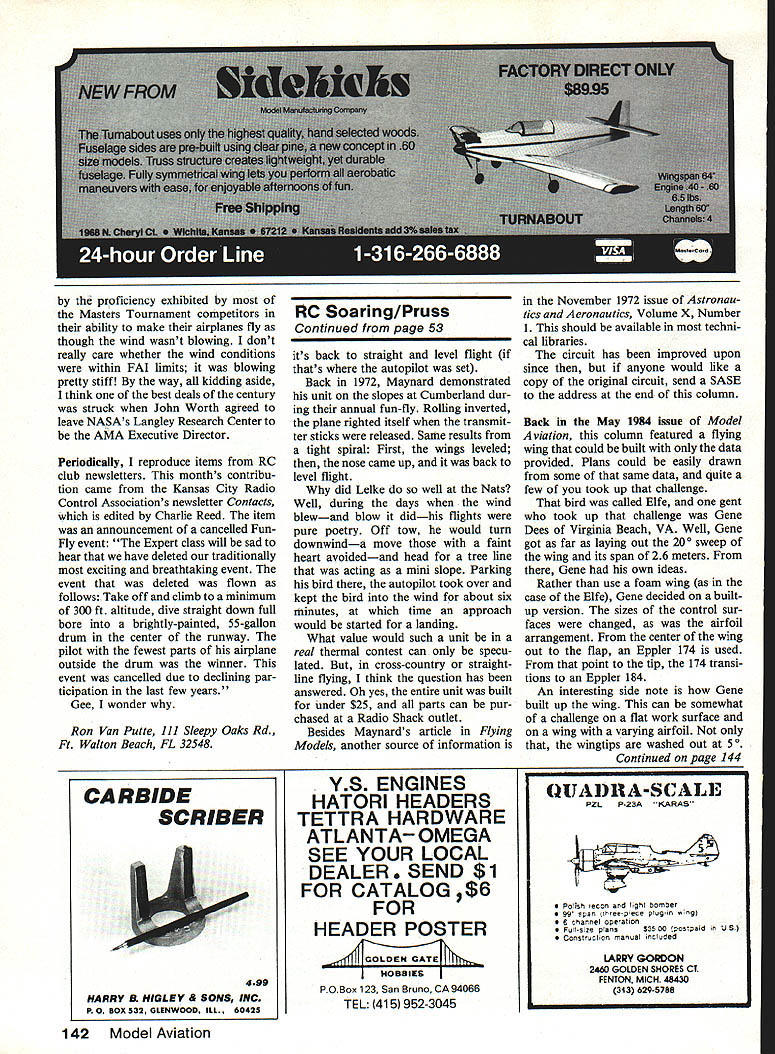
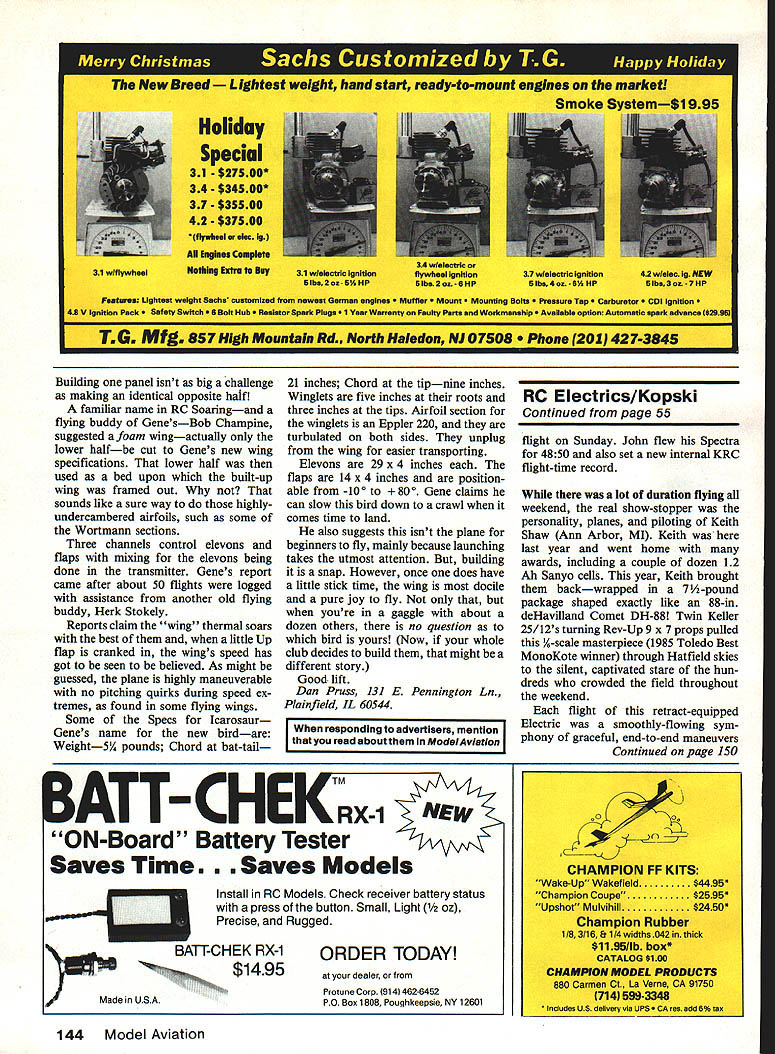
Back in the May 1984 issue of Model Aviation, this column featured a flying wing called Elfe that could be built from the provided data. Many readers took up the challenge. One who did was Gene Dees of Virginia Beach, VA. Gene started with the 20° sweep and 2.6 m span, then developed his own ideas.
Rather than use a foam wing like the Elfe, Gene built a built-up wing and changed control-surface sizes and airfoil arrangement. From the center out to the flap an Eppler 174 is used, transitioning to an Eppler 184 toward the tip. The wingtips are washed out 5°.
Building a panel with varying airfoil and washout on a flat work surface is challenging — making an identical opposite half is tougher. A flying buddy, Bob Champine, suggested cutting a foam lower half to Gene's wing specs and using that lower half as a bed upon which to frame the built-up wing. This eases construction for highly under-cambered airfoils.
Three channels control elevons and flaps, with elevon mixing done in the transmitter. Gene's report came after about 50 flights, with assistance from Herb Stokely. Reports claim the wing thermal soars with the best of them, and with a little "up flap" the wing's speed is remarkable. The plane is highly maneuverable with no pitching quirks during speed extremes, as sometimes found in flying wings.
Specs for Icarus:
- Weight: 5¼ pounds
- Root chord: 21 inches
- Tip chord: 9 inches
- Winglets: 5 inches at the root, 3 inches at the tip
- Winglet airfoil: Eppler 220 (turbulated on both sides)
- Winglets unplug from the wing for easier transport
- Elevons: 29 x 4 inches each
- Flaps: 14 x 4 inches, positionable from -10° to +80°
Gene claims he can slow the bird to a crawl for landing. He suggests this isn't a beginner's plane (launching requires careful attention), but building it is straightforward. Once you have some stick time, the wing is docile and a pure joy to fly. And when you're in a gaggle of a dozen others, there's no question which bird is yours — unless everyone in the club builds one.
Good lift.
Dan Pruss 131 E. Pennington Ln. Plainfield, IL 60544
When responding to advertisers, mention that you read about them in Model Aviation.
Transcribed from original scans by AI. Minor OCR errors may remain.

